Comfortable, Hypoallergenic Ear Cuffs — A Long-Term Wear Guide for Sensitive Ears
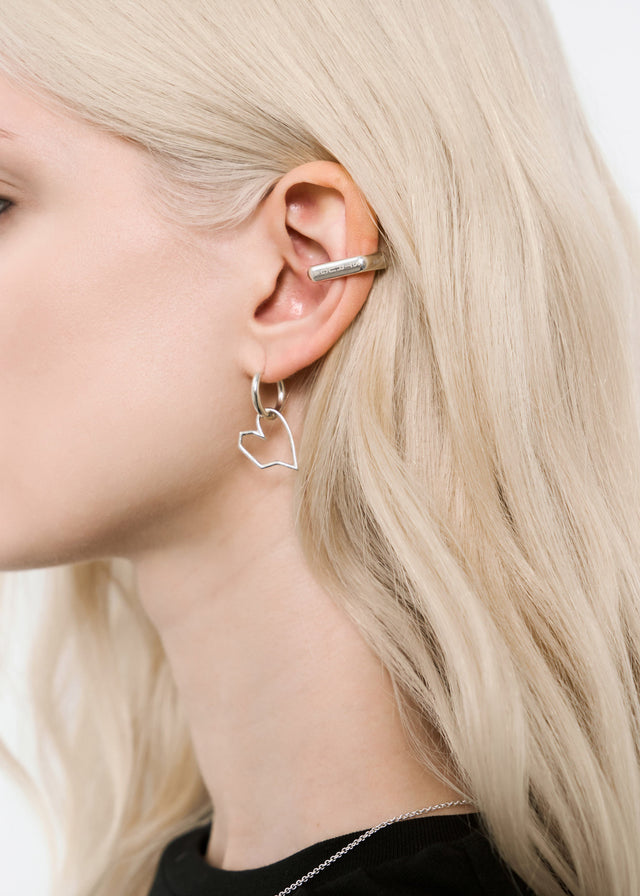
A comfortable ear cuff depends on three things: a shape that suits the ear, a secure position and a metal the wearer tolerates. Pressure, sliding or redness can have different causes, so no single gap adjustment fixes every case. This guide explains what to check before longer wear and when to try a different fit or remove the cuff.
Updated September 11, 2026
In short.
- "Hypoallergenic" alone does not identify the material. Check the stated alloy and whether the cuff is solid or plated; a solid cuff uses the same named alloy throughout.
- A plated cuff has a surface layer over a different base metal; if that layer wears, the base becomes exposed. For STRUGA forms, see the Signature Asymmetric and Blade cuffs.
- Placement is one part of comfort. Check where the cuff sits, how the edge meets the ear and whether the shape suits that part of the helix.
- A cuff should not require you to ignore persistent pressure or irritation. If repositioning does not help, remove it and check the size, curve, edge and material before wearing it again.
- If a cuff leaves repeated pressure marks or remains uncomfortable, remove it and reassess the position, shape and material instead of waiting for a fixed adaptation period.
- Remove the cuff before sleep; do not create a separate night gap.
- Before ordering, check the current exchange terms for the exact cuff; if a fit point is unclear, ask STRUGA.
An ear cuff offers visible jewelry without a piercing, but fit varies from one ear and design to another. Pinching, sliding or a red mark are reasons to stop and check the position, gap, edge and stated material rather than forcing more wear.
Placement and adjustment can improve comfort, but they cannot make every cuff suit every ear. A piece that continues to pinch, slide or irritate after a careful fit check may need a different size, curve or material.
This guide covers what hypoallergenic actually means in silver jewellery, why "comfortable" is a placement question more than a design question, what to do when the cuff slides or leaves a red mark, whether you can sleep with one in, and how to choose a different piece if your current one will not behave.
- Ear-cuff comfort depends on shape, placement, edge finish and sensitivity to the stated metal.
- "Hypoallergenic" alone does not identify the material. Check the stated alloy and whether the cuff is solid or plated; solid 925 silver uses the same stated alloy throughout.
- A plated cuff has a surface layer over a different base metal; if that layer wears, the base becomes exposed.
- Placement is one part of comfort. Compare where the cuff sits, how the inner edge meets the ear and whether the shape suits that part of the helix.
- Do not wait through persistent pressure or irritation. Remove the cuff and check its size, curve, edge, position and material before wearing it again.
- Remove the cuff before sleep rather than creating a separate night gap. STRUGA silver cuffs are unplated 925 (Living Silver); check current exchange terms and do not bend a cuff unless its model instructions allow it.
I am Dmitry Strugovshchikov, founder of STRUGA. We have been making ear cuffs for the upper ear in the Bali workshop for five years.
What "hypoallergenic" actually means in an ear cuff
The word is loosely regulated, so it appears on listings whatever the piece is made of. On its own it tells you little. Two questions tell you more: which metal touches the skin, and whether it is still the same metal after months of wear. "Silver-tone" names only a colour; "white gold plated over base metal" names the surface and leaves the metal underneath unnamed — the metal your skin meets once the plate wears.
With solid 925 silver, the stated alloy runs through the whole piece, so wear does not expose a different base metal. The patina guide explains how unplated silver changes at the surface. A product description should name the exact alloy rather than asking the word "sterling" to stand in for its full composition.
A plated cuff has a surface layer over a different base metal. If that layer wears, the base becomes exposed and the material touching the skin changes. The timing depends on the particular piece and wear, so it cannot be reduced to a fixed number of months.
The filter is the listing wording: "solid 925 sterling silver" or "solid gold" means one metal through the whole piece; "plated", "filled" or "vermeil" means a surface over something else. If you already know which metal your skin reacts to, the material line is where to check it: on a solid piece, the metal named there is the metal against your ear for as long as you wear it. See oxidized silver explained and our Living Silver philosophy for why we never plate our silver.
Oxidized silver and skin
Oxidized silver is darkened on purpose: a sulphur reaction at the bench produces black silver sulphide. This is a surface finish, not plating, and it does not change the stated alloy underneath. The surface can change at contact points with wear; the finish alone cannot predict an individual skin response. Most STRUGA silver is Living Silver; the patina guide covers the surface change.
How do shape and placement affect comfort?
Ear cuffs hold through light pressure around the edge of the ear. Comfort depends on where that pressure falls, the cuff's curve and edge, and how closely the shape matches the ear.
Ears vary in thickness and curve. Use the sizing and fit guide and the instructions for the exact model instead of a fixed anatomical distance. Signature Asymmetric (L) and Blade are offered in L, while BRUTALISM also includes M; compare the model’s fit guidance with your ear.
When a cuff hurts, remove it and compare its position with the model’s fitting instructions. Reposition it only as those instructions allow.
Do not rely on a fixed daily movement rule. If a cuff repeatedly leaves a mark, remove it and reassess the position, curve, edge and material; a different size or model may be needed.
When the fit still feels wrong
A cuff should not require you to ignore sharp or persistent pressure. Remove it, then compare the position, curve, inner edge and gap with the maker's fitting instructions. If the same discomfort returns, try a different size or shape rather than repeatedly bending the piece.
If the cuff still presses after you have moved it, the design may not suit your ear shape. Before ordering, check the current exchange terms for the exact cuff; if a fit point is unclear, ask STRUGA. Tell us exactly where it presses, and we will suggest a softer-curve design.
Sliding, rubbing, and red marks — three failure modes
Sliding (cuff drifts down during the day). Remove the cuff and compare its position and gap with the sizing guide. Follow the adjustment instructions for that design; if it still slides, a different size or curve may fit better.
Rubbing (metal drags the skin). Repeated sliding or a sharp internal edge can cause it. If an edge feels sharp, remove the cuff; a jeweller can assess and polish it if appropriate.
Red mark or irritation. Remove the cuff rather than tightening, loosening or moving it by a fixed amount. Before another fitting, check the pressure point, inner edge and stated material. Do not keep wearing a piece that continues to irritate the skin. The American Academy of Dermatology also advises stopping jewelry wear when a rash develops beneath it.
Can you sleep with an ear cuff in?
Remove the cuff before sleep. Do not create a separate night gap; adjust it only as the model’s instructions allow for normal wear.
If you are unsure, taking the cuff off at bedtime is the simpler option. For smooth, low-profile forms, see the minimalist silver collection.
What if an ear cuff stays uncomfortable?
There is no fixed adaptation period. A new cuff may feel unfamiliar, but it should not require enduring persistent pressure, sliding or irritation. Recheck the position and the maker's fitting instructions; if the problem continues, choose a different size, curve or material.
Caring for the metal so the comfort lasts
An ear cuff worn daily contacts skin oils, perspiration, hair products, and pillowcases. Solid 925 sterling tolerates this without structural change; the surface evolves — patina darkens, high points polish bright, recesses keep their oxidation. This is the core of our Living Silver philosophy.
Follow the care instructions for the exact finish. The care page explains the cloth routine; the full silver care guide covers when cleaning or polishing is appropriate.
Choosing your first long-term-wear cuff
Solid 925 sterling, not plated. You can check it in the listing ("solid sterling silver", "925 throughout") and by the stamp on the piece.
Smooth or rounded inner surface. The face touching the helix should have no sharp edges or inward-pointing decoration. All decoration goes on the outside. Run a fingertip inside the cuff before committing — your skin is the test.
Gap and adjustment instructions are model-specific. Bend a cuff only when its product instructions allow it; if the fit remains wrong, choose a different size or curve instead.
Our ear cuffs collection has silver and carbon cuffs; the silver ones are solid 925. The carbon ones are the exception to the adjustable-gap rule: they are cut from rigid multi-layer sheet and are not bent by hand, so their fit is not tuned with your fingers — ask STRUGA about it. Both the Blade and the Signature Asymmetric silver cuffs are made in size L and fitted before they ship. Designs in the Blackened Silver collection are calibrated for daily-wear comfort with smooth inner surfaces and adjustable gaps.
The faux-helix question
"Faux helix" is a cuff that gives the look of an upper-ear stud without a piercing. The appeal: no recovery time, no daily cleaning, no long-term commitment to a healed channel.
A cuff sits on the upper ear where a stud would and comes off at the end of the day. Trying that placement can help someone decide whether they like the look before considering a piercing. Smaller-diameter pieces sit closer to a stud profile, while wider bands make a larger visual accent — see the oxidized silver earrings page and the type-by-type comparison in ear cuffs vs studs vs hoops.
STRUGA's daily-wear calibration philosophy
Ear shape and cuff design vary, so one default gap cannot guarantee comfort. Adjust a silver cuff only as its product instructions allow; a piece that remains too tight or too loose needs a different fit rather than repeated bending.
For each silver cuff, check the product page for its profile, material and fitting instructions. More context is in our founder story and the men's ear cuffs guide.
Related guides in this cluster
- Ear cuffs guide — pillar reference.
- Ear cuffs without a piercing — placement walkthrough.
- All ear cuffs collection.
- Oxidized silver earrings collection.
- How to care for oxidized silver.
- Oxidized silver explained.
- Minimalist silver collection.
- Signature Asymmetric family.
- Blade family.
About STRUGA. STRUGA is a dark silver jewelry brand founded by Dmitry Strugovshchikov and Ekaterina Strugovshchikova, handcrafted with Balinese and international silversmiths. Most pieces are 925 sterling silver left uncoated, so they darken with wear; part of the range is darkened in advance, at the bench. The darkening is part of the design.
Frequently asked questions
Didn’t find the answer — write to us, we reply personally.
Ask a question →01Does "hypoallergenic" on a listing tell you what an ear cuff is made of?+–
No. "Hypoallergenic" is loosely regulated and appears on listings whatever the piece is made of. The material line tells you more: "solid 925 sterling silver" or "solid gold" means one metal through the whole cuff; "plated", "filled" or "vermeil" means a surface layer over a different metal, and on a piece that grips the skin, that layer wears through. "Tone" names only a colour.
02Is a plated cuff the same as a solid sterling cuff?+–
No. A plated cuff has a surface layer over a different base metal. If that layer wears, the material touching the skin changes. A solid cuff uses the stated alloy throughout; the product description should name that alloy clearly.
03Is oxidized silver the same as silver that has tarnished or worn out?+–
Not worn out — darkened on purpose. Oxidizing produces black silver sulphide as a surface finish rather than plating and does not change the stated alloy underneath. The surface may change at contact points with wear.
04Is wearing an ear cuff the same as getting a piercing (a "faux helix")?+–
No. A faux helix is a removable cuff worn where an upper-ear stud would sit. Trying that placement can help someone decide whether they like the look before considering a piercing.
05Are ear cuffs hypoallergenic?+–
The label alone does not answer the question. Check the exact stated alloy and whether the cuff is solid or plated. If a plated surface wears, a different base metal may come into contact with the skin.
06Do ear cuffs hurt?+–
An ear cuff should not require you to tolerate pain. If it pinches, remove it and check the position, edge, gap and shape against the maker's fitting instructions. Persistent discomfort calls for a different fit.
07Can you sleep with an ear cuff in?+–
Remove the cuff before sleep. Do not create a separate night gap; adjust the cuff only as its model instructions allow for normal wear.
08Why does my ear cuff leave a red mark?+–
Remove the cuff and check the pressure point, inner edge and stated material instead of moving it by a fixed distance. If a rash develops beneath jewelry, the American Academy of Dermatology advises stopping wear; if the cause is unclear, consult a dermatologist.
09How do I stop my ear cuff from sliding?+–
Remove the cuff and compare its position and gap with the maker's instructions. Adjust only as that design allows; if it still slides, try a different size or curve.
10Can I wear an ear cuff every day?+–
Daily wear is possible only while the cuff remains comfortable and the material suits the wearer. Remove it if pressure, sliding or irritation persists, and follow the maker's care and fitting instructions.
11Is oxidized silver safe for sensitive skin?+–
Sensitivity is individual, so the finish alone cannot guarantee comfort. Check the exact stated alloy and remove the cuff if irritation develops.
12What is a faux helix?+–
An ear cuff worn at the position a helix decoration would occupy, giving the visible aesthetic with no piercing, no recovery, no daily care routine. Removable at the end of the day.
13What if an ear cuff stays uncomfortable?+–
There is no fixed adaptation period. If pressure, sliding or irritation continues, remove the cuff and reassess its position, size, curve, edge and material.
14Can I wear an ear cuff with sensitive ears?+–
Check both fit and the exact stated material. Do not rely on a fixed position or daily movement rule: if pressure or irritation continues, remove the cuff and choose a different size, curve or material.
Continue from the journal to a current STRUGA object: Signature Asymmetric Ear Cuff (L).