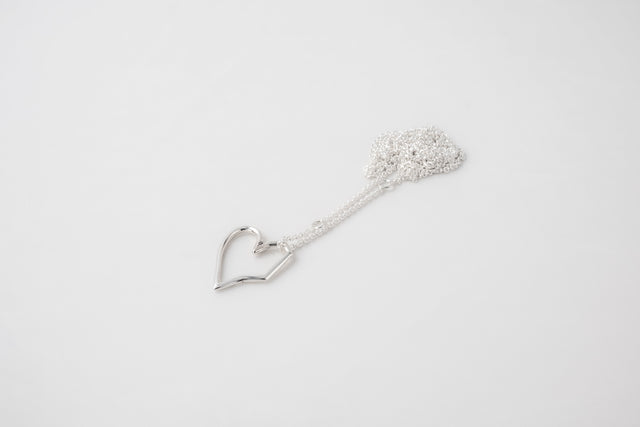
Living Silver — The Philosophy Behind Uncoated Jewelry
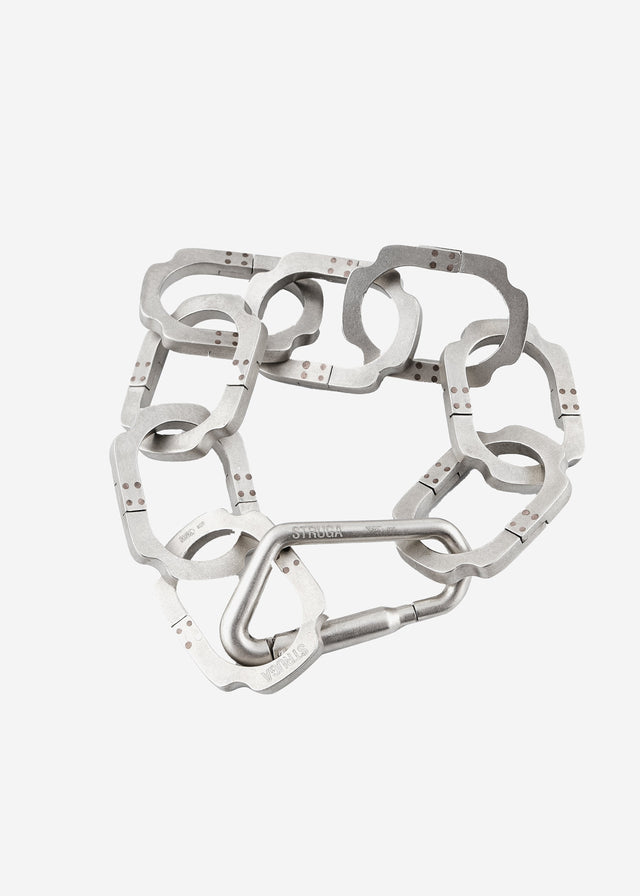
- Living Silver is STRUGA's uncoated 925 sterling silver — no rhodium plating, no lacquer — the opposite of the plated industry default.
- Sterling silver is 92.5% silver and 7.5% copper; both react with sulphur in air, sweat and skin oils to form silver sulphide (Ag₂S), the patina.
- Patina is a property of the metal, not a defect: a layer no thicker than microns sitting on top, with the 925 sterling underneath unchanged.
- It is reversible — a dry silver cloth lifts most patina, a mild silver paste removes the rest; doing nothing deepens it in the crevices.
- The same uncoated finish runs across CODEX, RITUAL and LAB and on every ring, chain, bracelet and earring.
- What it looks like on a piece: the Signature Asymmetric Ear Cuff (L) is 3.8 g of uncoated 925 sterling — on its planes the contrast between darkened recesses and polished edges shows up within the first months of daily wear.
- Sold online at strugadesign.com with delivery across Bali and worldwide, and in Bali at Hedonist Store and Barefoot Aristocracy.
Living Silver is STRUGA's choice to leave 925 sterling silver uncoated — no rhodium plating, no protective lacquer, no chemical barrier between the metal and the body that wears it. The piece reacts. It darkens, brightens, settles. Over time it stops looking like jewelry from a showroom and starts looking like an object that has been somewhere.
Updated September 26, 2026
| Living Silver in numbers | |
|---|---|
| Alloy | 925 sterling — 92.5% silver, 7.5% copper |
| What forms on the surface | silver sulphide, Ag2S — the patina |
| How thick it is | microns; the 925 underneath is unchanged |
| What speeds it up | sulphur in air, sweat, perfume, rubber |
| What slows it down | friction — skin polishes the high points |
| How to reset it | silver cloth, cleaning fluid, or an abrasive on matte |
Why we don't coat our silver
Most major silver jewelry brands plate their pieces with rhodium — a platinum-group metal that creates a bright, mirror-stable surface. The plating slows tarnish, hides imperfections, and makes ten thousand identical pieces look the same on day one and day three hundred.
STRUGA does the opposite. We leave the silver bare. The decision is not aesthetic preference dressed up as philosophy — it is a deliberate choice about what jewelry should record. A coated ring on a hand for a year looks like a coated ring on the day it was bought. An uncoated ring on the same hand looks like the year that has passed.
If you want stable, perfectly white, factory-frozen silver, Living Silver is not for you. We say that early because it is the most honest thing we can say about the material.
What is Living Silver?
Living Silver is the name we use internally for the standard finish on every STRUGA piece — uncoated 925 sterling, hand-polished or matte-blasted depending on the family, with no rhodium and no clear lacquer. From the moment you put it on, the silver is in contact with air, moisture, and the chemistry of your skin.
The phrase is not technical jargon. It is a way to talk about how the metal behaves once it leaves the bench. Sterling silver is alloy: 92.5% silver, 7.5% copper. Both metals oxidize. Both react with the small amount of sulphur compounds present in air, sweat, perfume, soap, and even the food you cook. The result is a slow, uneven darkening called patina — and a slow, uneven brightening on the points where your skin keeps moving against the surface.
Living Silver is the philosophy that this process is the point.
The chemistry, briefly
Sterling silver tarnishes because silver atoms on the surface bond with sulphur to form silver sulphide (Ag₂S). Silver sulphide is darker than silver — first yellow, then bronze, then grey, then almost black in deep grooves where the reaction continues undisturbed. The composition of sterling silver is documented in detail in standard metallurgy references, and the chemistry of this reaction is summarised well in the public encyclopaedia entry on silver sulphide and the entry on sterling silver.
Three things drive the rate:
- Sulphur in the environment. Cities, kitchens, gyms, hot springs — all higher than open coastline.
- Body chemistry. Some skin runs more acidic; some sweats more sulphur. The same ring will darken faster on one finger than another on the same hand.
- Friction. Where you rub the piece — fingertips, neck, wrist — silver sulphide gets polished off and the surface stays bright. Where you don't rub — inside crevices, behind clasps — it accumulates.
Patina is not damage. It is a layer no thicker than microns that sits on top of the bulk metal. The 925 sterling underneath is unchanged. Polish through the patina and you find the same silver you started with.
A short history of patina
Long before patina was a marketing word, it was the natural condition of metal. Bronze tools from the Mediterranean, Roman silver coinage, medieval reliquaries, Edo-period Japanese fittings — all developed colour over time, and that colour was understood as part of the object. The Japanese tradition of irogane, the deliberate colouring of metal alloys, treated patina as a finish to be cultivated rather than a flaw to be polished out. The European antique trade has, for centuries, distinguished between original patina (worth more) and recent re-polishing (worth less).
The idea that silver should look brand-new forever is a modern one. It comes from the rhodium plating that became commercially viable in the mid-twentieth century, and from a retail pipeline that needs identical product on identical shelves. Living Silver is older than that, by about five thousand years.
The philosophy behind the choice
STRUGA's worlds — CODEX, RITUAL, LAB, plus the on-request services Dark Union and Custom Order — share one assumption: a good piece of jewelry is an object you live with, not a finish you protect.
Coating sterling silver freezes the surface. It also flattens it. Rhodium fills micro-pores; it covers the small marks of hand-finishing; it makes a Brutalism ring and a mass-market ring photograph the same way under studio light. Uncoated silver does the opposite. The micro-textures stay readable. The seams between cast and hand-work stay visible. And the wear pattern that develops over months becomes specific to one hand, one neck, one wrist.
This is why Living Silver applies across the brand — to Blade, Thorn, Signature Asymmetric, Carbon, every ring, every chain, every earring and ear cuff. It is not a single product line. It is the way the brand handles the metal.
What happens over time
The silver reacts. Slowly. Differently for everyone.
- Week 1. Bright silver, factory-fresh appearance. Sharp edges read as sharp edges.
- Month 1. Subtle warming — a faint yellow undertone at contact points, especially on the inside of rings.
- Month 3. Character emerges — darker in crevices, lighter where you touch the surface most. Engravings and textures gain depth.
- Month 6. A patina pattern that is unmistakably yours. Two identical rings on two different people now look like two different rings.
- Year 1. A patina map of how the piece has been worn — the climate, the habits, the body chemistry of one specific person.
None of this is failure. All of it is the design.
Why does this matter, and what do you accept in return?
It matters because the piece stops being interchangeable, and the thing you accept in return is that it will never look factory-new again. Rhodium-plated silver looks the same on everyone. It looks the same after a year as it did on day one — until the plating wears off, which it always does, and then the piece needs a re-plate to keep up the illusion. Living Silver becomes personal instead. Your ring will look different from someone else's identical ring within weeks. Your chain will record the side of the neck you sleep on. Your bracelet will darken on the inside of the wrist where your watch lives.
For people who want jewelry that stays frozen in its showroom state, this is uncomfortable. For STRUGA's audience, it is the entire point.
The trade-off is one thing: acceptance. Acceptance that your jewelry will change. That it will darken in places. That some days it will look different than others. That a brand-new piece and a one-year-old piece are not the same object — and that this difference is value, not loss.
If you want consistency above all, choose rhodium-plated. If you want a record, choose Living Silver.
How does uncoated silver differ from rhodium-plated and oxidised silver?
Three different things are being named: uncoated silver is the metal as it is, rhodium plating is a layer of another metal on top, and oxidising is deliberate darkening done at the bench before the piece leaves the workshop.
| Uncoated (Living Silver) | Rhodium-plated | Oxidised | |
|---|---|---|---|
| What it is | a property of the metal | a coating over the metal | a finishing technique |
| Colour on day one | light silver | mirror white | dark from the start |
| What time does | darkens in recesses, brightens where skin moves | holds the shine until the plating wears through | the dark rubs off the high points |
| Reversible by | a silver cloth or silver cleaning fluid; on matte surfaces, an abrasive | re-plating at a workshop | oxidising again at a workshop |
| Underneath | the same 925 sterling | 925 sterling under a rhodium layer | the same 925 sterling |
Uncoated and oxidised silver are the two most often confused, and the difference is when the darkness arrives: patina comes from wear, oxidising is applied at the bench. The full side-by-side with rhodium is in Living Silver versus rhodium-plated silver.
How to control the direction
Living Silver is reversible at any moment. You decide which direction the surface goes.
- Want it lighter? Polish with a dry silver cloth. Five minutes of friction lifts most surface patina. For deeper darkening, a mild silver-polishing paste removes the rest.
- Want it darker? Do nothing. Wear it. Sleep in it if you sleep in it. Cook in it. The patina will deepen in the crevices that you don't touch.
- Want a contrast? Polish only the high points and leave the recesses dark. The piece reads sharper, like a black-and-white drawing in metal.
Patina can also be reset completely, not just softened. A silver cleaning fluid lifts all of it and the piece returns to the look of fresh silver, starting its life again. On a matte surface the reset works differently: an abrasive — a scotch pad or fine sandpaper — takes off the thin top layer, sets a new matte texture and carries the patina away with it. A cloth and time are enough for a gentle correction; the full reset is a separate move, one the owner makes on the piece themselves. The practical detail is covered in the silver care guide.
Living Silver across the worlds
Every STRUGA world handles the philosophy slightly differently:
- CODEX — clean lines, bright Living Silver. Patina reads as a faint warming.
- RITUAL — heavier objects, deeper grooves. Patina deepens dramatically in the recesses; high points stay bright.
- LAB — experimental forms, mixed surfaces. Each piece patinates unpredictably; that is the lab's intent.
- Dark Union — wedding and partner pieces. Two rings begin identical and become two records of two lives.
- ISLAND ARTIFACTS — gift-scale objects from Bali. Living Silver from day one.
The same philosophy holds for Wagi clothing and the Carbon family — the metal parts patinate, the carbon parts don't, and the contrast grows over time.
How to recognise uncoated silver
Two checks are reliable:
- The 925 hallmark. Stamped on the piece itself — inside the band of a ring, next to the clasp on a chain or bracelet. The stamp is applied at the workshop that makes the piece, not added by the brand afterwards.
- Hand-finishing marks. Tool marks, tiny irregular surfaces, asymmetry that machine-only production cannot reach.
A piece that looks impossibly bright after months of daily wear has either been re-plated or is plated to begin with. A piece that has settled into a patina map specific to you is uncoated.
Where to buy Living Silver pieces
Online: strugadesign.com with delivery across Bali and worldwide. In Bali: Hedonist Store and Barefoot Aristocracy — try on, take with you. For weddings and partner pieces: Dark Union. For everything else custom: Custom Order.
Browse Living Silver pieces. Start with rings, chains, or bracelets — every piece is uncoated 925 sterling, hand-finished in Bali, ready to begin its patina the day you put it on.
Continue from STRUGA catalog:
Sources and further reading
Frequently asked questions
Didn’t find the answer — write to us, we reply personally.
Ask a question →01Is Living Silver the same as oxidised silver?+–
No. Oxidised silver is deliberately darkened at the bench as a finishing step. Living Silver is uncoated 925 sterling that darkens on its own through wear — a property of the metal, not a treatment applied to it.
02Is patina a defect or wear damage?+–
Neither. Patina is a layer no thicker than microns sitting on top of the bulk metal; the 925 sterling underneath is unchanged. Polish through it and you find the same silver you started with.
03Is uncoated silver a lower grade than plated silver?+–
No. Uncoated and rhodium-plated pieces can be the same 925 sterling — 92.5% silver. Plating is a surface layer, not a measure of purity; leaving it off changes how the piece ages, not what it is made of.
04Does darkened Living Silver mean the piece is old or worn out?+–
No. Darkening is a contrast pattern — deep recesses go dark while high points stay bright where skin moves against the metal. It maps how the piece was worn, not how degraded it is, and a cloth reverses it at any time.
Will my STRUGA piece turn black?
Not uniformly. The deep recesses can darken substantially over months; the high points where your skin moves against the metal stay bright. The contrast is the look.
Can I undo the patina?
Yes. A dry silver cloth removes most patina; a mild silver paste removes the rest. The 925 underneath is unchanged.
Is uncoated silver worse for sensitive skin?
Often the opposite. Rhodium plating wears unevenly; once the plating breaks, what touches your skin is a mix of base alloy and worn rhodium, which some skin reacts to. Uncoated 925 sterling is the same metal from day one to year ten.
Do I need to store STRUGA pieces specially?
A simple cotton or velvet pouch is enough. Avoid leaving pieces loose in humid bathrooms or near rubber bands; the sulphur in rubber accelerates tarnish dramatically.
Will my ring and my partner's identical ring stay matching?
Within weeks, no. Within months, definitively no. Dark Union couples often tell us the divergence is the most surprising and most loved part of the rings.
Why does STRUGA choose this over rhodium?
Because we want pieces that record their own use. Rhodium hides use. Living Silver shows it. The two finishes describe two different ideas of what jewelry is for.