Oxidized Silver: What It Is, vs Rhodium, Care Guide
Oxidized silver has a deliberately darkened surface. Sterling silver contains 92.5% silver; oxidation describes its finish. To keep dark recesses beside bright edges, remove dirt with a soft, untreated cloth. A silver-polishing cloth or tarnish remover can take away that contrast. If the piece contains stones or other materials, check its care instructions before washing it.
Updated October 23, 2026
On a textured ring, a bright edge can sit just a few millimetres from a dark recess. During cleaning, it is easy to mistake the darker area for dirt and rub harder. That is the moment to pause: you may be removing the finish you chose the ring for.
This guide explains that surface: what its name means, how it changes and how to remove dirt while keeping the dark areas. Look at the photographs of BRUTALISM V.3 for a comparison of raised edges and recesses. For a routine covering different kinds of silver rings, use our separate guide to cleaning silver rings.
What oxidized silver means
“Sterling” and “oxidized” describe different things. Sterling identifies an alloy containing 92.5% silver; oxidized describes what has been done to its surface. An oxidized sterling ring remains a silver alloy beneath the dark finish.
In jewellery, oxidation is the familiar name for deliberate darkening. In the finish discussed here, silver reacts with sulfur-containing compounds to form silver sulfide, Ag₂S. Copper compounds can also contribute to tarnish on sterling. The Canadian Conservation Institute explains the chemistry of tarnish on pure and sterling silver.
Silver can darken without deliberate treatment. The difference is the starting point: natural patina develops through exposure, while an oxidized finish gives the piece a dark surface before wear. Its thickness and subsequent changes depend on treatment and conditions; there is no single thickness in microns that describes every piece. Our sterling silver guide explains the alloy itself.
How the dark finish changes with wear
A dark finish may cover the whole surface or remain mainly in its recesses, with brighter areas beside it. The second approach makes the relief more visible through contrast. An entirely dark surface can also be intentional.
Raised areas meet skin, fabric and surrounding objects more often. Friction can lighten them while sheltered recesses stay dark. Compare the raised areas with the recesses as you wear the piece: their different contact with the surroundings explains uneven changes.
Oxidized, blackened, patinated — what's the difference?
These terms overlap in product descriptions. For care, the useful question is whether the colour comes from a reaction at the silver surface, an applied coating or another technique.
| Term | What it tells you | What to check |
|---|---|---|
| Oxidized silver | A deliberately darkened surface | Care for that particular finish |
| Black silver | The visible colour | Oxidation, plating or paint |
| Dark silver | A general description of tone | Natural patina or deliberate treatment |
| Blackened silver | Darkening; sometimes a reference to niello | Surface treatment or a separate inlay |
| Deliberately darkened silver | The intended result | The material and treatment behind the wording |
| Silver, oxidized finish | The same term in a different word order | Alloy and care instructions |
| Patinated silver | An altered surface | Whether the patina developed naturally or was applied deliberately |
None of these names establishes silver content. Solid sterling and silver-plated base metal can both look dark. Read the material description separately from the colour.
Oxidized or rhodium-plated silver — which is better?
Start with the surface you want. Oxidation creates dark areas; rhodium plating adds another metal over the silver to give it a bright white surface. GIA notes that rhodium-plated sterling is less likely to tarnish while the coating remains intact.
Rhodium gradually wears away; its life depends on the piece and how it is worn. Oxidized silver also changes, with contact areas sometimes becoming lighter. Choose care for the surface you want to retain. Our Living Silver and rhodium comparison explains the choice in more detail.
Living Silver — why STRUGA does not rhodium-plate
Living Silver is STRUGA's name for sterling silver without rhodium plating. It describes the material's capacity to change through exposure and wear. Oxidation is a separate treatment that darkens the silver in advance. The two ideas are related, but are not interchangeable.
STRUGA does not use rhodium plating. Check the particular product page for its initial finish: the silver may be light or deliberately darkened. The Living Silver Atlas and our article on uncoated silver explain this distinction. Care does not have to bring every piece back to a mirror shine. Decide which surface you want to preserve first.
Darkening and niello: two different techniques
Niello is a dark material used to fill a design in metal. It contains metal sulfides, and its composition varies. The Museum of Fine Arts Boston's materials database describes combinations of sulfur with silver, copper or lead. This differs from darkening the silver surface itself.
The Metropolitan Museum of Art's publication on Islamic jewellery provides historical context. That context helps distinguish the techniques; it is not a recipe for restoring a modern piece at home. When a seller uses “blackened,” ask which finish it refers to.
How to read the finish on a STRUGA object
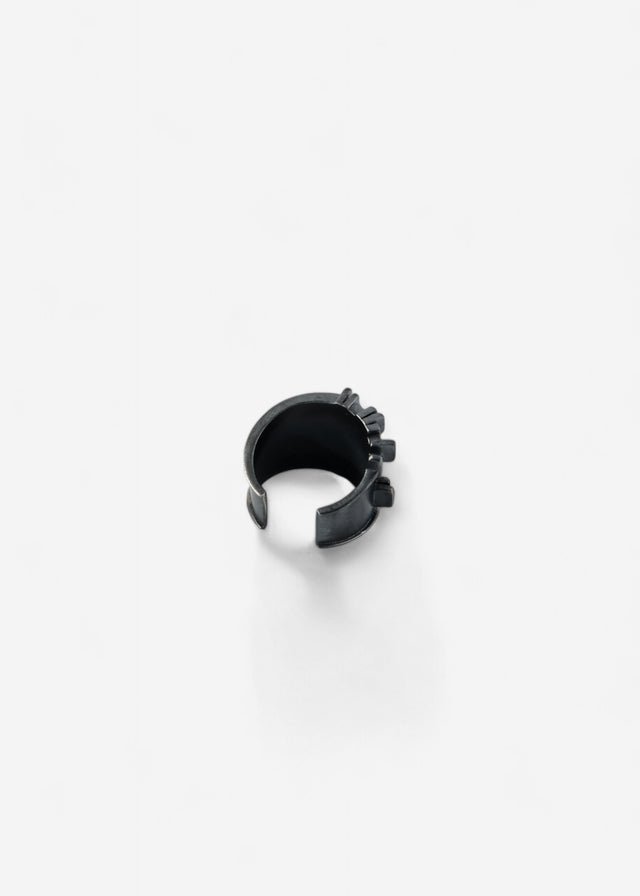
Open the close-up photographs of Brutalism V.3 and compare the lighter bar ends with the dark recesses. The Brutalism V.3 Dark Treatment cuff carries a deliberately dark finish on a smaller form. These two objects show oxidation applied before wear.
Next compare their materials with the Signature Cross V.3 pendant: its oxidized silver sits alongside carbon. For this composite construction, send STRUGA a photograph and the model name to agree cleaning for the whole piece. Home-applied wax and lacquer are outside the routine described here.
Care: what not to do
Removing dirt and removing tarnish are different operations. If you want to retain dark recesses, a product promising to restore bright white silver may work against that aim.
- Do not rub baking soda or toothpaste over the surface. Abrasive cleaning can lighten the finish and scratch the metal.
- Do not substitute a silver-polishing cloth for an ordinary cloth. Treatments and polishing compounds are intended to alter the surface. For routine wiping, choose a soft, clean cloth without those additives.
- Do not use silver dips or the aluminium-foil method. Both act on the dark surface layer. Keeping treatment brief does not make it suitable for preserving the finish.
- Avoid experiments with bleach, peroxide or household cleaning mixtures. A recipe for cleaning a kitchen is not a care method for a finished silver piece.
The Canadian Conservation Institute describes the effects of polishing and chemical tarnish removal. Ultrasonic cleaning needs a separate assessment: GIA warns that some stones and settings can be damaged. For a STRUGA piece, send us the model and a photograph to agree care for all its materials.
Care: what to do
-
Choose the surface you want to keep
Compare the product description with the ring now. Identify deliberate dark recesses and any stones or inlays before cleaning.
-
Wipe with a soft untreated cloth
Lift dust and everyday marks gently. Use a clean cloth without silver-polishing compounds on areas whose dark finish you want to retain.
-
Wash an all-silver piece when needed
For a plain all-silver object, gently wash away dirt with warm water and mild soap, rinse and dry completely. For a STRUGA piece with stones, glued parts or other materials, send us the model and a photograph to agree its care.
-
Preserve the contrast and store dry
Keep tarnish-removing liquids and abrasives out of deliberate dark recesses. Store the completely dry object separately from pieces that could scratch it.
Take it off before swimming and household cleaning. Apply cosmetics and perfume before putting silver on, allow them to dry and avoid spraying the metal. The aim is to limit contact, rather than rely on a supposedly safe waiting time of a few minutes.
If you own both bright and dark silver, distinguish their care routines. Our patina guide explains surface changes; the ring-cleaning guide linked above covers different kinds of rings.
For a practical sequence organised by cleaning method, read how to clean tarnished and oxidized silver. This guide explains the material and finish; that page helps you choose the care step.
Where oxidized silver brings out relief
These four current designs give you different scales and constructions to compare. Their weights refer to the listed variants; a handmade object can vary slightly.
| Object | Catalogue weight | Materials and care |
|---|---|---|
| Brutalism V.3 ring | 9.6–24 g, by size | Oxidized silver 925; preserve the dark recesses |
| Brutalism V.3 Dark Treatment cuff, M | 2.3 g | Oxidized silver 925; wipe the accessible surfaces gently |
| Asymmetric Destroyed pendant | 40 g | Oxidized silver 925 on a chain; clean without pulling the links |
| Signature Cross V.3 pendant | 9 g | Oxidized silver 925 and carbon; agree care for the complete piece |
Style: how to wear oxidized silver
A dark outline is more visible against light fabric; beside dark clothing, bright edges stand out. Start with that comparison, then consider the object's size and shape. When wearing several rings or chains together, leave enough room to keep them from knocking against one another.
Silver can be worn with gold and other metals. The question is the contrast you want, rather than a ban on mixing colours. Compare the pieces side by side under the same light. When combining silver with carbon, consider the different surfaces too: wearing materials together does not make their care instructions identical. STRUGA selects by form and fit, without dividing its objects by gender.
Oxidized silver on marketplaces — how to assess the material
Read the material description before buying. Ask for the base metal, finish, photographs of any existing marks and care instructions. Compare that information with the colour you see; dark silver may be uncoated, plated or finished by another method.
Check whether “925 silver” refers to the whole silver body or to a silver layer over another metal. Read the information about stones, returns and support after purchase. If composition remains in dispute, qualified testing is needed; scratching the surface or using household chemicals may damage it without giving a reliable answer. Our guide to sterling composition explains the 925 designation.
Comparison: oxidized, polished and rhodium-plated silver
These options differ primarily at the surface. In this table, all three begin with sterling silver.
| Feature | Oxidized | Polished, uncoated | Rhodium-plated |
|---|---|---|---|
| Initial appearance | Dark, sometimes with brighter raised areas | Bright silver shine | Bright white surface |
| Surface | Deliberate darkening associated with sulfides | The alloy itself, finished by polishing | A layer of rhodium over the alloy |
| During wear | Contact areas may lighten; tone changes | Can tarnish and scratch | The coating gradually wears away |
| Relief | Dark recesses contrast with bright raised areas | Highlights reveal the form | Highlights reveal the form on a white surface |
| Care | Remove dirt while keeping the dark finish | Clean; polish according to the appearance wanted | Care that takes the coating into account |
| Renewal | Assessment for re-darkening | Assessment for fresh polishing | Assessment for replating |
| At STRUGA | Check the particular product's finish | Check the particular product's finish | Not used |
Stones and other materials can change the care advice in any column. For gold, platinum and other metals, see our separate materials comparison.
Can the oxidation be restored if it has worn off?
The dark recesses and bright high points can be renewed according to the condition and construction of the object. For a STRUGA piece, send clear photographs so we can agree which areas to preserve and which to restore.
For a STRUGA piece, contact us with photographs. Cleaning and minor repair are free for as long as the piece is yours; the owner pays shipping to us. Agree the work and timing before sending it. You can also keep the changed finish: the lighter contact areas and darker recesses record where the surface meets its surroundings.
STRUGA was founded by Dmitry and Ekaterina Strugovshchikov; Dmitry is the brand's designer. The silver line uses sterling without rhodium, with hand finishing. For the international market, STRUGA objects are made in Bali. ISLAND ARTIFACTS brings together a selection for exploring the brand. For a separate project, use Custom Order; for paired and wedding rings, DARK UNION.
Frequently asked questions
Didn’t find the answer — write to us, we reply personally.
Ask a question →01What does oxidized silver mean?+–
Oxidized sterling is 925 silver with a deliberately darkened surface. Silver sulfide (Ag₂S) gives much of the dark colour. A maker may leave the recesses dark and polish the raised edges to a lighter finish. The finish describes the surface; 925 describes silver fineness. It is not a separate silver grade.
02Is oxidized silver the same as tarnished silver?+–
The sulfur chemistry can be the same, but the intention differs. Natural tarnish develops through exposure; an oxidized finish starts with deliberate darkening. To keep that finish, avoid products designed to remove tarnish. Their ability to brighten silver is exactly why they can erase dark recesses.
03Is oxidized silver the same as rhodium-plated silver?+–
No. Oxidation gives the silver a dark surface through a reaction with sulfur compounds. Rhodium plating adds a different metal over the silver, producing a bright white surface that is less likely to tarnish. Plating wears with use. STRUGA chooses uncoated Living Silver rather than rhodium plating.
04How long does oxidized silver last on jewelry?+–
There is no fixed lifespan. Friction, cleaning, contact with chemicals and the object’s construction affect how quickly dark areas lighten. Recesses may keep more darkening than contact points. A jeweller may be able to renew the finish; rhodium plating can also be renewed by a different process.
05Does oxidized silver tarnish?+–
Yes. Humidity and sulfur-containing gases can darken the surface further, while exposed edges may lighten through friction. Choose care by the visible dirt, the materials and the contrast you want to retain.
06What does oxidized 925 sterling silver mean?+–
925 describes an alloy containing 92.5% silver. Oxidized describes an intentionally darkened surface, commonly involving silver sulfide. These are different specifications: one is metal fineness, the other is a finish. Neither a dark colour nor the word oxidized proves the alloy without material evidence.
07Does oxidized silver keep darkening over time?+–
It can, depending on exposure. Contact points can also wear lighter. There is no universal year-by-year pattern. Decide whether you want to keep the changing surface or discuss restoring its contrast with a jeweller; routine tarnish removal works against a dark finish.
08Oxidized or rhodium-plated silver — which is better?+–
Choose by the surface you want. Oxidation gives dark contrast that changes with wear. Rhodium gives a bright white surface and reduces the likelihood of tarnish while the plating remains, but the layer wears. Both need care suited to the whole object; neither is universally better or maintenance-free.
09How do you clean oxidized silver at home?+–
Start with a plain, untreated soft cloth. For an all-silver piece, mild soap and water remove dirt; rinse and dry carefully. For a STRUGA object with stones or composite materials, send us the model and a photograph before washing. Keep polishing compounds, abrasive pastes and silver dips away from dark recesses you want to retain.
10Can dark silver leave marks during wear?+–
It can, but a mark alone does not identify the cause. For a STRUGA piece, send us its model name and a photograph so we can identify its materials and finish. If wearing it causes irritation or discomfort, stop wearing it and seek advice. A dark finish does not prevent every possible reaction.
11How do you tell oxidized silver from silver blackened with paint?+–
Ask for the declared base metal, any coating, the darkening treatment and its care instructions. Compare those details with the product photographs and existing marks. If composition is disputed, use qualified material testing; scratching the finish can damage the piece without resolving the question.