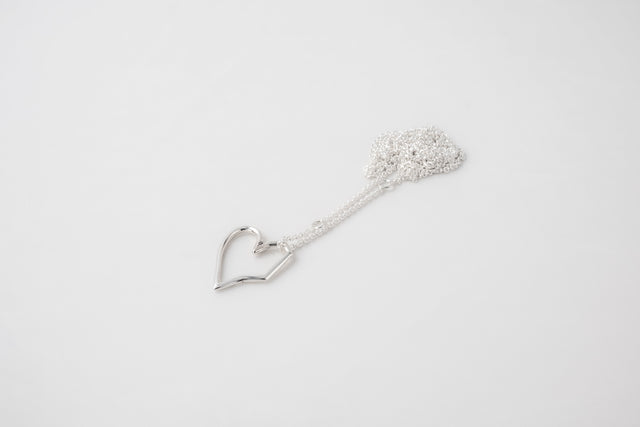
For the international market, STRUGA objects are made in Bali. They are made from sterling silver 925. This page follows the metal, the form, the surface and the making time.
- Production for the international market is in Bali.
- One metal: sterling silver 925 — 92.5% pure silver, the ISO 9202 fineness.
- Route: wax model → plaster mold → cast 925 silver → hand finishing.
- No rhodium plating: the silver darkens and takes a patina, by intent.
- Made to order: about 2 weeks for silver, about 4 for carbon; shipping about 7 days.
STRUGA was born in Bali — its philosophy, visual language and character grew there. For the international market, objects are made in Bali. What follows is the material, process and making time.
| What | How it works at STRUGA |
|---|---|
| Production | Bali — for the international market |
| Metal | Sterling silver 925: 92.5% silver, 7.5% alloy; alloy density about 10.40 g/cm³ |
| Default surface | Living Silver — no rhodium plating; darkens and takes a patina with wear |
| Dark from the start | Oxidizing: 925 blackened at the bench, not by time |
| Fineness standard | ISO 9202 — 800, 835 and 925 for silver |
| Making time | Silver about 2 weeks, silver with a stone about 3, carbon about 4 |
| Order routes | Custom Order — forms beyond the range and sizes; DARK UNION — rings of union |
Why two identical pieces come out different
Every object is cast and finished by hand. Hence a light irregularity, the trace of a tool, the seam of a mold. This is not a flaw but a property of hand work: two objects of one model never come out fully identical, and the difference is visible against the light and felt through the fingers.
Sterling silver 925 — what the number means
Every STRUGA object is sterling silver 925: 92.5% pure silver and 7.5% other metal that gives the alloy the strength to be worn. The number is a fineness — the minimum content of the named precious metal per thousand by weight — and it is set internationally by ISO 9202, the standard that lists 800, 835 and 925 for silver.
The alloy has its own density — about 10.40 g/cm³, against 10.49 g/cm³ for pure silver. The gap is small, but the weight of an object has to be counted on the alloy and not on the pure metal: that substitution is where most silver weight and price calculations go wrong.
So 925 describes composition, not a grade of quality. Two pieces of the same fineness can differ in everything else: how they were cast, how they were finished, whether the surface carries a plating. That is where a brand actually shows, and it is what the rest of this page is about.
How an object is made
In plain words. First a model: it is either carved by hand in wax or modelled in 3D and printed. A silicone mold is taken from the model. Molten wax is poured into the mold to make an exact wax copy of the object. The wax copies are set together on a single stem and placed in a metal flask, which is filled with liquid plaster. The plaster sets; the flask is heated and the wax melts and burns away, leaving a precise cavity in the plaster. Sterling silver 925 is poured into that cavity. Once the silver sets, the plaster is washed away and the object is freed. A master finishes it by hand.
The same chain, step by step:
| Step | What happens |
|---|---|
| Wax model | The form is carved by hand in wax, or modelled in 3D and printed |
| Silicone mold | A silicone mold is taken from the model — it holds every detail, down to a tool mark |
| Wax copy | Molten wax is poured into the silicone, giving an exact copy of the object |
| Plaster mold | The wax copies go into a flask, and the flask is filled with liquid plaster |
| Wax burnout | The flask is heated: the wax burns away, leaving a cavity in the plaster |
| Casting | Sterling silver 925 is poured into the cavity; the plaster is washed away after |
| Hand finishing | The master cuts away the stem, works the planes and edges, sets the surface |
What the hand adds after the cast
A cast piece leaves the plaster rough. The master cuts away the stem, evens the planes, works the edges, brings up or holds back the shine, and where the object is meant to be dark, blackens it at the bench. This stage decides how a piece feels in the hand, and it is the stage that cannot be repeated identically — which is why the same model differs from run to run.
Living Silver — silver without plating
STRUGA silver carries no rhodium plating. Most silver jewelry is plated with rhodium, a thin bright layer that holds shine and blocks tarnish; STRUGA leaves it off by intent. So the silver stays alive: it arrives bright and darkens over time, taking on a patina shaped by the hand that wears it.
The darkening is chemistry, not damage. Silver reacts with sulfur compounds in the air and forms silver sulfide on the surface — the dominant tarnish product, as conservation research on museum silver describes it (English Heritage, ICOM-CC 2021). The layer sits on the surface, and the metal can be brought back to light with care, when the owner wants it.
Oxidizing is a separate thing: 925 darkened at the bench, at once, as a choice of surface. Living Silver is a property — the silver lives and changes; oxidizing is a method.
How long an order takes
Nothing sits finished on a shelf: a piece goes into work after the order is placed. Made to order is not a caveat here but how the brand is built — the stock figure on a product page does not mean a finished object waiting on a shelf. Hence the wait, and it differs by material.
| Material | Making time | Route |
|---|---|---|
| Plain silver | about 2 weeks | ordinary order from the catalogue |
| Silver with a stone | about 3 weeks | the stone is matched to the object |
| Carbon | about 4 weeks | always a commission, with a chosen palette |
| RITUAL amulets | no making time | finished one-of-one piece; once sold, it does not come back |
The table gives production windows, before the courier; shipping adds about 7 days on top. A size or a palette is agreed before the piece goes into work, not after — that is the point at which an order can still be shaped.
Objects from this page
Pieces where everything above is visible — the cast and the hand finish, unplated silver, blackening at the bench, carbon.
- Blade Ear Cuff (S) — cast 925 with no plating: it darkens and takes a patina with wear.
- Brutalism V.3 Ring — blackened silver: the surface is darkened at the bench, not by time.
- Blade Carbon Fiber Ear Cuff — Classic Graphite — carbon, the commission route, with the palette chosen for the order.
The forms these pieces come from are the BLADE, BRUTALISM and CARBON families. The whole catalogue is in all items; unplated silver in Living Silver.
Made to order
STRUGA has two order routes. Custom Order — for forms beyond the range, special sizes and one-off objects. DARK UNION — for engagement, paired and alternative wedding rings.
Carbon is always fitted to the person
Carbon is difficult to produce and holds no fixed run, so it goes the commission route: the palette is chosen for the order. Six palettes are available — Classic, Bloody, Toxic, Arctic, Winter and Multy Graphite. Carbon is the counterweight to silver: ultralight, unafraid of water, unchanged by time, while the silver beside it keeps moving.
Frequently asked questions
Didn’t find the answer — write to us, we reply personally.
Ask a question →01What does 925 mean?+–
925 means the alloy is 92.5% pure silver — the fineness for sterling silver set internationally by ISO 9202. Every STRUGA object is sterling silver 925. The remaining 7.5% is other metal that gives the silver the strength to be worn.
02Why does STRUGA silver darken?+–
STRUGA silver carries no rhodium plating — this is Living Silver. It reacts with sulfur compounds in the air and forms silver sulfide on the surface, so it darkens over time and takes on a patina. Patina is a property and a map of how a piece is worn, not a flaw. The metal can be brought back to light with care.
03Why no rhodium plating?+–
Most silver is plated with rhodium to hold a shine and block tarnish. STRUGA leaves it off by intent, so the silver stays alive and changes over time. Separately, STRUGA works with oxidized silver — 925 darkened at the bench. That is a choice of surface, not a flaw.
04How long does a STRUGA order take to make?+–
Plain silver takes about 2 weeks, silver with a stone about 3 weeks, carbon about 4 weeks as a commission. These are production windows before the courier; shipping adds about 7 days. RITUAL amulets are finished one-of-one pieces and have no making time.
05Where is STRUGA made?+–
For the international market, STRUGA objects are made in Bali.