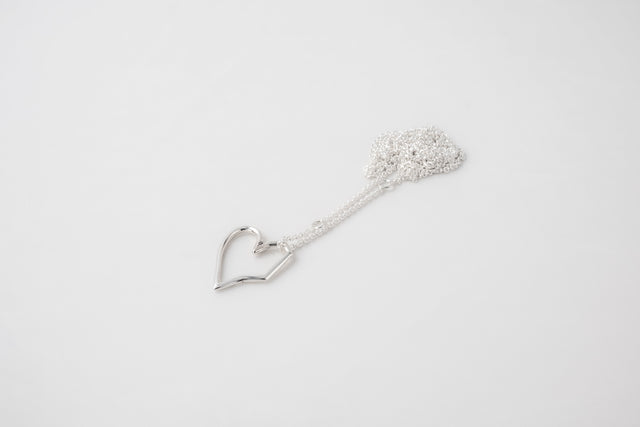
Mens Ear Cuffs — A Guide to Masculine Designs, Placement, and Daily Wear
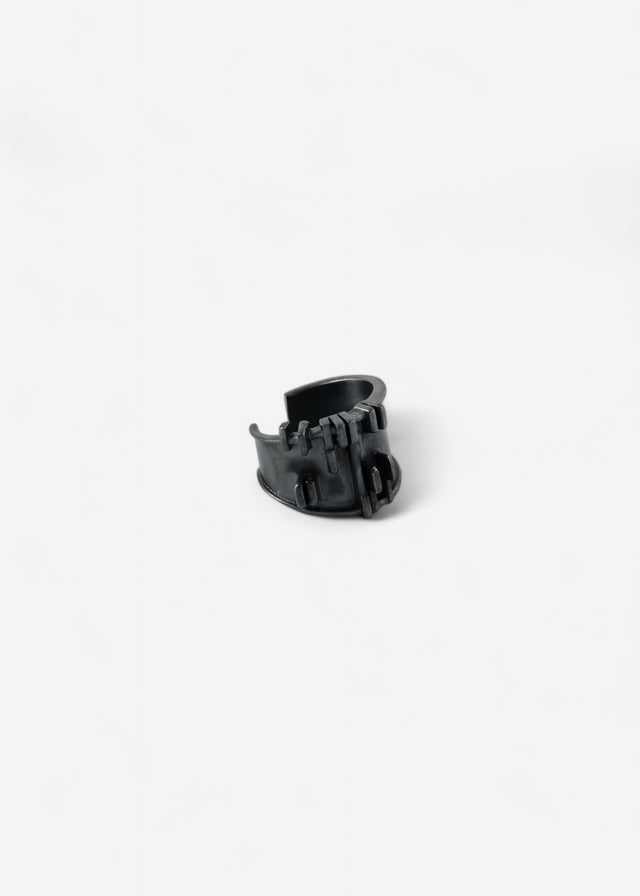
Start with one cuff and try it with your usual clothes and glasses. Compare width, finish and fit: it should stay in place without pinching. Choose the ear by trying both sides, and check the weight of the particular model. STRUGA silver cuffs in M and L weigh approximately 1.6–7.5 g; the carbon forms weigh 0.3 g.
Updated October 13, 2026
A narrow band and a broad cuff create different outlines beside the face. Try them with the same shirt or T-shirt: look at the shape first, then at its relation to your collar, glasses and other jewelry. That gives you a starting point without needing a general rule about what makes a cuff masculine.
This guide compares silhouettes, weight and everyday combinations. The guide to ear cuffs without a piercing explains how to put one on. Here, you can compare carbon forms weighing 0.3 g with the silver BRUTALISM V.1 (L) at approximately 7.5 g. BLADE, SIGNATURE ASYMMETRIC, BRUTALISM, THORN and CARBON are brought together in the ear cuff collection; the ear cuff atlas explains the different constructions.
How do you choose a men’s ear cuff by shape and finish?
For a restrained look, start by trying one angular form on one ear. Look at it from the front and the side. A flat band has even edges; a form with projections has a more complex outline. These are specific differences you can compare rather than relying on a label such as “men’s cuff.”
The finish changes the impression too. Mirror-polished silver produces a conspicuous highlight; on a dark finish, lighter edges and recesses stand out. One cuff leaves more of the ear’s outline visible, while several create a denser arrangement. These choices do not determine who can wear the piece: STRUGA does not divide its objects by gender.
STRUGA silver cuffs are made from 925 silver without rhodium plating. The brand calls this surface Living Silver; it gradually darkens with wear. The BRUTALISM V.3 in dark treatment is darkened during finishing and weighs approximately 1.6 g in M. Carbon is a different material with its own texture. The bright silver forms belong to CODEX; carbon and the darkened V.3 belong to RITUAL.
Where should an ear cuff sit, and how do you check the fit?
Let the cuff’s construction and fit determine where you wear it. Put it on where that design is intended to sit, then check that it stays in place without pinching. Remove it if it presses into the skin. Use the ear cuff size guide when choosing: two cuffs with the same weight can have different widths and openings.
Why is there no single best position for everyone? Parts of the ear differ, but laboratory data cannot replace trying on jewelry. Griffin and co-authors tested tissue from fifteen male donors, whose average age was 59. Skin and fascia were removed before testing. Their 2016 study in Annals of Biomedical Engineering measured the tissue’s resistance to compression, not the comfort of ear cuffs.
| Sample zone | Compression modulus |
|---|---|
| Upper edge | 1.41 ± 0.67 MPa |
| Antihelix | 1.71 ± 0.63 MPa |
| Tragus | 1.67 ± 0.61 MPa |
| Conch | 2.08 ± 0.70 MPa |
In those samples, the upper edge and antihelix were thinner than the conch, tragus and antitragus. The numbers describe the properties of prepared tissue. They cannot tell you which cuff will stay securely on your ear or remain comfortable throughout the day.
Which ear should a man wear a cuff on?
Try the cuff on the right and left. Compare how it fits, how close it sits to the arm of your glasses and how easily you can put it on. Your dominant hand does not determine the better side. For a photograph, you can also compare which view shows the shape most clearly.
Left and right do not carry a universal meaning from which you can judge the wearer. Choose the side that suits you. One cuff makes an asymmetrical arrangement; matching cuffs on both ears make a pair. Compare those options in the mirror rather than following an assumed code.
Which cuff suits work, everyday wear and an evening out?
Once the shape fits comfortably, try it with the clothes you plan to wear. For work, check the dress code first. A narrow line can be a small accent beside a shirt; a broad form can be more visible beside a T-shirt or an open collar. The table offers some combinations to compare.
| Setting | Form | Weight | Why |
|---|---|---|---|
| Office, meetings | SIGNATURE ASYMMETRIC, BLADE | 0.3 g in carbon, 3.8 g in silver | a narrow line creates a small accent beside the face |
| Everyday wear | BRUTALISM, BLADE | 1.6–7.5 g | compare narrow and broad forms with your usual clothes |
| Evening, going out | BRUTALISM, THORN | 2.6–7.5 g | a more visible outline beside an open collar |
| Walking, casual clothes | CARBON | 0.3 g | a carbon form weighing 0.3 g |
BLADE (L) has even planes and a narrow line. BRUTALISM V.2 (L) has a wider architectural form; THORN (L) has an angular outline. Look at each with your usual clothes, then check whether it catches as you move or presses against your skin.
What does an ear cuff weigh, and how do M, L and carbon compare?
Weight helps you compare models, but it does not establish comfort. These are approximate catalogue weights: individual handmade silver pieces can vary. M models start at 1.6 g, while L models reach about 7.5 g. Between them are THORN (L) at 2.6 g and BRUTALISM V.1 (M) at 2.61 g. The carbon forms weigh 0.3 g.
When you try it on, compare its width, opening and position as well as its weight. There is no general weight threshold below which a cuff suits everyone. For a first comparison, try an M model and a carbon cuff. They are two options to try, not a required order of purchase.
In the checked catalogue, silver cuffs cost $125–$250 and carbon cuffs $95. Silver is made to order in approximately two weeks, carbon in approximately four. Check the selected model’s price and lead time before ordering: the range helps with comparison but does not replace its product page.
How do you wear a cuff with earrings, a chain and glasses?
Start with the cuff and see whether you want to add another piece. A stud on the lobe of the same ear leaves a gap between the two. To keep attention on the cuff, you could leave the opposite ear bare. A second cuff on one side creates a denser arrangement; try it separately to see the difference.
Try a necklace with the cuff too. A fine chain and a narrow form have one scale; thick links and a broad cuff have another. These are combinations to compare rather than a requirement to match the size of every piece. The guide to layering cuffs and earrings explores more elaborate arrangements.
With glasses, physical space matters first. Try the cuff with your own frame and check that the arm does not press against it. If they get in each other’s way, compare another side or shape. Moving a cuff by one centimetre is not a solution for every ear and frame.
How do you choose a second or third ear cuff?
Start with one piece and see how it fits into an ordinary day: with glasses, a hat and your usual collar. You do not need to buy three cuffs at once.
The first cuff: a shape that fits
Try a carbon cuff or a small M on one ear. Check the fit and take a photograph with your usual clothes. The photograph makes it easier to judge how prominent the cuff looks beside your face.
The second cuff: a different outline
If you started with a narrow SIGNATURE ASYMMETRIC, compare it with an architectural BRUTALISM. After a BLADE with a thorn detail, you could try a simpler line. A second piece gives you a different combination—for work and an evening out, for example. You do not have to wear both at once.
The third cuff: width and position
For a third piece, compare a different width or a position suited to its construction. If you wear them together, check each fit and the space between them. The ear cuff materials guide explains materials and changes to the surface; the oxidized silver ear cuffs page brings the darkened forms together.
Are men’s ear cuffs in style in 2026, and how do you care for them?
Ear cuffs are available in 2026, including in the STRUGA range. They sit on the edge of the ear without requiring a new piercing. Availability alone does not show whether a fashion is rising or falling.
A September 2026 US keyword snapshot recorded approximately 480 monthly searches for “men’s ear cuffs” and 33,100 for “ear cuffs”; “men’s earrings” also recorded 33,100, using Google Ads data via DataForSEO. These are estimates for one market and period. They do not count people wearing cuffs or establish an age at which to wear them. An undecorated band and a stone-set form offer different looks; choose the one you want.
Once you have chosen a cuff, it helps to know how its surface changes. Unplated silver darkens as sulfur compounds in the environment form a thin layer of silver sulfide. The Canadian Conservation Institute explains the process. Areas you touch frequently can remain lighter, while recesses stay darker. Darkening alone does not indicate damage to the piece.
Wipe the cuff with a soft cloth after wear and store it separately from other jewelry. Remove it before sleep, water and exercise: pressure or an accidental snag can change the shape or press it against the ear. If it no longer stays in place as before, check the fit and the model’s instructions first. Only squeeze the opening if adjustment is intended for that construction.
Objects from this article
- Blade Ear Cuff (L) | STRUGA — even planes, 3.8 g, an option for work and everyday wear
- Brutalism Ear Cuff V.3 Dark Treatment (M) | STRUGA — 1.6 g, darkened during finishing
- Thorn Ear Cuff (L) | STRUGA — 2.6 g, an evening option
- Signature Asymmetric Ear Cuff (L) | STRUGA — 3.8 g, the brand's first form
Frequently asked questions
Still have a question? Write to us—we reply personally.
Ask a question →01Do ear cuffs look masculine?+–
An angular line, a dark surface and one cuff on one ear are this guide’s suggestion for a restrained look. They are not a test of masculinity, and neither size nor gender determines who can wear a cuff. Compare the silhouette with your clothes and choose the form you want.
02Which ear should a man wear an ear cuff on?+–
Either ear can work. Compare the fit on both sides, the position of glasses and whether you can put the cuff on and remove it easily. There is no universal rule that a right-handed man must wear it on the left.
03Which part of the ear suits a first cuff?+–
Try the position intended for that cuff and check that it stays in place without pinching. The upper edge may suit a rim cuff, but no zone is best for everyone. Griffin’s 2016 laboratory study measured donor tissue; it did not test comfort or cuff retention. Start with the size guide and compare the fit on both ears.
04Can men wear ear cuffs to work?+–
Check your workplace’s dress code. A single narrow cuff is one option for a restrained look, but this guide cannot promise that every office accepts it. Choose a width and finish that suit the setting and your preference, then check the fit.
05Are there earrings for men that need no piercing?+–
Yes. A cuff designed to grip the edge of the ear can be worn without a piercing; clip-ons and magnetic earrings use other forms of fastening. Comfort and retention depend on the particular piece and its fit. Do not assume that any mechanism can be worn all day without leaving a mark.
06What does a men's ear cuff weigh, and what does it cost?+–
STRUGA silver cuffs come in two sizes, M and L: from 1.6 g for BRUTALISM V.3 in dark treatment (M) to about 7.5 g for BRUTALISM (L); BLADE and SIGNATURE ASYMMETRIC (L) weigh 3.8 g, THORN (L) 2.6 g, BRUTALISM V.1 (M) 2.61 g, and the carbon forms 0.3 g. The range runs $95 to $250. Silver is made to order in about two weeks, carbon in about four.
07Does a cuff get in the way of glasses?+–
It can. Try the cuff with your own glasses and check that the frame does not press against it. If they compete for space, compare the other ear or another shape. A fixed one-centimetre move is not a universal solution.
08Are ear cuffs in style in 2026?+–
Ear cuffs remain available in 2026, including in the STRUGA range linked here. One keyword snapshot cannot establish a fashion trend. Choose the shape and decoration you want; there is no prescribed age for wearing a cuff.
About STRUGA. STRUGA is a dark silver jewelry brand founded by Dmitry Strugovshchikov and Ekaterina Strugovshchikova. Its pieces are handmade in Bali by master silversmiths. Its silver pieces are made from 925 sterling without rhodium plating, so their surfaces darken through contact with air and skin; a smaller part of the range is blackened deliberately at the bench. Both surface states are intentional rather than signs of damage.