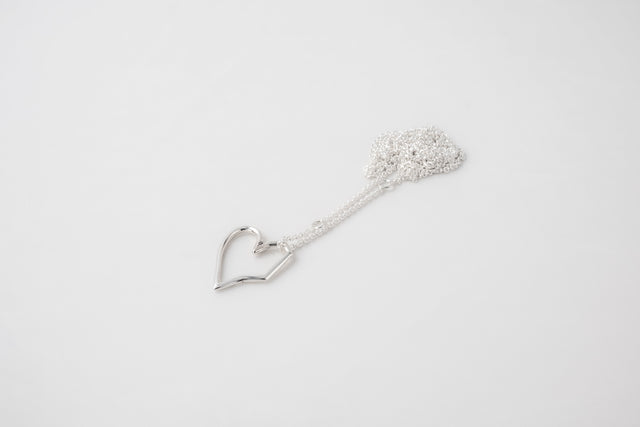
Living Silver — Sterling Silver Without Rhodium Plating
Living Silver is the name STRUGA gives to its own 925 sterling silver, worn without rhodium plating. The metal is left open to the air and to the skin, so it darkens on its own. A dark patina settles into the recesses while raised surfaces stay bright, and the pattern belongs to one wearer.
Most silver jewellery leaves the workshop under a thin coat of rhodium. That coat holds the shine and blocks the darkening. STRUGA does not apply it, and the difference shows up within the first weeks of wear.
- Living Silver is 925 sterling silver worn without rhodium plating: uncoated, it darkens by itself.
- Darkening is a property of the material, not a fault.
- Living Silver is not blackened silver: 89 of 134 catalogue objects arrive bright, 16 blackened at the bench.
- Finish — polished, sandblasted, scotch-brite — is how the surface was made, not a layer on top.
- The patina can be reset: cleaning liquid on polished pieces, an abrasive on matte.
What is Living Silver?
Living Silver is a STRUGA term, and it describes a property rather than a treatment. Sterling silver is 92.5 per cent silver, and it darkens from sulphur rather than from oxygen. British Museum research names hydrogen sulphide and carbonyl sulphide as the cause — gases present in ordinary air, which form silver sulphide on the surface. Left uncoated, the metal moves from bright to grey to near-black in the deeper parts of a form. STRUGA builds on that movement instead of stopping it.
The practical reading is simple. An object arrives light. Within weeks the recesses go dark and the edges stay bright, because fingers and cuffs polish whatever stands proud of the surface. That contrast is what makes a cast form legible from across a room. On a flat, plain shape the same patina reads as an even grey; on a deeply cut one it reads as depth. Nothing has been added and nothing has worn away — the same silver simply looks different.
Why STRUGA leaves 925 silver uncoated
Rhodium is applied to hold a piece at the moment it left the workshop. It works, and for a brand that sells sameness it is the right choice. STRUGA sells the opposite. An object that looks identical on every wrist carries no record of the person wearing it.
There is also a plain material argument. The rhodium layer is thin: the jewellery plating literature gives about 0.5 micron as typical, two to three at most, and it cannot simply be made thicker — internal stress builds with thickness until the layer cracks. Such a surface has an edge and a lifespan. It thins where the piece rubs, and the worn boundary becomes visible. Uncoated silver has no such boundary, because there is no second metal to wear through. What changes is the silver itself, evenly and reversibly. The full comparison, including what re-plating costs and how long it lasts, lives in rhodium-plated versus unplated silver.
Living Silver is not the same as oxidised, blackened silver
These two are confused constantly, including in our own older texts, so the line is worth drawing sharply. Living Silver is a property: the object leaves the workshop light and darkens later, on the wearer. Black oxidation is a technique: the object is darkened deliberately at the bench and arrives dark.
The catalogue makes the split countable. Of 134 STRUGA objects, 105 are unplated silver — 89 arrive bright and 16 are blackened at the bench; the remainder are carbon, mixed material or plated pieces. One further blackened object is silver combined with carbon and falls outside that count, which puts seventeen blackened pieces in the catalogue overall. A blackened object does not need weeks to look dark, and its surface is a decision, not a record. If a dark surface from day one is what you want, that is the blackened silver collection, not this page.
Finish is how the surface is made, not a layer on top of it
Living Silver comes in more than one surface, and none of them is a coating. STRUGA uses three:
- Polished — glossy; the surface reflects and holds almost no patina.
- Sandblasted — evenly matte across the whole form.
- Scotch-brite or abrasive paper — matte with visible traces; the grit of the tool decides how coarse they read.
The distinction matters for patina, because surface texture decides where the darkening can sit. A polished plane holds very little. A sandblasted one holds an even veil. A scratched one holds patina in every groove and darkens quickly. Two identical castings with different finishes will age at visibly different speeds. This is finish — the way the metal was worked — and it is not a film that can wear off.
Why no two patinas look alike
Patina is written by the wearer, not by the workshop. Skin pH differs from person to person. So do the oils the body produces, the humidity of the air, and the ordinary chemistry of soap, sunscreen and seawater. Add to that how the object is worn — daily, occasionally, on the working hand or the other one.
The result is that the same casting on two people diverges within a season. A ring worn every day in the humid air of Bali goes dark faster than the same ring in a dry northern winter. Neither is correct or incorrect. This is what STRUGA means by silver that remembers: the object carries a legible record of one particular life, and no second object repeats it.
How to reset the patina and start again
Living Silver is reversible, and that is part of the point. Nothing here is permanent, and the choice stays with the owner rather than with us.
On polished silver, a proprietary silver cleaning liquid takes the patina off and returns the metal to a clean, fresh state. On matte silver the method is different. An abrasive — scotch-brite or abrasive paper — takes off a thin top layer. That sets a new matte texture and lifts the patina with it. That second method is worth understanding properly, because it also lets the owner change the character of the surface, not only its colour. Everyday care is lighter still. A soft cloth after wear keeps the patina; a silver cloth brings the brightness back. You can move between the two as often as you like. Step-by-step method is in the silver care guide.
Which STRUGA objects are Living Silver
Uncoated silver is the default across the catalogue, not a sub-line. The table below counts all 105 unplated objects by form — those that arrive bright and those blackened at the bench; the weight range is taken from the catalogue rather than estimated. Making time is two weeks for plain silver and three when a stone is set.
| Form | Objects | Weight, g | Example |
|---|---|---|---|
| Earrings and mono-earrings | 53 | 1.6–8.0 | Thorn Earring |
| Necklaces | 15 | 5.0–40.0 | Wire Heart Necklace |
| Bracelets | 11 | 5.0–95.0 | Thorn Bracelet |
| Ear cuffs | 12 | 0.5–3.8 | Blade Ear Cuff (L) |
| Rings | 9 | 2.1–24.0 | Triple Drills Ring |
| Chains and chokers | 5 | 11.0–110.0 | Thorn Links Chain |
The lightest object in unplated silver weighs half a gram and the heaviest 110 grams, with a median of 5.1. Of those 105 objects, 89 arrive bright and 16 are blackened at the bench. Plain shapes are collected in minimalist silver. Everything above arrives light and starts darkening in the first weeks; how quickly depends on you, not on the object.
Living Silver at a glance
| Aspect | Detail |
|---|---|
| What it is | 925 sterling silver without rhodium plating: the metal is open to air and skin and darkens on its own |
| Why it darkens | Sulphur rather than oxygen: hydrogen sulphide and carbonyl sulphide form silver sulphide on the surface |
| Not to be confused | Living Silver is a property — the object arrives bright; blackening is a bench technique — the object arrives dark |
| In the catalogue | 105 of 134 objects are uncoated silver: 89 arrive bright, 16 are blackened at the bench |
| Finishes | Polished, sandblasted, scotch-brite — how the surface was worked, not a layer on top of the metal |
| Where patina sits | A polished plane holds almost none, sandblasting holds an even veil, abrasive traces hold it in every groove |
| Weight | From 0.5 to 110 grams, median 5.1 grams |
| Making time | Two weeks for plain silver, three when a stone is set |
| Reversibility | Cleaning liquid on polished surfaces, an abrasive on matte ones — the patina comes off completely |
Related Reading
Frequently asked questions
Didn’t find the answer — write to us, we reply personally.
Ask a question →01What is Living Silver and how is it different from ordinary sterling silver?+–
Living Silver is the name STRUGA gives to its 925 sterling silver worn without rhodium plating. The alloy is the same one other brands use; what differs is that nothing covers it, so it reacts to air and skin and darkens over time.
02Why does STRUGA silver darken instead of staying bright?+–
Because there is no rhodium coating to block the reaction. Uncoated 925 silver responds to air and to skin chemistry, and a dark patina settles first in the recesses of a form while raised surfaces stay bright.
03Is Living Silver the same thing as oxidised or blackened silver?+–
No, and STRUGA keeps the two apart. Living Silver is a property — the object arrives light and darkens on the wearer. Blackening is a technique — the object is darkened at the bench and arrives dark. Of the 134 objects in the catalogue, 105 are unplated silver, and 16 of them are blackened at the bench.
04Can I reset the patina and bring the silver back to bright?+–
Yes. On polished silver a proprietary silver cleaning liquid removes the patina and returns the metal to a fresh state. On matte silver an abrasive such as scotch-brite takes off a thin top layer, sets a new matte texture and lifts the patina with it.
05Does a matte finish change how the patina behaves?+–
Yes. Finish decides where patina can sit. A polished plane holds very little, a sandblasted surface holds an even veil, and a scotch-brite surface holds patina in every trace and darkens noticeably faster.
06How many STRUGA objects are Living Silver, and how long do they take to make?+–
Eighty-nine of the 134 objects in the catalogue are Living Silver: they arrive bright and darken on the wearer. Another 16 are blackened at the bench, and with them the catalogue holds 105 objects in unplated silver — earrings, necklaces, bracelets, ear cuffs, rings, chains and chokers. Weights run from 0.5 to 110 grams. Making time is two weeks for plain silver and three weeks when a stone is set.