Upper Ear Cuff Sizing and Fit Guide — Comfort, Helix Anatomy, Men vs Women
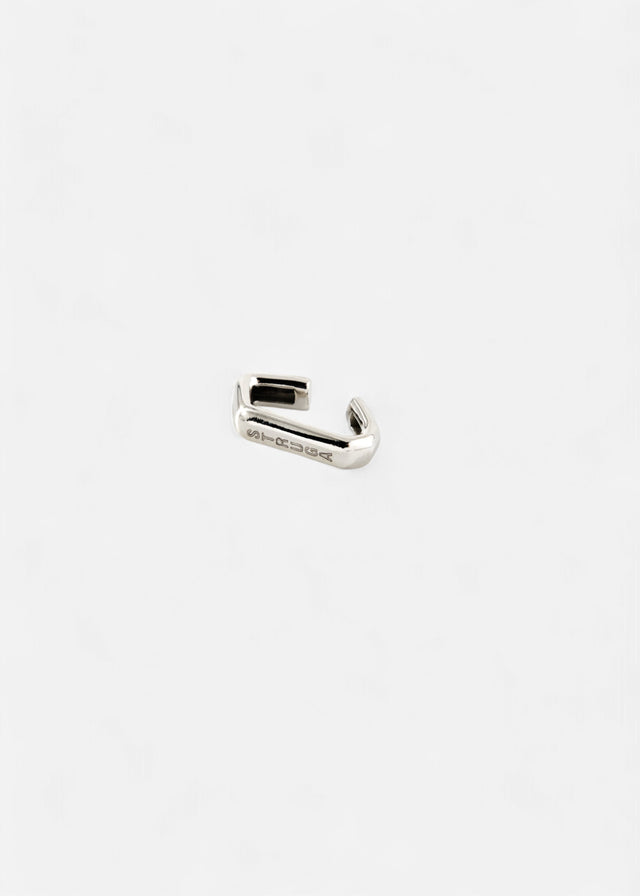
Size here is the thickness of the rim of your ear, not a number on the piece. Pinch the upper-middle edge between thumb and forefinger: a moderate edge — M, a thick edge — L; M exists only in BRUTALISM, every other form is made in L. The last half-millimetre is set by hand at the gap. A cuff that fits survives a head shake and stops being felt within a minute.
Updated September 29, 2026
The grid is M and L, and it describes your ear: an average edge or a thick one. M exists only in BRUTALISM; every other form is made in L.
The sizes are also amounts of metal. In the catalogue an M holds 1.6–2.61 g of 925 silver, an L 2.6–7.5 g; the Blade Ear Cuff (L) is 3.8 g at $160.
Fit is finished at the gap, with fingers, half a millimetre at a time. Solid silver takes that again and again; a plated or hollow cuff cracks there.
Men's and women's ears differ by about four millimetres in length in one measured series — the rim, not the label, decides the size.
Choosing without trying on is the hard part of buying jewellery for the upper ear, and it is where most returns start. This guide is about one thing: getting the size right, and fixing it when it is not. If you want the mechanics of wearing one — where it sits, which ear, how to put it on — that is the guide to wearing ear cuffs; the map of forms is the Atlas chapter. The pieces themselves are in the ear cuff collection.
What size ear cuff do you need — M or L?
STRUGA cuffs come in two sizes, and the size refers to your ear, not to the jewellery. M is for an average edge, L for a thick edge or for anyone who prefers a looser hold. Only BRUTALISM is made in both; BLADE, SIGNATURE ASYMMETRIC, THORN and the carbon cuffs come in L. The grid is set out on the ear cuff size guide; with a thin edge, write to us before ordering — every cuff is fitted to your measurements before it ships.
The two sizes are also two quantities of metal, which listings rarely state. Size therefore changes two things at once: how much ear the band wraps, and how much you feel on it by evening.
| Size | Your ear | Weight | Price |
|---|---|---|---|
| M | Average edge | 1.6–2.61 g silver | $125 |
| L | Thick edge, or a looser hold | 2.6–7.5 g silver | $160–$250 |
| Carbon | One variant per form | 0.3 g, no silver | $95 |
By form, from the catalogue as it stands today:
| Form | M | L |
|---|---|---|
| Blade | — | 3.8 g · $160 |
| Signature Asymmetric | — | 3.8 g · $160 |
| Brutalism V.1 | 2.61 g · $125 | about 7.5 g · $250 |
| Thorn | — | 2.6 g · $160 |
| Blade Carbon | 0.3 g · $95, carbon without silver | |
Brutalism V.2 (L, about 7.5 g, $250) and V.3 (M dark treatment 1.6 g at $125, L about 7.5 g at $250) follow the same grid. Every piece is made to order in about two weeks.
What part of the ear is a cuff actually gripping?
The metal is not holding the firm plate inside your ear — it is holding a rolled rim. At the helix that plate curls back on itself under skin on both sides, and the curl is what sits inside the gap.
The distinction matters because the numbers look wrong otherwise. Measured by 20 MHz ultrasound on 47 normal ears, that elastic layer averages about 0.6 mm, with the skin over it about 0.8 mm (Danter et al., 1996); at the tragus, sampled during ear surgery, it runs about 1.1–1.2 mm in adults. Nobody could hold jewellery on 0.6 mm of tissue. The rim you pinch between two fingers is several times thicker than the plate inside it, and it is the only measurement a cuff responds to.
It also explains why position changes fit. The rim is shallow at the top of the ear, fullest through the upper-middle stretch, shallow again as it turns back. One cuff can be loose at the crown and firm twenty millimetres lower, on the same ear, the same day.
How do you measure your own ear in about a minute?
You do not need a caliper. You need your own fingers and about a minute.
| What to check | How | What it decides |
|---|---|---|
| Edge thickness | Pinch the upper-middle rim between thumb and forefinger | M or L |
| Usable stretch | Run a finger down the rim until the curl flattens out | Where the cuff sits, and whether two will fit |
| Curve | Hold a pen cap against the rim and see if it follows the line | Which shapes lie flat rather than standing off |
Precision is not the point, and there is no reason to chase it. Thickness sorts you into one of two sizes, and the last half millimetre is set by hand afterwards, in thirty seconds, at the gap.
Do men and women need different sizes?
Less often than the market assumes. Adult ears do differ by sex, but the gap is smaller than most sizing advice implies, and it sits in the wrong dimension.
In a series of 208 adults from North India, ear length averaged 62.1 mm in men against 58.0 mm in women, width 33.1 mm against 30.1 mm (Nigam et al., 2019) — about four millimetres of length and three of width. Thickness barely moves: tragal plate taken during surgery measured 1.23 mm in men and 1.09 mm in women (Khan and Parab, 2015). That is the tragus, not the helix, but it is the only place the plate has been compared by sex, and the difference is a seventh of a millimetre.
A longer ear gives more rim to place a cuff along; a wider one changes which shapes lie flat. Neither reliably changes the size you order. Pinch the edge, take the size it gives you, and ignore the label: every STRUGA cuff also sits in the men's collection, because the grid is one and the edge decides.
How do you know a cuff fits — the sixty-second test
Run four checks before deciding a size is wrong. Together they take about a minute.
- Sliding on. The cuff should meet slight resistance as it engages and never need force. No resistance at all means the gap is wide.
- Tapping. Tap the ear lightly with a fingertip. A cuff that slides from a tap is too loose.
- Thirty seconds still. Wear it without moving. You should feel metal, not pressure.
- Walking and talking. Walk a few steps, speak out loud, shake your head gently. It should not move.
Pass all four and the size is right. Fail one and the fix is half a millimetre, not a different size — usually one or two adjustments settle it.
How do you adjust a cuff that is too loose or too tight?
The adjustment happens off the ear, between thumb and forefinger, at the gap.
Closing a loose cuff
Hold it with the gap facing you and press both sides inward together, moving them about half a millimetre. Try it on. Repeat.
Opening a tight one
Hold it the same way and spread the gap by the same half millimetre.
Four rules for both
- Half a millimetre at a time. Bigger steps overshoot, and repeated overshooting is what tires metal.
- Work the gap, not the body. Bending the body distorts the curve the cuff was built to follow.
- Fingers, not pliers. Steel jaws mark soft silver and put the force in one point; fingers spread it along the gap.
- Stop when you forget it. If you can still feel a cuff after a few minutes, go back half a millimetre.
Solid 925 silver takes dozens of these adjustments. A plated or hollow cuff does not — it cracks at the gap, which is why an adjustable cuff and a plated cuff are not the same object. The silver cuffs from STRUGA are alloy the whole way through, with no plating over the top, so they stay adjustable for as long as you own them. Carbon cuffs are a different material: write to us before trying to reshape one.
Why does a cuff slip in heat, rain or at the gym?
Three causes, and none of them mean the size was wrong:
- Sweat. The grip depends on friction against skin, and sweat removes it. Closing the gap another half millimetre for the season restores the hold.
- Warmth. The ear is one of the body's radiators: its skin carries shunt vessels that open to dump heat, and blood flow through them rises sharply when you are warm (Midttun and Sejrsen, 1996). Warm, damp skin holds metal less firmly than cool, dry skin, so a cuff already at the loose end of its range loses its margin first.
- Hair. Long hair moving past a cuff drags it, slowly. Wearing it in the upper-middle stretch rather than at the crown takes it out of the path.
What is going wrong — a symptom-by-symptom table
| What you notice | What it means | What to do |
|---|---|---|
| Slides off within an hour | Gap wider than the rim | Close it 0.5 mm, retest |
| Presses within thirty minutes | Gap narrower than the rim | Spread it 0.5 mm, retest |
| Holds at first, slips by evening | Warmth and sweat, not size | Seasonal fit — another 0.5 mm closed |
| Fine on one ear, not the other | Ears differ; this is normal | Adjust each cuff to its own ear |
| Stands away from the ear | Shape against curve, not size | Move it lower, or choose a flatter form |
| Loose again after months of wear | Silver relaxing with wear — normal | Close the gap before the next wear |
Can you sleep, shower or swim in an ear cuff?
Take it off for sleep and for the pool; a shower does it no harm. The reasons are mechanical and chemical, not rules for their own sake.
At night the pillow presses the cuff into the rim for hours. That is where soreness comes from, and a cuff pushed sideways in sleep is how a gap gets bent out of shape without anyone touching it. Taking it off takes two seconds; refitting a distorted gap takes longer.
Water itself does nothing to solid silver. Chlorine and sulphur do: pool water and hot springs darken 925 fast and attack the surface. After the sea, rinse the cuff in fresh water and dry it. The care guide for oxidized silver covers cleaning in detail.
When is a made-to-measure cuff worth it?
For most people it is not, and it is fairer to say so: a catalogue size plus one adjustment gets to the same place, sooner.
Three cases are genuinely different:
- An edge well outside the ordinary range, in either direction — no standard gap can be persuaded to hold without reshaping the piece.
- A form with its design element at the gap — opening it would distort the object rather than fit it.
- A cuff bought as a gift, where the ear cannot be measured at all.
In each case, write to us with what you measured before ordering. Everything is made to order, so a specified size costs no extra time — but know the trade-off: a piece made to an individual specification is final sale, while a catalogue size can be exchanged once within fourteen days of delivery, unworn, not reshaped and in its packaging, after we confirm the exchange (refund policy). For a gift, the form decides more than the size: BLADE, SIGNATURE ASYMMETRIC, THORN and the carbon cuffs are made in one size, L.
How long does an ear cuff last, and can adjusting wear it out?
Practically, as long as you keep it. Solid silver does not corrode through, and there is no plating to wear off — the surface darkens instead, which is the finish doing what it was chosen for. That is the Living Silver idea; the patina guide covers it properly.
Adjusting does not consume the piece either. Bending happens at one place, so the gap is where fatigue would show — after hundreds of adjustments across years, not dozens across a season. The commoner problem is the opposite: soft silver relaxes with wear, and a cuff worn daily needs closing back up now and then. Same thirty seconds.
Why should a new cuff start slightly tight?
Because a tight cuff is a thirty-second fix and a loose one is a lost cuff. Three reasons, all of them practical.
Spreading a gap takes two fingers; closing one evenly asks for a steadier hand. A piece that is right in a cool room goes loose in a hot one, so tight at rest is right in August. And most people drift, over a few weeks, to a spot slightly thinner than where they first put the cuff — a firm fit follows them there, a borderline one falls off.
So if a new cuff presses, do not send it back yet: open the gap half a millimetre with your fingers, run the sixty-second test again, and only then decide whether the size is wrong. If it still is, write to us and we will sort it out.
Related guides
- Ear cuff size guide — the M/L grid.
- How to wear an ear cuff — placement and mechanics.
- Atlas: ear cuffs — the map of forms.
- Ear cuff collection.
- What 925 silver is.
Two forms to start from: the Signature Asymmetric Ear Cuff (L), 3.8 g at $160, and the Brutalism Ear Cuff V.1 (L), about 7.5 g at $250. Both belong to CODEX, the world of milled planes and clean edges, where the BLADE family lives too.
About STRUGA. STRUGA is a dark silver jewelry brand founded by Dmitry Strugovshchikov and Ekaterina Strugovshchikova, handmade in Bali by master silversmiths. Most pieces are 925 sterling silver left uncoated, so they darken with wear; part of the range is darkened in advance, at the bench. The darkening is part of the design.
Frequently asked questions
Didn’t find the answer — write to us, we reply personally.
Ask a question →01What size ear cuff do I need — M or L?+–
Pinch the outer edge of your ear where the cuff will sit. A moderate edge means M; a thick edge, or a preference for a looser hold, means L. M exists only in BRUTALISM: BLADE, SIGNATURE ASYMMETRIC, THORN and the carbon cuffs are made in L, and the last half-millimetre is set by hand at the gap.
02How do ear cuffs stay on?+–
By pressure. The band is shaped slightly narrower than the edge of the ear, so it spreads as it goes on and settles back against the rim. Nothing pierces, nothing sticks, nothing clamps.
03Do men and women need different ear cuff sizes?+–
Usually not. In one series of 208 adults, ear length averaged 62.1 mm in men and 58.0 mm in women, while the plate inside the ear differed by about a seventh of a millimetre. The thickness of the rim decides the size, not the category label.
04How thick is the part of the ear a cuff grips?+–
Thicker than the plate inside it. The elastic plate of the outer ear averages about 0.6 mm by ultrasound, but the helix is a rolled rim — that plate curled back on itself under skin on both sides — so what the metal holds is several times thicker.
05How do I make my ear cuff fit better?+–
Adjust the gap off the ear, with thumb and forefinger, half a millimetre at a time. Squeeze if it slips, spread if it presses. Use fingers, not pliers: steel jaws mark soft silver.
06Can an ear cuff be too tight?+–
Yes. If it presses within half an hour of putting it on, the gap is too narrow. Spread it by about half a millimetre and wear it again — a cuff that fits is one you stop noticing.
07Can an ear cuff be too loose?+–
Yes. If it shifts when you tap the ear, the gap is too wide. Squeeze it closed by half a millimetre at a time until it holds through walking and talking.
08Why does my ear cuff slip in hot weather or at the gym?+–
Sweat removes the friction the grip depends on, and in heat more blood flows through the skin of the ear, which stays warm and damp. Closing the gap another half millimetre for the season restores the hold.
09Can I sleep or swim in an ear cuff?+–
Better not. A pillow presses the cuff into the rim for hours and can push the gap out of shape, and pool chlorine darkens and attacks silver. A shower does no harm; after the sea, rinse the cuff in fresh water.
10Will adjusting a sterling silver cuff break it?+–
No, not with finger pressure at the gap. Solid 925 is alloy the whole way through. A plated or hollow cuff is the one that cracks when bent, which is why plating and adjustability do not mix.
11How much does an ear cuff cost, and how long does it take?+–
STRUGA silver cuffs run $125 in size M and $160–$250 in L; carbon cuffs are $95. Each one is made to order: silver in about two weeks, carbon in about four.
12Is an ear cuff the same as a piercing?+–
No. A cuff holds the outer edge of the ear by pressure and comes off at the end of the day. Nothing goes through the ear, and nothing is left behind when you take it off.
13Is a tight cuff the same as a wrong size?+–
No. Spreading a gap by half a millimetre takes thirty seconds, so a slightly tight cuff is the right start. Adjust first, run the sixty-second test, and only then decide the size is wrong.