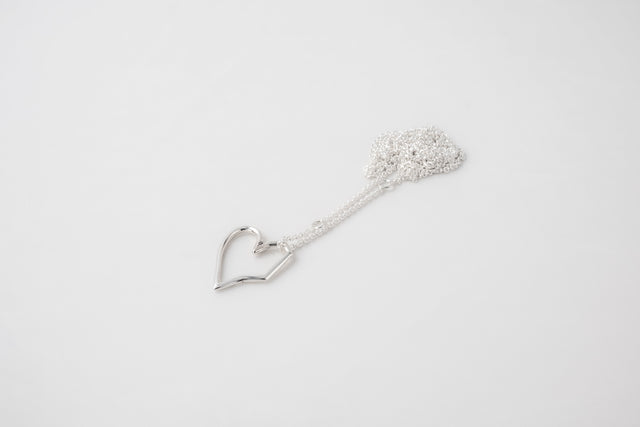
Earring Types: How Studs, Hoops and Ear Cuffs Fit
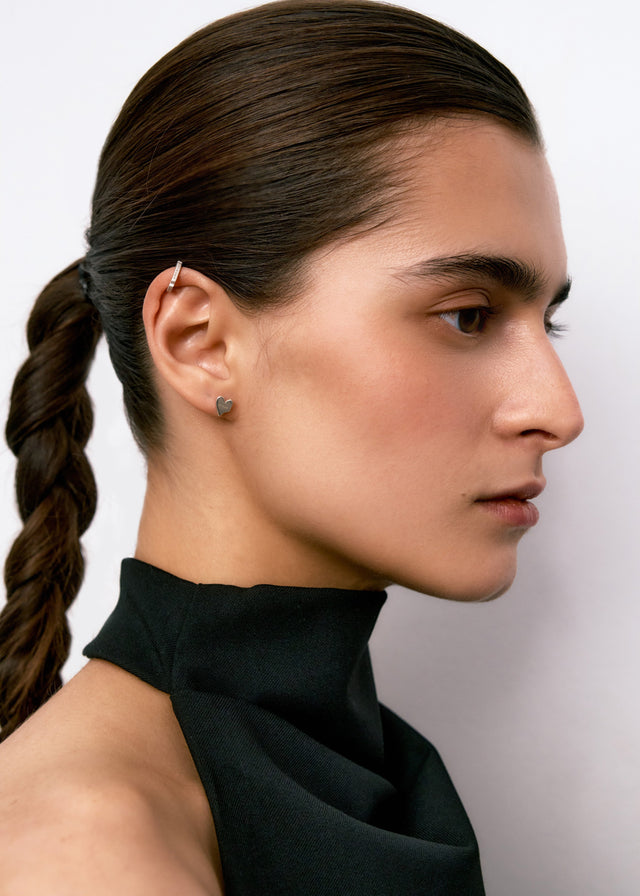
A stud uses a post through a piercing, a hoop outlines the lobe, and a non-piercing ear cuff wraps around the ear's edge. The attachment is the useful starting point: it determines where the shape sits, what you see from the front and side, and what might touch it during the day. This guide compares seven familiar earring types, then works through fit, proportion and combinations.
After choosing the attachment and fit, use the silver earring silhouette guide to compare outlines. It lists huggies as a close-fitting kind of hoop and separates drops from moving dangles. Here, seven groups organise the initial choice by attachment and position.
Choose the attachment first: a stud or conventional hoop uses a piercing, while a non-piercing cuff fits around the ear’s rim. Then compare the outline and the space it needs beside glasses, headphones and clothing. A drop adds a line below the lobe, a climber follows the ear upward, and a jacket adds a detail behind a stud.
Updated October 23, 2026
Two different attachments to compare are the Signature Heart stud and the Brutalism V.3 Dark Treatment ear cuff (M). The stud weighs 1.6 g and the cuff 2.3 g in the catalogue checked on 23 October 2026. One sits through the lobe and the other around the ear's rim; try each construction to compare its fit.
What are the types of earrings — the seven core types and what each does
Earring names describe different things. Stud refers to an attachment, drop to the position of an ornament, and hoop to a shape. They can overlap: a pendant may hang from a stud or a small hoop. The seven types below are a useful map for choosing, rather than an exhaustive classification that every catalogue follows.
| Type | Construction | Piercing | What to check when trying it on |
|---|---|---|---|
| Stud | A front ornament on a post, fastened behind the lobe | Usually required | Post length, backing and how the front sits |
| Hoop | A band around the lobe, with several possible closures | Usually required; clip versions exist | Inside diameter, thickness and closure |
| Drop or dangle | An ornament below the attachment; movement depends on its joints | Usually required; clip versions exist | Length, weight and contact with hair or clothing |
| Ear cuff | A shape wrapped around the ear's rim | None for a non-piercing model | Position, opening and any pressure |
| Climber | An ornament extending upward from a lobe piercing | Required for the usual construction | Direction and the fit of the support behind the lobe |
| Threader | A fine chain passing through a piercing, hanging on both sides | Required | Thickness of the part passing through, length and retention |
| Ear jacket | An extra ornament behind the lobe on a stud's post | Required | Compatibility and the ornament's position below the lobe |
Studs — a shape close to the lobe
A stud joins its front ornament to a post. A backing holds it behind the lobe; the backing and post length affect the space available for the ear. A small stud can be a useful starting point for someone with a healed piercing, but the name does not promise low weight. Large sculptural studs exist too.
Look at the ear from the side. The front should not tip forward, and the backing should not press into the lobe. Try your usual glasses or headphones as well: a small front ornament tells you little about the room its fastening needs behind the ear.
Hoops — the band and the space inside it
A hoop surrounds the lobe with a band. Small hoops that fit close to it are often called huggies. Two hoops with the same outside diameter can leave different amounts of space inside if the metal has a different thickness. Both dimensions matter to fit.
A circle is only one option: the outline may be oval, elongated or open in appearance. Compare it on the ear rather than choosing by a diameter alone. The fastening should close as intended for that model; forcing it shut cannot make up for the wrong fit.
Drops and dangles — length below the lobe
A pendant sits below the attachment. Some designs remain fairly still, while others swing on their joints. Catalogues often distinguish these as drops and dangles, although the terms are not used consistently. Looking at the connection is more useful than relying on the name.
Turn your head and put on the clothing you intend to wear with the earring. A pendant may meet a high collar or catch in your hair. A short drop need not be reserved for an evening, and a long one need not be heavy: those are properties of the particular piece.
Ear cuffs — an attachment around the rim
A non-piercing ear cuff stays in place through its shape and contact with the ear. Its position follows the design and your ear: some sit higher, others lower along the rim. Some hybrid earrings called cuffs also have a post; the attachment photograph shows which construction you are choosing.
A cuff should not need a week of discomfort before it feels right. If it presses or slips, check the model, size and position rather than squeezing the metal harder without instructions. Our ear cuff guide explains the constructions; the fit and sizing guide takes the next step. This comparison helps you choose an earring type. Adjustment starts with a particular model.
For a STRUGA silver cuff, adjust the gap off the ear, between thumb and forefinger, in half-millimetre steps. Set the fit once rather than bending it back and forth. Carbon cuffs are not bent. Contact STRUGA before adjusting if you are unsure: an altered cuff is not eligible for exchange or return. You can also send it to us for fitting. The ear cuff size guide helps you compare the models.
What is the difference between climbers, threaders and ear jackets?
These three types use a lobe piercing in different ways. A climber extends the ornament upward, a threader leaves chain on both sides, and a jacket adds a piece behind the lobe. Any can be your first earring: there is no required order in which to build a collection.
Climbers: a line along the ear
A climber extends upward from a lobe piercing. Compare its curve with your ear and check which side it is made for. The backing and support belong to the particular construction, so try the front and back together rather than judging only the front ornament.
Threaders: chain on both sides
A threader's chain passes through the piercing. Moving it relative to the lobe often changes the visible length on each side; check whether the model allows that adjustment and has a stop or other means of retention. Look behind the ear as well. The rear section contributes to the outline and can touch clothing.
Ear jackets: an ornament behind the lobe
A jacket fits onto a stud's post behind the lobe, before the backing is fastened. Its ornament usually shows below or beside the lobe. It may come as a complete earring set. When combining separate parts, check the post length and the position of the jacket's opening: try the assembled parts together to check their fit.
Which earring type suits which face shape?
Face shape can give you a starting point when trying to change the apparent proportions around your face. It helps compare two pieces; it need not rule out either one. Hair, the scale of the ornament and viewing distance also affect what you see.
For a round face, compare a vertical pendant with a circular hoop: one adds a downward line, while the other repeats the curve. For a longer face, try a fuller stud or hoop if you want more width beside the lobe. An oval face does not require a separate diameter limit.
With an angular jaw, compare a rounded band and a geometric stud to see how a curve or an edge sits beside it. With a broad forehead and narrower chin, you might try a pendant that widens toward its lower end. Repeating your face's lines is also a choice if you want to emphasise them. A front and profile photograph is more useful than treating these suggestions as fixed rules.
Which earring type suits which occasion?
Start with what will be next to your ear during the day. At a desk that may mean a headset, glasses and a high collar; in the evening, your hair and neckline may matter more. Check contact, movement and the fastening in each case. There is no universal office diameter or compulsory evening length.
For photographs, look at the earring from the distance at which the picture will be taken. A small stud may become difficult to distinguish in a full-length image, while a hoop or pendant remains visible. Close up, the surface of a cuff and the way a jacket sits against the lobe become easier to see.
Sleep, exercise and a new piercing
Choose earrings for sleep or exercise by their shape, fastening and the activity. Remove a non-piercing cuff before bed and activities where an impact or snag is possible. For a healed piercing, consider the shape, fastening and rules of the activity; small size alone does not rule out pressure.
A new piercing needs a separate fitting by a piercer. The Association of Professional Piercers advises avoiding pressure and trauma, and having a qualified piercer make any jewellery changes during the recovery period. Do not remove initial jewellery at night or replace it with a silver stud on the strength of a styling guide.
How do you layer different earring types on one ear?
Two pieces make a useful starting point: a stud or small hoop in the lobe, with a cuff above it. You can see the space each one needs. Check that they do not collide when you move your head before adding another.
Using one metal tone makes it easier to compare outlines; mixing silver and gold is also a choice if you like the result. Different widths create contrast, but there is no compulsory gap between cuffs. Enough space depends on their shapes and your ear. The earrings section of the Atlas maps the forms, while the ear cuff section focuses on constructions without a piercing.
Which type of earring should you buy first?
If you do not have a piercing and do not want one, start by trying a non-piercing cuff or clip earring. With a healed piercing, compare a stud and small hoop if you want a shape close to the lobe. Look at a climber for a line along the ear, or a drop or threader for length beneath it. A jacket adds an ornament around a stud you have already chosen.
Two STRUGA designs let you compare weight and attachment together:
| Piece | Listed weight | Difference when trying it on |
|---|---|---|
| Signature Heart Stud Earring | 1.6 g per earring | A post passes through the lobe piercing |
| Brutalism Ear Cuff V.3 Dark Treatment (M) | 2.3 g | A non-piercing cuff fitted around the ear's rim |
Two other constructions to compare are the Blade ear cuff (L) and Signature Asymmetric ear cuff (L). Compare each model’s dimensions and shape: its size letter belongs to that design. For online advice, send the model name and photographs of your ear through the STRUGA contact page.
The STRUGA approach — shape, surface and fit
For compact geometry beside the stud and cuff, compare the Thorn Earring with the Blade Mini Link Earring. The first places an angular silver element on the lobe; the second scales the BLADE link into a mono earring. Use their close-up photographs to compare outline and scale.
In STRUGA's silver range, the difference between a stud and a cuff can be examined through particular forms. SIGNATURE HEART combines a smooth half with an angular half of the heart; BRUTALISM uses relief and geometric edges. BLADE and SIGNATURE ASYMMETRIC offer different outlines. Consider shape and attachment together: if you like a piece in a photograph, the next step is to check how it sits on your ear.
Uncoated 925 silver changes with wear; an intentionally oxidized model starts with a dark surface. Choose care for the particular finish: our oxidized silver care guide explains how to keep the dark recesses. Compare the range through the silver earrings and ear cuff pages, then explore the ear cuff collection.
STRUGA was founded by Dmitry and Ekaterina Strugovshchikov. For the international market, STRUGA objects are made in Bali. If you are choosing silver earrings while on the island, check the current places to try STRUGA in Bali and ask about the particular model before visiting. Made-to-order production has a general guide of 2–4 weeks, often sooner; this is a range, not a promised date. Delivery time is confirmed separately.
Explore other catalogue sections: AMULET brings together pieces with stones; THORN is a separate family; CODEX is a world of everyday architectural forms.
Frequently asked questions
Didn’t find the answer — write to us, we reply personally.
Ask a question →01Is an ear cuff the same as a hoop?+–
No. A hoop usually passes through a lobe piercing and surrounds the lobe with a band. A non-piercing ear cuff wraps around the ear's rim. Hybrid designs exist, so check the attachment of the particular model.
02Is a stud the same as an ear jacket?+–
No. A stud has a front ornament, a post and a fastening behind the lobe. A jacket is an additional piece on that post behind the lobe, showing below or beside it. It may come with a stud; separate parts need a compatibility check.
03Is a climber the same as a drop?+–
No. A climber usually extends upward from a piercing along the ear. A drop sits below its attachment. Movement depends on the joints, rather than on the type name alone.
04Does an ear cuff need a piercing like other earrings?+–
A non-piercing cuff does not. However, cuff is also used for hybrid earrings with a post. Check the description and a photograph of the attachment; hoops and other earring shapes may also have clip versions.
05What are the main different earring types?+–
This guide covers seven familiar types: studs, hoops, drops, ear cuffs, climbers, threaders and ear jackets. They are not an exhaustive list: names describe attachments, shapes or the position of an ornament, and can overlap.
06Are ear cuffs better than hoops?+–
The choice depends on your piercing and the fit you want. A non-piercing cuff can sit around the rim; a conventional hoop passes through the lobe. Compare the particular constructions, clearance and fastening. There is no need to buy both types.
07Which earring type suits a round face best?+–
If you want to add a vertical line, try a drop or threader and compare it with a hoop. This is a styling suggestion, not a rule against circular shapes. Hair and the size of the ornament also change the effect.
08Which earring type suits an oval or long face?+–
For a longer face, start with a stud or hoop if you want more width beside the lobe. An oval face does not impose a diameter limit. Compare front and profile views and choose the effect you prefer.
09Can you mix different earring types on the same ear?+–
Yes. Start with two pieces, such as a lobe stud and a cuff above it, and check that they do not touch as you move. One metal tone makes shapes easier to compare; mixing metals is also a choice. There is no universal gap between cuffs.