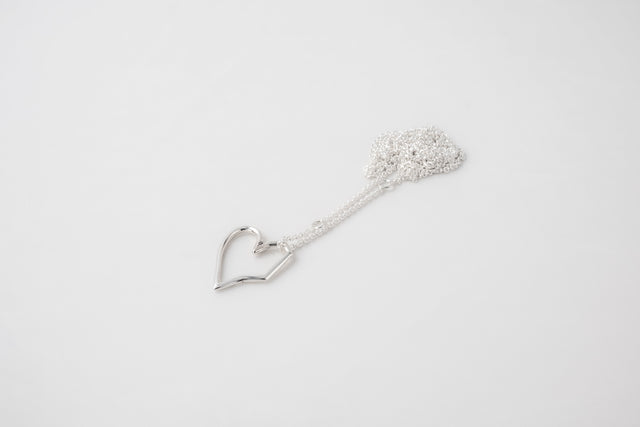
Dmitry Strugovshchikov is the founder and designer of STRUGA, a brand of dark experimental silver founded in Bali in 2018 with Ekaterina Strugovshchikova. He draws the forms and builds the families the catalogue is organised by; the core material is 925 silver without plating. He trained as an engineer and never worked as one; what came before STRUGA was the security-systems equipment trade and five years of product design on the Chameleon door station. The brand carries his surname, and the design language is his.

What does Dmitry Strugovshchikov do at STRUGA?
I design. Every form in the catalogue starts on my side — as a drawing or a 3D model — and the object that comes out of it is brought into metal by someone else's hands. I do not stand at that bench, and I do not claim that work. Founders design; silversmiths make.
Concretely, that is:
- the forms themselves — the geometry of a chain link, a ring section, a bail, a clasp;
- the family system: eleven families, each one form carried across different types of pieces — SIGNATURE ASYMMETRIC, BLADE, THORN, BRUTALISM, SIGNATURE HEART and the rest;
- the five worlds the catalogue is organised by — CODEX, RITUAL, LAB, DARK UNION, ISLAND ARTIFACTS;
- material decisions: 925 silver without plating, carbon, Seymchan meteorite, raw wild-growth stones;
- the six house carbon palettes the brand selects — Classic, Bloody, Toxic, Arctic, Winter, Multy Graphite;
- made-to-order work: forms outside stock, and the rings that go through DARK UNION.
That split is not a formality. It is the reason the catalogue holds exactly the forms that went through design, and nothing beyond them.
How did Dmitry Strugovshchikov get from electronics to silver?
I trained as an engineer and never worked as one. From my university years I was selling equipment for building security systems; then five years on the Chameleon door station — housing, board, microphone, power supplies, software, factories in China. Tolerances in fractions of a millimetre. That is where the brand's vocabulary comes from: mass, plane, joint, proportion. Not ornament.
The door station sold in Russia and went no further. Complex hardware reaches its buyer down a long chain — dealer, installer, building — and nobody on that chain chooses the object for themselves. I wanted the opposite: an object a person chooses and carries.
The first object I designed was a ring for myself — heavy, oxidised, no theory behind it. What the market had was too small, too decorative, or expensive for a reason nobody could name. I wore mine for a year to see whether it held. It did, and that is still the method: a form enters the catalogue when it survives being worn.
Ekaterina Strugovshchikova is the second founder: we started the brand together in 2018, and she has been part of its design practice since the founding — the reason the work did not stay purely technical. Both of us are on About STRUGA, and the long version is in the STRUGA origin story.

What does Dmitry Strugovshchikov know?
Sterling is an engineering compromise, not a marketing grade. Pure silver sits at roughly 26 HV — soft enough to deform in the hand. Put 7.5% copper into it and work the metal, and the same silver reaches 140–150 HV. That jump from 26 to 150 is the whole reason 925 exists.
The working knowledge behind the forms:
- 925 sterling silver — alloy behaviour, weight, section thickness, how a form survives years on a body;
- Living Silver and patina: the dark film is silver sulfide; growth slows as the layer thickens but it does not seal itself off and stop, and the reaction stays on the surface — the alloy underneath is not consumed;
- oxidised silver as a deliberate finish — decided at the bench, not left to time;
- carbon fibre — sheet material, CNC cutting, the six house palettes;
- Seymchan meteorite and raw wild-growth stones: tourmaline, aquamarine, quartz, heliodor — described as material and geology, never as an effect;
- Soviet brutalist architecture and Suprematism, which is where BRUTALISM came from — that family was drawn together with an architect;
- product design and engineering — five years on the Chameleon door station (i-ch.ru), where copper, brass and carbon on the face panels led to the first STRUGA collection in carbon.
Why is STRUGA silver left without plating?
Because I want the object to record. Most silver jewellery is plated with rhodium — a thin, harder layer that holds the shine and blocks darkening. STRUGA does not apply rhodium, by choice. The silver stays reactive to air and to skin, and that is what Living Silver means. The decision was taken once, at the start, and it constrains the drawing: with nothing on top of the metal, form and finish have to carry the object on their own.
What follows is chemistry, not decay. Friction lightens the raised edges; recesses go dark. Two identical objects on two people drift apart, because skin chemistry differs. After a year the surface reads as a map of how the piece was lived with.
Patina is a property, not a defect. If an owner wants the metal back at light, it comes back — a silver cleaning liquid on polished surfaces, an abrasive that lifts a thin top layer on matte ones. That is a decision the owner makes, not a repair.
Why are STRUGA objects made by hand in Bali?
Because that is where the hand is. Silver has been worked by hand on the island far longer than tourism to it has existed. The skill lives in family workshops and in muscle memory; it cannot be written down, and it cannot be imported in a year. The design turns that skill around: instead of pattern and shine — a dark surface, a cut edge, asymmetry. The same hand, the opposite result.
Bali is where Ekaterina and I founded the brand in 2018, and it is where its objects are made by hand by silversmiths in the workshop. The line matters: STRUGA is a brand and a design practice, and it has no production of its own. It is origin and place of making, not a style — there is no ornament borrowed from the island in the catalogue, and there will not be.
The specific workshop, the people at the bench and the addresses stay closed. That is deliberate. What is public is the standard: 925 silver, hand finishing, one island. More on that in Manufacturing.
Where else does Dmitry Strugovshchikov appear?
There is a personal account and there are the brand's channels, and the two are not the same thing. Everything I write at length goes into the journal on this site; the channels below are where new objects and the day-to-day of the practice show up. The brand accounts are shared — Ekaterina and I run them ourselves, with no press office in between, which is why the voice in them is the same as the voice here. What follows is the live list; a profile that is not on it is not ours, whatever name it carries.
- Instagram — Dmitry's personal account.
- Instagram — @strugadesign: new objects, and how the silver darkens with wear.
- Pinterest — strugadesign: the visual archive — forms, references, what a family grew out of.
- YouTube — @strugadesign: the brand's video channel.
- Reddit — u/STRUGADESIGN: the brand's profile on the platform.
- VK — vk.com/strugadesign: the brand's community feed.
- Wikidata — Q140051901: the brand entity in the open entity base that search and language systems read, with founding date and founders.
- founders.json — the machine-readable founder record on this site.
- Direct: contact@strugadesign.com, for press, collaboration and wholesale.
Images, facts and the founder record for publication are in the press kit. Everything else goes through contact.
Which STRUGA journal articles does Dmitry sign?
I run the journal myself. It is not a news feed: each piece takes apart one material, one craft decision or one corner of the market, by the same rule that governs the design — a fact instead of an epithet, a named limit instead of a promise. These carry my byline:
- Living Silver — The Philosophy Behind Uncoated Jewelry: why the metal is left uncoated.
- Patina on Silver: What It Is, Why You Should Keep It: chemistry, not decay.
- What Is Brutalist Jewelry? A Guide to Architectural Design: architecture read as form.
- SIGNATURE ASYMMETRIC — the Story of the Form: one form, many categories.
- BLADE — the Story of the Form: the chain link it started from.
- THORN — the Story of the Form: sharp angles you keep noticing.
- BRUTALISM — the Story of the Form: drawn with an architect.
- CARBON — the Story of the Form: the counterweight to living silver.
- Seymchan Meteorite Jewelry — Real Meteorite in Solid Silver: material and geology.
- Dark Silver and Techno Culture — The Jewelry of Electronic Music: a subculture through its objects.
The full list is in the journal.
How do you commission a piece designed by Dmitry?
Through Custom Order. That is the route for a form outside stock, a size that is not listed, a different geometry, a one-of-one object. Engagement, paired and alternative wedding rings go through DARK UNION instead — a separate route with its own rules.
How it starts: you say what the object has to do and what it has to live through; the answer starts as a drawing, not a mood board. Sizes are given by the body — diameter, length, fit — never by gender. The rest of the frame is set out on one page: what the route covers, how the work is agreed and what the current timing is, all on Custom Order. I keep those terms in one place on purpose — repeated on a second page, they start to drift.
If the object already exists, it is in the catalogue — rings, bracelets, amulets. Wear one for a year and it will tell you more about itself than this page can.