Dark Silver and Techno Culture — The Jewelry of Electronic Music
The dark layer on silver is not decay. It is silver sulphide, and it is self-limiting: the film seals the metal underneath and then stops. Passivation, not corrosion. That single piece of chemistry is why dark silver survived thirty years of dance floors while everything shinier gave up. Dark silver in techno culture is not gothic costume and not a trend cycle — it is industrial visual language worn on the body, speaking the same vocabulary as the music: concrete, raw metal, machined surface.
Updated September 24, 2026
- Dark silver reads as techno because it speaks the same industrial language as the rooms techno was built in. Polished gold reads from another genre on the same floor.
- Weight does the work. In the STRUGA catalogue the objects that carry this register run from a 1.6 g ear cuff to an 85 g links bracelet; the rings sit at 4.7–9.6 g.
- Two different things get called dark. Living Silver is a property — 925 silver left without rhodium plating darkens on its own in wear. Black oxidation is a technique — the surface was darkened at the bench beforehand.
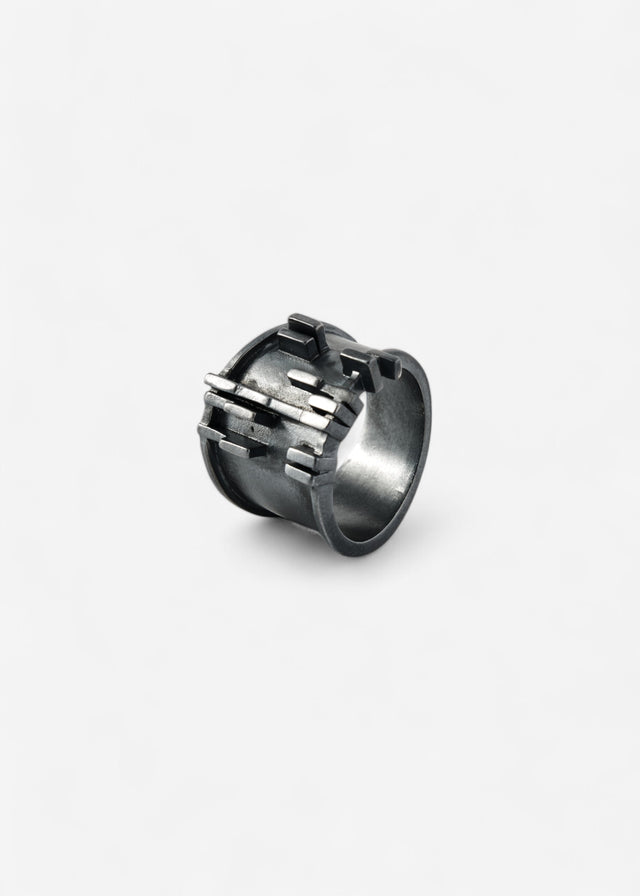
- Seventeen objects in the catalogue are darkened at the bench, but only one of them belongs to the techno register: Ring Brutalism V.3, the single blackened object of the architectural CODEX world. The other sixteen sit in the RITUAL world — thirteen amulet earrings with tourmalines, two necklaces and Cuff M Brutalism V.3. The whole blackened range is the Blackened Silver collection; the rest arrives bright and darkens on the wearer.
- Pure silver is too soft to live: around 26 HV, dentable by hand. The 7.5% copper in sterling takes it to roughly 140–150 HV after working. That is the number behind every claim in this article.
Why did dark silver become the techno aesthetic?
Techno came out of Detroit in the mid-1980s and found its permanent architecture in Berlin after 1989 — power stations, bunkers, disused factories. The rooms were concrete and steel. The visual code that grew inside them borrowed from the buildings, not from fashion, and jewellery followed the same logic. Oxidised silver holds the surface of machined metal. Polished gold holds the surface of a shop window, and across a dark room that difference is legible before anything else is.
Three things fixed the pairing in place, and only one of them is about looks.
- Anti-gloss positioning. Early techno refused the display language of the jewellery counter. Heavy dark silver carries weight without borrowing that language: the metal has presence, the framing does not.
- Freedom from gendered convention. Dark silver sits the same on any wearer. STRUGA does not split objects by gender either — sizes run by body, by form, weight and fit.
- Practicality, the underestimated one. A dance floor is a physical environment. Pure silver is soft, around 26 HV, and dents under a thumbnail; the 7.5% copper in sterling takes it to roughly 140–150 HV once worked. That is the margin a night out actually spends.
What does club wear actually do to silver?
The chemistry: sweat speeds up a process that protects the metal
Silver does not rust — it has nothing to rust with. It darkens from traces of sulphur, in the air and on skin, and sweat carries both sulphur and salt. A night out therefore speeds up a process that would take months anyway. On an unplated object this is not damage: the sulphide film builds, seals, and stops. The metal underneath is armoured rather than eaten.
Plating behaves in the opposite direction. A plated surface sits on top of a cheaper metal and wears through unevenly at the contact points — knuckles, clasp edges, the underside of a link. That result reads as worn out, because it is.
The physics: contact matters more than chemistry
Bar edges, door handles, other people. Thin or highly polished objects show every one of those hits. Heavier silver takes the contact into its own surface, and the marks join the patina rather than standing against it. The real failure point is not the metal at all — it is the closure.
- Closures. Toggle clasps and screw fittings hold through movement; spring rings work loose and are the single most common way an object is lost on a floor.
- Water and chemicals. Take objects off for swimming, chlorine and solvents. That is the whole of the care instruction — there is no step two.
- Patina. It is reversible in both directions: a cleaning liquid returns bright metal, and on a matte surface an abrasive lifts the top layer and sets a new finish with it.
Is it oxidised silver or Living Silver, and does the difference matter?
Both give a dark surface. They are not the same thing, and the difference shows up a year later. Oxidation is a technique applied at the bench: the object is darkened deliberately, before anyone wears it, and it arrives already black. Living Silver is STRUGA's term for 925 silver left without rhodium plating — a property of the material, not a step in the work. Most silver jewellery is rhodium-plated to hold its shine and block darkening. STRUGA leaves it off.
They age in opposite directions. A bench-darkened surface starts uniform and rubs back to brightness on the high points, so contrast grows outward. Unplated silver starts bright and darkens into the recesses, so contrast grows inward — friction lightens the raised edges while the hollows fill with graphite. Neither is more correct. Mixing the two directions on one wrist is what makes a stack look unresolved.
In the catalogue the distinction is recorded rather than implied: objects darkened at the bench are marked as blackened, and the rest is unplated 925 silver that will do the work itself. For the dance floor the practical consequence is this: an object darkened at the bench looks the same on the first night and on the hundredth, while an unplated one runs bright for the first months and goes dark on its owner — provided it is worn rather than kept in a drawer.
What to wear to a warehouse night: which objects read on a dark floor?
Low light removes detail long before it removes mass. That is the whole brief. One object large enough to hold its shape at four metres beats four that dissolve into the wrist. The weights below come from the STRUGA catalogue rather than from a general guideline, and they show the working range more usefully than any adjective.
| Object | Weight | Form and surface |
|---|---|---|
| Blade Big Links bracelet | 85 g | links bracelet, unplated silver |
| Big Thorn Bracelet | 45 g | rigid cuff, silver + carbon |
| Necklace Asymmetric Destroyed | 40 g | necklace, blackened |
| Thorn chain | 11 g | chain, unplated silver |
| Ring Brutalism V.3 | 9.6 g | ring, blackened |
| Cuff M Brutalism V.3 | 1.6 g | ear cuff, blackened |
A single heavy bracelet on the dominant wrist is the most reliable place to start: it moves when you move and catches whatever light there is. A ring is second — visible while holding a drink, gesturing, working a mixer. On the ear, a single cuff reads better than a matched pair; asymmetry is the point. What does not work: fine stacks, layered thin chains, ornamental gothic, and brightly polished silver at any weight.
Which brands sit inside the techno jewellery aesthetic?
The register is narrow and the names in it repeat, which is unusual for anything adjacent to fashion. Three studios come up alongside STRUGA, and the differences between them are real enough to be worth stating precisely.
- Werkstatt:München — founded in Munich in 1996 by Klaus Lohmeyer, a trained gold and silversmith. Objects are forged, hammered and oxidised by hand in the Munich workshop. Oxidation there is named as method, not as a finish label.
- Parts of Four — founded in 2011 by Evan Sugerman, designed and made in Bali. The shared geography with STRUGA is coincidence, not house style: Parts of Four works conceptually, in unusual materials and scale.
- Henson — founded in Australia in 2014, made in limited runs in Sydney from reclaimed silver, stones and gold. Organic forms rather than architectural ones, which places it beside this aesthetic rather than inside it.
- STRUGA — architectural silver, made to order. BLADE is a CNC aesthetic in silver, grown out of a single chain link. THORN is the thorn: sharp angles, CNC and 3D-modelling together. BRUTALISM is architecture in silver, and its rings are the heaviest in the brand. All three sit in CODEX, the brand's everyday architectural language.
Mass-market silver, most of it plated, does not enter the register at any price. Neither the surface nor the weight holds up.
How do you build a techno wardrobe around one silver object?
Five steps, in order. The first one is the only one that costs anything.
- Start with one heavy anchor and live with it a month. An anchor tells you what scale your hands and wrists actually carry, and the answer differs by person. Most people who begin with a stack end up wearing one object out of it.
- Hold one direction of surface. All bench-darkened, or all unplated and ageing. Mixing the two reads as an accident unless it is calibrated on purpose.
- Wear the objects consistently. Unplated silver that lives in a drawer stays bright and never joins the wardrobe. The wardrobe ages; the metal is supposed to age with it.
- Polish selectively, if at all. Ten minutes of aggressive polishing removes a year of accumulated contrast. Work the high points only, and leave the recesses alone.
- Let stones read as material, not ornament. Raw tourmaline, aquamarine and unpolished quartz sit inside this aesthetic. Faceted gems in conventional settings fight it, because a faceted stone is cut to throw light in a room built to absorb it.
Carbon works for the opposite reason: matte, ultralight, unchanged by time — the counterweight to a metal that keeps moving. One material records the wearing, the other refuses to.
Where to look next
- Dark Fashion Jewelry — carbon and blackened silver in one place.
- Blackened Silver — the objects darkened at the bench.
- Brutalist Bracelets — the heavy end of the wrist.
- Atlas: dark fashion — where this aesthetic sits among the rest.
About STRUGA. STRUGA is a brand of dark experimental silver founded in 2018 by Dmitry Strugovshchikov and Ekaterina Strugovshchikova. The founders are behind the design and the brand; the objects are handmade in Bali by master silversmiths. Most of the line is 925 sterling silver, and part of it is carbon — the counterweight to silver, since carbon does not change with time. Silver left without rhodium plating darkens on its own in wear, and that is Living Silver. Where a surface is darkened at the bench instead, it is black oxidation, and the catalogue marks those objects. Making time for silver is about two weeks.
Frequently asked questions
Didn’t find the answer — write to us, we reply personally.
Ask a question →01Is dark silver the same as gothic jewellery?+–
No. Gothic leans on ornament and symbolism; dark silver in the techno register works the other way — form reduced to the essential, industrial texture, nothing decorative. The darkness is a decision about visual language, not a costume reference.
02Is Living Silver the same as oxidation?+–
No. Oxidation is a technique: the surface is darkened at the bench before the object reaches anyone. Living Silver is STRUGA's term for 925 silver without rhodium plating — it darkens on its own through wear, in the places the object is touched. The two age in opposite directions.
03Is dark silver just plated metal?+–
No. The objects in this aesthetic are 925 sterling silver with no plating — either darkened at the bench or left to darken in wear. Plating is the opposite approach: a layer over a cheaper metal that wears through unevenly at the contact points.
04Is heavy dark silver impractical for clubs?+–
It is the opposite. Lightweight, brittle or plated pieces are what struggle in dance environments. Heavier silver bracelets, single ear cuffs and architectural rings handle movement, sweat and accidental contact better, and the marks they collect join the patina instead of standing against it.
05Will heavy silver hold up to club wear?+–
Yes. Sterling is worked copper-alloyed silver, hard enough for daily contact and easier to repair than gold or platinum if it ever needs it. Take objects off for swimming, chlorine and solvents; nightlife is exactly the use case they are built for.
06Should I go bigger or smaller for visibility?+–
Bigger. Low light removes detail before it removes mass, so a single object that holds its shape at four metres does the work. Several small pieces disappear entirely in dim venue lighting, however well they are made.
07Does the silver need refinishing?+–
Only if you want it. Unplated objects deepen in patina with wear, and patina is reversible: a silver cleaning liquid takes the surface back to bright, and on a matte finish an abrasive removes the top layer and sets a new one. STRUGA also offers refinishing as part of lifetime service.
08Can I wear dark silver in non-techno contexts?+–
Yes. The same objects work across dark contemporary dress — architectural fashion, professional dark wardrobes, daily minimal looks. A heavy dark ring reads as design in daylight and as a nightlife signal in a venue. The object does not change; the context does.
09What about stones?+–
Raw stones — tourmaline, aquamarine, unpolished quartz — work because they read as material rather than ornament. Faceted gems in conventional settings fight the aesthetic: a faceted stone is cut to throw light in a room designed to absorb it.
10Does the brand matter?+–
For design language, yes. STRUGA, Werkstatt:München and Parts of Four sit inside the register by construction rather than by marketing. Mass-market silver, most of it plated, does not, because neither the surface nor the weight holds up.
11Is this aesthetic only for night wearers?+–
No. The same objects work in daylight, they simply register differently. Heavy dark rings and bracelets read as architectural objects by day and as a nightlife signal in a venue. The association with techno is one cultural fit, not the only one.
Continue from the journal to a current STRUGA object: Ring Brutalism V.3 — 9.6 g of 925 silver, darkened at the bench, black from the first day.