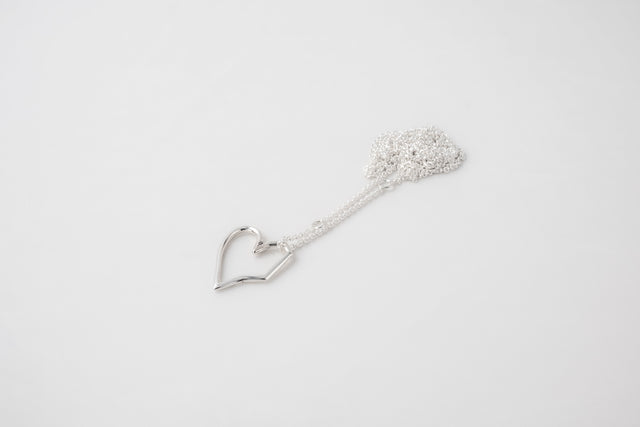
BLADE — the Story of the Form
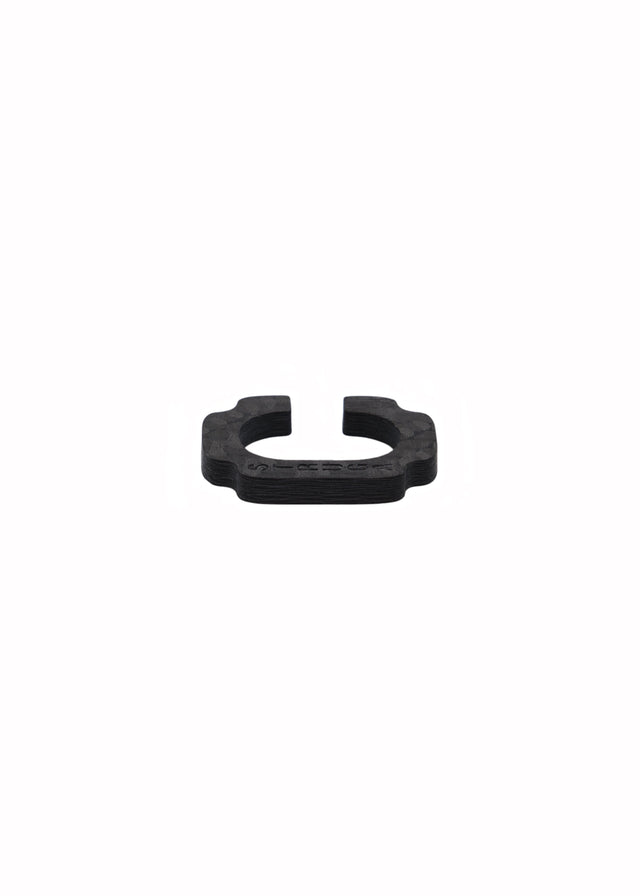
BLADE is not a manufacturing method but an aesthetic — a CNC look in silver. It is the second form of the brand, and it began with a single chain link: two halves on copper pins, soldered into one whole, with even planes that read as if cut from sheet material. When STRUGA says BLADE, it means that look, not the way the metal is worked.
In short.
- BLADE is the second form of STRUGA — a CNC aesthetic in silver, the look rather than the method.
- It began with one chain link: two halves on copper pins, soldered into one whole.
- The form comes in two sizes — Mini Links and Big Links — both closing with a massive Carabiner #2 Big.
- One form across many pieces: bracelets, chains, chokers, the Blade Pin, an earring and an ear cuff.
- 20 pieces carry the form today: 7 earrings, 5 ear cuffs, 5 bracelets, 2 necklaces and 1 choker; 17 of the 20 are pure 925 silver, 3 carry carbon.
- BLADE lives in the CODEX world in pure, uncoated 925 silver that oxidizes as it meets the outside world.
- Living Silver is STRUGA's term for 925 silver without rhodium plating; patina is the natural pattern of oxidation — a map of wear, not a flaw.
Updated August 29, 2026
The second form of the brand. BLADE began with a chain link.
The link is made in a CNC aesthetic: even planes, as if cut from sheet material. In BLADE we mean exactly that aesthetic — the look, not the method. The link itself is assembled from two halves on copper pins and soldered into one whole.
For STRUGA, BLADE is a CNC aesthetic in silver.
BLADE lives in the CODEX world — the everyday architectural form, the DNA of the brand. CODEX is not an observation of the world but a workshop of forms: here STRUGA creates a form that did not exist before and carries it across different types of pieces — from a chain link to a pendant, from a carabiner to an earring. CODEX is minimalism: simple lines, simple yet recognizable forms; contemporary experimental minimalism. No stones, no inserts — only pure, uncoated silver that oxidizes as it meets the outside world. You look at a CODEX object and you see the brand at once.
How was the BLADE form born?
The story of BLADE is short and precise, like the form itself. First came the link: two halves, copper pins, soldered into one whole. From these links, joined into a chain, grew the brand's first massive bracelet.
The family inherited three things from that first link, and they hold across all 20 pieces:
| What is inherited | What it is | Where it shows today |
|---|---|---|
| Two halves on copper pins | how the link is assembled and soldered into one whole | in every link across three sizes |
| Even planes | the CNC look — as if cut from sheet material | in 5 ear cuffs, 7 earrings, the pins |
| Carabiner #2 Big | the massive clasp that carries the SIGNATURE Asymmetric form | in 5 bracelets, the choker and 2 necklaces |
Then the form moved across the body. Today there are many BLADE links: Mini Links and Big Links — one form in two sizes. Mini go into women's bracelets, chains and chokers; Big into large men's bracelets and massive chokers. Both always close with a massive Carabiner #2 Big. Thinner, lighter versions have appeared too — for bracelets with a toggle clasp.
The same form also travelled beyond the chain:
- the Blade Pin — 3 earrings and a necklace;
- the BLADE earring and ear cuff — the link taken off the chain and put on the ear;
- the BearRabbit body — it repeats the BLADE link.
One of the early points of the story sits here as well: the first two ear cuffs of the brand were made in the BLADE form and in the SIGNATURE ASYMMETRIC form.
How do Mini Links differ from Big Links?
Mini Links and Big Links are one form in two sizes, not two different links. The difference is read on the body rather than on the drawing: the mini link builds a light line, the big one gives weight and volume.
Mini Links — the light line
Mini links are carried by four pieces of the family: the Blade Mini Links and Mini Links V.2 bracelets, the Blade Mini Links V.1 choker and the Blade Mini Link earring. This is the most frequent version of the form — it sits on the wrist and at the throat with the same calm.
Big Links — weight and volume
The big link is held today by a single bracelet, Blade Big Links. Between the two sizes stands a middle version: the Blade Medium Links V.2 bracelet, thinner than the big one and more present than the mini. Thinner, lighter links go into bracelets with a toggle clasp.
| Size | Where it lives today | How it reads |
|---|---|---|
| Mini Links | two bracelets, a choker, an earring | a light everyday line |
| Medium Links | one bracelet, V.2 | the middle between weight and lightness |
| Big Links | one bracelet | weight and volume, a large fit |
What does the BLADE family hold today?
The BLADE form lives in bracelets, chains, chokers, a pin, an earring and an ear cuff — across three places on the body:
- on the wrist — chain bracelets of big and mini links;
- at the throat — chains and chokers;
- on the ear — the earring and the cuff;
- and, as a line of its own, the Blade Pin.
For STRUGA the silver chain is a carrier, and the link on it changes:
- BLADE links — an even plane, three sizes;
- SIGNATURE ASYMMETRIC links — the asymmetric silhouette of the first form;
- pearl-link chains with the Heart Lock clasp — from the SIGNATURE HEART family.
The Carabiner #2 Big that closes BLADE chains itself carries the SIGNATURE Asymmetric form — the brand's first two forms meeting in one object.
How many pieces carry the BLADE form today?
As of August 2026 the BLADE form is carried by twenty pieces in the catalogue. Earrings take the largest share — seven; bracelets and ear cuffs hold five each; there is one choker and two necklaces.
| Type | Pieces | What sits there |
|---|---|---|
| Earrings | 7 | Blade Mini Link, Blade + BearRabbit, three pin earrings, Fused Mini Line Bloody, Classic Pin |
| Ear cuffs | 5 | sizes S, M, L in silver and two carbon ones |
| Bracelets | 5 | Big Links, Medium Links V.2, Mini Links and V.2, Blade Pins |
| Necklaces | 2 | Blade Link Small, Blade Pin Necklace |
| Chokers | 1 | Blade Mini Links V.1 |
The form spread across the body unevenly, and the numbers show it: the ear took it most readily — twelve pieces out of twenty are earrings and ear cuffs. Sizing for the wrist is a separate question, and the brand answers it in the bracelet sizing guide rather than here.
How does the BLADE form live on the body?
On the wrist, silver becomes architecture. A chain bracelet is a flexible bracelet of links with a clasp; STRUGA carries many of them — BLADE big and mini links, SIGNATURE ASYMMETRIC links and the THORN chain.
Around the neck, silver turns into architecture as well. A choker is a short necklace sitting close to the throat; STRUGA chokers read as a line of architecture, not as decoration.
How does the form sit on the ear?
The ear cuff is a self-sufficient form for a single accent or an asymmetric stack. STRUGA cuffs sit in the BLADE, SIGNATURE ASYMMETRIC, BRUTALISM, THORN and CARBON families. Two of the five BLADE cuffs are carbon ones: the Classic Graphite and the Arctic Graphite, cut on a CNC machine from sheet carbon in the brand's own palettes.
What does the surface do over time?
The even planes of BLADE are where the surface speaks. Living Silver is the STRUGA term for 925 silver without rhodium plating: the surface keeps living with the one who wears it — friction lightens the raised edges, the recesses darken. Patina is the natural pattern of oxidation — a map of how the object is worn. The beauty of this silver is in the traces of handwork: slight unevenness here is part of the object's beauty, not a flaw.
One form — from a chain link to a whole family of objects. View the BLADE family.
As of 2026, BLADE remains an aesthetic, not a manufacturing method: one CNC-look form in two sizes — Mini Links and Big Links — both closing with the Carabiner #2 Big, carried across bracelets, chains, chokers, the Blade Pin, an earring and an ear cuff. Seventeen of the twenty pieces in the family are pure, uncoated 925 silver — Living Silver that darkens in the recesses and lightens on the raised edges as it is worn; the remaining three carry carbon.
How does BLADE differ from the other CODEX families?
The CODEX world holds five families, and BLADE is the second of them both by number and by the order in which the forms appeared. SIGNATURE ASYMMETRIC came first and is the widest — thirty-one pieces; BLADE follows with twenty; SIGNATURE HEART holds nine, THORN and BRUTALISM seven each.
| Family | Pieces | What the form does |
|---|---|---|
| SIGNATURE ASYMMETRIC | 31 | the first form — an asymmetric silhouette, sharp edges, even planes, recesses |
| BLADE | 20 | the second form — an even plane, a CNC look, a link that becomes a chain |
| SIGNATURE HEART | 9 | the fifth form — a heart half smooth and half angular |
| THORN | 7 | the third form — a thorn, CNC joined with 3D modelling |
| BRUTALISM | 7 | the fourth form — architecture in silver, the heaviest pieces of the brand |
The difference between them is not the size of the collection but the task the form solves. BLADE is the only one of the five that started from a chain link, and that origin decides where it goes: a form built from repeating parts spreads across bracelets, chains and chokers more easily than a single-piece silhouette.
Frequently asked questions
Didn’t find the answer — write to us, we reply personally.
Ask a question →01Is BLADE a cutting or CNC manufacturing process?+–
No. For STRUGA, BLADE is a CNC aesthetic in silver — the look, not the method. The link is assembled from two halves on copper pins and soldered into one whole; BLADE names the even, sheet-cut planes, not the way the metal is made.
02Is Living Silver the same as a flaw or damage?+–
No. Living Silver is STRUGA's term for 925 silver without rhodium plating: the surface keeps living with the wearer — friction lightens the raised edges, the recesses darken. Patina is the natural pattern of oxidation, a map of how the object is worn — part of the object's beauty, not a flaw.
03Are Mini Links and Big Links two different forms?+–
No. They are one BLADE form in two sizes. Mini Links go into women's bracelets, chains and chokers; Big Links into large men's bracelets and massive chokers. Both always close with a massive Carabiner #2 Big.
04How many pieces are there in the BLADE family?+–
Twenty, as of August 2026. Seven earrings, five ear cuffs, five bracelets, two necklaces and one choker. Twelve of the twenty are worn on the ear, which makes BLADE the form the ear took most readily.
05Is every BLADE piece made of silver only?+–
No. Seventeen of the twenty pieces are pure, uncoated 925 silver; three carry carbon — two ear cuffs in the Classic Graphite and Arctic Graphite palettes, and the Blade Fused Mini Line Bloody earring, where carbon stands next to silver.
Continue from the journal to a current STRUGA object: Blade Link Small Necklace.