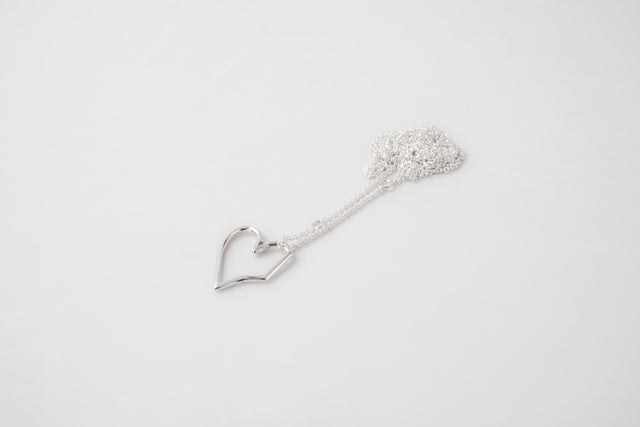
THORN — the Story of the Form
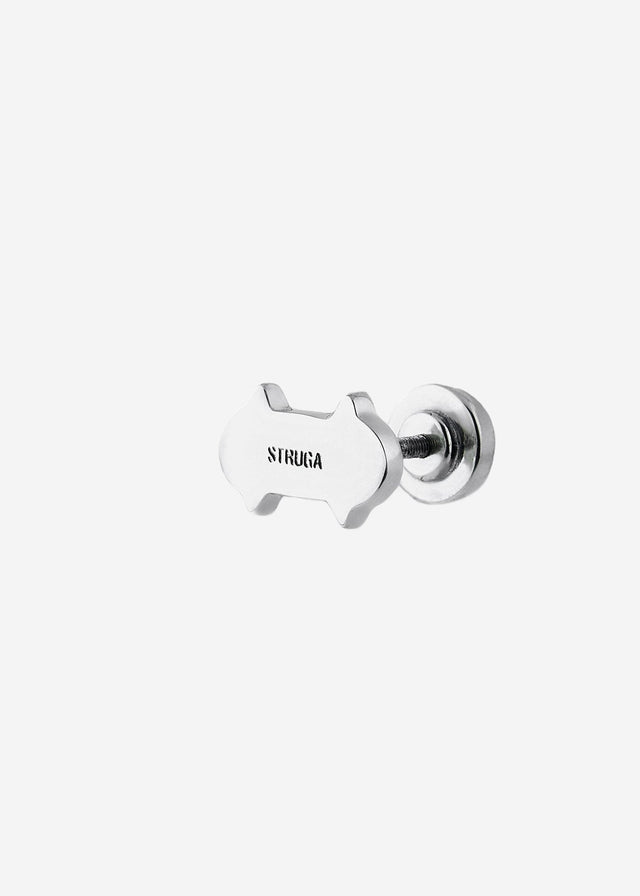
THORN is STRUGA’s third form: a thorn with sharp angles, grown from one chain link. It spans a chain, two bracelets, a ring, two earrings and an ear cuff in 925 silver with no stones; the Big Thorn Bracelet adds carbon. The edges stay sharp on purpose, so THORN pricks the skin a little. It shares only sharpness with a crown of thorns: the crown is woven from branches; THORN is built from an angle.
Updated October 17, 2026
THORN began with a chain link whose edges pricked the skin — a constant, quiet reminder that it was being worn. The sharpness stayed, and it carried through seven pieces, from the light Thorn Earring to the heavy, rigid Big Thorn Bracelet.
What follows is why the form is properly a thorn rather than a prickle, and how one angle works on an earlobe and on a wrist alike. The short definition of the form is in the Atlas entry on THORN; every piece is in the THORN collection.
Where did the THORN form begin?
With a single chain link. Repeated many times over, that link became bracelets and chokers. The form was then reworked as a three-dimensional amulet, the Thorn Amulet, set with raw wild-growth stones. Simple THORN earrings followed, then the Big Thorn Bracelet, the brand’s first rigid bracelet, and the Thorn Ring.
The THORN link is elongated, with pointed projections: each edge runs on a slant and narrows to a point, and the silhouette reads as a thorn from across the room. Two aesthetics meet in it — CNC machining and 3D modeling. The exact cut plane comes from the machine; the volume and the growth of the point come from the 3D model. THORN belongs to the CODEX world, STRUGA’s everyday architectural language, where one form is carried through different pieces.
The thorn itself never changed; its scale and its place on the body did. In the bracelet the link repeats and moves with the wrist; the ring keeps half a link; the stud reduces the angle to one flat plate with four sharp points; Big Thorn drops the links altogether for a single rigid arc with no clasp.
Thorn or prickle — what exactly is THORN named after?
A thorn in the strict botanical sense. Botanists distinguish three structures that everyday speech lumps together. A true thorn is a modified shoot: it grows in the axil of a leaf, where a branch would normally form, and ends in a sharp, durable, woody point. The hawthorn is the familiar example. A spine is a modified leaf or part of one, as on a barberry. A rose, strictly speaking, has prickles — outgrowths of the plant’s skin tissue, with no vascular tissue inside (Ohio State University).
STRUGA describes THORN as “a thorn with sharp angles,” and the botany shows why the word fits: as a thorn grows out of the branch, the angle grows out of the link. In the first link the edge itself did the pricking; no spike was set onto smooth metal.
What do thorns mean on jewelry?
Thorns carry no single meaning on jewelry; it depends on the image they point to. Four come up again and again.
- The plant. A thorn is a defense: Ohio State University says such sharp structures are often a plant’s first line of defense against insects and browsing mammals (source). On jewelry, that reads as a boundary, and the thorn’s durable point as endurance.
- The rose. “There is no rose without a thorn,” says the proverb: to enjoy a pleasant thing, one must also accept hardship (source). Botanically a rose has prickles, so the proverb uses “thorn” in the everyday sense.
- Punk. Spikes and studs belong to punk dress, which took shape in the 1970s and set out to provoke (source).
- The Gospel image. “And when they had platted a crown of thorns, they put it upon his head” — Matthew 27:29 in the King James text; Mark 15:17 and John 19:2 tell the same story (text). Crown-of-thorns rings recreate that woven crown. The Gospels do not name the plant: the Greek word akantha means any thorny plant, and Thayer’s lexicon says the species is not clear (lexicon). Tradition names the jujube Ziziphus spina-christi, though that identification has long been disputed (study).
STRUGA’s own answer is about form, not about a story: “For STRUGA, THORN is the aesthetic of the thorn: a sharp angle that holds beauty.” The meaning lives in the person. The metal only carries it.
Is a thorn ring the same as a crown of thorns ring?
Not quite: a crown-of-thorns ring is one kind of thorn ring. It refers to the Gospel scene: like the crown the soldiers “platted,” it is a band of woven thorny branches. “Thorn ring” is the wider name for any ring built from thorn-like points, with that reference or without it, and some shops sell one ring under both names. The Thorn Ring makes no such reference. It is not woven. It is half of a THORN link cast in silver, with a rigid asymmetric silhouette, sharp faceted planes and no stone.
In form, the ring sits where two STRUGA families meet: the sharp angle comes from THORN, the heavy planes from BRUTALISM.
Size here is the inner diameter in millimeters, from 16 to 22, not a US ring size; the ring size guide shows how to measure yours. Each size carries more silver: 4.7 g in size 16 and 12.7 g in size 22. Anything outside that range goes through a custom order.
Which pieces make up the THORN family today?
A chain, two bracelets, a ring, two earrings and an ear cuff — all in 925 silver with no plating and no stone; the Big Thorn Bracelet adds carbon to the silver. They differ in scale and in how they sit on the body. Prices are from the catalog on the date this article was updated; for sized pieces, from the lowest price to the highest. Every piece in the family is made to order in two to four weeks, often faster.
| Piece | How it is worn | Weight | Price |
|---|---|---|---|
| Thorn Links Chain | At the neck, in four lengths: 40, 45, 50 and 75 cm — from a choker to a long chain | 11–18 g | $353–$564 |
| Thorn Bracelet | A chain of the same links on the wrist, 17 or 21 cm | 4.95–5.4 g | $199 |
| Big Thorn Bracelet | A rigid open arc, carbon on the inner face, 16–23 cm | 45–95 g | $1,279–$2,701 |
| Thorn Ring | On the finger, sizes 16–22 | 4.7–12.7 g | $181–$488 |
| Thorn Earring | A single earring for a pierced lobe | 2.5 g | $125 |
| Thorn Stud Earring | Flat against the lobe, on a screw back | 2.92 g | $122 |
| Thorn Ear Cuff (L) | On the upper ear, no piercing needed | 2.6 g | $160 |
The numbers show scale better than photographs do. The lightest piece is the earring at 2.5 g. The heaviest is the Big Thorn Bracelet: 95 g in the 23 cm size, almost forty times as much — though that figure is the assembled bracelet with its carbon, not the silver alone. Between them sit the ring, which gains silver with every size, and the chain, which grows heavier with length: 11 g at 40 cm, 18 g at 75 cm.
Which THORN piece should you start with?
Start with a place on the body, not with a name. Within the family, the choice comes down to where the angle will live and how much silver you want to feel.
- Ear — the lightest way into the form. On the Thorn Earring the angle keeps its full depth and stands away from the lobe; the stud presses the same angle flat, with almost no relief. If the ear is not pierced, there is the 2.6 g Thorn Ear Cuff (L): it sits on the upper edge of the ear, held by its own band.
- Wrist — two different objects here. The chain Thorn Bracelet weighs about five grams and moves with the hand. Big Thorn is a rigid open arc with no moving links and no clasp: from 45 to 95 g of silver and carbon, sized from 16 to 23 cm by wrist circumference. For the chain bracelet, 17 and 21 cm are the length of the bracelet itself; the bracelet size guide shows how to measure the wrist.
- Neck — the Thorn Links Chain. Choose the length by where you want it to sit; fit depends on neck size and neckline, so the surest guide is a chain of your own that already sits right.
- Finger — the Thorn Ring: half a link, and the one THORN piece that is also worn as a wedding band.
Who THORN is not for: anyone who wants smooth silver and does not want to feel the piece on the skin.
How does THORN silver change over time?
It darkens — by design. The 925 silver is left without rhodium plating, which is what STRUGA calls Living Silver. The dark layer is silver sulfide, formed when the metal reacts with sulfur-containing gases in the air, above all hydrogen sulfide; on 925 silver it also contains copper sulfide from the alloy. As the film thickens from ten to a hundred nanometers, its color moves from yellow through red-brown to blue; beyond about a hundred nanometers it is black (Canadian Conservation Institute).
On a thorn this reads more sharply than on a smooth piece. The raised edges are rubbed bright by wear, while the recesses between the points sink toward graphite, so the relief stands out more than on the day of purchase. On the Big Thorn Bracelet only the silver arc darkens; the carbon does not change.
Patina is a property, not a defect. If you want to brighten the silver, a soft cloth or a silver-cleaning solution is enough; ultrasonic cleaners and harsh chemicals are not needed. Don’t polish the ring all over: wipe only the raised planes, so the dark recesses keep the relief. On the Big Thorn Bracelet, clean the silver arc separately, without touching the carbon.
How is the THORN family different from the Thorn Amulet?
By the stone. THORN without a stone is the form itself, a family of the CODEX world. THORN with a raw wild-growth stone becomes an amulet: it repeats the form in volume but belongs to the AMULET family, which lives in RITUAL, the world of objects with personal symbolic weight. That is why none of the seven THORN pieces is an amulet, even though the amulet is the third step in the history of the form.
The Thorn Amulet’s shape resembles a torpedo cut in half, as if unearthed thousands of years from now, with a crystal grown inside; the brand calls it an homage to Daniel Arsham.
The two also live differently in the catalog: a THORN piece is made to order and can be made again for the next order, while an amulet is one of one — its stone does not repeat, and a sold amulet does not come back. The neighboring family is covered in the AMULET form story.
Why is the Thorn Ring also part of DARK UNION?
Because it is also worn as an alternative wedding band. DARK UNION is STRUGA’s name for custom wedding and paired rings, and also for a line of rings you can order straight from the catalog. The Thorn Ring opened that line and is still the only ring in it; the line is growing. Here a wedding ring is a sharp angle rather than a smooth band — not a ring from a tray, but an artifact you arrive at. It carries no plating and ages with whatever it lives through.
For paired rings made to your own measurements, or a form outside the catalog, there are two routes: Dark Union for wedding and paired rings, and a custom order for everything else.
How long does a THORN piece take, and how does it ship?
Two to four weeks to make, often faster. Every THORN piece is made by hand to order, so STRUGA quotes the full range rather than the shortest turnaround. For the international market, STRUGA pieces are made in Bali and shipped worldwide; shipping adds about a week. The delivery cost is calculated at checkout; the shipping policy sets out the terms. If a piece is needed by a certain date, say so when you order: STRUGA replies at once whether it can be made in time and puts that order first. These are estimates, not guaranteed dates.
Frequently asked questions
Didn’t find the answer — write to us, we reply personally.
Ask a question →01What is THORN by STRUGA?+–
The third form of the brand — a thorn with sharp angles, where CNC and 3D modeling meet; it pricks the skin a little. It is a family of the CODEX world: a chain, two bracelets, a ring, two earrings and an ear cuff in 925 silver with no plating and no stones; the Big Thorn Bracelet adds carbon. The form began as a single chain link.
02Is the Thorn Ring a crown of thorns?+–
No. A crown-of-thorns ring is a woven band of thorny branches, a reference to the Gospel scene. The Thorn Ring is half of a THORN link: a rigid asymmetric silhouette with sharp faceted planes, no weave and no stone. Its recesses darken over time while the edges stay bright.
03Does THORN jewelry prick?+–
A little. The edges are left sharp on purpose: the form pricks the skin and reminds you of itself as you wear it. Anyone looking for smooth silver should choose another form.
04How much do THORN pieces weigh?+–
From 2.5 g for the earring to 95 g for the Big Thorn Bracelet in the 23 cm size. The ring weighs 4.7–12.7 g depending on size, the chain 11–18 g by length, the chain bracelet about 5 g.
05How much does THORN jewelry cost?+–
From $122 for the stud to $2,701 for the Big Thorn Bracelet in the 23 cm size. The earring is $125, the ear cuff $160, the ring from $181 in size 16, the chain bracelet $199, the chain from $353 and the Big Thorn Bracelet from $1,279.
06How is THORN different from the Thorn Amulet?+–
By the stone. THORN is the form without a stone, a family of the CODEX world. The Thorn Amulet repeats the form in volume around a raw wild-growth stone and belongs to the AMULET family of the RITUAL world; every amulet is one of one.
07Why does THORN silver darken?+–
It is Living Silver — 925 silver without rhodium plating. Sulfur-containing gases in the air form a thin layer of silver sulfide on the surface. On a thorn the recesses darken while the raised edges, rubbed by wear, stay light. Patina is a property, not a defect.
08How long does a THORN piece take to make?+–
It is made to order in two to four weeks, often faster. Shipping adds about a week; the shipping policy sets out the delivery terms.
09What do thorns mean on jewelry?+–
Thorns have no single meaning on jewelry: they point to an image. Four come up again and again: the plant’s own defense, the rose of the proverb, the spikes of punk dress and the Gospel crown of thorns. For STRUGA, THORN is the aesthetic of the thorn: a sharp angle that holds beauty. The meaning lives in the person. The metal only carries it.
10What is the difference between a thorn and a prickle?+–
A thorn is a modified shoot, a spine is a modified leaf, and a prickle is an outgrowth of the plant’s skin tissue. A hawthorn has thorns, a barberry has spines, a rose has prickles. THORN is named after the thorn: its angle grows out of the link as a thorn grows out of the branch.