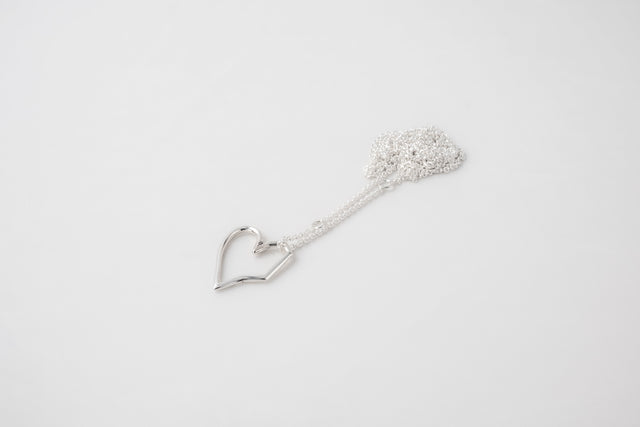
What Living Silver Is
Living Silver is sterling silver 925 left unplated, free to react with air and skin. The surface darkens in the recesses and lightens on the edges the hand passes over. It is not a defect and not wear: the silver keeps a record of how it is worn.
The dark film is silver sulfide (Ag₂S): it shields the metal beneath and slows the darkening, not corrosion cutting inward.
Silver starts to answer sulfur below one part per billion in the air — which is why no room is clean enough to stop it.
925 alloy: copper takes annealed silver from about 26 Vickers to about 75; forging carries it on to about 150.
Living Silver is a property (darkens on the hand over time); oxidizing is a technique (darkened at once, at the bench). Not the same.
Rhodium plating is 0.75 to 1 micron thick and wears through on a daily ring in 6 to 18 months; STRUGA lays on none.
Patina is reversible: a silver-cleaning solution on polished surfaces, a fine abrasive on matte.
Living Silver is the default surface of the CODEX, RITUAL and LAB worlds at STRUGA.
- What it is made of
- What time does
- Why STRUGA does not plate with rhodium
- What it is — and what it is not
- What it looks like on the objects
- Back to light
- Frequently asked
What it is made of
Silver does not rust. It has nothing to rust with — rust belongs to iron. What darkens on silver comes not from the air as such but from traces of sulfur, in the air and on the skin.
Pure silver is too soft for a ring. At .999 it dents under the fingers — twenty-six on the Vickers scale, softer than a copper coin. So 7.5% copper goes into it, and the hardening happens in two steps that are worth keeping apart. The copper alone takes the annealed alloy to about seventy-five Vickers. Forging it cold carries it on to about a hundred and fifty, close to six times the metal it started from (Ganoksin, Precious Metal Alloys). The alloy lets silver hold a form; the hammer lets it hold an edge.
The same copper makes silver responsive. A metal able to darken is a metal that reacts; and reaction is the condition for a surface that will live.
What time does
The dark film on silver is sulfide, Ag₂S. Silver draws sulfur from air and skin and pulls a thin layer over itself. It needs almost nothing to begin: silver answers hydrogen sulfide at concentrations below one part per billion, and humidity speeds the reaction (Corrosion Science, atmospheric corrosion of silver). No room is clean enough to stop it. As the layer thickens it slows the reaction more and more, but never seals it off completely: silver keeps reaching toward the sulfur, so the darkening creeps on, only slower year by year. This is not corrosion cutting into the metal — it is a surface that darkens while protecting what lies beneath.
On the object it reads as relief. Edges the hand touches wear back to light. Recesses the finger never reaches sink toward graphite. The range runs from straw through bronze, violet and graphite to near-black — depending on how long the silver has lived and whose skin has worn it. Two identical rings on two hands look different after a year, because the chemistry of skin is each person's own.
After a year a ring reads how a person lives by hand: where the fist clenches, where the palm stays open, right-handed or left. The inside is always lighter than the outside — the body polishes what no cloth and no eye can reach.
This is not care for an object. It is an object that keeps a record. How fast the record accumulates, and what slows it down, is a separate subject: why 925 silver tarnishes.
Why STRUGA does not plate with rhodium
Most silver jewelry carries a rhodium layer — hard, cold-bright, and thinner than it sounds. The working range is 0.75 to 1 micron, roughly a seventieth of a human hair. The layer is sacrificial: on a ring worn every day the wear shows through in six to eighteen months, and beneath it the same silver opens up, only now without the right to change by its own rules.
STRUGA lays on no rhodium. The decision looks strange right up to the moment you see what follows from it: an object that never changes is an object indifferent to who wears it. Refusing the coating is no lapse in finish — it is the condition for keeping a surface that holds a trace.
Three surfaces are sold under the same word, and they part ways in the first weeks of wear:
| Surface | How it starts | What time does to it | What upkeep means |
|---|---|---|---|
| Unplated 925 — Living Silver | Bright, bare metal | Darkens in the recesses, wears back to light on the edges | Nothing — unless the owner wants the light back |
| Rhodium-plated 925 | Cold white, uniform | Holds, then wears through in patches at 6–18 months of daily wear | Replating, or living with a two-tone surface |
| Oxidized 925 | Already dark, done at the bench | Rubs back to bright on the high points | Re-darkening, if the contrast is wanted back |
The first two compared in full, with the case for each in daily wear, is a separate reading: Living Silver vs rhodium plated.
What it is — and what it is not
Living Silver names a property of the material — that the silver lives and changes on its own. It should not be confused with oxidizing: that is a technique, where the silver is darkened at once, at the bench, by controlled chemistry. Living Silver comes to the owner bright and darkens on the hand; oxidized silver comes already dark. One metal, two different roads to black — the second one has its own section of the Atlas, oxidized silver, and its own care guide.
Patina here is a property, not a defect. Not wear, not damage, not a reason to doubt the metal. A slight unevenness, traces of the tool, an irregular surface — the character of handwork, not a flaw. And one more border, a hard one: STRUGA silver is endowed with no action upon the one who wears it. It darkens by chemistry, not by meaning; whatever the patina means, the owner decides.
What it looks like on the objects
The same surface reads differently depending on how much the hand touches it. That is easier to see across four STRUGA forms than on any single one — a ring is rubbed constantly, an ear cuff almost never. Weights are from the catalogue, silver 925 without plating — all 105 unplated objects are gathered here.
- Brutalism V.1 Ring — 9.6 to 24 grams depending on size. A ring takes more contact than anything else a person owns: within a year the facets are back to light and the deep cuts hold graphite. The strongest relief in the catalogue.
- Thorn Bracelet — 5 to 5.4 grams. On the wrist the contact is one-sided: the outer faces of the thorns keep lightening against the sleeve, the inner angles go dark and stay dark.
- Thorn Links Chain — 11 to 18 grams. A chain shows both states at once, link by link: the faces stay light, the joints between them are where the graphite collects.
- Brutalism Ear Cuff V.3 (L) — 3.8 grams. An ear cuff is hardly ever rubbed, so it darkens evenly and holds the patina longest — the clearest case of what silver does when the hand leaves it alone.
All four are silver 925 without plating, so all four start bright. Forms outside the stock are made through Custom Order.
Back to light
Living Silver is reversible. The patina is lifted and the look of fresh metal returns — the life of the object begins again. On polished silver this is done with a silver-cleaning solution; on matte silver, with a fine abrasive — Scotch-Brite or fine sandpaper — that lifts the top layer, sets a new matte, and takes the darkness with it.
This is not a repair. It is the same instrument in the owner's hands: whether to keep the record or reset it and start over is the owner's to decide. The gentler methods, and the ones that ruin a matte surface, are set out in cleaning silver without damaging the patina.
Sterling silver 925. Unplated. Darkens from air and skin. Reversible.
Living Silver at a glance
| Property | Value |
|---|---|
| Material | Sterling silver 925, left unplated |
| Copper in the alloy | 7.5% copper added to the silver |
| Hardness | About 26 Vickers pure and annealed, about 75 once alloyed, about 150 after forging |
| Surface | No rhodium plating — free to react with air and skin |
| Why it darkens | A thin film of silver sulfide (Ag₂S) drawn from sulfur in air and skin — below one part per billion is enough |
| Color range | From straw through bronze, violet and graphite to near-black |
| Relief on the object | Edges the hand touches wear back to light; recesses sink toward graphite |
| Property vs technique | A property that darkens on the hand over time — not oxidizing, darkened at once at the bench |
| Back to light | Reversible: a silver-cleaning solution on polished surfaces, a fine abrasive on matte |
| STRUGA worlds | The default surface of the CODEX, RITUAL and LAB worlds |
Frequently asked questions
Didn’t find the answer — write to us, we reply personally.
Ask a question →01Why does sterling silver turn black?+–
The dark film is silver sulfide. Silver draws traces of sulfur from air and skin and pulls a thin layer over itself. It is not corrosion eating into the metal — it shields what lies beneath and slows the darkening, though it never stops it completely.
02Does STRUGA silver tarnish, and is that a flaw?+–
It does, by design. Living Silver is 925 silver left unplated, free to react. Edges the hand touches wear back to light; the recesses sink toward graphite. Patina is a property, not a defect — a map of how the object is worn, never wear to apologize for.
03Can the patina be removed?+–
Yes. Living Silver is reversible. On polished surfaces a silver-cleaning solution returns the fresh metal; on matte surfaces a fine abrasive lifts the top layer, sets a new matte, and takes the darkness with it. Whether to keep the record or reset it is the owner's choice.
04Why doesn't STRUGA plate its silver with rhodium?+–
Most silver carries a thin rhodium layer that holds a cold shine and blocks darkening. STRUGA leaves the silver bare. An object that never changes is an object indifferent to who wears it; refusing the coating is the condition for keeping a surface that holds a trace.