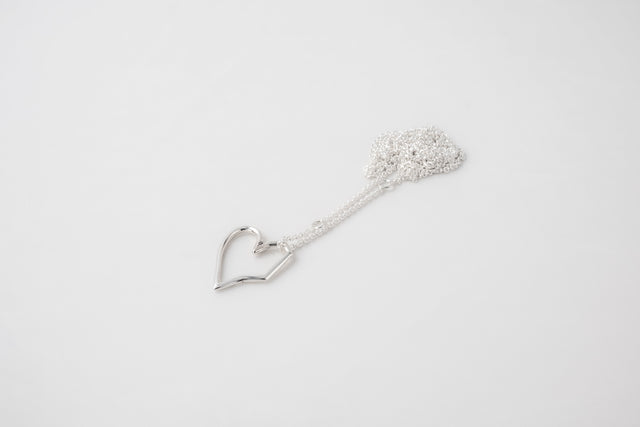
Oxidized Silver: What It Is, and How It Differs from Living Silver
Oxidized silver is 925 silver darkened on purpose, at the bench. The surface is set dark from the start — a chosen finish, not a trace of time. The metal underneath is unchanged: sterling is 92.5% silver and 7.5% other metals, usually copper, and oxidation reaches only the top few layers. What darkens it is sulphur, not oxygen: the black is silver sulphide. This is what separates oxidation from Living Silver, which arrives bright and darkens later, on the hand.
The black is silver sulphide, not an oxide: silver answers to sulphur, and mostly ignores oxygen. The name of the process is a historical inaccuracy that stuck.
The darkening does not stop: the sulphide film keeps thickening slowly — it does not seal itself off, it only slows down. The reaction stays on the surface, and the alloy beneath is not consumed.
Oxidation is the surface of the silver itself, not a coating: edges lighten with friction, recesses stay dark, and the relief reads sharper over time.
Living Silver is a property — 925 silver with no rhodium, arriving bright and darkening on the hand. Oxidation is a move: the same darkness, set in advance.
In the STRUGA catalogue weight is known for 130 of 134 active objects, from 0.3 g ear cuffs to a 95.2 g bracelet; the median object weighs 5 g.
At STRUGA, pre-oxidized objects enter one world only — RITUAL: cross pendants, objects set with meteorite, carbon.
- A move, not a defect
- Is oxidized silver real silver?
- Oxidation and Living Silver
- Oxidized, blackened, tarnished
- Does oxidized silver wear off?
- Can it be brought back?
- Caring for a dark surface
- A dark surface as language
- Across object types
- Where the dark surface is
- What it is — and what it is not
- At a glance
- Common questions
A move, not a defect
Silver darkens by two routes. One is time: uncoated silver takes sulphur from the air and from skin, and draws a dark film over itself — on its own, on the wearer's hand. The other is the maker's hand. The same reaction is started at once, at the bench, and carried to the depth the piece asks for.
That second route is what oxidation means. It is a decision, not an accident. The silver has not spoiled and has not been neglected — it was darkened on purpose, the way a weight or a finish is chosen.
The word itself is a little wrong, and the mistake is old enough to have stuck. Jewellers reach for liver of sulphur — a mix of potassium polysulphides — and what grows on the surface is silver sulphide, not an oxide. Silver answers to sulphur. Oxygen it mostly ignores.
That compound has a biography of its own. In 1833 Faraday noticed that silver sulphide loses electrical resistance as it heats — the opposite of every metal he knew. The black on a ring is not nothing. It is a substance science had to stop and look at.
Is oxidized silver real silver?
Yes. Oxidized silver is sterling 925 — 92.5% silver, 7.5% other metals, usually copper. Nothing is added on top and nothing is taken out. The composition of the metal before the bench and after it is the same.
What changes is a film a few molecules deep. Silver sulphide is a dense black solid, and it sits on the surface the way frost sits on glass: the same window, seen darker. It is not plating. There is no second metal involved and no layer that can lift.
Say it plainly, because "oxidized" reads to some buyers as "damaged", and to others as a coating over something cheaper. It is neither. A hallmark stays a hallmark. An oxidized 925 ring and a bright 925 ring are the same alloy at the same purity, carrying the same weight of silver — one of them simply had its surface decided in advance.
Oxidation and Living Silver
The market keeps folding these two ideas into one, and they describe different things. Living Silver is a property: 925 silver with no rhodium coating, left to live. STRUGA does not lay on rhodium by intent, so the metal answers to air and skin — it arrives bright and darkens over time on the person who wears it. Oxidation is a move: that same darkness is set at once, at the bench, and waits for nothing.
The short difference: Living Silver is what the silver does on its own; oxidation is what was done to the silver in advance. One is the behaviour of a surface over time, the other is the choice of a surface at the start. One metal, two routes to black — and the STRUGA concierge does not confuse them.
And one more difference: a property cannot be undone, a move can. Living Silver will darken again, always, because that is what uncoated silver does. An oxidized surface is something a bench gave, and a bench can give it back.
Oxidized, blackened, tarnished
Three words circle the same dark surface, and the trade uses them interchangeably. They are not the same thing.
Tarnish is what happens
Tarnish is the darkening silver gathers by itself, from sulphur compounds in the air. Growth slows as the layer thickens, but the common line that tarnish seals itself off and stops is not what the instruments show: in ordinary air the film builds 0.3 to 0.6 nanometre in a day and 6 nanometres or more in a month (Journal of Applied Physics, vol. 40, 1969). In practice that changes nothing alarming: the reaction stays on the surface, and the alloy beneath — 92.5% silver, 7.5% copper and other metals in sterling — is not consumed.
Oxidation and blackening are what someone did
Both name the deliberate version — the same reaction, started at the bench and stopped where the maker wants it. Strength decides colour. At full strength the surface goes to a matte gunmetal black; at lower concentrations it passes through blue, violet, yellow and red on the way there.
STRUGA names its own surface plainly: oxidized 925 silver, darkened by controlled oxidation at the bench.
Does oxidized silver wear off?
The honest answer is yes, unevenly — and that is the point of it.
Oxidation is a surface, not a coating laid over the metal, so there is no layer to peel. What happens instead is friction. Wherever a hand, a cuff or another finger keeps touching the piece, the raised planes lighten back toward bright silver. Wherever nothing touches — inside a recess, under a bevel, along the back of a link — the black stays.
Where it holds longest
Recessed detail holds darkness longest, because nothing rubs it. The order is predictable:
- Longest: earrings and pendants — an ear and a collarbone are quiet places.
- Middle: necklaces and chains — links rub each other, so outer faces lighten while inner faces stay dark.
- Fastest: rings and bracelets — a hand meets everything, and the inside of a band goes bright first.
What a year looks like
The relief reads sharper, not duller. Light catches the edges that use has polished, the depths stay closed, and the drawing of the piece comes forward. A worn oxidized object does not look worn out. It looks drawn.
Can it be brought back?
At any point, yes. The finish is restored at the bench, and the piece does not need remaking to get it — the surface is simply taken to depth again.
Going the other way is easier than owners expect, and this is where the damage usually happens. Silver sulphide resists most solvents but breaks down in strong acids, which is exactly how a commercial dip works. A dip cannot tell the difference between tarnish nobody wanted and a dark surface somebody chose. It strips both, in seconds, and the piece comes out flat and bright and wrong.
A polishing cloth does the same thing slower. It is built to abrade the top layer — the layer the whole drawing lives on.
Caring for a dark surface
The rule is short. No dip, no polish, no scrubbing.
- Wash: warm water, a drop of mild soap, a soft brush. This lifts skin oils and dust without touching the surface.
- Dry: properly, and store dry. Damp air is what feeds tarnish.
- Take off: before a shower, a pool or a workout — chlorine and sweat work faster than time does.
- Store: pieces apart, so they cannot scratch each other.
- Never: a commercial dip, a polishing cloth, an abrasive paste. All three strip the surface, not the dirt.
That is the whole rule for a dark surface. The full method — what actually lifts tarnish, what quietly destroys a finish, and how to tell the two apart — is set out at length in the oxidized silver care guide. This entry defines the surface; the guide handles it.
A dark surface as language
Silver darkened in advance enters one world at STRUGA — RITUAL. It is the only one of the brand's five worlds the oxidized objects step into: its language is the dark side, and a dark surface reads at home here. Cross pendants, objects set with meteorite, carbon — matter that black suits from the very start.
But the world does not reduce to it. RITUAL also holds clean uncoated, unoxidized silver — the same Living Silver that darkens by its own course. So one world holds both routes at once: silver darkened from the start, and silver that darkens on its own. A dark surface is part of the STRUGA vocabulary, not its only word.
Across object types
A dark surface behaves differently depending on where an object is worn and what it weighs. These are the real figures from the STRUGA catalogue: weight is known for 130 of 134 active objects, and the median object weighs 5 g.
| Object | In the catalogue | Weight | How the surface behaves |
|---|---|---|---|
| Earrings | 54 | 1.6–8 g | Least friction of any form — the surface stays as made for longest |
| Necklaces | 32 | 4–80 g | Links rub each other: outer faces lighten, inner faces stay dark |
| Ear cuffs | 16 | 0.3–3.8 g | The lightest objects in the brand; the pressure point lightens first |
| Bracelets | 14 | 2–95.2 g | Hardest wear after rings — a wrist meets tables, sleeves, keyboards |
| Rings | 9 | 2.1–11 g | Fastest to lighten; the inside of the band goes bright first |
| Chains | 4 | 11–80 g | The same behaviour as necklaces, over more surface |
Weight is not a warning here. It is a fact of the form: a 95 g bracelet and a 2 g stud are the same metal with the same surface, living different lives on the body.
Where the dark surface is, object by object
Pre-oxidized objects are gathered in one place: the Blackened Silver Collection holds 17 objects whose surface was darkened at the bench before they left it. Everything else in the catalogue is bright 925 that will darken on its own.
By form, the dark surface is entered here:
| Form | Where to look |
|---|---|
| Rings | Oxidized silver rings — and, narrower, men's rings, signet rings, stacking rings |
| Bracelets | Oxidized silver bracelets — cuffs and chain bracelets |
| Chains and pendants | Chains, pendants, and the cross objects of RITUAL |
| Ear cuffs and earrings | Inside the Blackened Silver Collection — where most of the darkened earrings live |
Four objects that show the range of what a bench-set surface does across weights: the Brutalism V.3 Ring, the Signature Cross V.3, the Brutalism Ear Cuff V.3 in its dark treatment, and the Asymmetric Destroyed Necklace. A ring lightens fastest, an ear cuff barely at all — the same surface, four different lives. Two of them come from the BRUTALISM family, where a dark surface reads against a heavy, plain form.
A form that is not in the catalogue, with a dark surface chosen in advance, is made through Custom Order.
What it is — and what it is not
Oxidation describes a move — the choice of a surface at the bench. It is not a defect, not damage, not "tarnished" silver to be returned to shine. The dark surface arrived that way on purpose; if an object is meant to be bright, bright is how it is made. Oxidized silver is not "spoiled" Living Silver, nor Living Silver carried there by time; it is a separate surface with its own logic.
And the boundary common to every STRUGA material: dark silver is given no power over the person who wears it. It is dark by chemistry, not by meaning. What the darkness of a surface signifies is the owner's to decide; the brand sets the surface, not a promise.
Oxidized silver at a glance
| Property | Value |
|---|---|
| Composition | 925 sterling silver deliberately darkened through controlled oxidation at the bench |
| When the darkness is set | In advance, at the bench, from the start — a chosen surface, not a trace of time |
| Surface or coating | The surface of the silver itself, not a coating laid over it |
| Is it real silver | Yes — true sterling 925, the same metal with its surface intentionally darkened; not a different, lesser metal underneath |
| Does it wear off | Nothing to wear off the way a coating does; edges a hand touches lighten with friction, recesses stay dark, relief reads sharper over time |
| STRUGA world | Enters one world only — RITUAL: cross pendants, objects set with meteorite, carbon |
| Named plainly, not 'blackened' | STRUGA names its dark surface as oxidized 925 silver, silver darkened by controlled oxidation at the bench |
| Copper and brass | Do not turn dark on their own; STRUGA oxidizes and patinas them by hand with its own techniques |
| What the darkness means | What the darkness signifies is the owner's to decide — the brand sets the surface, not a promise |
Common questions
Cannot find an answer — write to us, we reply personally.
Ask a question →01What is oxidized silver?+–
It is 925 silver deliberately darkened through controlled oxidation. The darkness is set at the bench, from the start — a chosen surface, not a trace of time, and not a defect.
02Is oxidized silver real silver?+–
Yes. Oxidized silver is true sterling 925 — 92.5% silver, the same metal, with its surface intentionally darkened at the bench. Oxidation is the surface of the silver itself, not a different, lesser metal underneath.
03Does oxidized silver wear off?+–
Oxidation is the surface of the silver, not a layer laid over it, so there is nothing to wear off the way a coating does. The edges a hand keeps touching lighten with friction, the recesses stay dark, and the relief reads sharper over time.
04How is oxidation different from natural patina?+–
Patina is the darkening Living Silver gathers on its own, on the wearer's hand, over time. Oxidation is the move: that same darkness is set at once, at the bench. Patina arrives through wear; oxidized silver arrives already dark.
05Is oxidized silver worth anything?+–
It holds the same silver as any other 925 piece — 92.5% of its weight. Oxidation changes a surface, not a composition, so the metal value is unchanged. What a finished object is worth beyond its metal is a question about the work in it.
06Can oxidized silver tarnish?+–
It can, and the difference is subtle. The deliberate surface is already silver sulphide; further tarnish adds more of the same, unevenly, wherever air and skin reach. On an already dark object this reads as depth rather than as change.
07What is the difference between sterling silver and oxidized silver?+–
None, at the level of the metal. Sterling describes the alloy — 92.5% silver. Oxidized describes what was done to the surface of that alloy. Every oxidized piece at STRUGA is sterling silver.
08Is oxidized silver safe to wear?+–
Yes. The dark layer is silver sulphide, the same compound that forms on any uncoated silver left in air. It sits on the surface rather than transferring to skin.
09Can you make oxidized silver shiny again?+–
Yes — but that removes a decision, not dirt. A dip or a polishing cloth takes the surface back to bright silver and cannot be selective about it. If a bright piece is what you want, ask for one. If a dark piece has lightened with wear, the bench can take it back to depth.