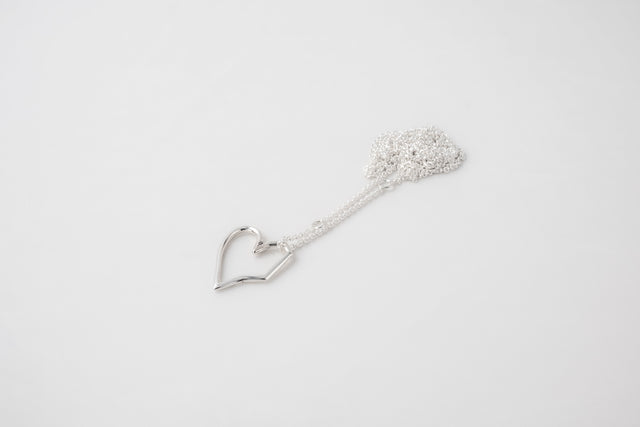
Silver Rings — Oxidized 925 Sterling Brutalist & Architectural Designs by STRUGA
Nine rings sit in this catalogue, and one of them leaves the workshop already dark. None of them is polished, generic or interchangeable: they are heavy 925 sterling silver with brutalist and architectural geometry, finished by hand in the Bali workshop. One ring of the nine in the catalogue leaves the bench already dark — Brutalism V.3. The other eight go out light and darken on the hand, because nothing here is sealed under rhodium plating. Both roads end in the same place: graphite in the recesses, light on the edges.
Oxidized silver rings are sterling silver rings whose surface has been intentionally darkened — either by the maker at the finishing stage, or by the simple fact of being worn without a protective coating. The recesses go deep graphite, the raised planes stay lighter from friction, and the geometry of the ring becomes readable in a way that polished silver rarely achieves. At STRUGA the two roads are named apart. Oxidization is a step at the bench, applied to the forms that ask for it. Living Silver is what the rest of the catalogue does by itself, over months on a hand. The two get confused constantly in this corner of the market — including, until this revision, on this page.
This page is about what oxidized silver actually is on a technical level, why we chose it over plating, how it behaves on the hand across our five design families, and what to expect from a ring like this six months in.
Nine rings in the catalogue: one ships already oxidized — Brutalism V.3 — and eight leave the bench light, darkening on the hand instead.
Sterling 925, no rhodium and no lacquer, so the surface stays open. That is the Living Silver finish.
Weights run 2.1 to 24 grams across sizes; catalogue prices $96–$450.
Non-standard sizes, engraving and paired bands go through Custom Order and Dark Union, roughly 3–6 weeks.
What "Oxidized Silver" Actually Means
Silver oxidizes on contact with air. That's a base property of the metal — sulfur compounds in the atmosphere react with the surface and form a thin layer of silver sulfide. On polished, high-touch areas this layer rubs off as fast as it forms; in recesses, grooves, and shadowed geometry it stays and deepens, eventually reading as deep graphite or near-black.
When a ring is sold as "oxidized silver," it usually means one of two things:
Naturally darkened 925 sterling silver. A piece that has been worn for months without polishing. The tone is uneven, follows the relief, and reflects how the wearer uses their hands. No chemistry was applied — the metal simply did what silver does.
Controlled oxidation by a jeweller. After casting and finishing, the maker accelerates the natural reaction using a sulfur-based solution. The piece comes out dark across the entire surface; high points are then walked back with a soft polish so light reads on the edges and the recesses stay graphite. This is what most "oxidized silver rings" in serious design catalogues actually are — including the darker variants in STRUGA's rings catalogue.
This is technically distinct from niello (a fused inlay of sulfur, copper, lead and silver, set permanently into engraved channels) and from heavy industrial blackening that uses lacquers or coatings. Oxidized silver is the metal itself reacting with itself — nothing on top of it, nothing covering it. That distinction matters because everything that follows on this page — wear, patina behavior, care — depends on it.
Why STRUGA Chose Oxidization Over Rhodium-Plating
Most silver jewellery on the global market is rhodium-plated. Rhodium is a hard, bright metal from the platinum group, applied as a thin layer over sterling silver to prevent tarnish, increase scratch resistance, and give the piece a uniform, almost-white shine. From a retail standpoint it solves a problem: a rhodium-plated ring looks the same on day 1 and day 400. Stable, predictable, easy to photograph.
We don't do it. None of our rings, none of our pieces, ever. The reason is philosophical and practical at the same time, and we call it Living Silver finish.
The philosophical part: silver is a living material. It reacts to air, to skin oil, to the salt of your sweat, to the soap you use. That reactivity is not a defect — it's the whole point. A piece of 925 sterling silver without rhodium records who wore it and how. After a year, your ring is yours in a way that no rhodium-plated ring can ever be. It's not a generic object anymore — it's a specific object with your wear pattern locked into it.
The practical part: rhodium fails. It always does. The plating wears thin at friction points first — the inside of a ring where the finger bends, the outer band where the hand brushes against pockets and steering wheels. Yellow-grey patches appear under the white surface. The piece looks worse than it would have looked with no plating at all. Re-plating is possible, but it's a maintenance loop you signed up for without realising.
Oxidization works the opposite way. We embrace what silver naturally does and direct it: dark in the recesses, light on the high points, contrast that grows with wear instead of degrading. The piece doesn't fight time — it uses time as a finishing tool. That is the whole bet, and eight years in — the brand was founded in 2018 — we still think it is the right one.
Oxidized Silver Rings Across STRUGA Families
Oxidization reads differently in each of our five design families. The rule we use internally: the more architecture in the form, the more the dark tone earns its place. A flat ring with no relief takes patina as a flat sheet of grey — uninteresting. A ring with edges, fascias, cuts, and changes of plane takes patina as drawing — every transition becomes visible. This is why we don't oxidize everything by default; we oxidize what asks for it.
Brutalism. The heaviest, most architectural rings in the catalogue. Designed in collaboration with an architect, drawing on the language of post-war concrete buildings — mass, fascia, planes meeting at sharp angles. Brutalism rings exist in two finishes: V.1 with open silver geometry that develops natural patina over months of wear, and V.3 with dark geometry oxidized at the workshop on the final stage. V.3 is where the architecture reads loudest — every fold of the form sits in shadow, and the polished crests catch light against it. If you want one ring that shows what oxidized silver can do for structural form, this is the entry point.
Thorn. Sharp, angular, ritual. One ring, carrying the vocabulary of the Thorn chains and amulets — pointed edges, deliberate aggression in the silhouette, 4.7 to 12.7 grams depending on size. It ships light. The dark tone arrives from wear, and when it does the shadow collects in the angles and each thorn separates from its neighbour.
Signature Asymmetric. The brand's first form, and the family with the most rings — three of the nine, from 2.1 to 13 grams across sizes. All three ship light. As patina settles on one side of the asymmetry and light keeps the other, the silhouette turns graphic and reads three-dimensional even in flat photography.
Signature Heart. One ring: the Heart Lock, a perline ball chain closed by the SIGNATURE HEART clasp and worn around the finger. The mechanism works — it clicks, locks and holds. Eleven grams, inner diameter 16 to 22 mm, shipped light like the rest.
Oxidized vs Blackened vs Natural Patina Silver
Comparison as of 2026. These three terms get used interchangeably online, and that's a problem because they describe different things. If you're shopping for dark silver jewelry — including oxidized rings — knowing the difference saves disappointment later.
Oxidized silver. A controlled chemical layer. The maker dips or brushes the finished ring with a sulphur compound, the surface reacts within seconds, and a dark film settles into the recesses. The polished high points get worked back with a soft cloth so the contrast reads. This is what most "designer silver" in Europe, the US, and Asia actually is. The film is thin — a few microns — but stable enough to last for years of normal wear. When people say "oxidized silver ring," this is what they mean ninety percent of the time. Brutalism V.3 is the single ring in our catalogue that ships this way; the other eight leave the bench light.
Blackened silver. In the strict historical sense, this means niello — an inlay technique where a sulphide alloy is fused into engraved channels in the metal. The black sits inside the silver, not on top of it. It does not wear off in fifty years. Modern sellers throw "blackened" around as a synonym for "oxidized," but proper niello requires a separate craft and is rare. We do not do niello. If a listing says "blackened" and the price is normal silver-jewelry money, it's almost certainly heavy oxidation, not niello.
Natural patina. No chemical step at all. The ring leaves the bench bright, and the wearer's skin, sweat, air, and friction do the work over months. The pattern that develops is unique to the person.
STRUGA's position: all three are legitimate. What we refuse is the fourth option — sealing silver under rhodium or lacquer. Oxidized, blackened, or naturally patinated, the metal stays open and continues to move.
Daily Wear and How Oxidized Silver Behaves Over Time
An oxidized silver ring is not a static object. The day you put it on is the start of a slow, visible process — and that process is the whole point of choosing this finish over rhodium.
First two to four weeks. The ring darkens fairly evenly. Even surfaces that were polished at delivery start picking up a soft grey haze. People sometimes panic at this stage and reach for cleaner — don't. This is the metal settling into your skin chemistry, your soap, your climate. Two identical rings cast from the same mold will already look different on two different hands by week three.
Two to three months in. The second phase kicks in: friction polishes the highpoints. The places where the ring meets the table when you rest your hand, the side that rubs your neighboring finger, the edge that catches your sleeve — all of these slowly come back up to a warm, soft shine. Meanwhile recesses, fascets, and architectural folds stay dark. The ring starts reading as three-dimensional in a way it didn't on day one.
Six months and beyond. Equilibrium. Recesses hold deep graphite, highpoints sit in muted light, changes happen slowly and become part of the ring's character rather than news. This is when oxidized silver looks best — the most honest version of itself.
Lifestyle matters. A desk-and-laptop life produces even, slow patina with sharp dark/light contrast. A gym-and-shower life accelerates everything — patina deepens faster, highpoints polish harder, equilibrium arrives in weeks rather than months. Construction work, kitchen work, daily handwashing all push the ring toward a more worn, lived-in surface. None of these is wrong. The ring records what you do with it. That's the contract.
Sizing, Weight, Fit for Oxidized Silver Rings
Oxidized rings sit on the hand differently than thin polished bands. Most of what we make has visible architecture — facets, ridges, asymmetry — and that geometry takes space both inside and outside the finger. Two practical rules cover most cases.
First — go comfort fit. Inside the band we round the inner edge slightly so the ring slides over the knuckle without catching. On wider profiles (5mm and up) this matters more than on a thin wire band. If you measure your finger and land between two sizes, take the half-size up. A heavier oxidized ring will feel snugger by midday than a light polished one — the mass settles, the inner surface grips skin friction more.
Second — match weight to wear. Rough working ranges from our catalogue:
- Light profiles — Signature Links, Triple Drills: 2.1–6 g, daily wear, layering, stacking.
- Middle weight — Fused Cross, Thorn, Double Line: 3.7–13 g, a single-finger object, still comfortable for desk work.
- Heaviest in the catalogue — Brutalism V.1 and V.3, Heart Lock: 9.6–24 g, meant to be the only ring on that hand.
Oxidized rings tend to come heavier than polished equivalents because the relief that makes patina readable also adds material. We don't hollow out the back to reduce grams — that compromises the structure.
Resizing. Standard ring sizing — up or down one size — is straightforward at the Bali workshop. The oxidized layer around the cut gets refreshed during finishing, so the ring comes back evenly toned, not patched. For larger jumps or full reshape, route through Custom Order.
Care of Oxidized Silver Rings — What to Do, What NOT to Do
Oxidized silver rings need a different care logic than rhodium-plated jewelry. The dark tone isn't a coating laid on top — it's a thin layer of silver-sulfide compounds bonded into the surface. You can't "scratch it deeper," but you can absolutely scrub it off. Most damage to oxidized rings comes from people trying to "clean" them the way they'd clean a plain polished silver chain.
What to do.
Wipe occasionally with a soft, dry microfibre cloth — only across the raised surfaces, never digging into the recesses. The point is to keep the highlights bright while leaving the dark geometry alone. Once or twice a year, that's enough.
Store the ring dry, in a small fabric pouch or in your shelf rotation away from humidity. If you want to slow further darkening, drop an anti-tarnish strip into the pouch.
If a ring drifts darker than you want — usually after a long stretch in storage — a very light wipe with a cloth dampened in lemon juice or saltwater on the highlights will pull the top layer back. Do this rarely. The dark recesses stay intact.
Take the ring off before the gym, swimming pool (chlorine eats the patina aggressively), and the beach (saltwater plus sunscreen plus sand acts like a mild abrasive scrub).
What NOT to do.
No polishing pastes, no jeweller's rouge, no toothpaste — they're abrasive and strip the oxidation in seconds, leaving a flat light ring with no contrast. No silver dip solutions ("just dunk it for 30 seconds") — these dissolve the entire patina at once, and what comes out is not your ring anymore. No ultrasonic cleaners — vibration loosens stone settings and meteorite inlays, and the cleaning solution removes oxidation. No buffing wheels at home.
The full philosophy behind why we don't seal our rings — and why oxidized silver gets better with use rather than worse — is in Living Silver finish.
Custom Oxidized Silver Rings
If the size, the geometry, or the oxidization depth you want isn't in the catalogue, we make it. Two paths, depending on what you need.
Custom Order — single rings, anything outside the standard run. A Brutalism ring resized to a non-standard finger, a Thorn silhouette with a specific raw tourmaline, an existing Signature Asymmetric form rebuilt with deeper oxidization in the recesses, a Seymchan meteorite inlay matched to a particular ring profile, internal engraving — initials, dates, coordinates, short text. Lead time is roughly 3–6 weeks, depending on materials; the exact date is confirmed by a person, not by this page. We work over email and voice notes; sketches and reference photos before casting, photos of the piece before shipping.
Dark Union — paired wedding bands. This is its own service because pairs need their own conversation: matching profile widths, mirrored or identical geometry, oxidization depth agreed between both partners, optional inserts (raw aquamarine, small Seymchan slices), engraving inside both rings. Roughly 3–6 weeks. Shipped worldwide.
Both routes use the same 925 sterling silver, the same Living Silver finish, and the same workshop. Nothing rhodium-plated, nothing sealed — same material logic as everything in the STRUGA rings catalogue, just built to your geometry.
The nine rings, in one table
| Ring | Weight by size | Leaves the bench |
|---|---|---|
| Brutalism V.3 | 9.6–24 g | oxidized at the workshop |
| Brutalism V.1 | 9.6–24 g | light |
| Thorn | 4.7–12.7 g | light |
| Double Line | 6–13 g | light |
| Heart Lock | 11 g | light |
| Fused Cross | 3.7–9 g | light |
| Signature Links V.1 | 2.7–6 g | light |
| Signature Links V.2 | 2.1–5.5 g | light |
| Triple Drills | 3.1–4.5 g | light |
Weight moves with size: the same form runs light on a 16 mm inner diameter and heavy on a 22 mm one. The figures above are the full spread across sizes, taken from the catalogue rather than rounded for the page.
Related Reading
Frequently asked questions
Didn’t find the answer — write to us, we reply personally.
Ask a question →01Is oxidized silver real silver or coated?+–
Real 925 sterling silver, not coated. Oxidization is a chemical reaction between the silver surface and a sulfur-based solution — it forms a thin layer of silver sulfide on the metal itself, not a paint or plating laid on top. The metal underneath is the same 92.5% silver as a polished ring. The dark tone is the silver reacting with sulfur, accelerated on purpose. No lacquer, no rhodium, no black coating. Just silver doing what silver does, faster.
02Does oxidized silver wash off?+–
Water and soap won't wash it off. The darkened layer is bonded to the metal at a molecular level — it survives showers, dishwashing, hand sanitizer, daily contact with skin. What does wear it down is mechanical abrasion: polishing cloths, abrasive pastes, ultrasonic cleaners, jeweler's rouge. On a STRUGA ring, friction from your finger against the ring band gradually lifts oxidization off the high points — that's intended. The recessed geometry holds it indefinitely, because nothing rubs there.
03Will oxidized silver get lighter over time?+–
Yes, on the high points. After two to three months of daily wear, raised surfaces — outer band, top edges, anywhere your skin or clothing touches constantly — start to come up brighter. Recessed lines, undercuts, deep texture stay dark because friction can't reach them. The result is a contrast that builds itself: dark architecture, light edges. This is the Living Silver finish doing exactly what it's designed to do. Re-oxidization through Custom Order is available if you want the dark tone reset.
04Can I clean an oxidized silver ring without removing the dark color?+–
Yes. Use warm water with a drop of mild dish soap, a soft toothbrush, then air-dry. This removes skin oils and grime without touching the oxidized layer. Avoid: silver polishing cloths, silver dip solutions, baking soda, toothpaste, ultrasonic cleaners — all of them strip oxidization in one pass. If a ring loses its dark tone through accidental polishing, send it back through Custom Order and we'll re-oxidize it at the workshop.
05Is oxidized silver hypoallergenic?+–
For most wearers, yes — same as any 925 sterling silver. The 7.5% alloy is copper, which a small percentage of people react to. Oxidization itself doesn't add allergens; the silver sulfide layer is inert against skin. If you've worn standard sterling silver without irritation, oxidized sterling silver will behave the same way. If you have a known nickel allergy — STRUGA silver contains zero nickel, so the oxidized finish is safe regardless.
---
Sources & further reading: