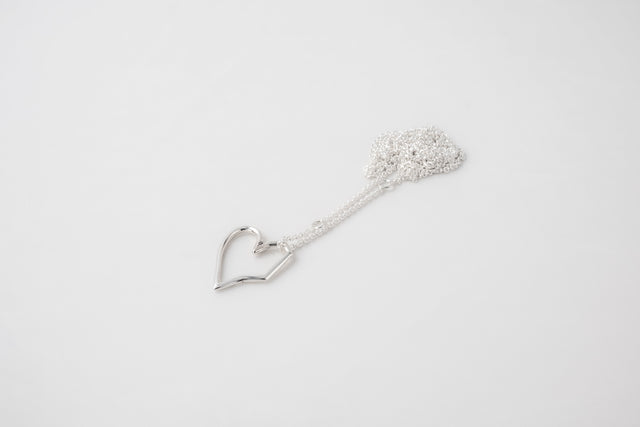
A silver pendant at STRUGA is the rarer case: the pendants-on-cord row holds thirteen pieces, and silver is the main material in none of them. Eight pendants are cut from carbon and contain no silver at all. Three carry 925 silver laid over carbon. Two more are heavy plates of 80 g each, where a slice of Seymchan meteorite sits beside a silver bar and a panel of aged copper.
Exactly one piece in the row is blackened in advance — Signature Cross V.3 — and what is blackened there is the cast silver element, not the cross itself. The rest of the silver in STRUGA pendants is never oxidised: it goes dark on its own, on the wearer, and brightens again on the raised edges.
So this page answers a different question from the one the title suggests. Not "which oxidized silver do you sell", but the one people ask before ordering: what a given pendant is made of, what it weighs, what it hangs on, and how long the wait runs. How a pendant differs from a charm as a word is covered by a separate Atlas page; here it is the row itself and the figures behind it. Every figure below was read off the catalogue and the checkout on 29 August 2026.
A silver pendant in the STRUGA row is three cases out of thirteen. The row: thirteen pieces on a 75 cm cord, 4 to 80 g, $165 to $450, charged in rupiah — eight of carbon without silver, three of carbon with 925 silver, two with Seymchan meteorite. One piece is blackened in advance. Carbon is made to order in about four weeks, silver in about two.
- Oxidation is a method, Living Silver is a property
- What STRUGA pendants are made of: the whole row
- Carbon: the material the brand started with
- Where the silver and the meteorite sit
- The 75 cm cord and the chains: length, weight, drop
- Care: carbon and silver are cleaned differently
- The row in short
- Frequently asked questions
Oxidation is a method, Living Silver is a property
Silver is not painted black. Sterling 925 is an alloy: 92.5% silver and 7.5% other metals, mostly copper (Royal Society of Chemistry). Sulfur compounds react with the surface of that alloy to form silver sulfide, Ag2S — molecular weight 247.801, CAS registry number 21548-73-2 (NIST Chemistry WebBook). It is the same dark film that appears on cutlery forgotten in a drawer.
From there two paths split, and the difference is the whole question. Oxidation is a method: the reaction is accelerated in a bath, the piece leaves the bench already dark, and the maker decides where the shadow stays and where the shine comes back. Living Silver is a property: the piece leaves bright and darkens later on the wearer, month by month, in its own recesses, brightening where a shirt rubs it.
In STRUGA pendants that method is used once. The silver element of Signature Cross V.3 is blackened at the bench, and that object is dark from day one. The silver in every other pendant is left living. There is no rhodium and no lacquer anywhere in the row: plating holds its shine for about two years, then thins, and the copper in the alloy comes through in patches.
What STRUGA pendants are made of: the whole row
Below is the full pendants-on-cord row, thirteen pieces, with material, weight and price. The international checkout is charged in Indonesian rupiah, so the dollar figure is a reference number rather than the sum you pay.
| Piece | Material and finish | Weight and price |
|---|---|---|
| Signature Asymmetric Toxic | carbon, Toxic palette | 5 g · $165 |
| Signature Asymmetric Arctic | carbon, Arctic palette | 5 g · $165 |
| Signature Asymmetric Winter | carbon, Winter palette | 5 g · $165 |
| Signature Asymmetric Multy | carbon, Multy Graphite palette | 5 g · $165 |
| Signature Asymmetric Bloody | carbon, Bloody palette | 5 g · $165 |
| Cross V.4 Arctic | carbon, Arctic palette | 4 g · $165 |
| Cross V.4 Bloody | carbon in the Bloody palette, a steel cross set inside | $165 |
| Big Line Aged | carbon and aged copper, no silver | 17 g · $175 |
| Signature Asymmetric Aged | carbon, Aged treatment | 17 g · $175 |
| Signature Cross V.3 | Classic Graphite carbon and a cast 925 silver element, blackened | 9 g · $210 |
| Fused Mini Line Bloody | carbon in the Bloody palette and 925 silver | 9 g · $260 |
| Asymmetric Fused Winter with Meteorite | Winter carbon, Seymchan meteorite, 925 silver, copper | 80 g · $450 |
| Asymmetric Fused Bloody with Meteorite | Bloody carbon, Seymchan meteorite, 925 silver, copper | 80 g · $450 |
The weight of Cross V.4 Bloody currently differs between the catalogue and the product description, so it is left out of the table until the figure is settled.
Eight pieces with no silver
Five asymmetric plates, two crosses and Big Line are cut from carbon, and there is no silver in them. That is not a saving and not a downgrade: carbon is many times lighter than silver, unafraid of water, and unchanged by time. A 5 g plate is not felt on the neck at all — it is noticed by eye, not by body.
Three pieces where silver lies on carbon
Signature Cross V.3, Fused Mini Line Bloody and Cross V.4 Bloody are built from two materials at once. This is the language of the MOSAIC family: one material is set into another and meets a third in a single plane. Here silver is a part of the composition, not the body of the piece.
Carbon: the material the brand started with
STRUGA began with carbon, and it began with a pendant. The first pieces were carbon with inserts of copper, brass, steel and meteorite — two families grew out of that early work at once, CARBON and MOSAIC, and it was there that the carbon palette the brand still uses was chosen. Both families live in the RITUAL world, alongside the amulets and the meteorite objects.
There are six palettes, and they are not paint colours but the brand's own layer stacks. The sheet is cut on a CNC machine, which is why carbon forms have clean edges and flat planes — an aesthetic cast silver never produces.
- Classic — black-graphite layers, neutral and industrial
- Bloody — near-black graphite scattered with red along the edges
- Toxic — acid green over black
- Arctic — cold pale veins across a dark field
- Winter — the same cold range, lighter and more even
- Multy Graphite — layers of several palettes mixed in one sheet
One practical consequence follows for an order: carbon runs the made-to-order route. The palette is chosen for the person, and the wait is longer than for silver — about four weeks against two, plus roughly another week in transit. The Aged treatment stands apart: it is not a palette but aged copper embedded into a dark graphite core, and in this row it is carried by Big Line Aged and Signature Asymmetric Aged.
Where the silver and the meteorite sit
There is exactly as much 925 silver in this row as the table names: the cast element on Cross V.3, the silver in Fused Mini Line, and the silver bar in the two meteorite plates. A piece made wholly of silver lives in the neighbouring neck row instead: Asymmetric Destroyed at 40 g of silver blackened in advance, Signature Pyramid at 40 g of plain silver, Solid Heart at 8 g. Across the whole neck row of thirty-two pieces, two are blackened in advance.
STRUGA works with one meteorite — Seymchan, a pallasite with olivine inclusions in an iron-nickel matrix. In pendants it appears in two objects of 80 g each: a carbon plate carries the meteorite slice at the top, a silver bar engraved with the brand name in the middle, and a panel of aged copper below, all hanging from a braided cord strung with steel beads along its length. These are the heaviest and the dearest pendants in the row, at $450.
The 75 cm cord and the chains: length, weight, drop
All thirteen pendants arrive on a 75 cm cord — suede or braided, closing on a sliding knot. The knot matters more than it sounds: the drop is set by hand rather than by choosing a size, so the same object is worn high under a collar and low over a sweater.
STRUGA chains are sold separately and exist in five lengths. The in-between 55 and 60 cm do not exist in the catalogue at all. Chain weights run from 11 g for THORN to 110 g for Blade Mini Links, and that difference is felt far more than the difference in length.
- 40 cm — at the base of the neck, visible above a collar
- 45 cm — at the collarbones
- 50 cm — just below the collarbones, the usual length under a t-shirt
- 75 cm — the cord length of the pendants, the object sits on the chest
- 120 cm — doubled around the neck, or worn low over a sweater
The matching rule is simple, and the reverse of the common one: a heavy meteorite plate goes on a chain because 80 g needs support, while a light carbon form of 4–5 g stays on the cord, or the chain outweighs the object and becomes the subject. Between those edges the choice is not arithmetic — it is whether metal or form should be seen first.
Care: carbon and silver are cleaned differently
Carbon does not oxidise. It does not darken, does not film over and does not fear water: wipe it with a damp cloth and the care is done. Showers, the sea and rain are all the same to it, because there is nothing in it to spoil.
The silver in this row behaves differently. Living Silver darkens in the recesses and brightens on the raised parts — that is its property, not damage, and there is no need to reverse it with polishing paste. On Signature Cross V.3 there is a reason not to: paste strips the blackening off the element along with the tarnish, and the object loses the very contrast it was made for.
A dry soft cloth once a week is enough. Jewellery dips and silver cleaning solutions should be kept away from every piece in the row. Storage is best in a cloth pouch rather than a sealed bag, which traps moisture.
The row in short
| Question | Answer |
|---|---|
| Pieces in the row | 13 pendants on cord |
| What they are made of | 8 carbon with no silver, 3 carbon with 925 silver, 2 with Seymchan meteorite |
| Blackened in advance | 1 piece — the element of Signature Cross V.3 |
| Weight | 4 to 80 g |
| Price | $165 to $450, charged in rupiah |
| Cord included | 75 cm, suede or braided, sliding knot |
| Chains, sold separately | 40, 45, 50, 75, 120 cm |
| Made to order | carbon about 4 weeks, silver about 2, transit about a week |
Related reading
Objects from this row
Frequently asked questions
Didn’t find the answer — write to us, we reply personally.
Ask a question →01Are STRUGA pendants oxidized silver?+–
They are not. The pendants-on-cord row holds thirteen pieces, and eight of them are cut from carbon with no silver in them at all. Three carry 925 silver laid over carbon, and two set a silver bar beside a meteorite fragment and copper. Exactly one piece in the row is blackened in advance — Signature Cross V.3 — and only its cast silver element is blackened. The rest of the silver is left as Living Silver and darkens on the wearer.
02What is the difference between a pendant and a charm?+–
A pendant is any object that hangs from a cord or a chain; a charm is a small pendant carried for meaning rather than form. A necklace is neither: the necklace is the chain around the neck, and the pendant hangs on it. STRUGA keeps the three words apart on purpose, because the catalogue rows are different — cords, chains and pendants are ordered separately.
03How much does a pendant weigh, and what does it hang on?+–
The row runs from 4 to 80 grams. The light carbon forms weigh 4–5 g and are barely felt; 17 g covers Big Line and the Aged pieces; both meteorite plates weigh 80 g. A 75 cm cord comes with every piece in the row — suede or braided, closing on a sliding knot, so the drop is set by hand. STRUGA chains are sold separately, in 40, 45, 50, 75 and 120 cm.
04Why does carbon take about four weeks?+–
Carbon at STRUGA is the made-to-order route: the sheet is CNC-cut and the palette is chosen for the person, so the wait is longer than for silver. The house figures are about four weeks for carbon, about two for plain silver and about three for silver with a stone, plus roughly a week in transit. There are six palettes: Classic, Bloody, Toxic, Arctic, Winter and Multy Graphite.
05Are carbon and silver cared for the same way?+–
No, and this is the one place where the row splits. Carbon does not oxidise and does not darken: wipe it with a damp cloth, water does it no harm. The silver here is Living Silver — it darkens and brightens with wear, and polishing paste will strip the blackened element of Signature Cross V.3 along with the tarnish. A dry soft cloth is enough for both; keep jewellery dips away from either.