Silver Signet Ring for Men: STRUGA Architectural Guide
The device on the table was cut in mirror image — otherwise the impression in hot wax came out reversed. The ring worked as a signature turned backwards, and it did so for some three thousand years, from Sumerian cylinders to the seals of Roman citizens. Nobody seals letters now, but the table stayed: a wide plane facing upward, the reason this ring is the first thing noticed on a hand. What follows are the three numbers that decide the choice — weight from 4.7 to 24 g, size from 15 to 22, and the density of sterling silver, 10.40 g/cm³.
Updated August 29, 2026
A ring becomes a signet through the table wider than the shank, not through mass; the name comes from Latin signum, a small seal.
Weight bands: 10–15 g light, 15–22 g medium, 22–30 g heavy, above 30 g an occasion piece rather than a daily one.
Sterling silver has a density of 10.40 g/cm³, so the same form in size 15 and size 22 differs in mass by two and a half times.
STRUGA has three signets: Brutalism V.1 and V.3 at 9.6–24 g in sizes 15–22, and Thorn Ring at 4.7–12.7 g in sizes 16–22.
No rhodium is applied to any piece: bright silver builds its own patina, while the dark surface of V.3 is set in the workshop.
What makes a ring a signet rather than a heavy band?
The table makes it, not the grams. The upper plane sits wider than the shank and reads as a separate object; a wedding band has no such plane — it is identical all the way round. The outline is not fixed: oval, square, octagon, free contour.
That gives a clean split:
- signet — a table wider than the shank; the ring has a top and a bottom;
- statement ring — mass without a table: a heavy smooth band stays a band;
- sculptural ring — form over plane; it could not take an impression at all.
A ten-gram signet stays a signet as long as the table is built as a plane of its own.
Latin signum means a small seal, and English signet came from it. Cassius Dio describes Caesar's ring with an armed Venus (Roman History, 43.43). Suetonius lists three seals of Augustus in a row: a sphinx, the profile of Alexander the Great, then his own portrait cut by Dioscurides (Divus Augustus, 50).
The full history — the finger tradition, engraving, meanings — is covered in a separate guide to the signet ring. What follows here is the choice of one specific ring.
How many grams fall on each size?
One form across sizes is not one weight. Below are the actual figures from the production size run, not a calculation from a formula; what «light», «medium» and «heavy» stand for is set out in the next section.
| Size | Brutalism V.1 and V.3 | Thorn Ring |
|---|---|---|
| 15 | 9.6 g | — |
| 16 | 10.0 g | 4.7 g |
| 17 | 11.5 g | 5.5 g |
| 18 | 14.0 g | 7.0 g |
| 19 | 17.0 g | 8.0 g |
| 20 | 19.0 g | 9.6 g |
| 21 | 22.0 g | 11.0 g |
| 22 | 24.0 g | 12.7 g |
From size 15 to size 22 the mass grows two and a half times on the same drawing. The table reads like this:
- sizes 15–18 — architecture without the load: 9.6–14 g in Brutalism, 4.7–7 g in Thorn Ring;
- sizes 19–20 — the middle of the run, 17–19 g: the weight is noticed, and the hand adapts within a day;
- sizes 21–22 — declared mass, 22–24 g, the top of the standard run.
Sizes here are the European run — how to measure at home is in the ring sizing guide.
How much does a silver signet ring weigh and how does that feel?
After form, weight is the main technical parameter. Sterling silver measures 10.40 g/cm³ — lighter than pure silver at 10.49 because of the copper, and still heavier than the eye promises. The step from ten grams to twenty-four feels roughly like the step from an ordinary watch to a large chronograph on the wrist.
| Band | Weight | How it behaves on the hand |
|---|---|---|
| Light | 10–15 g | Table 3–4 mm, narrow shank. Present without dominating. A first massive ring starts here. |
| Medium | 15–22 g | Table 5–6 mm. Felt constantly, still out of the way when hands are working. |
| Heavy | 22–30 g | The hand carries it without pause; without the habit, the wrist tires by evening. |
| Occasion | above 30 g | Not a daily piece. Nothing in the standard STRUGA range reaches it — only through Custom Order. |
The order of decisions runs backwards from the usual one: fix the finger size first — from an existing ring or a fitting — then choose the band. A thin signet on a large finger looks fragile; a heavy one on a slim finger sits out of proportion. The long read on mass is in the silver ring weight guide.
How does a classic signet differ from a brutalist one?
The difference is not price and not period. It is what the table does: the classic form gives it away to a sign, the brutalist one keeps it.
| Feature | Classic | Brutalist |
|---|---|---|
| Table | oval or shield, smooth | faceted plane, cut rather than polished |
| Transition to shank | a smooth wave | an angular joint, volumes left unblended |
| Engraving | crest, monogram, date | none; relief belongs to the composition |
| Surface | polished, sometimes rhodium | tool marks visible, no rhodium |
| What it says | origin through a symbol | choice through form |
The practical conclusion is short. If the point is initials, the classic form and an engraver are what the job needs. If the point is a piece recognised without decoding, the architectural one is.
What styles of signet rings exist?
Signets divide by the geometry of the face, not by period or material: that classification describes what is actually visible on a hand. The four groups below cover almost the whole market, from factory classic to authored architecture.
| Style | Table | Who it suits |
|---|---|---|
| Classic oval | oval or shield, smooth, ready for engraving | anyone who wants initials or a crest |
| Square | rectangle, corners right or chamfered | anyone after geometry without a crest |
| Asymmetric and figured | irregular outline: facets, cut-outs, a symbol | anyone choosing sculpture |
| Brutalist architectural | cut planes, thickened transitions | anyone who wants form without a symbol |
Classic came out of European heraldry and is the most saturated of the four: factory casting, base polish, sometimes rhodium plating — and near-identical results across brands. Square came out of 1920s Art Deco, returned in the 1990s, and often carries an engraved pattern or a set stone: onyx, hematite, lapis. Figured belongs to independent workshops and the rock scene since the 1970s, almost never works as a seal, and its value is sculptural; at STRUGA this is Thorn Ring, the thorn form of the THORN family, tagged in the catalogue as a signet. Brutalist grew out of a language with specific addresses: the 400-metre residential block on Bolshaya Tulskaya in Moscow (1972–1986, architects Vladimir Babad and Vsevolod Voskresensky), the VNIITE building on Akademika Koroleva Street (1970, Mikhail Posokhin's studio), the now-demolished House of Soviets in Kaliningrad.
What is BRUTALISM at STRUGA?
Four rules of the form
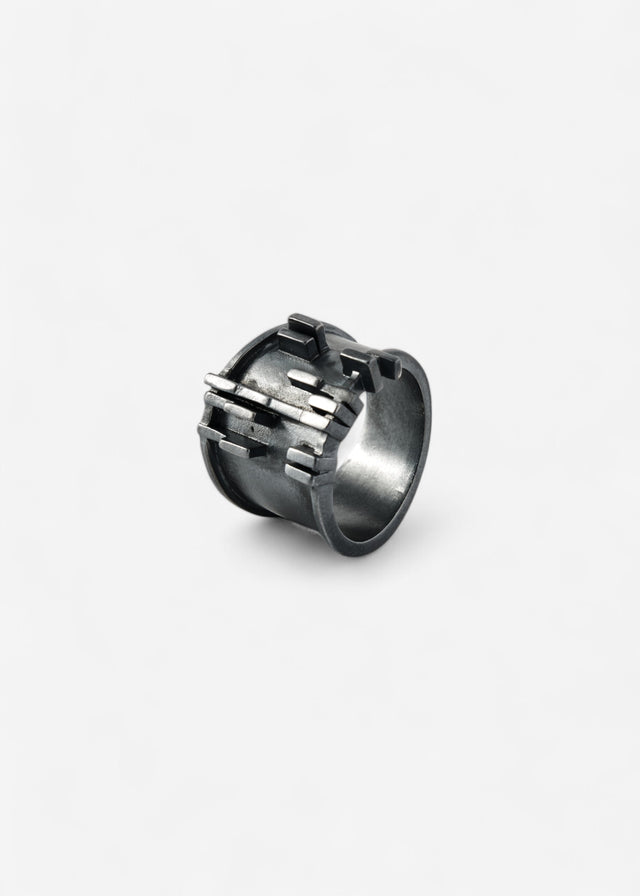
BRUTALISM is the fourth numbered form of the brand and part of the CODEX world — architecture in silver. It is an exploration of Soviet brutalist aesthetics: its forms, its lines, its visual composition, developing under the influence of Suprematism. The BRUTALISM rings are the heaviest and most massive in the brand, and they stand on four rules.
- Mass over silhouette. The table does not grow out of the ring in a wave — it is set in as a separate volume with its own plane and edges. The angularity is deliberate: blending reads as factory work.
- Tool marks stay. Casting is followed by hand finishing, but not to a mirror: cut planes and micro-texture are kept as part of the form.
- No heraldry. The table is not prepared for a crest or initials; relief and cut-outs belong to the composition, not to a personal code.
- Silver only. No stones, no enamel, no decorative inlay. Colour comes either from workshop darkening or from natural patina.
How V.1 differs from V.3
The versions read as parallel variations of one language, not as steps of an evolution: V.3 is not an improved V.1 but another reading of the same code. Their weight run is shared — from 9.6 g in size 15 to 24 g in size 22 — so the choice between them is not a choice about mass.
The difference shows on the hand at once. V.1 holds a bright surface and darkens on its own: the first months go straw, then graphite. V.3 leaves the workshop already dark, with the relief drawn out along the ridges — the contrast is set from the start and only deepens. The bright ring shows how it was worn; the dark one shows the form from day one.
Why does a signet darken, and should it be cleaned?
The dark surface arrives by two different routes, and they are worth keeping apart. Brutalism V.3 is darkened in the workshop on purpose — a surface decision made during the work, with the relief brought out along the edges. Brutalism V.1 and Thorn Ring leave as bright 925 and darken on their own: from air, from skin, from the way the piece is worn.
Neither one is tarnish to be scrubbed away. There is no rhodium plating and no protective lacquer here — that refusal is deliberate, part of Living Silver. Patina sits unevenly: ridges rub back to bright, recesses collect black. After a year the ring reads as a record of how its owner lives with their hands.
Care comes down to three actions:
- keep it dry — moisture and airborne sulphur darken the surface unevenly;
- wipe it with a soft cloth after wear — that covers nine cases out of ten;
- polish the ridges only, and only to bring back the contrast between edge and recess.
Abrasive pastes and ultrasonic baths strip exactly what the piece was made for. What happens to a silver surface over time is set out in the note on patina.
Which signet rings does STRUGA make?
There are three in the catalogue, all in 925 silver, all made to order in Bali.
- Brutalism V.1 Ring — architectural table, bright silver, 9.6–24 g, sizes 15–22.
- Brutalism V.3 Ring — the same weight run, surface darkened in the workshop.
- Thorn Ring — the figured thorn form, 4.7–12.7 g, sizes 16–22.
Weights follow the production size run and are confirmed piece by piece at order. For more volume than the standard run or a different table, that is Custom Order: a widened shank, an enlarged plane, another finish.
See STRUGA signet rings — 925 silver, the BRUTALISM and THORN families.
About STRUGA. STRUGA is a dark silver brand founded by Dmitry Strugovshchikov and Ekaterina Strugovshchikova, handcrafted with Balinese and international silversmiths. Every piece is 925 silver, darkened in the workshop or patinated over time. Darkening is part of the design: the object changes through contact with its environment and with the person wearing it.
Frequently asked questions
No answer here — write to us, we reply personally.
Ask a question →01Is a signet ring the same as any heavy ring?+–
No. A heavy ring is volume alone; a signet is a ring with a solid upper table wider than the shank, one that reads as a separate object. The table makes it a signet, not the grams. A heavy smooth band without that table is a statement ring, not a signet.
02How much should a men's silver signet ring weigh?+–
As bands: 10–15 g light, 15–22 g medium, 22–30 g heavy, above 30 g an occasion piece. STRUGA Brutalism V.1 and V.3 run 9.6–24 g across sizes 15–22; Thorn Ring runs 4.7–12.7 g across sizes 16–22. Fix the finger size first, then choose the band.
03Why does a signet ring darken, and should it be cleaned?+–
The dark surface arrives by two routes. Brutalism V.3 is darkened in the workshop on purpose, with the relief drawn out along the edges. Brutalism V.1 and Thorn Ring leave as bright 925 and darken on their own — no rhodium, no lacquer. Neither is tarnish to scrub off: keep the piece dry, wipe it with a soft cloth, polish the ridges only if you want the contrast back.
04Does a brutalist signet carry engraving like a classic one?+–
No. A classic oval signet has a smooth table prepared for initials, a monogram or a crest. A brutalist one has no place for heraldic engraving — relief, cut-out or counter-form belong to the architectural composition rather than to a personal code.