How to Clean Silver Rings: Care for Each Finish
For everyday care, wipe a silver ring with a soft dry cloth. To reset the patina of uncoated Living Silver, use a silver-cleaning liquid according to its label; on uncoated matte silver, Scotch-Brite or fine abrasive paper removes the thin surface layer and creates a fresh matte finish. Choose first whether you want to keep the patina or start the surface again. Deliberately oxidized areas and rings with inlays follow a different route below.
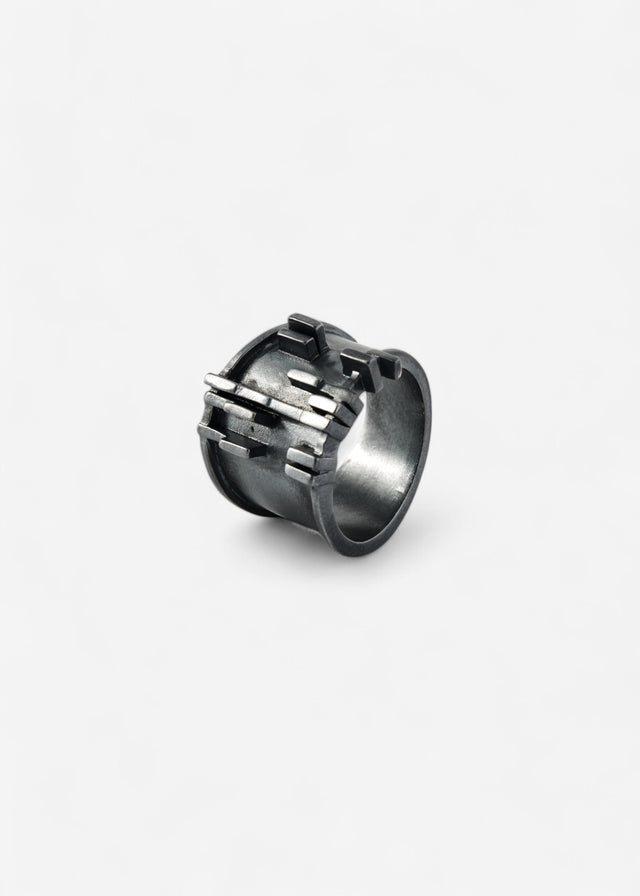
Dark recesses help define Brutalism V.3. Care should remove dirt while preserving that contrast. Bright Triple Drills and polished Signature Links V.2 show other surfaces. Brutalism V.3 and Signature Links V.2 belong to the CODEX world; compare each model’s starting finish with the surface you want to keep.
Keep patina: soft dry cloth. Reset uncoated Living Silver: silver-cleaning liquid. Renew matte silver: a soft abrasive such as Scotch-Brite or fine abrasive paper. Protect deliberate dark recesses and match the method to every material in the ring.
Updated October 23, 2026
What needs to come off the ring?
Skin oils, cream residue, and tarnish are different problems. Washing can remove ordinary dirt when the ring allows water. Silver itself reacts with sulfur compounds to form silver sulfide. Sterling silver contains 92.5% silver; other alloy components can also contribute to surface changes. The claim that only copper tarnishes leaves out the silver.
The Canadian Conservation Institute explains the chemistry in its guide to understanding silver tarnish. The guide explains how silver sulfide forms at the surface.
Choose the method before reaching for water
Start with the finish you want to keep. Living Silver is STRUGA’s uncoated sterling silver 925: its patina records wear. A deliberately oxidized ring starts dark at the bench. Matte silver describes a texture cut into the metal, rather than a layer applied over it.
| Surface and aim | Steps | Result |
|---|---|---|
| Living Silver; retain the patina | 1. Wipe accessible surfaces with a clean dry cloth. 2. Leave the dark areas you enjoy. 3. Store dry. | Removes everyday residue while keeping the worn surface |
| Uncoated Living Silver; reset the patina | 1. Choose a liquid formulated for silver. 2. Follow its stated application time, rinsing and drying instructions. 3. Check the fully dry surface. | Returns the silver to a fresh, lighter starting point |
| Uncoated matte silver; renew the texture | 1. Use a soft abrasive such as Scotch-Brite or fine abrasive paper. 2. Work the intended matte silver area. 3. Remove residue and inspect the new texture. | Removes a thin top layer and sets a new matte finish |
| Deliberately oxidized silver; retain the contrast | 1. Wipe the accessible raised surfaces. 2. Keep silver dips and abrasive pads out of the dark recesses. | Keeps the contrast between light and dark areas |
| Stone, carbon, meteorite, plating or an uncertain finish | 1. Photograph the ring and identify its materials. 2. For STRUGA, send the photo and model through the contact page. 3. Use the method agreed for that whole piece. | Protects components that need different treatment |
Daily care and periodic inspection
After wear, gently wipe accessible surfaces with a clean, soft, lint-free cloth. Keep ordinary wiping separate from polishing. A cloth impregnated with polishing compounds can alter a finish that you intend to keep dark. Replace a dirty cloth rather than rubbing trapped particles against the metal.
A weekly check is a chance to notice dirt or a loose component. Condition, construction, finish, and wear determine the care it needs. A clean ring does not benefit from unnecessary treatment.
Remove it before swimming, household cleaning, and contact with chemicals. Let cosmetics dry before putting it on. GIA’s jewelry-care guidance explains why gemstones, treatments, and settings matter: a method suitable for the metal can still be unsuitable for the rest of the ring.
Gentle washing when the whole ring allows water
Washing sequence
-
For a plain uncoated ring whose components allow washing, prepare a separate small bowl of lukewarm water with mild soap. Do not add bleach, acids, or kitchen cleaning products. Choose mild soap whose instructions suit the materials.
-
Gently lift accessible dirt with your fingers or a soft cloth. Wash until the accessible dirt lifts; keep to the care instructions for any insert. Rinse over a bowl so the ring, or a loose component, cannot disappear into an open drain. Blot with a soft cloth and let it dry completely before storage.
-
Compare the dry surface with your photograph. If greasy residue has gone but a dark area remains, do not automatically repeat with hotter water or harder rubbing. Soap may leave silver-sulfide tarnish in place. The remaining color may belong to the finish or need assessment before a different treatment.
Deep cleaning when soap is not enough
Resetting patina is a choice the owner can make. On uncoated Living Silver, a special silver-cleaning liquid removes the dark surface and returns the silver to a fresh starting point. Read the product label for the method, contact time, rinsing and drying; these vary between formulations.
On matte silver, STRUGA uses a soft abrasive — Scotch-Brite or abrasive paper — to remove the thin top layer and create a new matte texture. The marks are the finish itself. Work only the area whose texture you intend to renew; preserve polished details and deliberate dark recesses.
After cleaning, inspect the ring when completely dry. A liquid resets the colour; an abrasive also changes the texture. Select the result you want before starting. For a composite ring or a surface you want STRUGA to match, send us a photograph and arrange cleaning.
The CCI guide to silver care explains chemical and mechanical tarnish removal. Its conservation context is useful for understanding why polishing and repeated cleaning also remove a small amount of metal.
Dark finishes, inlays, and ultrasound
Construction limits
-
On intentionally oxidized silver, wipe the raised surfaces and preserve the dark recesses. A silver dip removes patina; use it only on areas you intend to lighten. For a dark STRUGA ring, send a photograph through the contact page to agree a method that keeps its original contrast.
-
For a ring with meteorite, carbon or another inlay, start with the dry care specified for that material. Agree the cleaning method for the complete piece with STRUGA before using a liquid; keep household solvents away from adhesives, coatings and composite materials.
-
Ultrasound can loosen an inlay and is unsuitable for some gemstones and treatments. GIA recommends considering the object’s condition and leaving this treatment to a professional. Stop wearing a ring with a moving stone, a click, or a visible crack and have it checked.
For the contrast between dark recesses and light edges, see the focused guide to oxidized silver. It explains the finish and how to retain it.
A silver ring bought in Bali
For the international market, STRUGA objects are made in Bali. A ring’s place of purchase does not change the cleaning method: its materials and finish do. Keep the maker’s care instructions with your purchase record. A dark silver ring should not be polished bright simply because it has become part of a travel kit.
Before swimming or using sunscreen, take the ring off. Let cosmetics dry before putting it back on. After permitted washing, dry it completely before closing a travel pouch. Separate rings so they cannot strike or scratch each other in a bag. If you bought a piece from another maker, follow that maker’s instructions rather than assuming every Bali-made ring has the same finish.
Storage and when to ask a jeweler
-
Store the ring completely dry, apart from objects that might scratch it. Choose a suitable anti-tarnish pouch or case according to the maker’s instructions. Do not seal a wet ring in airtight packaging. Keep it in a separate padded compartment when traveling.
Ask a jeweler about a moving inlay, deformation, a deep scratch, or an unexplained change to a coating. For a STRUGA object, send a photograph and the model name so its materials and finish can be identified first. Our team can explain cleaning and surface work for that model.
Care is complete when the ring is clean enough to wear and its intended surface is preserved. Constant mirror brightness is not the goal for every form. When choosing another object, compare surfaces in the ring collection, including Fused Cross. The individual description helps establish what you will be caring for.
About STRUGA. STRUGA works in experimental minimalism and Dark Fashion. Dmitry Strugovshchikov and Ekaterina Strugovshchikova are its founders and designers. The silver line uses sterling silver 925; CARBON brings layered matte carbon together with other materials. Patina belongs to the life of the object.
Frequently asked questions
Didn’t find the answer — write to us, we reply personally.
Ask a question →01Does soap remove tarnish from a silver ring?+–
Water and mild soap remove ordinary dirt from a water-compatible ring; a silver-cleaning liquid resets patina on uncoated Living Silver. Use the liquid’s label instructions. Keep deliberate dark areas and sensitive inlays out of treatments that would change them.
02Should I soak a silver ring every week?+–
Use a weekly check to look for dirt, a moving stone or a worn joint. Wipe after wear and wash a water-compatible ring when dirty. Reset patina when you want a fresh silver surface, rather than as a weekly requirement.
03Can I clean a silver ring with toothpaste or baking soda?+–
Choose a silver-cleaning liquid for resetting uncoated Living Silver instead of a household paste. For a deliberately matte silver surface, STRUGA uses a soft abrasive such as Scotch-Brite or abrasive paper to renew the texture. Keep abrasives away from polished details and intentional dark recesses.
04How can I distinguish tarnish from a dark finish?+–
Compare the original description and photographs. Living Silver is uncoated silver 925 that develops patina; oxidized silver was darkened at the bench. For a STRUGA ring, send the model and a photograph through the contact page to identify the finish before resetting it.
05Is ultrasound safe for a ring with a stone?+–
Not for every ring. The stone, any treatment, and the condition of its setting matter. Ultrasound can loosen an inlay; a professional should assess whether it is suitable.
06How do you clean a silver ring bought in Bali?+–
The materials and finish determine the care. A STRUGA Living Silver ring can retain its patina or be reset with a silver-cleaning liquid; a matte silver surface can be renewed with a soft abrasive. Rings with stones or other inlays need the method for that complete construction.
07Can I restore a rubbed-off dark finish at home?+–
For a STRUGA ring, send photographs through the contact page and arrange a surface assessment. A silver-cleaning liquid removes patina; renewing an intentionally oxidized finish is a separate workshop treatment.