Sterling Silver vs White Gold, Yellow Gold and Platinum: Costs, Weights and Upkeep
White gold is not a coating. It is an alloy — gold mixed with white metals such as nickel or palladium, in the GIA's description — and it leaves the crucible anywhere from near-white to pale yellow, which is why it is usually plated with rhodium. Usually, not always: on the whiteness scale drawn up for the trade in Gold Bulletin, the top grade is white enough to sell unplated. Sterling silver is a shorter story: 92.5% silver, at STRUGA copper for the remainder, and nothing on top. Maintenance splits exactly there. Rhodium is a finish, and a finish gets laid down again; silver is polished, and it is still the same metal.
- The 925 hallmark fixes only the 92.5%. What the remaining 7.5% is made of, no fineness standard governs; at STRUGA it is copper. Silver is also the only one of the four metals here that takes a true patina.
- White gold is an alloy, not a plated yellow gold. Most of it is rhodium-plated because the alloy itself comes out anywhere from near-white to pale yellow, and rhodium is a consumable: when it thins, it is laid down again.
- At the close of 11 September 2026 a gram of alloy costs $1.93 in sterling 925, $54.90 in platinum 950 and $105.75 in 18k gold. Gold is 2.4× platinum by pure metal but only 1.93× by the gram of alloy — the two multiples are not interchangeable.
- One band — 6 mm wide, 1.7 mm thick, US size 9 — weighs 6.9 g in sterling, 9.7 g in white gold 18k, 10.3 g in yellow gold 18k and 13.7 g in platinum 950. Platinum is twice the weight of silver.
- Metal in that band: $13 in sterling, $1,090 in 18k gold, $750 in platinum. The gold band is a quarter lighter than the platinum one and carries about 45% more money.
- Europe limits nickel by release, not by recipe: 0.5 micrograms per square centimetre per week for prolonged skin contact, 0.2 for piercings.
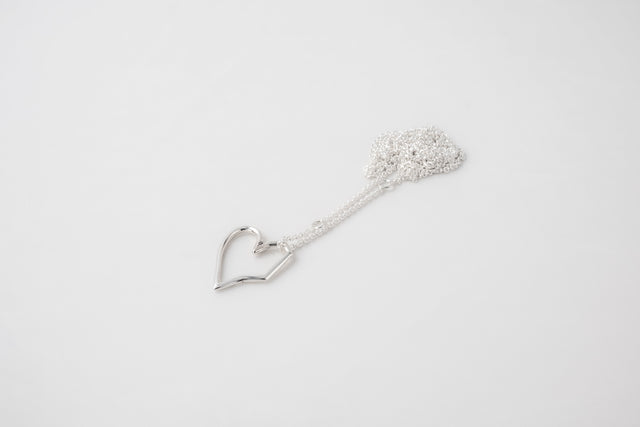
What that difference looks like in metal is on the Blade Ear Cuff (L): solid 925, no plating, nothing to wear through and nothing to re-plate. Neighbouring forms sit in STRUGA ear cuffs, the same metal in ring form in the rings section.
Updated 14 September 2026
How is sterling silver different from white gold?
By composition, and by whether anything is plated on top — everything else follows from that. Sterling silver is its own colour: 92.5% silver, the balance copper at STRUGA, with nothing over it. White gold is an alloy of gold with whitening metals — GIA describes it as pure gold mixed with white metals like nickel or palladium, often coated with rhodium. The coating evens out a colour the alloy does not always have on its own, and it is a consumable.
Two ownership scenarios grow out of that. A silver piece is worn and occasionally polished; the surface darkens and brightens, but it stays the same metal. A white gold piece is worn until the rhodium thins on the inside of the shank and the underside of a clasp, and then it goes back to be re-plated. Neither is the worse choice — they simply cost different amounts of money and attention.
| Metal | Composition | Metal per gram | Maintenance |
|---|---|---|---|
| Sterling 925 | 92.5% silver, the balance unregulated — copper at STRUGA | $1.93 | no plating, polish when you like |
| White gold 18k | 75% gold with palladium or nickel, usually rhodium on top | $105.75 | re-plating whenever the layer thins |
| Yellow gold 18k | 75% gold, copper and silver | $105.75 | no plating |
| Platinum 950 | 95% platinum, 5% iridium, ruthenium or cobalt | $54.90 | no plating, polish every few years |
Metal cost is calculated from spot prices at the close of 11 September 2026, adjusted for the precious-metal content of each alloy.
Which is more expensive — gold, platinum or silver?
At the close of 11 September 2026 the order was: gold at $4,386 per troy ounce, platinum at $1,797, silver at $64.90. Per gram of pure metal that is $141.00, $57.79 and $2.09.
Two conclusions follow, and both cut against habit. First: gold costs 2.4× more than platinum by pure metal, but only 1.93× by the gram of finished alloy — because platinum jewellery is 950 and gold jewellery is 750. Quoting the first multiple next to weights of the second is the commonest arithmetic error in this comparison, and the idea of platinum as the most expensive jewellery metal is in any case left over from the market of the 2000s. Second: the gold-to-silver ratio is not a constant. It stands at 68 today; over the past forty years the corridor has run roughly from 15 to 125, so any multiplier printed in an article about metals lives exactly until the market moves again.
In a finished piece the gaps compress. The metal in a silver ring costs a few dollars while the ring costs a few hundred, because what is paid for is hours at the bench — current prices sit on the silver rings page. In a gold ring the proportion inverts: the metal alone outweighs the work before the bench has started.
How do you tell platinum from silver — and both from white gold?
Weight and hallmark are the reliable tests; everything else is supporting evidence. A platinum ring and a silver ring of the same size differ by a factor of two — jewellery alloy densities of 20.70 against 10.40 g/cm³, and the hand registers that immediately. The 21.40 that circulates in comparison tables is pure platinum rather than Pt950, and it overstates every platinum weight by about three per cent. White gold sits between the two at roughly 14.60. For the platinum-and-silver pair one on one, with hallmark systems country by country, see platinum vs silver; the table below adds the third metal.
| Sign | Platinum 950 | Sterling 925 | White gold 18k |
|---|---|---|---|
| Hallmark | 950, PLAT, Pt950 | 925, Sterling, Ag925 | 750, 18K, 18kt |
| Weight at equal size | twice as heavy | half the weight | about 1.4× the silver |
| Tarnish | does not tarnish | tarnishes slowly, polishes off | does not tarnish; the rhodium wears instead |
| Colour | slightly greyer, colder | slightly warmer, brighter polished | cold white while plated, warmer where it has worn |
| Scratch | metal displaces into a ridge, volume stays | metal is carried away, a groove stays | harder than silver, but the plating marks first |
A magnet helps very little here: both metals are non-magnetic, but the jewellery alloy of platinum with cobalt is noticeably attracted to one. A magnet answers what a piece is not, and almost never what it is.
What does rhodium plating cost, and how often is it redone?
No published standard sets a rhodium thickness for jewellery. The CIBJO Blue Book governs how a coating must be disclosed, not how thick it has to be; ASTM B634 covers industrial rhodium plating rather than rings. What is known is the behaviour, not the number: the layer leaves high-contact surfaces first — the inside of a shank, the underside of a clasp, the edges of a setting — and how fast depends on the piece and the wearer.
Re-plating in 2026 costs $50–150 per ring — nearer the bottom at an independent bench, nearer the top at a retail counter or when stones have to be unset first. It is not a one-off cost: it repeats for as long as the piece is worn. How long a layer lasts depends on what is being worn:
- A ring worn daily — the first to go, and the fastest: the shank rubs constantly against neighbouring fingers and everything the hand picks up.
- An occasional ring — far slower, because there is almost no friction and the layer thins gradually.
- Pendants and earrings — slowest of the four: they hang rather than rub, and touch skin only at an edge.
- A bracelet clasp — faster than a ring on its underside, where metal rests on the wrist.
Sterling gets rhodium-plated too, for the same reason and with the same outcome. Once the coating goes patchy, a two-tone surface is harder to put right than the even patina of unplated metal: it has to be either re-plated or stripped entirely.
How much does the same ring weigh in each metal?
Take one band and weigh it five times: 6 mm wide, 1.7 mm thick, US size 9 — 0.66 cm³ of metal. The thickness matters as much as the width, and a comparison table that names neither cannot be checked by the reader. Weights and metal costs below are calculated from alloy densities rather than pure-metal densities: those are different numbers, and substituting one for the other throws the result out by a tenth.
| Metal | Alloy density | Band weight | Metal in the band |
|---|---|---|---|
| Sterling 925 | 10.40 g/cm³ | 6.9 g | $13 |
| Gold 14k | 13.07 g/cm³ | 8.7 g | $720 |
| White gold 18k | 14.60 g/cm³ | 9.7 g | $1,030 |
| Gold 18k yellow | 15.58 g/cm³ | 10.3 g | $1,090 |
| Platinum 950 | 20.70 g/cm³ | 13.7 g | $750 |
The least obvious thing sits in the last column: the yellow 18k band is a quarter lighter than the platinum one and still carries about 45% more money in metal. In 2026, heft in the hand and cost on the receipt point in opposite directions.
Which metal is safer for sensitive skin?
By reaction risk the four line up like this, lowest to highest:
- Platinum 950 — risk close to zero; the same metal goes into surgical implants.
- Sterling 925 — low when the balance of the alloy is copper: a true silver allergy is extremely rare.
- Yellow gold 18k — low: the higher the karat, the less of the alloy anyone reacts to.
- White gold — medium to high, for one reason: nickel, still used to whiten part of the alloys on the market.
European law limits it by release, not by recipe: an article in prolonged contact with skin may not release more than 0.5 micrograms of nickel per square centimetre per week, and for piercings the limit is stricter at 0.2 (REACH, Annex XVII, entry 27; test method EN 1811). A piece may therefore contain nickel and still be legal, as long as it stays under the threshold. The limit exists because nickel is the most common contact allergen there is — in jewellery and outside it.
Here the hallmark stops being useful: a 925 stamp fixes the silver at 92.5% and says nothing about the remaining 7.5%. ISO 9202, the international standard for precious-metal fineness, sets the fineness and leaves the balance to the maker — which is why GIA describes sterling as silver mixed with copper or nickel. On very acidic skin copper can leave a temporary green mark — a reaction on the skin rather than an allergy, and it washes off. Anyone who specifically wants white gold should ask for a palladium alloy and get the composition confirmed by the seller.
Which metal tarnishes, and what do you do about it?
Only silver tarnishes, and what tarnishes is not the silver but the copper in the alloy: it reacts with sulphur compounds in air, water and cosmetics. Gold from 14k upwards and platinum do not oxidise at all in ordinary conditions.
The practical difference is smaller than it sounds. Dark film on silver comes off with a cloth in half a minute and takes months to return. Rhodium on white gold does not darken, but it abrades — and that is irreversible without re-plating. Silver's surface is maintained by its owner; white gold's, by a workshop.
Patina is a third state, often confused with tarnish. It is the stable dark drawing that unplated metal accumulates over years in the recesses of a form and never on the high points. Where a design calls for it, the surface is darkened deliberately — controlled potassium-sulphide patination, as in the oxidised collection.
What can each metal actually be shaped into?
Silver gives the widest range of finish — one casting yields four different objects:
- Mirror polish — a cool bright metal, the closest thing to the look of white gold.
- Sandblasting — an even matte grey that hides small scratches.
- Oxidising — a near-black surface; neither gold nor platinum darkens like that.
- Darkening with the high points brought back — relief that reads across a room, and that is unreachable in gold.
Gold offers no such range: gold is always gold, and it cannot be darkened. A large form in gold runs into the weight of the metal — a five-gram 18k ring carries $530 of metal alone, a ten-gram one twice that.
Platinum behaves differently at the bench: it is gummy, melts near 1,770 °C, and needs its own tools and a jeweller who works with it regularly. Hence its territory — a simple durable form meant for decades, rather than sculpture.
Which metal should you choose for your case?
If the budget is under $250
Sterling 925 is the only precious metal in which that money buys a large designed form rather than a thin stamped one. In gold, the same sum is consumed by the metal before the work even begins.
If you want one piece to outlive you
Platinum 950. It does not oxidise, a scratch displaces metal instead of removing it, and it survives several owners without a jeweller's intervention. The entry price is the highest of the four; the cost of ownership is the lowest.
If your skin reacts to jewellery
Platinum or sterling 925. White gold is worth buying only as a palladium alloy and only with the composition confirmed; nickel-whitened alloys are best left alone.
If you want a white metal rather than a gold colour
This is where the market's main trap sits. Rhodium-plated white gold and polished sterling are close enough in a display case that most buyers read them as one metal — GIA still describes a difference in tone — and they cost and behave very differently afterwards. If it is the look you are after, silver delivers it without the re-plating bill.
Why does STRUGA work in 925 sterling silver?
925 is the base metal of the catalogue, and the reason is design rather than budget. Silver makes it possible to build large sculptural forms — asymmetric, darkened, openly textured — at a price where a piece is bought to be worn daily rather than kept in a safe. The same form in platinum would become a display object rather than a wearable one.
STRUGA deliberately does not use rhodium. Unplated 925 develops a patina over years of contact with skin, and in the dark series that patina is not a side effect but the finish itself, as in the oxidised rings. No plating means no re-plating.
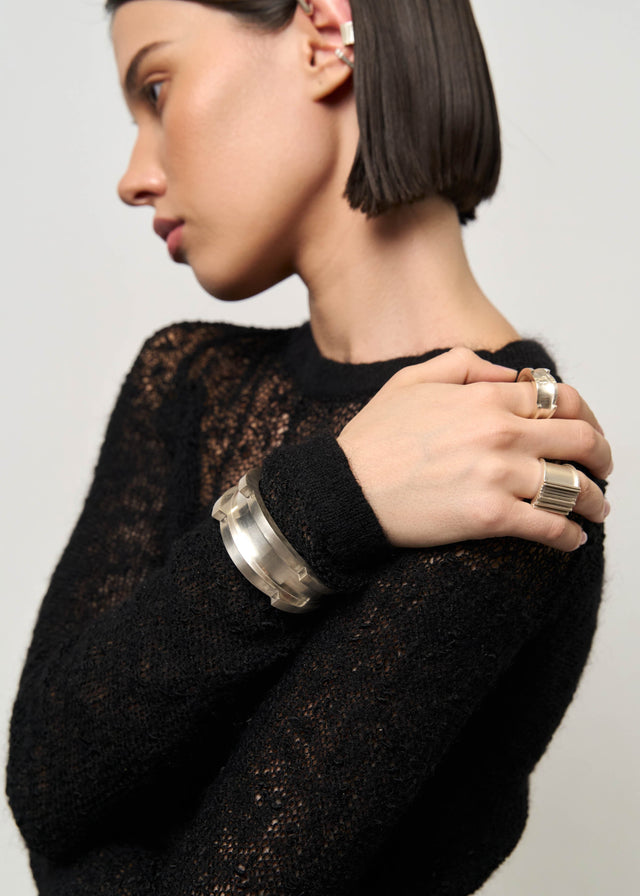
What silver makes possible is visible in the Big Thorn bracelet: a rigid frame cast in solid silver from a wax model, without rhodium, hand-fitted with fifteen carbon inserts. It is not assembled from links — its 45 grams read as a single object. For wider context see the 925 silver guide and the Atlas chapter on the metal.
| Metal | What it is good at | What it costs the owner |
|---|---|---|
| Sterling 925 | large forms and the full range of finishes at an accessible price | a polish every few months, scratches arrive sooner |
| White gold | the look of platinum at a lower entry price | re-plating for as long as it is worn, plus nickel risk if it is a nickel alloy |
| Yellow gold | a colour that never changes and needs no upkeep | the metal price caps how large the form can be |
| Platinum 950 | a piece for generations with no jeweller in between | the highest entry price and twice the weight on the finger |
Continue from the STRUGA catalogue:
About STRUGA. STRUGA is a dark silver jewelry brand founded by Dmitry Strugovshchikov and Ekaterina Strugovshchikova, handmade by master silversmiths in Bali and international workshops. The base metal is 925 sterling silver, worn unplated — left to darken on its own, or patinated at the bench where the design asks for it. The darkening is part of the design. It is a brutalist object that reacts and changes through contact with the environment and the wearer.
Frequently asked questions
Didn’t find the answer — write to us, we reply personally.
Ask a question →01Is white gold the same as silver?+–
No. White gold is an alloy of gold with whitening metals, usually rhodium-plated to even out its colour; sterling silver is 92.5% silver with the balance — copper at STRUGA — in its natural colour. They read as one metal when new, but they hold very different amounts of money: the same band, 6 mm wide and 1.7 mm thick, carries about $1,090 of gold in 18k against $13 of silver in 925 (spot, close of 11 September 2026). White gold's rhodium is a consumable and gets laid down again; sterling has no plating to fail.
02Is Living Silver the same as oxidized silver?+–
No. Living Silver is STRUGA's unplated 925 in its natural state, which develops a real patina over years of contact with skin. Oxidation is a deliberate, controlled potassium-sulphide patination applied at the bench to darken the surface intentionally — a finishing choice, not the natural ageing of the metal.
03Is sterling silver patina the same as tarnish damage?+–
No. Tarnish is a soft sulphide film that builds up over months and wipes off in seconds with a polishing cloth. Patina is the surface story the unplated metal earns over years of wear — it is a property of Living Silver, not damage or a defect, and it is reversible with care.
04Is rhodium-plated sterling the same as unplated sterling silver?+–
No. Rhodium-plated sterling looks brighter when new, but the plating wears through on the surfaces that get handled and goes patchy — leaving a two-tone finish that is harder to repair than an honest patina. Unplated sterling (STRUGA's Living Silver) is 925 in its natural state, ageing evenly with the wearer.
05Is sterling silver as good as white gold?+–
For the look, close enough that most buyers read them as one metal when new — though GIA describes a difference in tone. For durability, the difference is small in everyday wear: white gold is slightly harder, but its rhodium plating wears through and leaves an uneven surface. Sterling tarnishes, and a 30-second polish reverses it. The metal in a sterling band costs roughly eighty times less than the metal in the same band in 18k: $13 against $1,090 at the close of 11 September 2026.
06Is platinum better than silver?+–
For permanence and lifetime durability, yes — platinum is the most durable jewelry metal made. For sculptural design, daily wearability, and value, silver is the winner. The two metals are answering different questions, and both can be the right choice depending on what you want from the piece.
07Does white gold tarnish like silver?+–
White gold does not tarnish in the way silver does — but the rhodium plating wears off, exposing the alloy underneath, which runs anywhere from near-white to pale yellow and looks visibly different from the original showroom finish. Functionally this is the same problem as tarnish: the piece changes colour over time and needs maintenance. The fix is re-plating, not polishing.
08Is white gold or sterling silver better for sensitive skin?+–
Sterling silver, in most cases — but ask about the alloy, not about the hallmark. Nickel is the most common contact allergen there is, and it is still used to whiten part of the white gold on the market; Europe limits how much of it an article may release, not whether it may contain any. A 925 stamp governs only the 92.5% silver, so sterling can in principle carry nickel too. If you must have white gold, choose a palladium alloy and confirm the composition with the seller.
09Can sterling silver replace white gold for a wedding band?+–
Yes, with two trade-offs to know about: silver tarnishes (a 30-second polish reverses it), and silver is softer than white gold (it picks up scratches faster). Many couples deliberately choose silver for the design freedom and budget; many also choose silver as a starter band and upgrade later. STRUGA designs both — see our sterling silver jewelry guide for the wedding-band families.
10Does sterling silver last as long as gold?+–
Structurally, yes — sterling silver does not degrade or oxidise into the alloy in any meaningful way. 19th-century sterling jewelry is still in daily use today. The visible surface wears faster than gold (more scratches, more tarnish), but the metal itself lasts indefinitely with reasonable care.
11Should I get rhodium-plated silver or unplated sterling?+–
Unplated, in most cases. Rhodium-plated silver looks brighter when new but the plating wears through on the surfaces that get handled, leaving a patchy two-tone finish that is harder to repair than honest patina. Unplated 925 — Living Silver at STRUGA — is the alternative: the metal ages evenly, without patches.