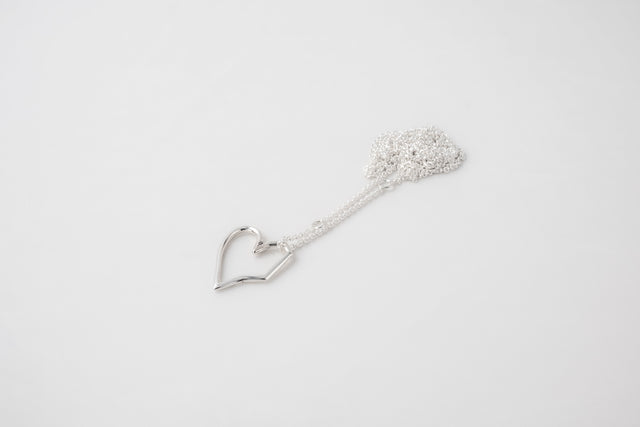
Why 925 Silver Tarnishes — and How to Clean It Safely
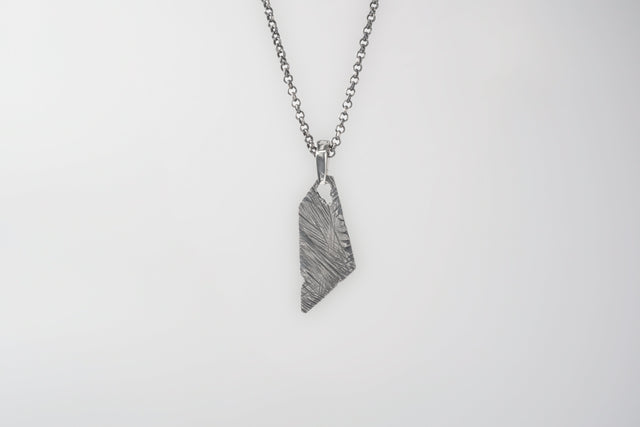
Yes — 925 sterling silver tarnishes, and so does pure silver. Traces of hydrogen sulphide and carbonyl sulphide in ordinary indoor air turn the top layer of the metal into silver sulphide, and that film looks black. Sterling darkens faster because of its 7.5% copper. Tarnish is not rust, not a health signal and not proof of a fake: it can be removed, or kept as patina.
Updated September 29, 2026
Uncoated silver that arrives bright and darkens on the wearer: Thorn Earring — 2.5 g · Fused Cross Ring — 3.7–9 g. Darkened at the bench: Brutalism V.3 Ring — 9.6–24 g.
A bright ring darkens in its recesses within a couple of months, a yellowish cast runs along the band, and a cross pendant goes black faster than the chain it hangs on. The first question is usually whether the piece is fake. It is not: this is how silver behaves. Below is what happens to the metal, why the same piece darkens at different speeds on two people, which silver does not tarnish, and how to bring back the shine without stripping the dark pattern a workshop put there on purpose.
Does 925 sterling silver tarnish, and what is the black layer made of?
Yes. The black layer is silver sulphide: the metal combines with sulphur, which is present in every room’s air. Silver always carries an invisible oxide film. When it meets hydrogen sulphide or carbonyl sulphide, that film turns into silver sulphide, Ag₂S — the dark layer you see. The mechanism is set out by Tim Burstein of the University of Cambridge in a paper for the Assay Office London. Very little gas is needed: by Burstein’s calculation, the oxide film reacts with hydrogen sulphide and carbonyl sulphide at any practical concentration — the threshold lies below what instruments can measure. Carbonyl sulphide alone is present in natural air at about 0.5 parts per billion.
It is not rust. Rust is iron oxide, while oxygen gives silver only the invisible film described above, too thin to have any colour; sulphur is what darkens it. The sulphide film stays on the surface and does not eat into the alloy beneath. Its growth slows as it thickens but does not stop, so the idea that tarnish “seals itself” is wrong: a piece left alone keeps darkening.
Why does 925 silver tarnish faster than 999?
925 is an alloy: under the Russian standard GOST 30649-99, grade 925 holds 92.5–93.0% silver and the rest is copper — the same 92.5% that makes silver “sterling”. Copper, in Burstein’s words, tarnishes as readily as silver and is the more base metal. That is why sterling darkens faster than pure silver, an observation the Canadian Conservation Institute (CCI) makes too. The copper is there for strength: by the same standard, pure silver measures 50 HV annealed, while 925 measures 77 HV and up to 170 HV after working. Without copper, a ring band or a chain clasp would not hold its shape.
Does pure silver tarnish?
It does, only more slowly. Sulphur reacts with silver itself; copper only speeds things up, so there is no fineness that stays bright. Between 999 and 925 the difference is speed, not whether the metal darkens. Pure silver is also too soft for a piece worn every day — which is why sterling exists.
Why does silver turn yellow before it turns black?
The colour shows how thick the film is: yellow is the first, thinnest stage of the same sulphide. According to CCI, as silver sulphide grows from about 10 to 100 nanometres, the surface moves from yellow through red-brown to blue; beyond about 100 nanometres the film looks black. A hundred nanometres is a ten-thousandth of a millimetre: black tarnish is a layer you can only see by its colour.
That answers a common question — why silver turns yellow. The yellow is not a different problem and not a sign of a poor alloy; it is the start of the same tarnish while the film is still thin. Left alone, it will travel the same road to black. A yellow mark can also be left by a silver dip, which CCI names separately. Rainbow streaks that look like an oil film are the same colour stages lying in patches: yellow in one place, blue in another.
On a piece that is worn, the film builds unevenly. Where metal rubs against skin and fabric, it wears away faster than it grows, so raised areas stay bright while recesses collect it and darken. That is why a relief cross goes black faster than a smooth chain whose links keep rubbing against each other, and why the inside of a ring stays lighter than the pattern outside. If a chain never darkens at all, it is most likely rhodium-plated — more on coatings below.
What makes silver tarnish faster?
Three things set the speed: a source of sulphur near the metal, humidity, and whatever reaches the silver from skin. The mechanism stays the same; only the pace changes. The table shows what speeds the reaction up and how firmly each point is established.
| What is near the silver | What happens | How well it is established |
|---|---|---|
| Rubber: stoppers, O-rings, latex gloves, rubber bands | Gives off sulphur compounds that darken nearby metal | Established: CCI |
| Wool, felt | Another sulphur source; a felt-lined box or woollen cloth darkens stored silver | Established: CCI |
| Hard-boiled eggs | Release hydrogen sulphide: in the CCI demonstration, silver next to the egg turns yellow within 5–30 minutes | Established: CCI demonstration |
| Some foods and paints, sulphur-contaminated water | Also sources of sulphur | Established: CCI |
| Humid air | At the same hydrogen sulphide level, silver tarnishes faster as humidity rises; store it below 50% relative humidity | Established: CCI |
| Sweat, fingerprints | Salt forms silver chloride on the metal, which darkens over time in light; in a sweat model, corrosion ran faster the more salt there was | Established: CCI; Park et al., 2023 |
| Cream, powder, sunscreen | Particles harder than the metal grind it into black dust — the dark mark on skin; zinc oxide and titanium dioxide are named among them | Mechanism: a peer-reviewed paper of 1985; the particles: trade papers of 1969 and 1971 |
| Water, especially with chlorine | Frequent contact with water speeds tarnish up, especially if the water contains chlorine | GIA |
| Illness, hormones, medication, “bad energy” | The primary sources describe no such link: the mechanism is sulphur in the air and salt on the skin | Not established |
Sources for the table: the CCI note on silver care and the CCI note on storing metals, the CCI page on how silver tarnishes, the sweat model in Park et al., 2023, the paper on dark marks on skin Rapson, 1985, and the Gemological Institute of America. The cosmetics studies — D. Gardam (1969) for the Goldsmiths’ Company in London and A. Fisher (1971) in the trade journal JCK — are summarised in the Hoover & Strong technical archive.
Why did my silver suddenly turn black?
A sudden jump almost always means a new, strong sulphur source nearby. A felt-lined box, a wool sweater, a rubber band in the same drawer, a soak in a hot spring or well water with hydrogen sulphide — look at what changed in storage and wear just before it happened. Silver that went black overnight is not a mystery or a diagnosis; it is a reaction to what it was kept next to.
How long does it take for sterling silver to tarnish?
There is no single answer: next to a strong sulphur source silver starts to yellow within minutes, while in a closed, dry box it stays bright for a long time. In the CCI demonstration, a sample beside a hard-boiled egg turns yellow within 5–30 minutes; in ordinary air the same road is slower, and conservation sources give no timetable: speed depends on the gas concentration, humidity and how often the metal is rubbed. Figures like “in a week” or “in a month” without conditions are guesses.
One pattern is established, though: freshly polished silver tarnishes faster than silver that has already tarnished — CCI explains that a layer of tarnish partly protects the metal from further tarnishing. So a piece you have just polished to a shine dulls again noticeably faster, and that is no sign of a poor alloy.
On the body, everyone’s pace is different. Sweat varies from person to person: its sodium runs from 10 to 90 millimoles per litre (Baker, 2019), and more salt on the metal means more silver chloride. So two identical rings on two hands look different after a month, which is normal behaviour for silver, not a fault in one of them. A piece worn every day darkens unevenly — friction keeps the raised areas bright — while in a box next to felt the film spreads over the whole surface. Why skin affects the colour, and where a black mark on the finger comes from, is covered in why silver turns skin green or black.
Does tarnish prove that silver is real?
No: tarnish proves neither that silver is real nor that it is fake. Real silver tarnishes — that part is true. But copper and brass tarnish too, and silver-plated brass darkens for as long as its silver layer lasts. The reverse also holds: 925 silver under rhodium does not tarnish while the plating is intact. Metal is checked by its fineness mark, hallmark and instruments, not by the colour of its tarnish; how to do that, and what home tests are worth, is in how to tell if silver is real.
Nor does tarnish take away the metal. The film removes neither fineness nor any noticeable mass — a layer a hundred nanometres thick weighs next to nothing, and the alloy underneath is the same. What costs metal is frequent cleaning: every polish and every chemical tarnish removal takes a little silver away, CCI warns.
Which silver does not tarnish?
No silver stays bright forever; what stays bright longer is covered by a coating or carries a protective addition. How the options compare:
| Surface | Does it tarnish? | Why |
|---|---|---|
| 999 fine silver | Yes, more slowly than 925 | Silver itself reacts with sulphur; there is no copper |
| Uncoated 925 silver | Yes | Both silver and copper react |
| 925 silver under rhodium | No, while the plating is intact | Rhodium covers the silver; where the plating wears through, the metal starts to darken |
| Argentium — silver with germanium | More slowly than ordinary 925, according to its developer | Germanium is added to the alloy, and its developer lists tarnish resistance among the benefits |
| Silver-plated brass or copper | Yes, then the layer wears through | A thin silver layer over a copper alloy |
| Silver darkened at the bench | Already dark | The dark layer is applied on purpose; recesses stay dark |
The Argentium alloy was developed by Peter Johns at Middlesex University (argentiumsilver.com). Most silver jewellery is plated with rhodium — a thin layer that holds the shine and blocks tarnish. STRUGA does not apply rhodium, by choice: the silver is left open to darken with its wearer, and that is Living Silver. How open silver and rhodium-plated silver differ in wear and care is set out in a separate comparison.
How is tarnish different from patina and oxidising?
Chemically it is one reaction; what differs is where the dark layer sits and who intended it. Burstein writes plainly that tarnishing is synonymous with patination, the only significant difference being the appearance of the product. “Tarnish” usually means a film the owner did not want; “patina” is the same sulphide lying along the relief and becoming part of how the piece looks.
Natural patina develops with time: friction lightens raised surfaces while recesses retain a darker tone. After a year the same piece looks different on two owners — the pattern records how it was worn.
Oxidising is a separate, deliberate finishing step. The workshop sets a dark layer and then exposes selected edges. Cleaning that finish as if it were plain bright silver can erase the contrast it was made to hold. The same dark colour therefore calls for different decisions: accidental tarnish on a bright piece comes off if you want the shine back, while a deliberate pattern in the recesses stays.
Of the 134 objects in the STRUGA catalogue on September 29, 2026, 17 are darkened at the bench: 13 earrings, two necklaces, an ear cuff and a ring; 16 of them belong to the RITUAL world. Among them are the Brutalism V.3 Ring and the Asymmetric Destroyed Necklace, 40 g: the plate was darkened at the bench, and the gouges across it stayed lighter than the ground. Every other silver piece arrives bright and darkens with its owner.
How do you clean tarnished silver without damaging it?
First work out what the piece is, and only then choose the gentlest method that will do the job. Solid silver or plating, stones, enamel, adhesive, hollow parts, deliberate blackening — these decide what is allowed and what is not. For most all-metal objects, CCI begins with a mild detergent and water, followed by a thorough rinse and complete drying; parts made of other materials must not be wetted.
| Method | What it removes | What it risks |
|---|---|---|
| Mild soap, water, complete drying | Oil, sweat and dust; barely touches tarnish | Almost nothing, unless there is adhesive, a cavity or a glued stone |
| Silver cloth or polish | Tarnish from the surfaces it reaches | Every polishing takes a little silver away with the tarnish |
| Dip solution | Dissolves tarnish faster than the metal — wherever it reaches, recesses included | Also takes a little silver, damages niello and strips deliberate darkening; CCI advises applying it locally and rinsing with distilled water |
| Foil, baking soda and hot water | Turns the sulphide back into silver without dissolving the metal | Leaves a loose matte layer after which silver tarnishes faster; the dark relief pattern brightens too |
| Scotch-Brite pad or sandpaper | A thin top layer together with the patina | Sets a new matte finish — a method for matte silver, not for polished |
For oxidised STRUGA objects, use a soft dry cloth on raised edges without trying to bleach the recesses. If the construction or finish is unknown, stopping is safer than testing an aggressive recipe on the piece itself. Take a piece to a jeweller if it has stones, enamel, gilding, glued joints or hollow parts, or if it is cracked or has a loose stone.
Step-by-step routines are in how to clean silver rings; care for darkened silver is in the oxidised silver care guide; and how to store silver so it darkens more slowly is in how to prevent silver from tarnishing.
How is STRUGA silver finished, and what does that mean for care?
STRUGA silver carries no coating: it arrives bright and darkens on its wearer, and part of the range is darkened in advance, at the bench. By the catalogue count of September 29, 2026, 117 of 134 objects contain 925 silver, and none of them is rhodium-plated. Seventeen are darkened at the bench; the Living Silver collection gathers 89 bright ones. Carbon does not tarnish at all, and the light inserts in it are a silver-plated jewellery alloy, not silver.
Care follows from that. A bright piece needs only a cloth, if you want the shine; the patina can also stay — it brings out the relief. It can be reset, too: with a silver-cleaning solution, or on matte silver with a Scotch-Brite pad or sandpaper, which remove a thin top layer and set a new matte finish. That is the owner’s choice, not a repair. A darkened piece needs a dry cloth on the edges and no dips. The workshop cleans and makes small repairs to any STRUGA piece free of charge for as long as it is with its owner; shipping to us is on the owner, and patina is removed only on request.
The pattern shows most where there is relief and a gap. The Blade Mini Link Earring, 4.2 g, is a link split in two and reassembled on copper pins: the recesses darken, the planes stay bright. In the Fused Cross Ring, four molten rods meet inside a round openwork frame: shadow gathers in the gaps between them, and the raised edges lighten with friction.
Uncoated silver does what it was left open to do: it records where it has been and how it was worn. Care is deciding how much of that record to keep.
Which sources is this guide based on?
- G. T. Burstein. The tarnishing conundrum of silver — the mechanism: the oxide film, hydrogen sulphide and carbonyl sulphide, copper in sterling, tarnish and patina as one reaction.
- CCI. Understanding how silver objects tarnish — colour stages by film thickness, why 925 tarnishes faster than 999.
- CCI Notes 9/7. Silver: care and tarnish removal and CCI Notes 9/2. Storage of metals — sulphur sources, humidity, cleaning and its risks.
- Park et al., 2023 and Baker, 2019 — sweat, its salt and silver chloride.
- GOST 30649-99 — composition and hardness of 999 and 925 silver.
- Argentium and GIA — the germanium alloy; water, chlorine and rhodium plating.
- Rapson, 1985 — the black mark on skin from abraded metal.
- STRUGA catalogue count of September 29, 2026 — finishes, materials and number of objects.
About STRUGA. STRUGA is a dark silver jewelry brand founded by Dmitry Strugovshchikov and Ekaterina Strugovshchikova, handmade in Bali by master silversmiths. Most pieces are 925 sterling silver left uncoated, so they darken with wear; part of the range is darkened in advance, at the bench. The darkening is part of the design.
Frequently asked questions
Didn’t find the answer — write to us, we reply personally.
Ask a question →01Does real silver tarnish?+–
Yes. Silver combines with sulphur in the air and forms silver sulphide, and the 7.5% copper in 925 speeds that up. Pure 999 silver tarnishes too, only more slowly. It is a property of the metal, not a defect.
02Does pure silver tarnish?+–
Yes — no fineness stays bright: 999 and 925 both tarnish. What stays bright longer is silver under rhodium plating, while the plating is intact. Argentium, a germanium alloy, is described by its developer as tarnish-resistant.
03Why does silver turn yellow?+–
A yellow cast is the first stage of the same silver sulphide, while the film is still thinner than about 100 nanometres. As it grows it passes through red-brown and blue and turns black. A yellow mark can also be left by a silver dip.
04Why did my silver suddenly turn black?+–
Usually a strong sulphur source appeared nearby: a felt-lined box, wool, a rubber band, eggs, hot-spring or well water with hydrogen sulphide. Humidity speeds the reaction up. There is no mystery or diagnosis behind it.
05Is silver tarnish rust?+–
No. Rust is iron oxide; the dark layer on silver is silver sulphide from sulphur in the air. Neither conservation sources nor studies of sweat link tarnish to illness, hormones or medication.
06Does tarnish prove that silver is real?+–
No. Copper, brass and silver-plated pieces tarnish too, and silver under rhodium does not tarnish while the plating is intact. Metal is checked by its fineness mark, hallmark and instruments, not by the colour of its tarnish.
07How is patina different from deliberate oxidising?+–
Patina develops through wear: raised areas lighten with friction and recesses darken. Oxidising is set by the workshop as part of the finish. Aggressive cleaning can erase the intended dark pattern.
08How long does it take for sterling silver to tarnish?+–
There is no single timetable. Next to a strong sulphur source silver yellows within minutes — within 5–30 minutes beside a hard-boiled egg in the CCI demonstration — while in a dry, closed box it stays bright for a long time. Freshly polished silver tarnishes faster than silver that has already darkened.