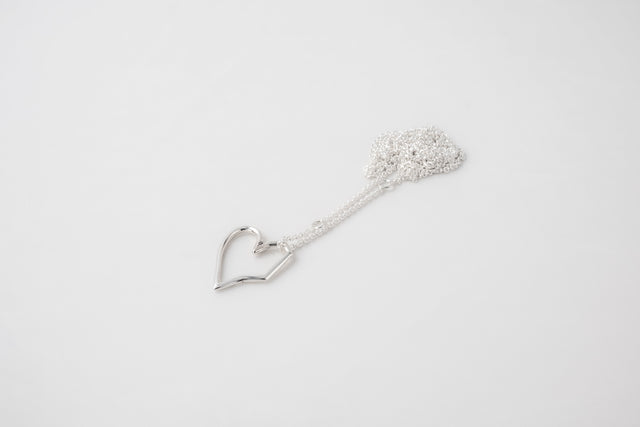
Ear Stacks and Curated Ears — A Layering Guide for Cuffs, Studs, Hoops, and Mixed Metals
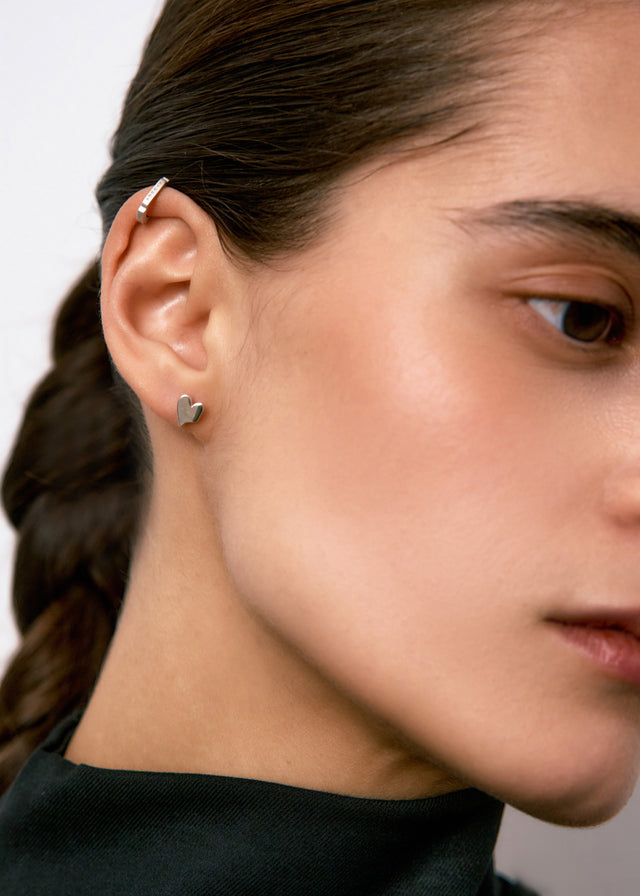
In short.
- Most well-composed stacks land at 2–3 pieces per ear; more than four needs careful compositional discipline.
- Three rules: graduated scale (largest on the lobe, smallest up top), one hero with one or two supporters, repeated metal or motif.
- An ear cuff is usually the supporting piece above the lobe; its exact position and fit depend on the ear and the object, and it covers an upper-ear position without another piercing.
- Mixing silver and gold works on the one-third / two-thirds rule: one metal dominates, the minority metal serves one clear accent purpose. A 50/50 mix reads confused.
- Ear curation is the long-game version: each proposed piece is tested against the exact objects already worn, without a fixed buying interval.
Updated August 2026
An ear stack — or "curated ear", or "ear party" if you came up through Instagram in the late 2010s — is the practice of wearing several pieces on a single ear at once. A small stud in the lobe, a hoop one position up, an ear cuff on the upper helix. The look reads as a deliberately assembled composition rather than three pieces of jewellery competing for attention. Low-cost to update, fully reversible at the end of the day, instantly modern.
Done poorly, an ear stack reads as clutter. Three pieces of mismatched metal at the same scale, fighting each other for the eye. The difference between "curated" and "cluttered" is not budget — it is composition. A two-piece stack of well-matched metal at correctly graduated scales reads richer than a six-piece stack assembled at random.
This guide covers how to build a stack that reads intentional: the three rules of scale and rhythm, the mixed-metal logic that lets silver and gold sit together without arguing, where ear cuffs fit, and how to evolve a stack over time. The principles apply whether you have one lobe hole or eight — cuffs cover the upper-ear positions without committing to a piercing.
I am Dmitry Strugovshchikov, founder of STRUGA. We make ear cuffs in Bali, but the styling logic here is broader — it is the same compositional discipline that runs through any layered jewellery look. Most of what I learned came from photographing customers wearing our pieces alongside the rest of their jewellery, and noticing what made some compositions sing while others fell flat.
A current lobe piece to start a stack from: Signature Heart Stud Earring.
The three rules of a curated ear
Stacks that read composed obey three rules. They are not strict — every rule has exceptions — but breaking more than one at the same time is what tips a stack from "intentional" to "chaotic".
Rule 1: Graduated scale. Pieces should differ in visual weight from bottom to top. The lobe wears the largest piece, the mid-helix wears something medium, the upper helix or top crown wears the smallest. Three pieces of identical visual weight read as repetition; three pieces in clear scale order read as composition. Scale is not the same as size — a small but visually dense piece (a heavy stone, a textured surface) reads larger than a thin smooth band of the same physical dimension. Composition is about visual weight.
Compare the exact pieces together before deciding. Catalogue labels cannot show how their scale, texture and position interact on one ear.
Hero, supporters, and a repeated thread
Rule 2: One hero, two supporters. Most well-composed stacks have one piece that anchors the look — usually the largest, most distinctive piece — and one or two supporting pieces that defer to it. Four equal heroes is a competition; one hero with two supporters is a chord. The hero is most often a lobe piece, with the cuff and the second-position piece playing supporting harmony.
Rule 3: Repeated metal or repeated motif. The eye reads unity through one of two channels. Either the metals match across the stack or one motif repeats: round geometry, oxidized texture, or a shared colour. Without one thread, a stack reads as separate pieces on the same ear. With one, the pieces read as a set.
Customers who break only one rule (intentional same-scale "minimalist" stacks, or one hero with one equal-weight supporter) usually still produce a coherent look. Breaking two simultaneously almost always reads as chaotic.
Where the ear cuff fits in the composition
An ear cuff is the supporting piece in most stacks. It sits on the upper ear above the lobe and below the top crown, occupies a position that lobe and stud-only wearers cannot, and provides the upward visual movement that makes a stack feel layered rather than just "ear with stuff in it".
The cuff's strength as a supporter is that it is shape-flexible. A simple smooth band is a quiet supporter; an angular or textured cuff carries more weight and pulls toward hero status. A wearer designing a stack chooses the cuff's visual register based on what the lobe piece is doing. Big bold lobe stud → quiet smooth-band cuff. Subtle lobe stud → louder textured or angular cuff. The two pieces should be in dialogue, not duplicating each other.
Without a lobe piece, the cuff can become the visual anchor. A second cuff may then take the supporting role. Position and fit still belong to the exact ear and object; use the sizing guide rather than a universal placement promise.
Two-cuff stacks without another piercing
Stacking two cuffs on a single ear — one in the upper-middle helix and one closer to the top crown — is one of the cleanest ways to add visual depth without additional piercings. The two cuffs read as a composition immediately, because the rhythm is established by the pair. The upper cuff is usually slightly smaller in diameter than the lower one (graduated scale, Rule 1). Both should share metal or motif (Rule 3). The hero-supporter logic plays out within the pair: one cuff is more decorative, the other is the quiet repeat.
In our ear cuffs collection one form is made at two sizes: the Brutalism Ear Cuff V.1 (M) and the Brutalism Ear Cuff V.1 (L) carry one relief at two diameters, so the pair reads as a chord rather than two unrelated notes.
Check both objects as a pair: metal, surface, diameter, visual weight and current availability. A family resemblance supports the composition, but the exact two pieces determine whether the scale really graduates on the wearer.
Mixed metals — when silver and gold can share a stack
For two decades the styling rule was strict: silver with silver, gold with gold, never the two together. That rule is now considered out of date in jewellery editorials, and the contemporary view is that mixed metal can read as the most intentional choice in the stack — provided the ratios are deliberate and one metal anchors the composition.
The contemporary rule is one-third / two-thirds. The minority metal should be unmistakably less than half the visual weight of the majority. A predominantly silver stack with one gold accent reads as composed; a 50/50 silver-and-gold stack reads as confused. The minority metal should also serve a clear purpose — it should highlight a specific detail rather than appear randomly distributed across the stack.
Treat the ratio as a visual check, not a measured formula. Surface, stone, thickness and position can change which metal appears dominant.
Mixed-metal patterns and failure checks
The most reliable mixed-metal patterns are: silver stack with one gold-stone accent; gold lobe with silver upper helix, where the metals sit at distinct positions; and oxidized silver between bright silver and rose gold. The oxidized silver explained guide covers the material context for blackened silver.
Failure begins when no element establishes hierarchy. Equal visual weight, alternating metals without a repeated motif, or several unrelated finishes can make the ear read as separate objects. Reset the comparison: choose one dominant metal, give the second one a single role, and repeat one geometry or surface. Test the exact objects together; do not infer the result from metal names alone.
Other current pieces for the same two positions: Thorn Stud Earring on the lobe, and Signature Asymmetric Ear Cuff (L) above it.
Current product pages establish the actual metal, stone, scale and availability; a styling pattern never supplies a missing catalogue fact.
Ear curation — the long-game version of stacking
Ear curation is the slow version of a daily stack. Instead of treating every new piece as a complete restart, compare it with what is already worn: position, visual weight, metal, surface and repeated motif. The sequence can develop over time without assigning a fixed shopping interval.
The wardrobe analogy is useful only as a checking method. Save the exact objects, then ask what the new one contributes and which existing piece it supports. A cuff can open an upper-ear position without adding another piercing, and it can be changed as the composition develops.
Start from a stable anchor, such as an existing lobe stud, then test one cuff against it before introducing another object. The current minimalist silver collection offers quieter forms, but availability and fit belong to each object page. Curation describes deliberate comparison, not a required piece count or timetable.
Stacking with men's ear cuffs
The composition rules do not require a gendered size or piece count. Start with the wearer's actual ear, existing jewellery and preferred visual weight. A single lobe stud can be paired with a quieter cuff; without a lobe piece, the cuff can hold the visual centre.
A second cuff can extend the composition without another piercing, but it must be checked against the first for scale, metal, surface and fit. “Men's” is a route into styling language, not evidence that one placement or diameter works for every wearer.
The men's ear cuffs guide provides the adjacent vocabulary. Return from that guide to the exact product page for dimensions, material and current availability, then test the object on the intended ear. The object-level record outranks a category assumption.
Keep the chosen side, position and pairing in the same record so the comparison can be repeated without relying on memory.
Common mistakes
-
Equal visual weight
Three equally dense pieces compete. Replace one with something smaller, smoother or quieter, then compare the hierarchy again on the exact ear and side.
-
Unassigned metal contrast
Random mixing has no dominant note. Choose a majority metal and let the minority metal serve one specific, visible accent purpose.
-
Every object is a hero
All loud and all decorative removes the focal point. Keep one anchor and soften the remaining objects through scale, position or surface.
-
The cuff has no shared thread
A disconnected cuff breaks the composition. Repeat a metal tone, geometry, texture or colour already present in a documented lobe piece. Save the exact pairing and compare it again before changing another variable in the stack.
After one correction, stop and compare again. Changing scale, metal and motif at once makes it impossible to see which relationship repaired the stack.
Keep the comparison record beside the exact object links, so a later change in one piece does not silently alter the original styling decision.
Building a starter stack with one ear cuff
Begin with the object already on the lobe and compare one cuff against it. Four practical relationships cover the first decision:
- A simple bright-silver stud can meet an oxidized-silver cuff: one metal family, contrasting surface, checked together in the same light.
- A stone stud can meet a smooth cuff that repeats the documented setting metal without competing with the stone.
- A statement lobe piece needs the quietest cuff, so the selected anchor remains clear.
- A hoop can meet a cuff that repeats its curve; an angular contrast should be deliberate and checked on the intended ear.
Wear the two objects together, record what feels missing or excessive, and adjust before adding another piece. Two verified objects can form a complete stack. The next addition should earn a clear, documented role rather than satisfy a preset count.
Recheck the same pair from the front and side before documenting another addition to the stack.
STRUGA's stacking philosophy
STRUGA cuffs are designed to read as supporters by default, not heroes. Many wearers have lobe pieces already, and the cuff can extend an existing stack upward. A loud, decorative cuff competes with what is already on the ear; a smooth or moderately textured cuff completes it.
For wearers who want the cuff itself as the hero — usually those without lobe pieces — the heavier forms carry the anchor. The Brutalism Ear Cuff V.3 Dark Treatment (M) is the one cuff blackened at the bench; the blackened silver collection gathers the pieces that leave the workshop already dark. Every other cuff is Living Silver: it arrives bright and darkens on the wearer. A heavier cuff carries enough visual weight to anchor a stack on its own, and it pairs with a quieter supporting cuff lower on the helix when the wearer wants a two-cuff composition.
The deeper context — how uncoated silver darkens on the wearer, and when a piece is blackened at the bench instead — is in our Living Silver philosophy and the founder story. The short version: darkened silver is the most flexible neutral in jewellery composition, sitting cleanly between bright silver and gold without forcing a choice.
Related guides in this cluster
Use each guide for one exact question, then return to the object page. The cluster separates fit, object type, styling context, material and current catalogue routes.
- Ear cuffs guide — pillar reference.
- How to wear ear cuffs without committing to a piercing.
- Sizing and fit guide.
- Ear cuffs vs studs vs hoops.
- Men's ear cuffs guide.
- All ear cuffs collection.
- Oxidized silver earrings collection.
- Minimalist silver collection.
About STRUGA. STRUGA is a dark silver jewelry brand founded by Dmitry Strugovshchikov and Ekaterina Strugovshchikova, handcrafted with Balinese and international silversmiths. Every piece is 925 sterling silver, naturally oxidized or hand-patinated. The darkening is part of the design. It is a brutalist object that reacts and changes through contact with the environment and the wearer.
Frequently asked questions
Didn’t find the answer — write to us, we reply personally.
Ask a question →01Is an ear stack the same as ear curation?+–
No. A stack is daily styling — assembled and disassembled in a day. Ear curation is the long game: pieces accumulated deliberately over months or years, each one tested against the existing set before it is added. A stack is an outfit; a curation is a wardrobe.
02Is "mixed metal" the same as random metal mixing?+–
No. Mixed metal is a deliberate ratio — the one-third / two-thirds rule, where one metal dominates and the minority metal serves a single clear accent. Random mixing interleaves gold and silver at equal weight and reads confused, not composed.
03Is an ear cuff the hero of a stack?+–
Usually not. The cuff is most often the supporting piece, giving upward extension above the lobe. It only becomes the hero by default for wearers with no lobe pieces, where nothing else holds the visual centre.
04Is graduated scale the same as size?+–
No. Scale is visual weight, not physical dimension. A small but dense piece — a heavy stone or a textured surface — reads larger than a thin smooth band of the same size. Composition orders pieces by visual weight, lobe to upper ear.
05What is an ear stack?+–
Several pieces of jewellery worn on a single ear at once — typically a lobe stud, a mid-helix piece, and an ear cuff on the upper helix. The composition reads as deliberately assembled rather than as competing pieces.
06How do I layer ear cuffs with earrings?+–
Choose the cuff against your existing lobe piece. Statement lobe → quiet smooth-band cuff. Simple lobe → cuff can carry more weight. Match either metal or motif (texture or geometry) so the stack reads as a unit.
07Can I mix silver and gold in an ear stack?+–
Yes, with the two-thirds rule: one metal dominates, the other serves a specific accent purpose. Silver-dominant with one gold accent reads composed; a 50/50 mix reads confused.
08How many pieces should I have in an ear stack?+–
Most well-composed stacks land at 2–3 pieces per ear. Two pieces well chosen beat three chosen at random. More than four requires careful compositional discipline.
09What is the difference between an ear stack and ear curation?+–
Stack is daily styling — assembled and disassembled. Curation is long-game: deliberately accumulating pieces over months or years that work together, each tested against the existing curation.
10Where does the ear cuff sit in the stack?+–
On the upper-middle helix, above mid-helix pieces and below the top crown; the exact position depends on the ear and the object. The cuff provides upward visual extension that makes a stack feel layered.
11Can I wear two ear cuffs on the same ear?+–
Yes — two-cuff stacks add visual depth without additional piercings. One in upper-middle, one near top crown. Graduated scale (smaller higher), shared metal or motif so the pair reads as a chord.
12What is a curated ear?+–
An ear styled with multiple pieces that have been deliberately chosen to work together as a composition. Editor's term for ear curation, with emphasis on long-game build over daily styling.
13Can men do ear stacks?+–
Yes — men's stacks tend to be smaller (1–2 pieces) and lower in visual weight. Same rules apply. A common pair: lobe stud plus upper-helix smooth-band cuff.
14What is mixed metal earrings?+–
Wearing pieces in different metals on the same ear or across both. Use the two-thirds rule: one metal dominates, the other serves a clear accent purpose. Random mixing reads confused.
Continue from the journal to a current STRUGA object: Signature Asymmetric Ear Cuff (L).