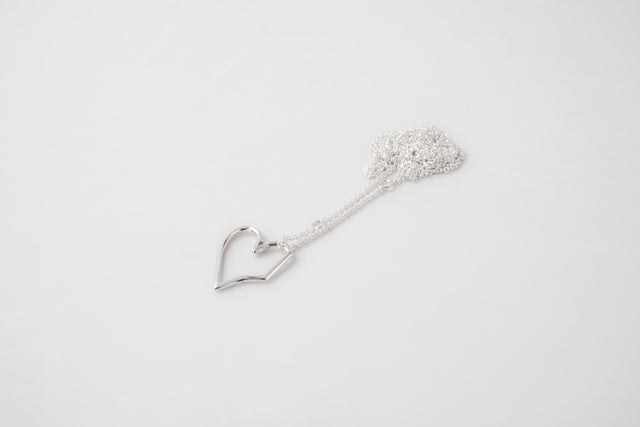
Silver Bracelets for Women: Styles, Widths, Stacking 2026
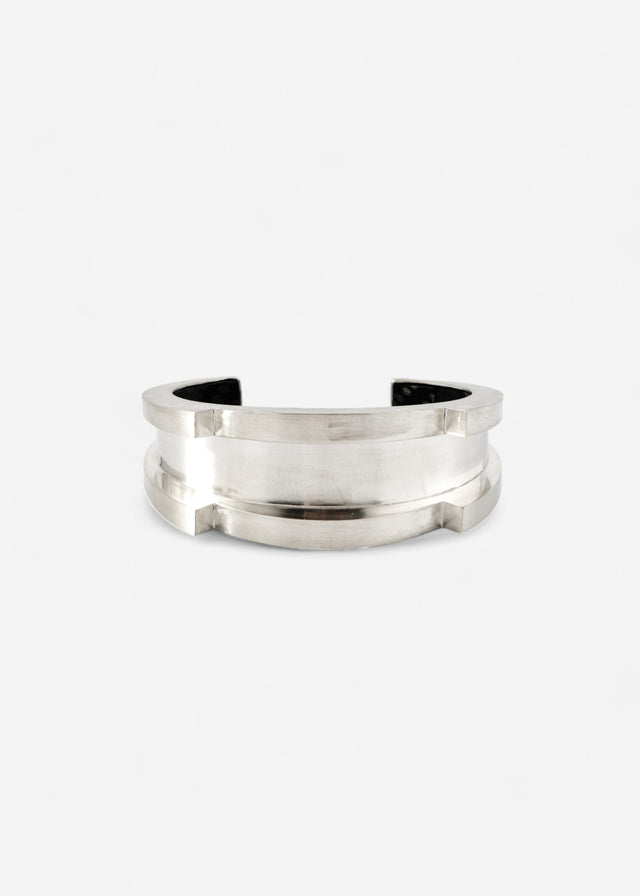
Choice starts with construction, not pattern: a chain, an open cuff, a closed bangle or beads — then width and weight, and only then size.
The numbers below come from the STRUGA catalogue, from the 5-gram Thorn Bracelet chain to Big Thorn, an open rigid cuff in silver and carbon. STRUGA does not split bracelets into women's and men's: size follows the wrist, not the label.
A woman's silver bracelet is chosen by construction, width, weight and size. Up to 3–4 mm a bracelet reads as an everyday line; from about 8 mm it becomes the main piece on the arm. Construction sets the weight: at 17–17.5 cm, STRUGA's silver bracelets weigh from 5 to 113 grams. Size is the wrist measurement plus room for the construction; sterling 925 means at least 92.5% silver.
Updated October 1, 2026
Which silver bracelet should you choose — chain, cuff, bangle or beads?
For everyday wear without taking it off, a chain bracelet is the easiest: it bends with the wrist and does not argue with a sleeve. A rigid form reads stronger but asks for an exact size. The five constructions differ in how they go on and what you measure:
| Construction | How it goes on | What to measure |
|---|---|---|
| Chain with a clasp | fastens around the wrist | wrist circumference and the length of the piece |
| Cuff, open and rigid | slides on sideways through the gap | wrist, inside dimensions and the opening |
| Bangle, closed and rigid | passes over the hand | the hand, as the maker specifies |
| Beads | on a cord or with a clasp | wrist circumference |
| Charm bracelet | a chain with a clasp | wrist plus room for the charms |
Chain bracelets
The largest family. Cable, curb, figaro, rope, snake, box, byzantine — each name describes how the links interlock. A curb is a cable chain whose links have been twisted to lie flat, which turns round rings into a dense, flat band on the wrist. Figaro is named after the barber of the opera: Italian chainmakers named their patterns after operas.
A chain's weak point is its clasp, and on cheap pieces it fails first. STRUGA builds its chains from its own links: THORN links in the Thorn Bracelet, flat BLADE links in Blade Medium Links V.2 with a toggle, elongated asymmetric links in Signature Links. All of them are in chain bracelets.
Cuffs: open rigid bracelets
A cuff is open at the back and slides onto the wrist from the side, so its inside can sit closer to the arm than a bangle's ever could. STRUGA's rigid form is Big Thorn, the brand's first rigid bracelet: a silver arc set with fifteen carbon elements, 45–95 g across five sizes from 16 to 23 cm. A rigid bracelet should not be bent to fix a size; ask whether the exact model can be adjusted before you buy.
Bangles: closed rigid bracelets
A bangle is closed, so the hand decides, not the wrist: it has to pass over the knuckles with the fingers drawn together. Too loose and it spins and slides onto the hand; too tight and it will not go on. Measure the way the maker of that bangle specifies — a closed form has no universal allowance over the wrist. The current STRUGA range has no closed bangle; the open cuff takes its place.
Beaded bracelets
Beads sit softer than a chain: each one turns on its own and catches the light separately. Small Beads with Heart is a chain of silver balls closed by the Heart Lock — the classic clasp of a ball chain, reworked in the SIGNATURE HEART form. Big Beads with Capsule, from the LAB world, is larger and heavier. Both are in beaded bracelets.
Charm bracelets
The base is a chain with a strong clasp. Charms add weight and bulk, so the bracelet needs more room than a bare chain, and on well-made pieces each charm hangs from a soldered ring. In Carabiner #2 Mini any link can be the charm: each micro carabiner opens, comes off and moves to a chain as a pendant.
What width silver bracelet looks best on a woman's wrist?
For everyday wear 3–4 mm is usually enough: the bracelet shows without competing with a watch or a sleeve. Narrower reads as a line for a stack; past 8 mm a bracelet becomes the main piece on the arm.
| Width | Reads as | How to wear it |
|---|---|---|
| 2 mm | a fine line | stacked with two or three others |
| 3–4 mm | everyday | alone or beside a watch |
| 5–7 mm | a visible accent | alone, with a plain sleeve |
| 8–15 mm | the main piece | alone, on a bare forearm |
| 15 mm and wider | close to a cuff | bare arm, quiet top |
The same width looks larger on a slim wrist than on a broad one, so check millimetres against the arm rather than the chart. Width is not weight either: the BLADE link comes as a lighter 17-gram bracelet and as the original 50-gram one at the same 17 cm — alike to the eye, entirely different on the wrist. How proportions shift between men's and women's bracelets is set out in our comparison of widths, lengths and weights.
How much should a sterling silver bracelet weigh?
As much as its construction requires: at the same 17–17.5 cm, STRUGA's silver bracelets weigh from 5 to 113 grams. A fine chain is barely felt; 15–20 grams is noticed without pulling; past 50 grams the wrist registers the piece with every movement.
| Bracelet | Length | Weight | Price |
|---|---|---|---|
| Thorn Bracelet | 17 cm | 4.95 g | $199 |
| Carabiner #2 Mini | 17.5 cm | 13 g | $345 |
| Blade Medium Links V.2 | 17 cm | 17 g | $545 |
| Small Beads with Heart | 17 cm | 17 g | $550 |
| Blade Mini Links | 17 cm | 50.5 g | $1,237 |
| Big Thorn | 17 cm | 52 g | $1,478 |
| Carabiner #2 Big Cross | 17.5 cm | 112.74 g | $3,205 |
Weights are catalogue figures for size S; every handmade piece varies slightly.
“Heavier means solid” only works within one pattern and one width. A solid cable chain with 4 mm links weighs about 35 g per metre — some 6 g at bracelet length, according to the Cookson-CLAL specification. A hollow marine chain weighs about half as much as a solid one of the same pattern in the Halstead catalogue, because each hollow link is a thin-walled tube. Weight does not prove a bracelet is real silver; the purity mark and the traces of handwork do.
Which bracelet clasp is the most secure and the easiest to fasten?
A good clasp closes with one hand and does not open with a tug. A small spring ring is fiddly to fasten on your own wrist; a toggle and a carabiner are easier. A toggle holds only at the right length: on a loose bracelet the bar can slip back through the ring.
- Toggle — the bar passes through the end link and lies across it, with no spring. Signature Links, Asymmetric Minimalist and the lighter BLADE V.2 bracelets close this way.
- Carabiner #2 Big — a massive clasp that becomes part of the design; Blade Mini Links and Blade Big Links always close with it.
- Heart Lock — the ball-chain clasp in the SIGNATURE HEART form, on Small Beads with Heart.
- No clasp — Big Thorn: the rigid frame holds its shape, with neither moving links nor a lock.
What size bracelet should a woman get?
Measure your wrist with a flexible tape or a paper strip where the bracelet will sit, then add room for the construction. A fine chain needs little; heavy links and charm bracelets need more; for a closed bangle you measure the hand, not the wrist.
- The tape lies on the skin without pressing in. Write the number down without any allowance: “wrist 15.5 cm”.
- For a chain, add ½ inch (about 1.3 cm) for a snug fit or a full inch (about 2.5 cm) for a relaxed one, as Mejuri’s sizing guide puts it; one finger should fit under the chain.
- Thick links take up room inside the bracelet, so a heavy chain needs more length than a fine one on the same wrist.
At STRUGA a size is the length of the piece including its clasp, not a wrist measurement: S is 17 or 17.5 cm and M is 21 or 21.5 cm, depending on the model, and Big Thorn comes in five sizes from 16 to 23 cm. Compare the length with a bracelet that already fits before ordering — the bracelet size guide goes through it model by model. Custom Order makes lengths outside the range in 2–4 weeks from sketch approval: a frame, not a promise.
How do you stack silver bracelets on one wrist?
Combine different constructions: a rigid piece next to a flexible chain reads as two objects, while two identical chains merge into one.
- One main piece. Either the cuff is the centre and chains support it, or the charm bracelet is the centre and a fine chain frames it. Two centres compete.
- Different weights and textures. A 5-gram chain beside a 50-gram one reads as a decision; three bracelets of the same mass read as one wide band.
- Space. Three bracelets with a centimetre of bare wrist between them look deliberate; seven packed tight look forced.
- The watch counts. A 38 mm case and three heavy bracelets on one wrist is too much; a watch and one chain is a quiet day.
How many bracelets to wear and which weights work together is the subject of the bracelet stacking guide; necklaces, wrists and hands as one composition — of the guide to layering silver jewelry.
How can you tell a silver bracelet is real?
Two checks cover most cases: the purity mark and the traces of handwork. In the US, calling a piece “sterling” or “solid silver” is deceptive unless it is at least 925/1,000 silver, under the Federal Trade Commission’s jewelry guides; in the UK, an assay office hallmark means that the whole piece is no less than the fineness it shows, as Assay Office London explains. A missing mark is a reason to ask the seller rather than proof of a fake: marking rules differ from country to country.
Handwork leaves faint asymmetry, marks from the file and the polishing wheel, and small differences between two pieces of one model; mass-cast silver is identical piece to piece. Neither is worse, but they are not the same object. Sterling 925 means at least 925 parts of silver in 1,000; the rest is usually copper, because pure silver is too soft to hold a link. The alloy is explained in the Atlas section on 925 silver.
Why does a silver bracelet darken, and how do you clean it?
What darkens is not the metal as a whole but a thin film on its surface: sulphur-containing gases in the air react with the copper and silver of the alloy, and humidity speeds this up, as the Sheffield Assay Office explains. The wrist is a hard place for silver: sweat collects under the bracelet, its salt reacts with the metal, and lotion fills the recesses.
STRUGA's silver is Living Silver: 925 left without rhodium plating, so it darkens by design. Friction brightens the raised edges, the recesses stay dark, and the surface becomes a record of how the bracelet is worn.
- To bring back the light — a soft cloth or a silver-cleaning liquid; on a matte surface, a gentle abrasive that takes off a thin top layer together with the patina.
- To keep a dark finish — pieces blackened at the bench are wiped with a dry cloth only: a cleaning liquid strips the darkening that was put there on purpose.
- Before water — take the bracelet off for swimming, bathing and the beach, and keep perfume and body lotion away from it.
- Storage — dry, and apart from other jewellery.
The chemistry is set out in the Atlas section on why silver tarnishes, cleaning in the bracelet care guide, and dark finishes on the page about oxidized and Living Silver bracelets.
Where can you buy a STRUGA bracelet?
For the international market, STRUGA objects are made in Bali. Silver bracelets in the range run from the $199 Thorn Bracelet to the Carabiner #2 Big Cross at $3,705 in its largest size; the Atlas section on bracelets sets the forms side by side.
- Online — strugadesign.com ships worldwide. Silver and carbon pieces are made to order in 2–4 weeks, often sooner; delivery adds about a week, and orders from $300 ship free.
- In person — on Bali at Hedonist Store and Barefoot Aristocracy, in Phuket at Soul Mate, in Dubai Hills at Poison Drop.
- Outside the range — Custom Order makes another length or a form of your own in 2–4 weeks from sketch approval: a frame, not a promise.
Frequently asked questions
Didn’t find the answer — write to us, we reply personally.
Ask a question →01What is the difference between a bangle and a cuff?+–
A cuff is open: it slides onto the wrist sideways through its gap, so it is sized to the wrist. A bangle is closed and goes on over the hand, so the hand decides its size. A rigid bracelet without a gap is a bangle, not a cuff.
02How much should a real silver bracelet cost?+–
The price follows the weight of silver and the work: links, clasp and hand finishing. STRUGA's silver bracelets run from $199 for the Thorn Bracelet chain to $3,705 for the Carabiner #2 Big Cross in 21.5 cm, and the heavy BLADE link chains start at $1,237.
03What size bracelet should a woman get?+–
Measure your wrist and add room for the construction: about ½ inch for a snug chain, a full inch for a relaxed one, more for heavy links. STRUGA's size S is 17 or 17.5 cm and M is 21 or 21.5 cm, measured with the clasp.
04How much should a sterling silver bracelet weigh?+–
As much as its construction needs: at 17–17.5 cm, STRUGA's silver bracelets weigh from 5 to 113 grams. Compare weight only within one pattern and width — a hollow chain weighs about half as much as a solid one of the same pattern — and do not treat it as proof of real silver.
05Does a silver bracelet turning black mean it is damaged?+–
No. Sulphur in the air and salt from sweat form a thin film on the surface; the alloy beneath is not eaten away, and the film comes off with a cloth or a silver-cleaning liquid. STRUGA leaves its silver without rhodium on purpose, so darkening is a property, not a defect.
06Can I wear a silver bracelet in water?+–
Take it off for swimming, bathing and the beach: salt reacts with silver, and perfume and body lotion speed up tarnish. Brief contact with fresh water does no harm — dry the bracelet afterwards.
07Which wrist should a silver bracelet go on?+–
There is no rule. Many people choose the hand they write and work with less, where a bracelet knocks against desks and keyboards less often — that matters most for a rigid cuff. With a watch, a bracelet either shares its wrist or balances the other one.
08Can STRUGA make a bracelet in another length?+–
Yes: Custom Order makes lengths outside the range and forms of your own. The guide is 2–4 weeks from sketch approval — a frame, not a promise; the exact time is confirmed by a person at STRUGA.
Continue from the journal to a current STRUGA object: Small Beads with Heart Bracelet.
About STRUGA. STRUGA is a dark silver jewelry brand founded by Dmitry Strugovshchikov and Ekaterina Strugovshchikova. For the international market, STRUGA objects are made in Bali, handmade by master silversmiths. Most pieces are 925 sterling silver worn without rhodium plating, so the surface darkens with air and skin; a smaller part of the range is blackened deliberately at the bench. Both are choices, not wear.