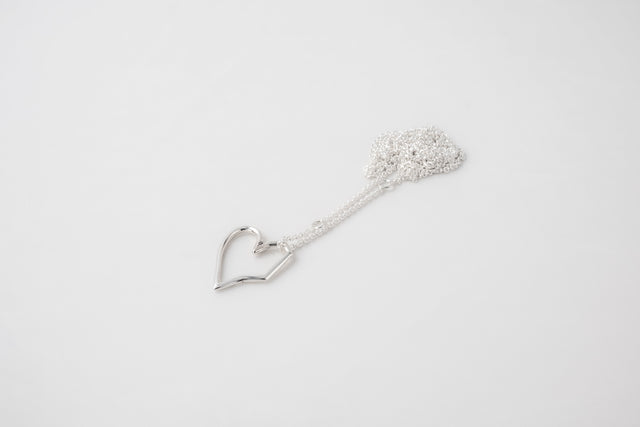
Bracelets
A bracelet is worn where the body moves most. The wrist bends hundreds of times a day, meets desks and sleeves and car doors, and whatever sits on it takes all of that. This is why a bracelet is chosen differently from a ring: not by how it looks in the hand, but by how it behaves after a week.
- Types by construction — what actually holds the piece together
- Width and weight decide more than length
- Fit — the gap is the whole question
- Material — what the surface does over time
- How STRUGA makes bracelets
- In short
- Frequently asked questions
Bracelets are told apart by four things, and none of them is style. By construction — what holds the piece together. By width and weight — what the wrist actually feels. By fit — loose or close. By material — what the surface does over time.
Construction divides bracelets into links, chain, bangle and open cuff.
Width and weight decide comfort more than length does: a narrow band disappears on a large wrist, a heavy one is felt all day.
Fit is set by the gap between the piece and the skin — roughly 1.5 to 2.5 cm added to the wrist measurement.
Material decides the surface: uncoated 925 silver darkens on its own, blackened silver was darkened at the bench, carbon is three times lighter.
At STRUGA bracelets come from families as forms: SIGNATURE LINKS, BLADE. Each is cast from a wax model and finished by hand; made to order takes about two weeks.
Types by construction — what actually holds the piece together
A link bracelet is built from repeated elements joined one to the next. It follows the wrist, sits differently every time you put it on, and its character comes from the link — its shape, its edge, its weight.
A chain bracelet is the same principle taken finer: smaller links, more of them, more drape. It moves like fabric rather than like a structure. The chain bracelet in full.
A bangle is rigid. It does not follow the wrist — it holds its own shape and slides. Size here is not adjustable: it either passes the hand or it does not.
An open cuff sits between the two. Rigid, but with a gap: it is put on sideways and holds by the shape of the metal, not by a clasp. That gap is what makes it fit a range of wrists.
More: Bracelets at STRUGA · Blackened silver bracelets
Width and weight decide more than length
A bracelet is judged by the wrist, not by the mirror. A narrow band on a large wrist reads as a thread and disappears; a wide one on a slim wrist takes over the whole arm. The proportion matters more than the piece itself.
Weight is the second thing, and it is the one people underestimate. A heavy bracelet is present all day: it shifts when you type, it knocks against a table, it reminds you it is there. Some want exactly that. Others take it off by the third day.
If it is a first bracelet, start narrower and lighter than you think. A piece that is too quiet gets worn; a piece that is too loud gets put away.
More: Men's proportions in full · Men's bracelet sizing · Men's and women's proportions
Fit — the gap is the whole question
A bracelet is not sized like a ring. You measure the wrist and then add a gap: roughly 1.5 to 2.5 cm depending on how you want the piece to sit. The smaller end gives a bracelet that stays where you put it; the larger end gives one that slides toward the hand.
The second question is the hand itself. A bangle has no clasp, so it must pass the widest part of the hand with the thumb tucked in — that measurement, not the wrist, sets its size.
Stacking changes the maths again: two or three bracelets need slightly more room each, or they push one another off the wrist.
In full: Bracelet size guide
Material — what the surface does over time
Uncoated 925 silver darkens on its own. Patina settles into the recesses and wears back off the ridges — on a bracelet this happens faster than on a ring, because the wrist meets more surfaces.
Blackened silver is the reverse: the surface was darkened at the bench in advance, then taken back off the edges. The relief comes forward from the first day.
Carbon changes the equation. The same form becomes three times lighter, which turns a bracelet you notice into one you forget you are wearing.
More: Blackened silver · Cleaning a silver bracelet
How STRUGA makes bracelets
A bracelet begins as a wax model of a single link. A silicone mould is taken from it, the links are cast in 925 silver, then assembled and finished by hand: sprues cut away, edges smoothed, the surface worked to its final state.
Families are forms, not collections. SIGNATURE LINKS carries the asymmetric silhouette of the brand into a repeating element. BLADE began with a chain link and keeps machine-shop precision in every edge — where the form came from.
All bracelets are made by hand by master silversmiths in Bali. Made to order takes about two weeks — the length is sized to your wrist rather than adjusted afterwards.
In short
| Type | What sets it apart |
|---|---|
| Links | follows the wrist, character comes from the link |
| Chain | finer links, moves like fabric |
| Bangle | rigid, must pass the hand — no clasp |
| Open cuff | rigid with a gap, fits a range of wrists |
| Narrow | quiet, stacks, disappears on a large wrist |
| Wide | takes the arm, worn alone |
| Blackened | relief forward from the first day |
| Carbon | three times lighter, forgotten on the wrist |
Other sections of the Atlas: Rings · Earrings · Ear cuffs · Cuff bracelets · Necklaces
Frequently asked questions
Didn’t find the answer — write to us, we reply personally.
Ask a question →01What are the main types of bracelets?+–
By construction there are four: a link bracelet built from repeated elements, a chain of finer links, a rigid bangle that slides over the hand, and an open cuff held by the shape of the metal. Everything else — beaded, woven, charm — is a variation on one of these.
02How do I measure my wrist for a bracelet?+–
Wrap a strip of paper around the wrist just below the bone, mark where it meets and measure the length. Add 1.5 to 2.5 cm depending on how loosely you want it to sit. For a bangle measure across the hand instead, with the thumb tucked in.
03What width should a first bracelet be?+–
Narrower than you expect. A wide bracelet is present all day and takes the whole arm; a medium width is worn without thinking about it. Width is also read against the wrist — the same band looks heavier on a slim arm.
04What is the difference between a bangle and a cuff?+–
Both are rigid, but a bangle is a closed circle and has to pass over the hand, while a cuff has a gap and goes on sideways. The gap is why a cuff fits a range of wrists and a bangle has to be sized.
05Will a silver bracelet darken?+–
Yes, if the silver is uncoated. On a bracelet it happens faster than on a ring, because the wrist meets more surfaces. Patina settles into the recesses and wears back off the ridges; a silversmith can restore the original tone.