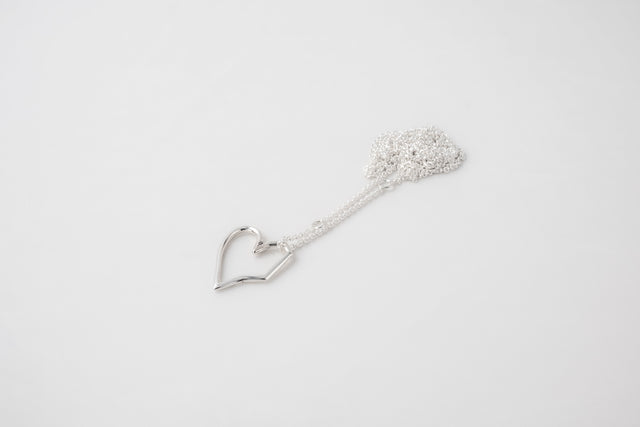
Men's and Women's Silver Bracelets: Width, Length, Weight and Unisex Fit
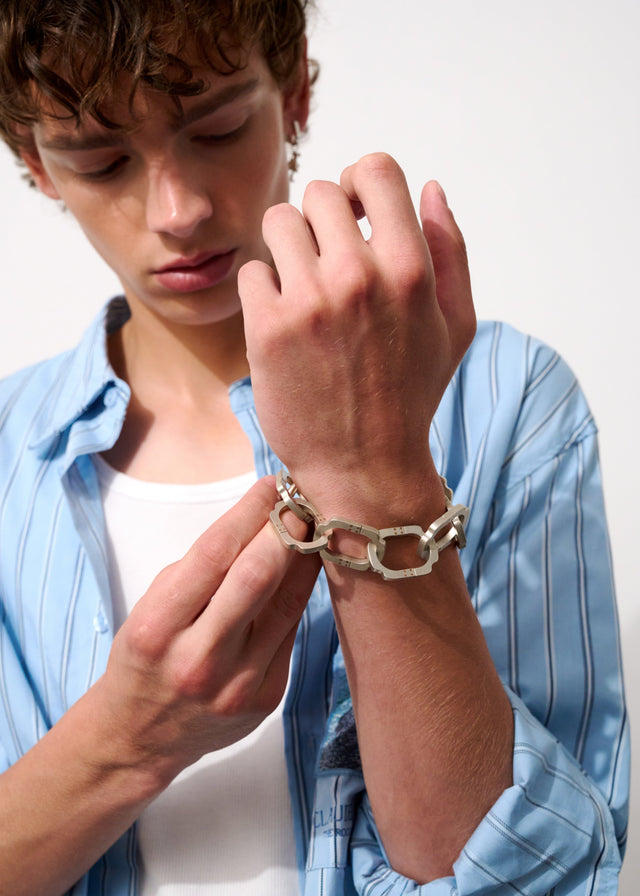
Signature Links comes in two sizes: S at 17 cm and 15 g, and M at 21 cm and 18 g. Choosing between them starts with a wrist measurement and a preference for a close or looser fit. A men's or women's label does not tell you either.
Updated October 15, 2026
You can begin by browsing STRUGA for men, then look more closely at the pieces themselves. How much wrist does each cover? How does it fasten? What does the selected size weigh? Those questions make the differences easier to compare.
Short answer. Width changes the bracelet's appearance; length and construction affect fit; weight changes the feel on the wrist. There are no universal men's or women's values for these measurements. Use the dimensions of the particular model alongside your own wrist measurement.
Is there a separate bracelet size for men and women?
When you open a men's or women's collection, check the sizes of the bracelets you like. Lengths, links and clasps differ between models. Even the letter M belongs to a particular size chart: read it with the listed centimetres and check what was measured.
| Specification | What it helps you understand | What to compare |
|---|---|---|
| Length | How the bracelet will fasten and move | The sizing method and the selected option |
| Width and thickness | How much space it occupies on the wrist | Measurements and a photograph with scale |
| Weight | The selected bracelet's stated weight | Grams for the selected size |
| Clasp | How you put it on and take it off | Operation and position on the wrist |
Check each specification separately. A bracelet can be the right length while being broader or heavier than you expected, whether you found it in a men's or women's collection.
How does width change a bracelet's proportions?
A fine chain leaves more skin visible. A broad bangle forms a continuous band, while a large-link chain has spaces between the links. The difference is visible on the wrist even when the listed lengths match.
A photograph showing the whole wrist and hand helps you judge scale. A close crop of a single link does not. Look for a wrist close to your own size, or compare the piece beside a ruler.
- A fine chain leaves room for a watch or another bracelet, although the combination still needs a fit check.
- Broad links make a prominent band with gaps, and the chain remains flexible.
- A wide rigid bracelet covers a continuous area; its inside dimensions and opening determine how it goes on.
- Equal widths do not mean equal thicknesses or weights.
Width is measured across the band or link; thickness describes its profile. A broad flat link and a narrow thick one can sit differently against the skin. If the product page does not list those dimensions, ask for the width at the widest point and a side view. With an open cuff, ask about the gap as well.
Where do men's and women's bracelet lengths differ?
Choose length for your own wrist. A body-survey average does not replace that measurement. The US Army's ANSUR II release, for example, describes 93 measurements collected in 2012 from 4,082 male and 1,986 female soldiers, with the data released in 2017. Those figures apply to that military sample. They do not establish bracelet sizes for all adults or show how people choose bracelets.
Wrap a measuring tape around the place where you plan to wear the bracelet. It should touch the skin without pressing into it. Record the circumference without adding extra room. Then check the product page: does its number describe the bracelet's length, its inside circumference or a recommended wrist measurement?
- A chain bracelet with a clasp opens and fastens around the wrist. Establish how its length is measured; thick links and the clasp affect the space inside when it is closed.
- A closed bangle must pass over the hand first. Follow the model's instructions for measuring the hand as well as the wrist.
- An open rigid cuff goes on through a gap. Compare its inside dimensions, shape and opening. Do not bend it to change the fit unless that design allows adjustment.
- An adjustable bracelet has a minimum and maximum length. A 19 cm chain with an extender can become longer; the extender alone will not shorten it.
The bracelet size guide explains the measuring steps. Adding 2–3 cm is not a rule for every design: the same centimetre value can describe different dimensions in a chain and a rigid bracelet.
How does weight change the feel on the wrist?
Once the length makes sense, compare weight. You cannot reliably judge it from a photograph: hollow and solid links with a similar outline may weigh differently. Find the grams for the size you intend to order.
Two models with close listed lengths show the difference. Thorn weighs 4.95 g at 17 cm; Carabiner #2 Big Cross weighs 112.74 g at 17.5 cm. You can compare their weights from those figures. Similar listed lengths do not mean that the designs leave the same room for a wrist.
During a fitting, bend your wrist and rest your hand on a desk. Notice whether an edge or clasp presses, and whether the bracelet moves as you want it to. A heavier piece is more noticeable as the hand moves. Width, shape and the way it sits against the skin determine where that weight is felt. Compare the actual pieces on your wrist.
What do the STRUGA catalogue's lengths and weights show?
The catalogue checked on 13 October 2026 contains 14 bracelet models and 31 size variants. One model can have several lengths. The table describes those products, rather than average men's or women's wrists.
| Catalogue data checked on 13 October 2026 | Value |
|---|---|
| Active models and size variants | 14 models, 31 variants |
| Listed lengths across different constructions | 14.5–26 cm |
| Weight of all variants, including cord-and-carbon | 2–130.28 g |
| Thorn: 17 cm → 21 cm | 4.95 g → 5.4 g |
| Big Thorn: 17 cm → 21 cm | 52 g → 82 g |
The extra four centimetres add 0.45 g to the listed weight of Thorn. For Big Thorn, the same length difference adds 30 g. Their construction differs, which is why you cannot calculate one model's weight from another's length.
BLADE offers another comparison: Blade Mini Links is 50.5 g at 17 cm and 62.1 g at 21 cm. The smallest and largest listed Carabiner #2 Big Cross options are 14.5 cm at 95.2 g and 21.5 cm at 130.28 g. Big Thorn, an open rigid cuff with carbon inlays, ranges from 16 cm at 45 g to 23 cm at 95 g.
Which bracelet forms are described as masculine or feminine?
Catalogues often use men's and women's labels alongside descriptions of shape. To work out what you want, name the details directly: large links, a fine line, a broad rigid band, beads or stones. Compare that description with photographs and dimensions.
Large links and broad forms:
- Curb, Cuban, anchor and mariner chains.
- Rigid bangles with thick geometric profiles, and broad cuffs with pronounced texture.
- Carbon and silver combinations, or ID bracelets with a plate.
- Bracelets with a surface darkened before wear.
Fine lines, beads and stones:
- Snake, box, fine cable and herringbone chains.
- Charm bracelets and bead bracelets.
- Fine polished bangles, worn alone or beside other pieces.
- Stone-set tennis bracelets and fine mirror-polished chains.
These groups help compare shape and surface; they do not determine who can wear a piece. In CODEX, you can compare two lighter models: Carabiner #2 Mini at 17.5 cm and 13 g or 21.5 cm and 16 g; Blade Medium Links V.2 at 17 cm and 17 g or 21 cm and 20 g. Choose the model you like, then look at its available sizes.
What should you check about a bracelet clasp?
Try fastening the chain you are considering. Signature Links uses a toggle, with a bar as part of the closure. Carabiners form part of Carabiner #2 Mini's construction. The difference becomes practical when you put the pieces on and take them off.
Check that you can operate the clasp, that it stays closed through normal movement and that it does not press into your skin. Try a toggle, carabiner or box clasp on the actual bracelet rather than choosing by the mechanism's name. If you wear a watch, try both together and see where the clasp rests.
What does unisex mean for a bracelet?
Unisex means that the same model is offered to different wearers. It does not prescribe a width, weight or neutral appearance. The bracelet can be broad and heavy or fine and light; dimensions are still needed to choose a size.
On its product page, check:
- what the listed centimetres measure;
- which fixed sizes are offered, or the minimum and maximum adjustment;
- the selected option's width and weight;
- how the bracelet is constructed and put on.
Ask about a particular missing measurement rather than looking for a general “unisex size”. Neither a width of 5–7 mm nor a weight of 18–35 g is a requirement for the label.
How do you choose length, width and weight together?
Work through the choice in five steps: measure your wrist, compare the model's dimensions, then check the fit when you try it on.
- Measure the wrist where the bracelet will sit, without adding an allowance. For a closed bangle, also take the hand measurement specified for the model.
- Open the product page and establish what its size chart measures. Use that information for the bracelet's particular construction.
- Compare width and thickness with a bracelet that works for you or a photograph with scale. Request any dimensions that are missing.
- Read the weight of the selected size, rather than just the lightest option.
- Try the piece beside a watch or other bracelets if that is how you will wear it. Bend the wrist, pull on a sleeve and check the clasp.
For online advice, send the model link, wrist circumference with its unit and the fit you prefer. For example: “My wrist is 18 cm with no allowance added. I want a little movement, without the bracelet reaching my hand.” If you have a comfortable bracelet of similar construction, photographs beside a ruler and a separate close-up of the clasp help with comparison. The 925 silver guide explains the material; the model's own information is the basis for choosing its size.
What are the common bracelet sizing mistakes?
Before using a measurement, label what it describes. “18 cm” on a note could be wrist circumference, the length of an older chain or a measurement with extra room already added. Make that clear before choosing a product option.
- Do not choose M simply because an older bracelet is M; compare dimensions and construction first.
- Do not estimate width from a close-up with no scale.
- Do not assume the larger option weighs the same as the smallest one.
- Do not expect an extender to shorten a chain.
- Do not decide watch clearance from the name of a clasp.
A bracelet you already own is useful for comparing fit. If it is too large, though, copying its length will not help. Explain what you want to change before looking for the next one.
How do you combine several bracelets on one wrist?
Several fine bracelets take up more space together than individually. Three bracelets measuring 4 mm across span 12 mm when laid side by side with no gaps. On the wrist, gaps and movement change the arrangement, and one piece may slide over another. Adding the widths does not describe the whole fit.
Try the combination as a group. Look for rubbing edges, catching clasps and pieces that move over one another. You might place a heavier bracelet beside a fine chain, or wear them on separate wrists. Judge them by how they move together.
Should a bracelet share a wrist with a watch?
A watch takes up some of the wrist beside a bracelet. Check whether the metal touches its case, catches on the crown or slides under the strap. Bend your wrist and pull on a sleeve to notice contact that may not show while the hand is still.
Metal contact can mark surfaces. If the pieces keep colliding, wearing them on separate wrists is a practical choice. Choose the arrangement for comfort and to avoid that contact.
How can you compare STRUGA bracelets by weight?
After trying a bracelet on, it is easier to decide which models to look at next. The bracelet collection lists individual size options; the groups below provide a weight comparison.
- Options below 22 g: Thorn, Carabiner #2 Mini, Asymmetric Minimalist, Signature Links, Blade Pins, Blade Medium Links V.2, Blade Mini Links V.2 and Small Beads with Heart. Check the particular size on its product page.
- Beaded and linked examples from 34.4 to 62.1 g: Big Beads with Capsule at 34.4 g for 17 cm and 50 g for 21 cm; Blade Mini Links at 50.5 g for 17 cm and 62.1 g for 21 cm.
- Heavier options: Blade Big Links at 85 g for 23 cm and 95 g for 26 cm; Carabiner #2 Big Cross at 95.2–130.28 g; Big Thorn at 45–95 g across the 16–23 cm options.
- A separate cord example: One Display Techno at 2 g in both 17.5 and 21.5 cm. It uses carbon hardware, so its weight should not be taken as a reference for a silver chain.
Weight does not tell you the bracelet's width. Ask for that dimension separately if it is missing from the product page. Use the grams to compare the weights of the options you are considering.
What separates a men's bracelet from a women's when choosing?
Begin with whichever collection contains pieces you like. Before ordering, note the model name and your wrist measurement, and decide whether you want a close or looser fit. For a gift, use the recipient's wrist measurement or a similarly constructed bracelet that already fits them.
The bracelet atlas and men's bracelet atlas give more detail about form. Measuring is covered in the men's bracelet sizing guide; the silver bracelets for women guide looks at fine lines and stacking.
About STRUGA. STRUGA is a dark silver jewellery brand founded by Dmitry Strugovshchikov and Ekaterina Strugovshchikova. For the international market, STRUGA objects are made in Bali. The silver line uses 925 sterling silver; its uncoated surface darkens with wear, and part of the range is darkened before wear. If you are choosing a bracelet in Bali, check the current locations on Where to buy before visiting.
Frequently asked questions
Can’t find the answer? Write to us — we reply personally.
Ask a question →01Is a “unisex” silver bracelet the same as a neutral or genderless one?+–
Unisex describes who a model is offered to, rather than its appearance. It can be broad, fine, smooth or textured. Choose among its sizes using your wrist measurement, the construction and the fit you prefer. A neutral design is not a requirement.
02Is bracelet width the same thing as wrist size?+–
No. Wrist circumference is measured around the wrist. Bracelet width is measured across the band or link. The first helps you choose fit; the second describes how much of the wrist the piece covers. Use the particular model's size information to choose length.
03Can a woman wear a men's bracelet?+–
Yes, if its dimensions, weight and fit suit her. Signature Links, for example, is offered at 17 cm and 15 g or 21 cm and 18 g. Check the selected option rather than the collection in which you found it.
04What is the standard length difference between men's and women's silver bracelets?+–
There is no single number: models have different size charts and measuring methods. Establish whether the listed length describes the product or a recommended wrist circumference, then follow the instructions for that construction. An extender lengthens a chain; it will not shorten the chain by itself.
05How wide does a silver bracelet have to be to look masculine?+–
There is no millimetre cutoff. Link shape, thickness and surface also affect appearance. Compare measured width with a photograph showing the wrist and hand or a bracelet you already wear. If the width is missing from the product page, ask for it.
06Is a 20 cm bracelet a men's size?+–
First check what 20 cm means on the product page: bracelet length or a recommended wrist circumference. Then use the model's instructions to compare it with your measurement. A chain, closed bangle and open cuff labelled 20 cm can leave different amounts of usable space.
07How much should a men's silver bracelet weigh?+–
There is no required weight. For comparison, Thorn is 4.95 g at 17 cm and Carabiner #2 Big Cross is 112.74 g at 17.5 cm. Read the grams for the selected option and try the piece on. How the bracelet sits against the wrist, including its edge and clasp, matters alongside its weight.
08What is the average man's wrist size for a bracelet?+–
A survey average applies to the people measured. ANSUR II measured US Army personnel; that sample cannot set a universal bracelet size. For a purchase, measure your own wrist and use the chosen model's instructions, taking its clasp and construction into account.
09What is the average woman's wrist size for a bracelet?+–
Your own measurement is more useful for a purchase than a group average. Measure where you will wear the bracelet, record the circumference without an allowance and check what the product page lists. For a rigid design, also establish its inside dimensions and how it goes onto the hand.