Silver Bracelet Stack — How Many to Wear, What Weights Work, and When to Mix Metals
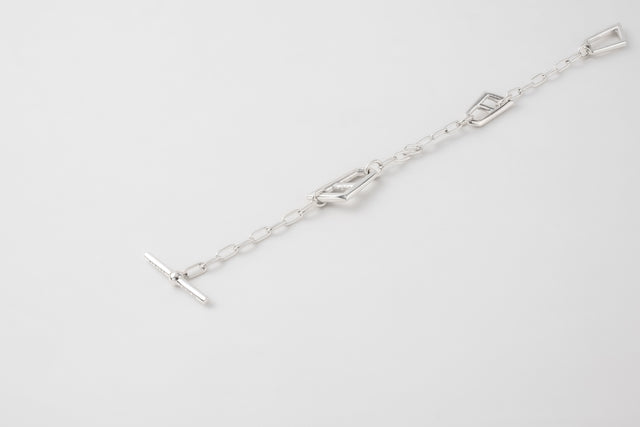
Between the lightest and the heaviest bracelet in the STRUGA range there is a factor of sixty-five: 2 g against 130 g.
A stack is two to four separate 925 silver bracelets of different weights on one wrist, not one wide bracelet.
Two pieces is the safe start, three is the working maximum for most wrists, four needs length: S bracelets run 17 cm, M runs 21 cm.
The anchor should weigh at least twice the accent — in the STRUGA range that is 45–130 g against 9–21 g.
Mix two metals at most, in roughly 70/30 proportion; silver with gold is the pairing with the longest record.
STRUGA bracelets are Living Silver — 925 without rhodium. They arrive light and darken together as they are worn.
Updated August 29, 2026
Sixty-five times. That is the spread between the lightest object we make for the wrist and the heaviest — 2 g against 130 g, both of them 925 silver — 92.5% fine, one of the four legal standards for silver under the Hallmarking Act 1973 — both of them bracelets. The light end is One Display Techno at 2 g; the heavy end is Carabiner #2 Big Cross at 130 g in size M. Almost everything that goes right or wrong on a stacked wrist happens inside that spread, and almost none of it is about pattern. This is the workshop view: how much mass the arm carries, which contrasts the eye registers, and where a sequence stops being one. The wider system — necklaces, rings and bracelets read together — sits in our silver layering guide.
What is a silver bracelet stack?
A stack is two to four separate bracelets on one wrist, each one still legible. A wide bracelet is one object; a stack is a sequence, and a sequence needs difference between its parts.
Weight carries a stack, not pattern. Two bracelets of the same weight in different weaves read as one bracelet doubled: the eye groups objects of equal mass before it reads their surface. A 17 g bracelet beside a 20 g bracelet is a single silhouette; a 17 g bracelet beside a 95 g one is a sequence.
The vocabulary is anchor and accent. The anchor carries the mass — 45 g and up in our range. The accent runs 9 to 21 g and supplies the contrast that makes the anchor read as a choice. Both families that carry the wrist at STRUGA, BLADE and THORN, sit in the CODEX world.
| Role | Weight in the STRUGA range | What it does on the wrist |
|---|---|---|
| Anchor | 45–130 g | Carries the mass, sets the centre of gravity |
| Mid-weight | 14–21 g | Bridges anchor and accent in a three-piece stack |
| Accent | 9–13 g | Supplies the contrast that makes the anchor read |
How many bracelets should you wear on one wrist?
Two is the safe start; three is the expressive maximum for most wrists. Four is possible, and it asks for length rather than courage — a stack of four needs bracelets in the longer sizes, because four pieces at S (17 cm) sit on top of each other instead of beside each other.
Beyond four the eye stops counting. Pieces five and six are absorbed into the mass of the stack and add nothing but weight on the arm.
The arithmetic is worth knowing before you start. Built from our own range, a two-piece stack totals 54 to 151 g, a three-piece 68 to 171 g, and a four-piece passes 180 g. That is the weight the arm carries all day, and it is the number most people underestimate.
| Pieces | What it needs | How it reads |
|---|---|---|
| Two | One anchor, one accent, roughly double the weight apart | Considered, hard to get wrong |
| Three | Anchor, mid-weight, accent — three distinct masses | Composed, the common resting point |
| Four | Longer sizes, stepped weights, varied forms | Committed, built over years |
What widths and weights work together?
Two rules carry almost every stack, and both are about contrast rather than taste.
The anchor weighs at least twice the accent
Weight is the reliable variable because it is printed on every piece we make. In the STRUGA range the anchors run 45 to 130 g and the accents run 9 to 21 g, so the doubling happens naturally when an anchor meets an accent. A 50 g bracelet beside a 45 g bracelet does not read as a stack; it reads as one heavy wrist.
Adjacent pieces need visible width difference
Width does the same work at speed. Roughly 3 mm between neighbouring pieces is where the eye registers two objects instead of one; below that the outlines merge at conversational distance.
Order on the arm is a free choice. Heaviest near the elbow reads as escalation toward restraint; heaviest near the hand reads as presence first. Neither order rescues a stack whose pieces weigh the same.
Can you wear silver and gold on the same wrist?
Yes, and the rule is arithmetic rather than etiquette. Two metals work; three rarely do, because the eye needs one dominant tone to measure the others against.
Keep the proportion near 70/30. Three silver pieces with one gold accent reads as a decision. Two silver and two gold reads as indecision, because neither metal is dominant and the wrist splits down the middle.
| Pairing | Why it behaves that way | Verdict |
|---|---|---|
| Silver + yellow gold | Tones sit far apart, so both stay visible | The safe pairing |
| Silver + rose gold | Warm pink against cool grey, softer contrast | Works |
| Silver + copper or brass | Reads best when one metal is patinated | Works with intent |
| Silver + white gold | Tones too close, contrast is spent unseen | Avoid |
| Three metals at once | No dominant tone for the eye to measure by | Avoid |
Silver with yellow gold has the longest record in jewellery. Our comparison of silver against other metals covers what each metal carries on its own.
Should every bracelet in a stack have the same finish?
A stack in one finish reads cleaner than a stack in two: width and form are left as the only variables.
Two different roads lead to that single tone. Oxidising is a technique: the silver is darkened at the bench and arrives dark. Living Silver is a property: 925 without a rhodium layer, so it arrives light and darkens on the wearer. All fourteen STRUGA bracelets are Living Silver; none is blackened at the bench. What darkens the metal is sulphur, not oxygen: the Canadian Conservation Institute names hydrogen sulphide and related sulphur compounds in the air as the cause of the black film. That is why two wrists in the same city darken at different speeds — and why a stack kept in a closed box moves slower than one worn daily.
For a stack the property does more work than the technique. Pieces worn together age together: the same skin, the same air, the same daily contact, so the patina deepens across the wrist at one rate. A stack of Living Silver arrives as several bright objects and becomes one tonality over the first year. A piece added later starts light and takes time to join — which is what makes an old stack look earned. The patina comes off at any point with silver cleaner.
How do you stack bracelets alongside a watch?
The cleanest arrangement is a stack on one wrist and the watch alone on the other. Each wrist keeps its own job, and neither has to negotiate with the other.
Three configurations cover it, and only one of them is difficult.
- Stack on the free wrist, watch alone. Two or three pieces on one side, the watch on the other. Nothing has to be coordinated, and this is where most people land.
- One thin piece on the watch wrist. A 9–15 g bracelet between watch and hand. It reads deliberate and costs almost no watch visibility.
- A heavier piece above the watch. Sits toward the elbow, away from the crown. Works up to about 60 g; beyond that the arm reads crowded, and the crowding shows in photographs long before it shows in the mirror.
Which stack combinations actually work?
Four combinations cover most wrists. Each is built from the anchor-and-accent pair, and each uses weight from the STRUGA range rather than an invented figure.
- The quiet two. One mid-weight bracelet at 15–21 g with one lighter piece at 9–10 g. The smallest stack that still reads as a stack, and the one that survives an office.
- The architect. One heavy anchor at 85–95 g with one accent at 15–18 g. Maximum contrast in two pieces, and the combination that shows form rather than quantity.
- The three-step. Anchor at 50–62 g, a mid-weight at 17–20 g, an accent at 9–10 g. Three separate masses, which is the point at which a wrist stops being a pair of bracelets and becomes a built object.
- The two-metal pair. One silver anchor with one thin gold band as the accent. Silver dominant, gold as the single warm note, proportion near 70/30.
None of these depend on matching. They depend on mass far enough apart that the wrist reads as a sequence.
What mistakes flatten a stack?
- Equal weights. The single most common failure. Two pieces of similar mass merge into one silhouette however different their patterns are.
- Three metals. Silver with gold works. Silver with copper works. All three together leaves the eye without a dominant tone.
- Packing the wrist tight. Leave half a centimetre to a centimetre of movement between pieces. A stack with no air in it bunches at the sleeve and reads as one wide cuff.
- All accents, no anchor. Four light bracelets read as underweight. At least one piece has to carry mass, or the stack has nothing to be measured against.
- Ignoring length. Four pieces on a short bracelet size crowd; two pieces on a long one look sparse. Our bracelet sizing guide applies to every piece in the stack, not only the first.
How do you build a stack over time?
Stacks are assembled rather than bought. The sequence that holds:
- Start with the anchor — the heaviest piece, 45 g and up. Wear it alone long enough to know it.
- Add the accent that contrasts with it most clearly, 9 to 21 g.
- Add a third piece only when the pair has stopped being interesting, and take it from the middle, 14 to 20 g.
The order matters practically, not only sentimentally. Living Silver bought together darkens together; pieces added later join gradually. A stack built in stages carries visible dates in its surfaces — the oldest piece is the darkest, and no single purchase produces that gradient.
Budget the metal, not the count. A three-piece stack in the weights above is 68 to 171 g of 925 silver plus the work of making it. Five inexpensive bracelets read worse than one good one, and worse every year, because cheap pieces do not age.
Which STRUGA bracelets stack together?
Every bracelet below is 925 Living Silver, made to order in about two weeks. Weights are catalogue figures; the role follows from the weight, not the name.
| Bracelet | Weight | Lengths | Role |
|---|---|---|---|
| Carabiner #2 Big Cross | 95–130 g | 14.5 / 17.5 / 21.5 cm | Anchor |
| Blade Big Links | 85–95 g | 23 / 26 cm | Anchor |
| Big Thorn | 45–95 g | 16 / 17 / 19 / 21 / 23 cm | Anchor |
| Blade Mini Links | 50–62 g | 17 / 21 cm | Anchor |
| Blade Medium Links V.2 | 17–20 g | 17 / 21 cm | Mid-weight |
| Signature Links | 15–18 g | 17 / 21 cm | Mid-weight |
| Asymmetric Minimalist | 14–15 g | 17 / 21 cm | Accent |
| Thorn | 9–10 g | 17 / 21 cm | Accent |
Two families carry the wrist at STRUGA. BLADE began as a chain link and grew into the brand's first massive bracelet; it spans 13 g to 95 g, so a whole three-piece stack fits inside one form language. THORN runs from a 9 g chain to the Big Thorn Bracelet, the brand's first rigid piece for the wrist. Pair across the two and the contrast arrives without effort. The full range sits in the bracelet collection; the material is in the Atlas chapter on 925 silver, and how it changes on the wearer in our guide to sterling silver over time.
About STRUGA. STRUGA is a dark silver jewelry brand founded by Dmitry Strugovshchikov and Ekaterina Strugovshchikova, handcrafted with Balinese and international silversmiths. Every piece is 925 sterling silver, naturally oxidized or hand-patinated, and the darkening is part of the design. It is a brutalist object that reacts and transforms through contact with the environment and the wearer.
Related pieces from STRUGA
Frequently asked questions
Didn’t find the answer — write to us, we reply personally.
Ask a question →01How many silver bracelets should you stack?+–
Two is the safe start and three is the expressive maximum for most wrists. Four is possible but needs the longer bracelet sizes, because four pieces at 17 cm sit on top of each other rather than beside each other. Beyond four the eye stops counting individual pieces.
02Can you wear silver and gold bracelets together?+–
Yes. Two metals work and three rarely do, because the eye needs one dominant tone to measure the others against. Keep the proportion near 70/30 rather than equal. Silver with white gold is the pairing to avoid, since the tones are too close for the contrast to be seen.
03Is a bracelet stack the same as one wide bracelet?+–
No. A wide bracelet is one object; a stack is two to four separate bracelets that read as a sequence. Pieces of equal weight collapse back into looking like one bracelet doubled, which is why the anchor should weigh at least twice the accent.
04Are STRUGA bracelets oxidised?+–
No. All fourteen bracelets in the range are Living Silver — 925 silver carried without a rhodium layer. They arrive light and darken on the wearer rather than being blackened at the bench. Oxidising is a separate technique, and STRUGA keeps the two apart.
05What weight should an anchor bracelet be?+–
An anchor should weigh at least twice its accent. In the STRUGA range the anchors run 45 to 130 g and the accents run 9 to 21 g, so the doubling happens naturally. The anchor is chosen first and the accent follows it.
06Should bracelets in a stack have the same finish?+–
A stack in one finish reads cleaner, because width and form are left as the only variables. Living Silver pieces worn together reach one tonality on their own: they share the same skin and air, so the patina deepens across the whole wrist at one rate.
07Can men stack silver bracelets?+–
The same weight rules apply regardless of who wears the stack: anchor plus accent, two or three pieces for everyday wear, four only with the longer sizes. Heavier overall stacks are more common on larger wrists simply because there is more length to fill.
08How long does a STRUGA bracelet take to make?+–
About two weeks. Every bracelet is made to order in 925 silver, handmade in Bali by master silversmiths, so stock is not the constraint on what you can order.