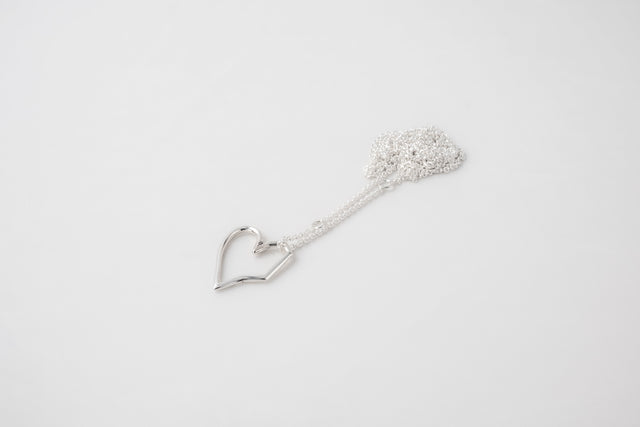
Byzantine Silver Chain: History, Weave & Styling Guide
A Byzantine chain is made from small rings arranged in paired, alternating clusters. Up close, you can follow the individual rings; from a distance, they form a rounded, textured chain. Choosing one starts with those connections and the measured weight of a particular length.
Updated October 24, 2026
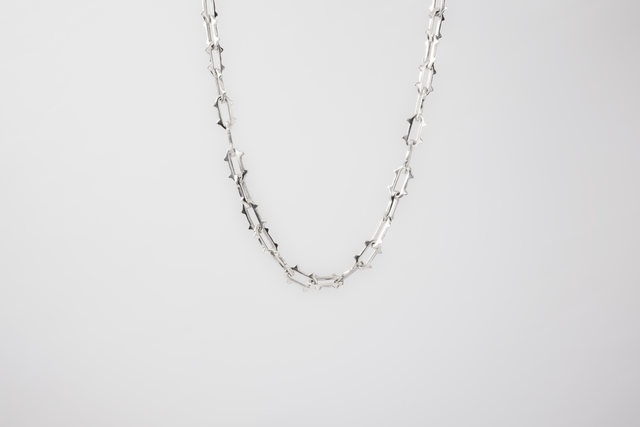
STRUGA explores chain construction through different forms: the Thorn chain has elongated links with side spikes, while the BLADE Mini Links choker pairs small, flat links with a large clasp. These are distinct designs. First, it helps to understand what makes a Byzantine weave.
At 50 cm, two documented silver Byzantine constructions calculate to about 33.3 g and 61.7 g before adding a clasp. Their catalogue diameters are 6.4 and 7 mm. Compare length, weight and fit together when choosing a chain.
What is a Byzantine chain? Anatomy of the weave
The pattern combines short ring clusters with connectors, usually in pairs. Each successive cluster reverses direction. Small gaps remain between the rings, giving the chain a textured surface without making it a continuous metal tube.
The Rio Grande Byzantine bracelet instructions start with three connected ring pairs. The end pair folds back, opening a space for the next connectors; the process then repeats in the opposite direction. Following that sequence lets you recognise the repeating unit and inspect how each cluster connects to the next.
Recognising the weave in photographs
Ask for a close view of several consecutive clusters and a view from the side. Follow the repeat and inspect the joins rather than relying on the overall shine. A short video of the chain being lifted and laid down can also show how that particular piece moves.
A light chain is not automatically a fake. Length, ring dimensions and solid or hollow wire all affect weight. A hollow silver chain can carry the same weave; hollow construction and silver plating describe different things. Check the seller’s material information and markings, and ask a jeweller to assess the metal if needed. Squeezing the rings is not a useful authenticity test.
Byzantine chain width and weight: measured examples
The Rio Grande chain guide measures width across the outside of the widest link. A 5 mm measurement therefore describes the chain’s external size, rather than the thickness of the wire used to make each ring.
The Cousins UK technical catalogue gives two sterling-silver constructions at 66.6 and 123.3 grams per metre. The table calculates shorter cuts before adding a clasp.
| Catalogue link diameter | 50 cm, calculated | 60 cm, calculated | 100 cm, catalogue |
|---|---|---|---|
| 6.4 mm | 33.3 g | 40.0 g | 66.6 g |
| 7.0 mm | 61.7 g | 74.0 g | 123.3 g |
Approximate values for two specific constructions, rather than a standard for every Byzantine chain. Source: Cousins UK technical catalogue, 2018, p. 18. Finished-chain weight includes its clasp and end fittings.
| Specification | What it tells you | What to check |
|---|---|---|
| Width: 3, 5 or 8 mm | External scale of the weave | A photograph beside a ruler |
| Length: for example, 50 or 60 cm | Overall chain length | Whether the clasp is included |
| Weight in grams | Mass of a particular length | Which size was weighed |
| Solid or hollow wire | Construction of the rings | The maker’s specification |
| Pendant bail opening | Whether the pendant will fit | Clearance for the end ring |
Start with a chain whose fit you already like, comparing length, thickness and where it rests. At a fitting, turn your head, fasten your collar and try the chain with clothes you normally wear. There is no single everyday width for everyone. The chain and necklace length guide covers measurement in more detail.
Where does the name Byzantine come from?
The M.A.I.L. weave library lists Byzantine alongside Etruscan, Birdcage, Bird’s Nest, Fool’s Dilemma and Idiot’s Delight. These names help you find photographs and diagrams of the same pattern.
Ancient chains have specific histories of their own. The Metropolitan Museum holds a gold chain with a Bes pendant from second-century CE Egypt, identified as loop-in-loop construction. The Walters Art Museum holds a fifth- to seventh-century Byzantine necklace in gold and emeralds. Their dates and materials describe those particular museum objects; the paired jump-ring weave is identified by its own construction.
The name Byzantine helps you find this modern weave. For a dated historical object, start with the museum record of its material and technique. The Metropolitan Museum’s overview of Byzantine art places the surviving objects in their historical setting.
How a Byzantine chain is made: by hand or by machine
In hand assembly, the maker takes prepared rings, threads them in sequence and closes them. The relationship between a ring’s inner diameter and wire thickness affects how tightly the weave fits together. Makers call this its aspect ratio, or AR. M.A.I.L. lists ratios for several connector arrangements, so match the ratio to the exact pattern.
Machine assembly also exists. Manufacturer Fasti describes its BZ Byzantine chain machine as working from two wires to assemble paired rings, including hollow wire. Hand and machine assembly share the paired-ring pattern; the maker’s description explains how the joints were closed and the piece finished.
When examining a piece, look for open joins, sharp edges or clusters that catch as they move. These checks are more useful than trying to identify hand assembly from a single feature. Check the clasp and end rings too, making sure their connections are secure.
Weave variations: classic, double and X-link
Basic Byzantine usually has doubled connector rings. Changing their number and size changes the spacing of the pattern. The Bead Man’s Graduated Byzantine project shows another approach, gradually changing ring sizes along the chain.
Names such as Double Byzantine and X-link still call for a close photograph or diagram. Compare one repeating section, its side profile and its measured width. The distinction should be visible in the piece, even when sellers use different names.
Byzantine versus box, curb, Figaro and rope
The first difference is the arrangement of the links. These visual features help you decide what to examine more closely. Strength also depends on the wire, joints and condition of the actual piece.
| Weave | Pattern | What to examine |
|---|---|---|
| Byzantine | Ring clusters and paired connectors | Volume and spaces between rings |
| Box | Squared links; rounded versions also exist | The individual chain’s profile |
| Curb | Twisted links arranged to lie flat | Width of the flat surface |
| Figaro | A long link alternating with several short ones | Rhythm and proportions |
| Rope | Interlinked rings forming a spiral pattern | Shape and density of the spiral |
For a pendant, check that its bail fits over the end of the chain and ask the seller what pendant weight the chain is intended to support. For repairs, a jeweller needs the metal, link thickness and actual damage. The silver chain style comparison covers further designs.
To compare the structures side by side, open the atlas of chain weaves.
What replaces a Byzantine in the STRUGA catalogue
If you like volume but want the shape of each link to remain visible, consider chains from the CODEX world. These four designs use elongated, angular or flat links instead of the compact Byzantine ring clusters. The cover photograph shows Thorn, an example of a different chain design.
- Thorn Links Chain: 40 cm — 11 g, 45 cm — 12 g, 50 cm — 13 g, 75 cm — 18 g; $353–564. Its elongated links have the side spikes characteristic of the THORN family form.
- Long Chain with Signature Asymmetric Links: 120 cm, 35 g, $1,295. A fine rolo chain with cast SIGNATURE ASYMMETRIC elements along its length.
- Signature Asymmetric Links Choker: 40–50 cm, 27–33 g, $865–1,141. A short chain with angular links.
- Blade Mini Links V.1 Choker: 40–50 cm, 80–110 g, $2,276–3,128. Small BLADE links meet a large Carabiner #2 Big clasp.
The list above gives the measurements for the listed STRUGA sizes. The pieces are 925 sterling silver without rhodium plating, a surface STRUGA calls Living Silver. For the international market, STRUGA pieces are made by hand in Bali. The general making time is 2–4 weeks, often sooner; shipping takes additional time. Compare the available sizes in the chain collection.
How to wear a Byzantine chain
Start with the chain on its own against a plain top. The dense ring pattern is easiest to see when fabric and neckline leave it clear: a collar can frame a shorter chain, while a longer one rests over the shirt. Try both positions with the clothes you expect to wear.
For a pendant, test the bail opening against the chain’s end fittings and keep the pendant free to move. For two chains, choose different lengths, then turn and bend forward during the fitting: each should settle without pulling the other into a knot. The length guide gives a loop method for trying the positions before choosing a size.
How to care for a woven chain
Identify the finish first. Bright silver, intentional darkening and a coating need different treatment. Begin routine care with a soft cloth. Avoid pulling the chain forcefully through the cloth or scrubbing the inner rings with a stiff pad. A jammed cluster or an open joint needs a jeweller’s attention.
Polishing changes the surface and gradually removes metal, as the Canadian Conservation Institute explains. Avoid abrasive Scotch-Brite pads for routine care. Choose a silver-cleaning product that suits the finish, clasp and any other materials, and follow its instructions. With a deliberately darkened chain, check whether the treatment will preserve that finish.
Store the dry chain separately from other pieces, without tight knots. If you want to brighten a STRUGA piece, ask the brand about cleaning. Cleaning and minor repairs are free while you own it; shipping to STRUGA is at the owner’s expense. Patina is removed at the owner’s request.
After the comparisons, the choice comes back to the object: whether you enjoy seeing the individual rings, whether the weight suits you, and whether the clasp is easy to use. Those are the details you will live with.
Further reading: the silver signet ring guide, runes in silver, and the STRUGA catalogue.
Frequently asked questions
Didn’t find the answer — write to us, we reply personally.
Ask a question →01Is Byzantine the same as Etruscan or Birdcage?+–
M.A.I.L. lists Etruscan, Birdcage, Bird’s Nest, Fool’s Dilemma, Idiot’s Trap and Idiot’s Delight as alternative names for Byzantine. When buying, still examine a close view of the repeating section: the rings and their connections identify the weave.
02Is a modern Byzantine chain a genuine Byzantine antique?+–
A contemporary Byzantine chain is a modern piece identified by its paired-ring construction. A museum antique has its own recorded date, materials and technique; the Metropolitan and Walters examples above show what those records contain.
03How much does a Byzantine chain weigh in 925 silver?+–
At 50 cm, two catalogue constructions calculate to about 33.3 g at 6.4 mm and 61.7 g at 7 mm before adding a clasp. The table above gives their source and longer cuts. For a finished piece, use the measured weight of the selected size, including its fittings.
04Is a hollow Byzantine the same as a solid 925 one?+–
The weave name describes the arrangement of rings; solid or hollow wire describes their construction. The 925 designation concerns the silver alloy. Hollow construction and silver plating are different characteristics, so check each separately without squeezing the chain.
05Does STRUGA make a Byzantine chain?+–
The four pieces shown here have different constructions: Thorn has links with side spikes, the Signature Asymmetric Choker has angular links, the long Signature Asymmetric uses fine rolo chain with cast elements, and BLADE Mini Links has small, flat links with a large clasp. Sizes, weights and prices appear in the catalogue section and product pages.
06How should a woven silver chain be cleaned?+–
Begin with a soft cloth and identify the finish. Stiff pads and abrasives change the surface. Use a silver-cleaning product only according to its instructions and with all component materials in mind; discuss intentional darkening with the maker first. Store the dry chain separately without tight knots.