How to Clean a Sterling Silver Bracelet — A Jeweler's Guide to Care That Won't Damage It
Five minutes is enough: two to three minutes in warm water with a drop of mild soap, a soft brush along the links, an immediate dry, and a silver cloth on the raised edges only. The dark in the recesses stays, and it should: on uncoated 925 it is the same compound as tarnish, silver sulfide. Chemistry cannot tell the two apart — only position can — which is why foil baths and silver dips strip all of it at once.
Updated September 29, 2026
Tarnish is a film of silver sulfide, Ag2S; on 925 copper sulfide joins it. It sits on the metal rather than eating into it, and grows faster in humid air.
The default method: warm water, a drop of soap, 2–3 minutes, a soft brush, dry at once. A silver cloth goes on the raised edges only. Ammonia does not dissolve tarnish — it only removes grease.
Foil and baking soda, silver dips and abrasive pastes reset the patina completely. A dip dissolves some silver too; after a foil bath the surface turns matte and tarnishes faster.
13 of the 14 STRUGA bracelets are uncoated 925 silver, from the Thorn Bracelet (5–5.4 g, from $199) to Blade Big Links (85–95 g). The fourteenth, One Display Techno, is carbon on a cord with a silver-plated plate — no silver in it.
STRUGA cleans and does minor repairs on its pieces free for as long as the piece is yours; shipping is on the owner.
How do you clean a sterling silver bracelet at home, step by step?
Warm water, a drop of soap and a soft brush remove grease, sweat, lotion and dust — the usual reasons a bracelet looks dull. The method barely touches tarnish, and that is the point: it cleans without erasing the pattern of darkening.
What you need
- A bowl of warm, not hot, water.
- A drop of mild liquid soap or dish soap — no bleach, no abrasive.
- A soft brush: a child's toothbrush or a makeup brush.
- Two soft cotton or microfiber cloths.
- A silver polishing cloth — optional, for the edges.
The steps
- Open the clasp. Water then runs through every link, not just along the outside.
- Soak the bracelet for 2–3 minutes. Longer does nothing more: grease lets go straight away.
- Brush along the links and around the clasp — no pressure, one section at a time.
- Rinse under warm water over a bowl or a closed drain: a small clasp is easy to lose.
- Blot and dry at once. Press the bracelet in a cloth, then lay it flat on a dry one until the joints have no water left in them.
- If you want light on the edges, run a silver cloth over the raised surfaces only, gently.
That is all the care a bracelet needs in normal wear. Anything stronger no longer cleans — it removes tarnish, patina or metal, and the sections below say which.
Why does a silver bracelet tarnish?
Tarnish is a thin layer of silver sulfide: the metal reacts with sulfur-bearing gases in air, above all hydrogen sulfide. That is how the Canadian Conservation Institute describes it: on pure silver the layer is Ag2S, and on sterling copper sulfide forms as well, from the 7.5% copper in the alloy. The more humid the air, the faster the reaction. The colour follows the thickness — yellow, red-brown, bluish — and turns black once the layer passes roughly 100 nanometres.
Tarnish sits on the metal; it does not eat it. Metal is lost to cleaning, not to darkening: each polishing or chemical tarnish removal takes away some of the silver underneath, the same conservators warn. A bracelet cleaned rarely and gently outlasts one that is scrubbed every week.
A bracelet has one feature of its own — links and joints. Moisture and sweat stay in them longer than on a smooth surface, so they need drying after water. The chemistry is covered in why 925 silver tarnishes, and the dark mark on skin in why a bracelet leaves a mark on the wrist.
Are tarnish and patina the same thing, and how do you clean without removing the dark?
Chemically, yes: natural darkening and deliberate blackening are both black silver sulfide. Liver of sulfur, used to blacken silver, is a mixture of potassium sulfides: it builds the same layer air does, only fast and exactly where it is applied. A tarnish remover cannot tell one from the other; the only difference left is position.
On a piece with relief, the dark in the recesses is part of the design and the bright edges are where it has been rubbed. Conservators at the US National Park Service write plainly that removing all tarnish is often undesirable: darker tarnish in the recesses helps the design stand out. Hence the rule: soap and brush everywhere, a cloth only on the edges it reaches without effort.
STRUGA bracelets fall into two cases. Thirteen of the fourteen are 925 silver without rhodium, in the Living Silver finish: they arrive light and darken on their own with wear — recesses go dark, friction brightens the edges. None of the bracelets is darkened in advance; that finish lives on rings and earrings such as the Brutalism V.3 Ring. A piece darkened in advance never goes into a silver dip: the maker of one widely sold dip rules it out on artificially oxidized silver.
| Finish | STRUGA bracelets | How to clean |
|---|---|---|
| Living Silver — uncoated 925 | 13 of 14: from Thorn at 5–5.4 g to Blade Big Links at 85–95 g | water and soap; cloth on the edges; resetting the patina is optional |
| Carbon and silver-plated alloy | 1: One Display Techno, 2 g | a soft dry cloth, no water, no chemicals |
| Silver darkened in advance | none among bracelets | water and soap only: a dip or foil bath removes the blackening |
What does each home method actually do to a bracelet?
Home methods fall into three groups: some wash off dirt, some strip tarnish together with patina, some wear away metal. Advice online contradicts itself — one site recommends ammonia or lemon juice, the next forbids it. The table shows what each method really does, going by conservators and chemistry.
| Method | Dirt and grease | Tarnish on edges | Dark in recesses | Cost to the metal |
|---|---|---|---|---|
| Warm water and soap | washes off | barely touched | stays | none |
| Silver polishing cloth | — | removes | stays unless rubbed into the relief | the thinnest layer of silver |
| Ammonia | washes off | does not dissolve | stays | no benefit against tarnish |
| Baking soda and foil in hot water | washes off | removes | removes | cuts no metal, but leaves a matte surface that tarnishes faster |
| Silver dip | — | removes | removes | dissolves some silver too; frequent dipping pits the metal |
| Toothpaste, baking soda paste | — | abrades | abrades wherever it reaches | scratches: the abrasive is no softer than silver |
| Ultrasonic cleaner | flushes out of links | does not remove | stays | unsafe for many stones; not recommended on STRUGA product pages |
| Lemon juice, vinegar, cola, peroxide | no reliable data on what they do to 925 — we do not recommend them | |||
Ammonia is the most argued-over. Silver sulfide practically does not dissolve in it: the dissolution constant, worked out from tabulated values, is on the order of 10⁻³⁵. The visible effect is grease washed away. Foil is the opposite story: it really does turn the sulfide back into silver electrochemically, but that silver settles as rough particles — hence the matte look and faster tarnish afterwards. Toothpaste and baking soda are abrasives: even fine calcium carbonate is hard enough to scratch silver, conservators note, and baking soda is almost as hard as silver itself — about 2.5 on the Mohs scale — so it can dull a mirror finish.
How do you clean a chain bracelet between the links, and the clasp?
A chain is cleaned open and dried longer than a smooth piece: water leaves the joints slowly. Run the brush along the chain one section at a time, so the bristles go into the gaps between links instead of sliding over the top. After rinsing, lay the bracelet out straight on a dry cloth and leave it until the gaps are dry — never fold a wet chain into a bag.
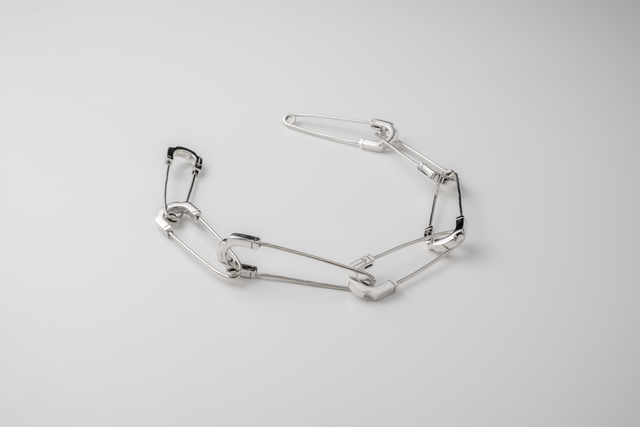
Clean the clasp separately and check it once dry: does it close with a clear click, has the spring weakened? STRUGA bracelets close in different ways. The Blade Medium Links V.2 Bracelet (17–20 g, from $545) and the Signature Links Bracelet close with a toggle, the bar passing through a ring; Blade Mini Links and Blade Big Links close with the massive Carabiner #2 Big, which has its own mechanism. After water, open and close it a few times to make sure no moisture is left inside.
The links of Blade Medium Links V.2 and Blade Mini Links are cast, each split in two and rejoined on copper pins. The pins get no abrasive and no more than a couple of minutes in solution. On the Thorn Bracelet the link edges are sharpened by hand: brush along the link and use a cloth without pressure, or it catches on the edges.
How do you clean a rigid bracelet or one with carbon?
A rigid bracelet is cleaned with a cloth and brush without soaking, and carbon is only wiped: it does not darken or change. Silver and carbon in one piece are cared for differently, and silver products are not needed on carbon at all.
Big Thorn is an open rigid arc of cast 925 silver with fifteen Classic carbon inlays, from 45 g in the 16 cm size to 95 g at 23 cm, from $1,279. The inlays are fitted by hand, one at a time, and there is no reason to keep them in any solution: wipe the silver frame with a damp cloth and a drop of soap, brush the relief and dry at once. Wipe the carbon with a soft dry cloth.
The Carabiner #2 Big Cross Bracelet (95.2–130.28 g, from $2,712) is built from working carabiners with a carbon cross at the centre. Clean the carabiners like a chain clasp — one by one, checking each mechanism once dry. Keep this bracelet out of long spells of wet: the carbon does not mind water, but silver kept damp darkens faster and unevenly.
The One Display Techno Bracelet (2 g, $160) is Classic Graphite carbon fittings on a black cord with a TECHNO plate of silver-plated jewellery alloy; there is no 925 silver in it. A soft dry cloth is enough. Keep the silver cloth off the plate: polishing removes metal, and silver plating is a thin layer.
How do you take a bracelet back to bright silver, and does the dark come back?
The patina on Living Silver can be reset, and that is the owner's choice, not the repair of a defect. Polished silver goes back to light with a silver-cleaning solution: a short immersion, then a thorough rinse and dry. Conservators advise keeping silver in such a solution as briefly as possible, with gloves on and in a ventilated room. Matte silver is reset with an abrasive — a scouring pad or sandpaper — which takes off a thin top layer and sets a new matte texture, and the patina goes with it.
Living Silver then starts to darken again with wear — that is the nature of the finish — and over time the pattern of darkening builds up anew, following the way you wear the piece. A piece darkened in advance is different: removed blackening does not come back on its own and has to be applied again.
Resetting often is not worth it: each time a little silver goes. If you would rather not do it yourself, STRUGA will return a piece to bright silver free — the patina is removed only at the owner's request. The terms are in the refund policy, and the finish itself is explained in the Atlas chapter on Living Silver.
How often should you clean a silver bracelet?
Less often than it seems: with daily wear, soap and water once a month, and a dry cloth the rest of the time. Cleaning does not extend the life of silver; it removes dirt, and extra cleaning removes metal.
- Daily wear: a soft dry cloth after wearing, if you like; soap and water once a month and after the sea, sport or lotion.
- Occasional wear: soap and water before you put the bracelet away.
- Silver cloth: when the edges look dull and you want light, not on a schedule.
- Resetting the patina: only when you want to start over — the rarest step.
Take the bracelet off in a pool and when cleaning with chlorine products: the Gemological Institute of America warns that chlorine and other bleaching agents can damage some gemstones and metal alloys. Plain water does silver no harm.
How should you store a bracelet so it tarnishes more slowly?
Dry, separately and away from wool and rubber: that is where tarnish grows slowest. The Canadian Conservation Institute advises keeping silver below 50% relative humidity — which is why a bathroom is a worse place for it than a bedroom.
- A separate sealed polyethylene bag. Put the bracelet in only when dry; a sachet of silica gel in the box helps.
- An anti-tarnish strip. It absorbs sulfur compounds; sellers state it works for up to six months.
- Not next to wool, felt or rubber. Wool fabric, felt linings, rubber bands and rubber seals give off sulfur — they are on the conservators' list.
- Not in newspaper. The UK's National Trust warns that newspaper makes silver tarnish rapidly.
- Not pressed against other jewelry. Chains tangle, edges scratch the surfaces next to them.
A bracelet worn every day needs almost none of this: on the wrist it is looked after anyway. Storage matters for pieces that wait months for their day.
Is a rhodium-plated bracelet cleaned differently?
Yes: rhodium is a thin layer over the silver and any polishing wears it away, so such a bracelet is cleaned with soap and water only. Cloths, pastes and silver dips are not used on rhodium-plated pieces. How fast rhodium wears depends on the thickness and on friction; a thin deposit eventually wears off, and then a jeweler plates it again.
STRUGA pieces are not rhodium-plated: Living Silver is 925 with no coating, so there is nothing to wear through except tarnish. A dark band on the skin under a bracelet has nothing to do with rhodium — it is the finest particles of metal and sulfide rubbed off the piece, and powder on the skin makes it stronger.
When should a bracelet go to a jeweler?
When the issue is mechanics rather than tarnish: the clasp, a link or the shape. Take the bracelet to a jeweler if:
- the clasp no longer closes with a clear click, or a carabiner spring has weakened;
- a link has opened, a pin sticks out, or the chain catches on clothing;
- a rigid bracelet has a dent or has lost its shape;
- you want the blackening back on a piece darkened in advance.
For STRUGA pieces, cleaning and minor repair are free for as long as the piece is yours; shipping to us is on the owner. Write through the contact page. If you are still choosing, all fourteen are in bracelets, and how silver, blackened silver and carbon change over time is in the Atlas chapter on bracelets.
About STRUGA. STRUGA is a dark silver jewelry brand founded by Dmitry Strugovshchikov and Ekaterina Strugovshchikova, handmade in Bali by master silversmiths. Most pieces are 925 sterling silver left uncoated, so they darken with wear; part of the range is darkened in advance, at the bench. The darkening is part of the design.
Frequently asked questions
Didn’t find the answer — write to us, we reply personally.
Ask a question →01How do you clean a sterling silver bracelet at home?+–
Open the clasp, soak the bracelet for 2–3 minutes in warm water with a drop of mild soap, brush gently along the links, rinse and dry at once. Use a silver cloth on the raised edges only, so the dark in the recesses stays in place.
02Does the baking soda and aluminum foil method ruin oxidized silver?+–
It removes the oxidized finish. Foil turns the sulfide back into silver and cuts no metal, but it takes the dark out of the recesses and leaves a matte surface that tarnishes faster. Use it only if you want all the dark gone.
03Can ammonia clean tarnished silver?+–
Not really. Silver sulfide, the compound tarnish is made of, practically does not dissolve in ammonia. The visible effect is grease washed away, and warm soapy water does that just as well.
04Can I use toothpaste to clean my silver bracelet?+–
Better not. The abrasive in toothpaste is usually silica or calcium carbonate, and conservators warn that even fine calcium carbonate scratches silver. Toothpaste removes tarnish together with a thin layer of metal and the patina wherever it reaches.
05How do I clean a silver chain bracelet between the links?+–
Open it, soak it in warm soapy water and run a soft brush along the chain section by section so the bristles reach the gaps. After rinsing, lay it straight on a dry cloth until the joints are dry, then check the clasp.
06How do you clean oxidized silver without removing the black?+–
With soap, water and a soft brush only. Blackening is the same silver sulfide as tarnish, so silver dips, foil baths and pastes remove both. The maker of one widely sold dip rules it out on artificially oxidized silver.
07Why does my silver bracelet tarnish?+–
Silver reacts with sulfur-bearing gases in air, mainly hydrogen sulfide, and forms a thin film of silver sulfide; the copper in 925 adds copper sulfide. Humid air speeds the reaction up. It is a layer on the metal, not damage to it.
08How often should I clean my sterling silver bracelet?+–
With daily wear, soap and water once a month and after the sea, sport or lotion; a soft dry cloth is enough the rest of the time. Every polish and chemical clean takes a little silver with it, so more often is not better.
09Can I wear a sterling silver bracelet in the shower or pool?+–
Plain water does silver no harm. Take the bracelet off in a pool and when cleaning with chlorine products: chlorine and bleach can damage some metal alloys. After water, dry a chain bracelet well, especially between the links.
10Will the patina come back after cleaning?+–
On Living Silver, yes: uncoated 925 darkens again with wear and the pattern builds up anew. A piece darkened in advance will not get its blackening back on its own — it has to be applied again.