What is a chain bracelet?
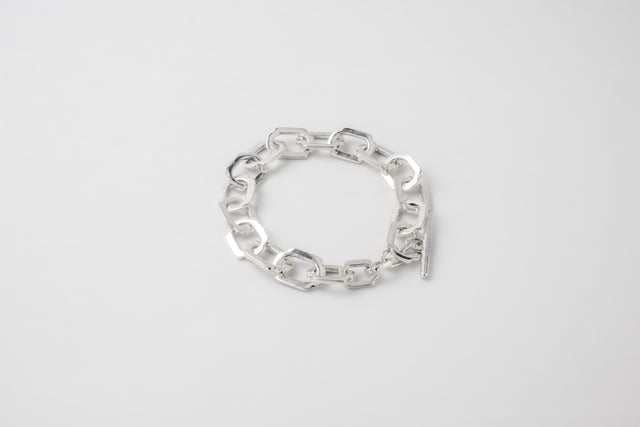
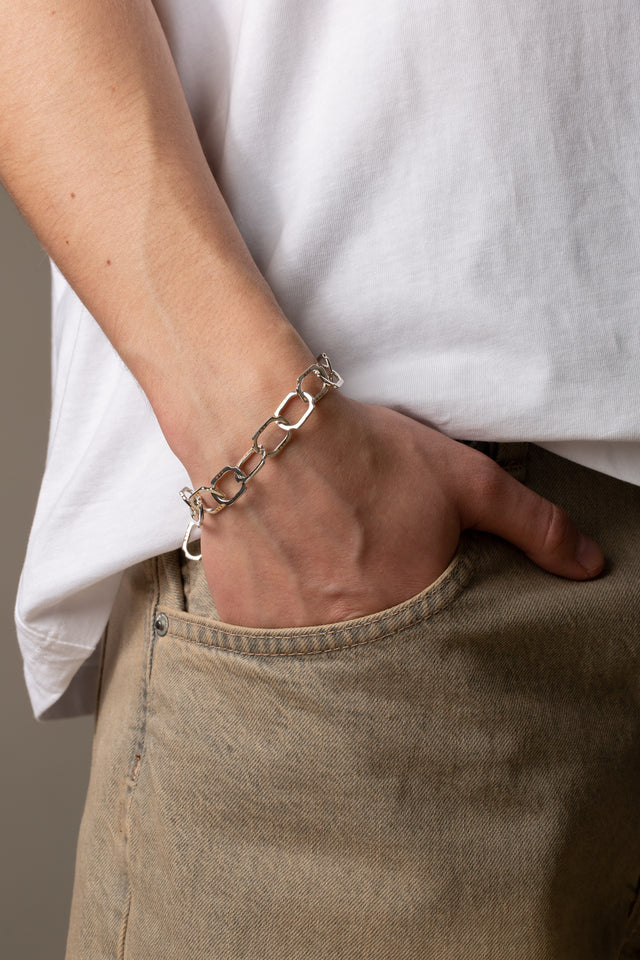
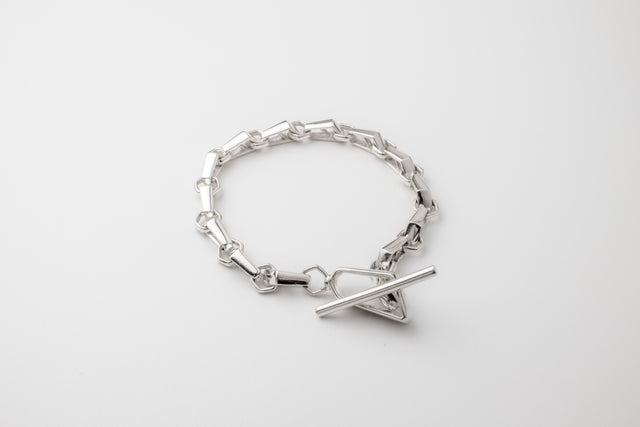
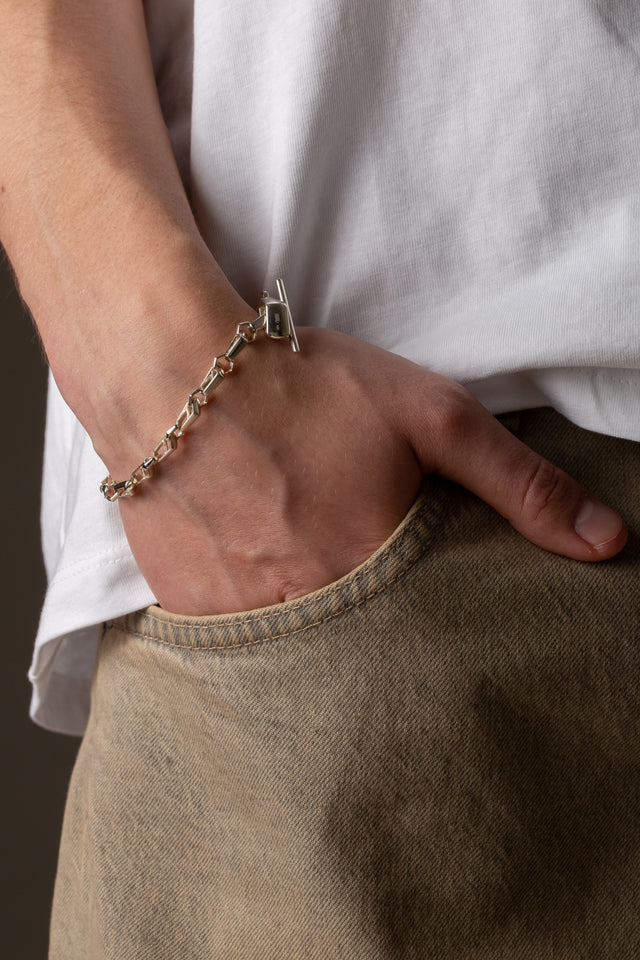
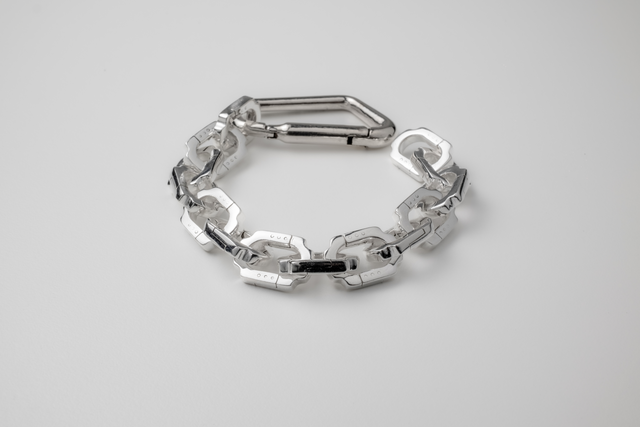
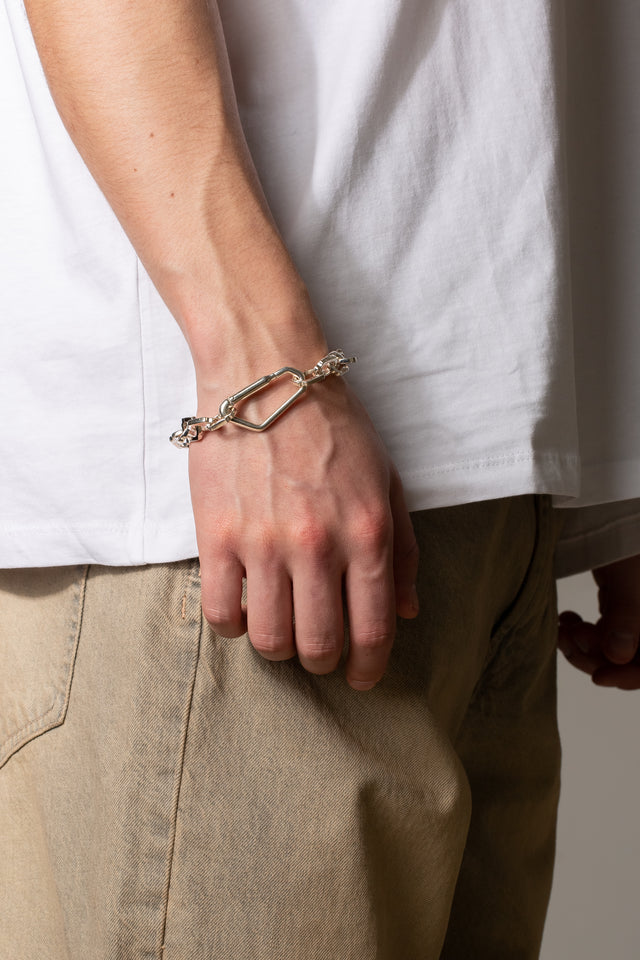
A chain bracelet is built from links: separate cast elements, each joined to the next, closed by a clasp. Nothing about it is one piece. Because the links repeat, the bracelet flexes in every direction, drapes around the wrist rather than gripping it, and can be built to a length. STRUGA has seven of them, and all seven come from the CODEX world — the everyday side of the brand, where the forms are made to be worn in rotation.
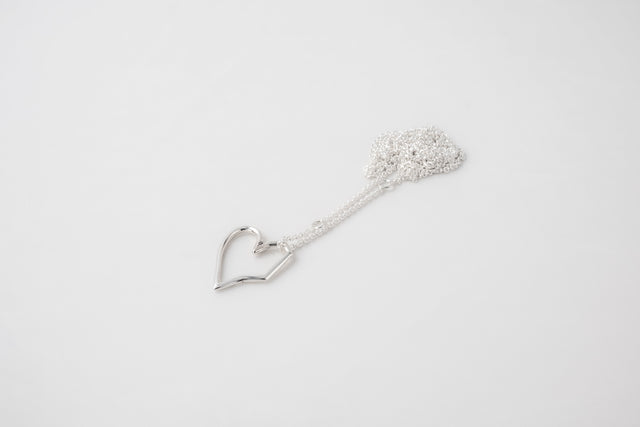
STRUGA divides bracelets by construction, not by look, and there are three forms. A chain bracelet — the seven here — is a chain of separate links with a clasp; it is flexible along its whole length. A rigid bracelet is one solid body that holds its shape: STRUGA makes one, the Big Thorn Bracelet, 45 to 95 grams across five sizes from 16 to 23 cm, and it is a cuff, not a chain. Then there are the plain bracelets — six objects that are neither: beads strung with a capsule or with a heart, a strand of BLADE pins, carabiners worn as the body of the bracelet, and a carbon bracelet with a silver-plated plate. Different construction, different behaviour on the wrist, different way of choosing a size. That is why they sit in separate sections instead of one long list. All three forms together are in Bracelets; rigid forms are explained in the Atlas entry on cuff bracelets.
A carabiner as a clasp is not a carabiner as a body
This is the line people cross most often, because the same part appears in both places. On Blade Big Links and Blade Mini Links a Carabiner #2 Big closes the chain — it is the clasp, the chain is still a chain of BLADE links, and the form stays a chain bracelet. On Carabiner #2 Mini and Carabiner #2 Big Cross the carabiners are the bracelet: every element is itself a working carabiner, so there is no separate clasp and no repeating link. Same hardware, two different constructions. Where the carabiner holds the chain shut, it is a chain bracelet; where the carabiner is what the bracelet is made of, it is a plain bracelet.
How the links are made
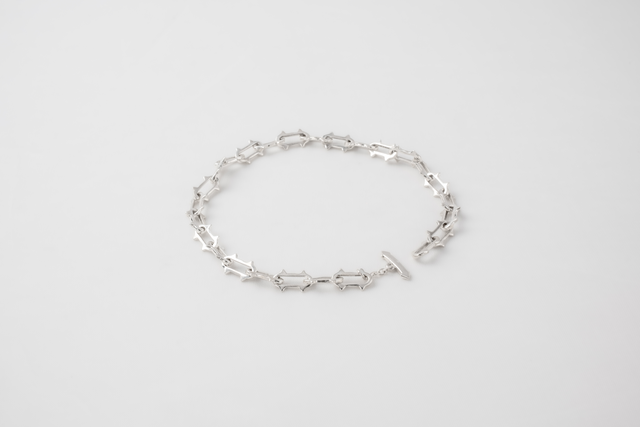
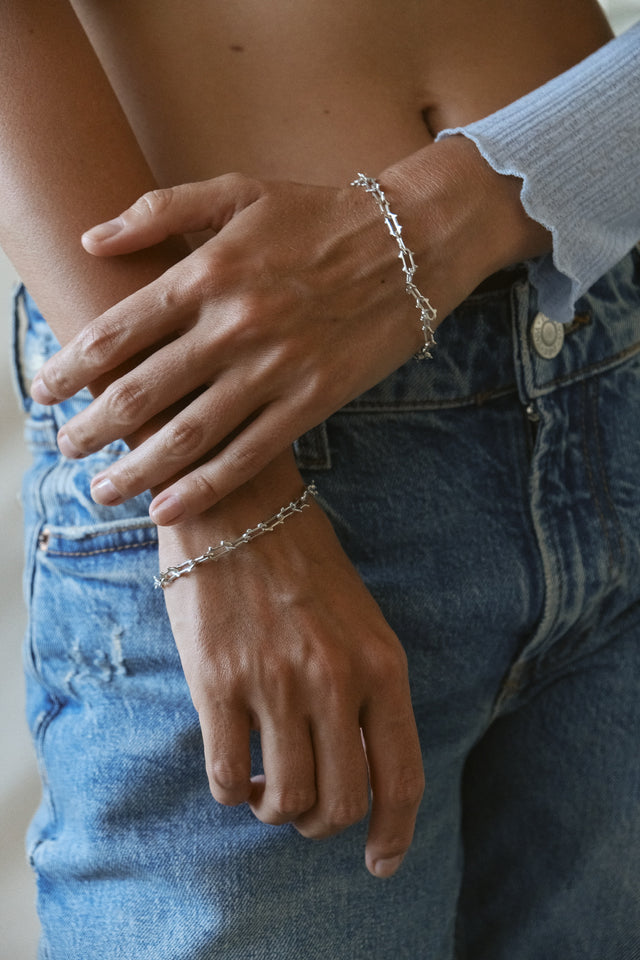
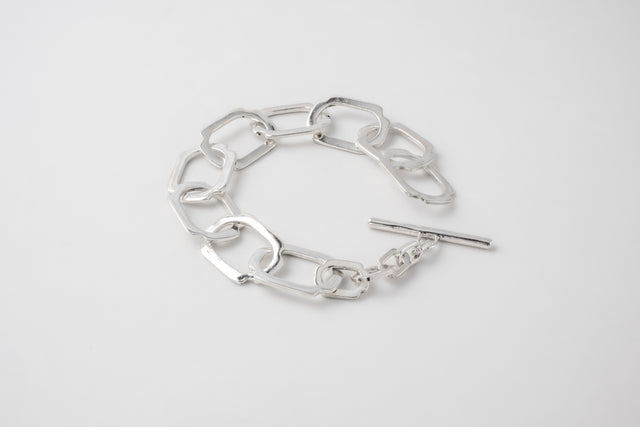
Each link starts as a model — built in 3D or shaped in wax — from which a silicone form is taken and 925 silver is cast. Then the links are joined, and how they are joined is the character of each family. In the four BLADE bracelets every link is split in two and reunited on copper pins: the seam is visible, the planes stay flat, the edges stay sharp, and the whole chain reads as if it were cut from sheet metal. SIGNATURE ASYMMETRIC joins its links through hexagonal connectors, or sets them at deliberately uneven sizes. THORN sharpens the edges of each link by hand, so the chain is felt against the skin as well as seen. The full method, from wax to hand finishing, is in the Atlas entry on what handmade means here.
None of these are machine-woven chains, so the usual names — Cuban, curb, Figaro, rope, box — do not describe them. A woven chain repeats one stock link drawn from wire; here each link is cast separately in 925 silver and joined by hand, which is why a family is recognised by the shape of its link and not by a weave pattern. The same thing sets the weight: a cast link holds more metal than a drawn one of the same length, and that is the difference between a 5-gram chain and a 95-gram one.
The clasp: toggle or carabiner
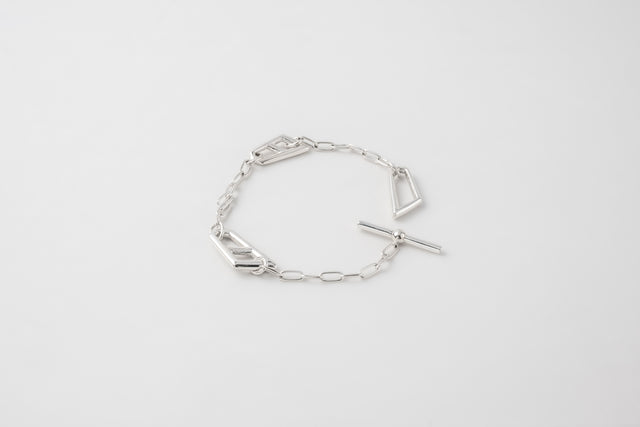
Four of the seven close with a toggle — a bar that turns through a ring — and on Asymmetric Minimalist and Signature Links that toggle is cut in the same silhouette as the links, so clasp and chain read as one form. The two heaviest, Blade Big Links and Blade Mini Links, close with a Carabiner #2 Big: it carries the SIGNATURE ASYMMETRIC form and on Mini Links it is the largest single element of the composition — the carabiner reads first, the chain second.
Weight: 5 to 95 grams
The lightest is the Thorn at 5 grams in S; the heaviest is Blade Big Links at 95 grams in L. That is a tenfold spread and it decides how the bracelet behaves. Under 20 grams the chain drapes and you stop noticing it — that band covers Thorn, Asymmetric Minimalist, Signature Links and both V.2 variants. Past 50 grams the bracelet has its own inertia: it swings when the hand moves and settles back. The V.2 pieces exist for exactly this reason — they are parallel cuts of the BLADE Mini and Medium links at lighter proportions, not upgrades of anything.
Size: 17 to 26 cm (6.7 to 10.2 inches)
Six of the seven come in S 17 cm (6.7 in) and M 21 cm (8.3 in). Blade Big Links is the exception and runs larger, M 23 cm (9.1 in) and L 26 cm (10.2 in), because a massive link needs slack to sit properly. Measure the circumference of your wrist and choose by that number; a chain bracelet is meant to move a little, so between two sizes take the one that sits looser unless you want it close. Because the construction is made of repeated links, a length between the two can be built — write through Custom Order. Measuring is set out in the bracelet size guide.
Why the silver darkens
All seven are 925 sterling silver with no rhodium plating, so the metal keeps reacting. Recesses deepen, friction lightens the raised edges, and on a chain of many links that happens on every facet at once — a link bracelet shows patina faster and more clearly than a smooth surface, because it has more edges. Patina is a property, not a defect. A soft cloth or a silver-cleaning solution returns the metal toward the light; harsh chemicals and ultrasonic baths are what to avoid. The copper pins in the BLADE links patinate on their own schedule and stay darker than the silver around them.
Price, lead time and delivery
The chains here run from $195 for the Thorn in M to $1,690 for Blade Big Links in L, and the price follows the weight of silver: the links are cast solid, so a 95-gram chain holds nearly twenty times the metal of a 5-gram one. Nothing waits in a warehouse — each bracelet is made to order, about two weeks in the workshop, handmade in Bali by master silversmiths, and from there it ships worldwide. Orders from $300 are delivered free; below that the delivery cost is added at checkout. If the bracelet is needed by a date, count backwards: two weeks of work plus the time in transit.
Chain bracelets in the line
What the types of chain bracelet are and how to choose between them is set out in the Atlas entry on chain bracelets.
Read about silver bracelets