How to Layer Silver Jewelry for Women — Necklaces, Bracelets, Rings
The number of pieces matters less than how they are distributed: one zone of the body leads, the other two answer it. There are three zones — neck, wrists, hands — and an everyday look built this way usually comes to five to seven pieces, earrings included. The eye reads the body in zones and links them across distance: when one line of silver repeats at the throat, the wrist and the finger, the set reads as a decision rather than as things put on one after another. Below — how to split visual weight between zones, whether gold and silver can be worn together, what chain and ring gauges to choose, and which six pieces to start with.
Updated September 29, 2026
STRUGA pieces are not split into men's and women's — sizing follows the body, so the system below works for any set. The numbers in this guide come from our own catalog. The Thorn Links Chain, for example, comes in 40, 45, 50 and 75 cm and weighs about 11–18 g — a single form that gives the neck its whole length ladder. General rules for stacking inside one zone live in the guide to stacking and layering silver; this one is about bringing neck, wrists and hands into one composition.
A layered look is one composition across three zones: neck, wrists, hands.
One zone carries about 60% of the visual weight, the next 30%, the last 10%; the look falls apart when all three compete as equals.
Gold and silver can be worn together when one metal leads: it takes about 60–70% of the set, and the second metal repeats at least twice.
Space neck chains 1–2 inches (2.5–5 cm) apart — lengths near 40, 45 and 50 cm — with a single pendant on the longest chain only.
How many pieces of jewelry can you wear at once?
There is no single number, but there is a limit, and it is set by volume rather than count. One zone can be full — three chains at the neck or three rings on one hand. The other two stay quieter: one or two pieces each. That is how an everyday look ends up at five to seven pieces, earrings included. In the evening the ceiling rises, but the rule holds: one loud zone.
Overload usually comes from equality, not from quantity. Three bracelets, three chains and six rings of the same weight give the eye nothing to rank, and it reads the whole thing as costume. The same dozen pieces arranged as a hierarchy read as composed: a heavy chain leads, fine bracelets and one ring answer. The check is simple. Stand at conversation distance from a mirror, about a metre, and name the zone you see first. If you cannot name it, one piece is too many. The tip "take one thing off before you leave the house" is often credited to Coco Chanel, but it has circulated in print anonymously since 1949 (Quote Investigator) — the check works just as well without her name.
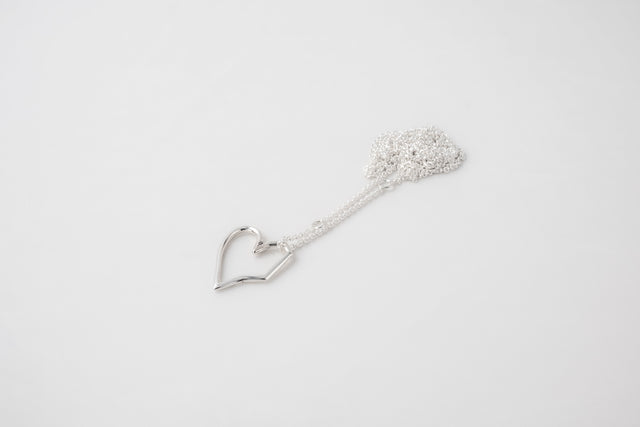
Earrings sit next to the neck and read with it. With a loud neck, a small stud is enough; with a quiet neck, the earring can take the accent. The smallest object STRUGA makes — the Signature Heart stud, about 1.6 g — is built for the first case.
Why is a full-body layered look harder than layering one zone?
Anyone can put three chains around their neck: the neck is a single visual unit, and the chains stack inside it. Brilliant Earth suggests keeping 1–2 inches between lengths, and Dana Rebecca Designs names the flip side: chains of the same length and style will almost always tangle. A full-body look — necklaces, bracelets and rings worn as one composition — is a different problem. Done badly, it reads as three unrelated decisions glued onto one outfit.
When it works, the reason is coherence across distance. One metal at the throat, the wrist and the finger reads as a language. Matched weight reads as a vocabulary. One lead zone with two supporting ones reads as a sentence. Random pieces in random combinations read as noise. How to choose the pieces themselves by form, weight and occasion is covered in the women's silver jewelry guide; this one is about putting them together.
What are the three zones of a layered look, and what does each one do?
| Zone | Share of the look | What goes on it |
|---|---|---|
| Neck — frames the face, read first | 60% in most looks | two or three chains 1–2 inches apart, one pendant on the longest |
| Wrists — seen when the hands move | 30% | two or three pieces of contrasting texture — a fine chain and a denser bracelet |
| Hands — read at conversation distance | 10% by day, 60% in a hand-led look | rings on two fingers, one or two fingers left clear |
Neck — the lead zone
The neck frames the face, and the face is read first. A neck stack is chains of different lengths: a short one at the throat, a middle one at the collarbone, a longer one carrying a pendant. GIA describes chokers as 14–16 inches and princess length as 17–18 inches. The full length ladder, choker through opera, lives in the necklace layering guide. One form that gives you the ladder on its own is the Small Beads with Heart Choker: 40, 45 and 50 cm, about 27–33 g.
Wrists — the supporting zone
The wrists sit in the middle of the body's vertical line and show whenever the hands move. A wrist stack is built on circumference and contrast of texture: a fine chain, a cuff bracelet, a beaded piece. The Thorn Bracelet weighs about 5 g and works as a thin line; the Small Beads with Heart Bracelet, about 17–21 g, gives the wrist density. The full range is in the bracelet collection, and wrist-only combinations are in the bracelet stacking guide.
Hands — the close-up zone
Hands are read at conversation distance. The base rule: rings on two fingers, one or two fingers left clear. In an everyday look the hands are the quietest of the three zones; in the evening they can take the lead. The dark minimalist rings are built to group two or three on one hand, and the oxidized stacking rings page covers finger-by-finger placement. With sensitive skin, read the hypoallergenic silver guide first: rings touch skin more than any other piece.
What is the 60/30/10 rule, and how do you use it?
The 60/30/10 rule assigns visual weight before anything goes on: one zone gets 60% (the lead), one gets 30% (support), one gets 10% (a minimal presence). The proportion comes from interior design, where 60% of a room goes to a dominant colour, 30% to a secondary one and 10% to an accent (Elephantstock). On the body the same arithmetic runs on metal instead of colour.
It works because the eye cannot read three loud zones at once. Three heavy chains, three cuff bracelets and three rings on each hand — the brain stops sorting and sees costume. The 60/30/10 split forces a hierarchy:
- Neck-led look. Neck — three layered chains with a pendant (60%), wrists — one fine chain bracelet each (30%), hands — one signet ring on the dominant hand (10%).
- Hand-led look. Hands — three rings across two fingers (60%), wrists — one substantial bracelet (30%), neck — one fine chain, no layering (10%).
- Wrist-led look. Wrists — three bracelets layered on one arm (60%), neck — a single short chain (30%), hands — two thin bands on one finger (10%).
The rule fails when every zone is treated equally. Equal layering across neck, wrists and hands is the most common reason a layered look feels overloaded. Pick the lead zone before adding anything.
Can you mix gold and silver jewelry?
Yes, as long as one metal clearly leads. Brilliant Earth advises letting one metal make up about 60–70% of a stack, and Jennifer Fisher puts the whole of metal mixing down to balance and proportion. It is the same arithmetic as the zones: the second metal stays a minority. To read as a decision rather than an accident, it repeats at least twice — a ring and earrings, a bracelet and a ring. Polished and darkened 925 sterling silver, meanwhile, are not two metals but two surfaces of one, and they mix across zones freely.
The reliable patterns:
- All silver, varied surface. Bright chains at the neck, a darkened bracelet at the wrist, a matte ring.
- All silver, one surface. All bright or all dark — the cleanest read for minimalist looks.
- Silver with a gold accent. Gold goes to the smallest zone — a ring and earrings — never to the lead one.
- Silver and gold as equals. You need a bridge piece that carries both metals; it goes in the lead zone and explains the rest. Mejuri suggests rings similar in shape or size, so the two metals read as one group.
How do you combine pieces of different gauge and weight?
After metal, weight is the second signal the eye reads. A 1 mm chain at the neck cannot hold proportion next to a 10 mm bracelet at the wrist. Pick a weight register and keep to it:
- Fine at all three zones. Thin chains (1–2 mm), light bracelets (2–4 mm), thin stacking bands (1–2 mm). Reads restrained, wearable every day.
- Mid-weight at all three zones. Chains of 3–4 mm, dense bracelets of 5–7 mm, rings 3–5 mm wide. Reads confident.
- Substantial at all three zones. Heavy chains from 5 mm, cuff bracelets, large rings. Reads architectural, evening.
The spread inside one category is wider than photographs suggest. In our catalog the Signature Links V.2 Ring weighs about 2–3.3 g depending on size, while the Brutalism V.3 Ring weighs about 9.6–14 g. The Thorn Bracelet is about 5 g; the Blade Mini Links Bracelet is about 50–62 g. Pieces from different registers share a zone only on purpose, as a single point of contrast.
Which six pieces should a layered wardrobe start with?
Six pieces, two per zone, in one metal — the smallest set that produces 60/30/10 looks in any direction: neck-led, wrist-led or hand-led. Below is that set from the STRUGA catalog; lengths and grams come from the product pages, and handmade weight is always approximate.
| Zone | Piece | Length or size | Catalog weight |
|---|---|---|---|
| Neck, short | Thorn Links Chain | 40 cm | about 11 g |
| Neck, long | Small Beads with Heart Choker | 45 or 50 cm | about 30–33 g |
| Wrist, fine | Thorn Bracelet | 17 or 21 cm | about 5 g |
| Wrist, dense | Small Beads with Heart Bracelet | 17 or 21 cm | about 17–21 g |
| Hand, accent | Heart Lock Ring | sizes 16–19 | about 11 g |
| Hand, fine | Signature Links V.2 Ring | sizes 16–19 | about 2–3.3 g |
The set holds together through repeated form. The Thorn chain and bracelet are one sharp-angled line at the throat and at the wrist. The choker, bracelet and Heart Lock Ring carry one Signature Heart — half smooth, half angular — across three zones at once. The thin Signature Links V.2 band turns the hand down when the neck leads. All six come from the CODEX world, the brand's everyday architectural form. If the ears need balance, a stud in the same register becomes the seventh piece.
Which five full-body looks work?
Look 1: everyday, neck-led
Two layered chains at the neck (40 and 50 cm), one fine chain bracelet on the dominant wrist, one ring. A look that runs all day: it suits crew necks, blouses and most office wardrobes.
Look 2: the hands lead
Three rings: a signet on the middle finger, a wider band on the index, a thin band on the ring finger. One substantial bracelet on the dominant wrist and a single 50 cm chain at the neck. Best where hands are on show — meetings, dinners.
Look 3: the wrist stack
Three bracelets on the dominant wrist: a fine chain, a mid-weight chain, a cuff bracelet. One 40 cm choker and one thin band on the index finger. Reads architectural — many people layer the neck, fewer commit to the wrist.
Look 4: quiet three-zone minimalism
One fine 50 cm chain, one fine bracelet on each wrist, one thin band on each ring finger. The exception to 60/30/10: it works when every piece is genuinely fine and the look reads as one continuous line of metal down the body.
Look 5: evening, all dark
Three darkened chains at the neck (40, 50 and 60 cm), one darkened bracelet, two dark rings on neighbouring fingers. One metal, one surface, layered across all three zones. Best with a monochrome wardrobe — black, charcoal, deep navy. Most STRUGA silver arrives bright and darkens with wear; pieces darkened in advance are in the catalog too — the Brutalism V.3 Ring, for one.
How do you match layered jewelry to a neckline and outfit?
Layered jewelry works with what you wear, and the strongest looks are tuned to the neckline and to the overall weight of the outfit.
V-neck or wrap blouse: full neck layering works — the V opens the chest, the best canvas for a neck-led look. Crew-neck T-shirt: skip the choker, wear a 50 and 60 cm pair, and let wrists and hands matter more. Turtleneck: chains sit on the fabric, so weight decides — chains from 2 mm, no choker. Strapless: one chain at the collarbone, then move attention to wrists and hands.
Match the weight register of the jewelry to the weight register of the clothes. Casual outfits take fine or mid-weight layers; structured ones take substantial pieces. A linen sundress with heavy bracelets reads off, and so does a sharp blazer with a scatter of thin rings.
Which mistakes make a layered look feel overloaded?
- Equal weight at all three zones. No lead zone, no hierarchy, nowhere for the eye to land.
- A stray second metal. A single gold ring with no echo in an all-silver look reads as a piece put on by mistake.
- Overloading one zone. Six bracelets on one wrist with a bare neck and bare hands looks unbalanced.
- More than seven pieces by day. Past that point each new piece takes away more often than it adds.
- Pendants in several zones. One pendant for the whole look — usually on the longest chain.
How do you store and clean jewelry worn in layers?
Layers wear pieces against each other, so caring for a set starts with order. Everything comes off at night: sleeping in layers kinks chains and loads the clasps. Chains are stored apart — hung, or in separate bags; a set coiled into one tray becomes a knot by morning. Silver is kept in a closed zip bag: a small sealed volume holds less sulphur from the air, and the metal darkens more slowly. Why sealed storage beats sprays is explained in the guide on how to prevent silver from tarnishing.
Cleaning follows the surface. Bright silver comes back to light with a silver dip or a silver cloth; on darkened pieces the dark recesses are part of the design and polishing leaves them alone. Cleaning frequency, bright versus darkened pieces and clasp checks are covered in the sterling silver care guide.
Why choose uncoated silver for layering?
Plating on layered pieces lasts less time than it seems. Rhodium is a thin layer over the metal, and GIA states plainly that it wears away gradually and the piece has to be replated. In a set the wear speeds up: chains rub against chains, rings against neighbouring rings, and the layer goes first exactly where pieces touch. Jewelers who replate give a rough rhythm — rings every 12–18 months, necklaces every two to three years (Robinson’s Jewelers).
Uncoated silver behaves differently. STRUGA calls it Living Silver: friction brightens the raised edges, the recesses darken, and the patina settles as a map of how the set is worn. Six pieces worn together darken in step, because they live in the same conditions — the same skin, the same air. That is why STRUGA makes its layering pieces in 925 sterling silver with no rhodium coat.
A year in, a set like this cannot be bought again: the edges touched most are brighter, the recesses darker, and the pattern follows your hand, not a shop window. Six pieces assembled to one system and worn every day read at conversation distance, in a photograph and in the mirror — and outlast every change of outfit.
About STRUGA. STRUGA is a dark silver jewelry brand founded by Dmitry Strugovshchikov and Ekaterina Strugovshchikova, handmade in Bali by master silversmiths. Most pieces are 925 sterling silver left uncoated, so they darken with wear; part of the range is darkened in advance, at the bench. The darkening is part of the design.
Frequently asked questions
Didn’t find the answer — write to us, we reply personally.
Ask a question →01How do I layer necklaces without them tangling?+–
Chains tangle when they are alike. Chains of the same length and style tangle almost every time, so space the lengths 1–2 inches (2.5–5 cm) apart and vary the style and gauge. Flat, even chains such as curb and box tangle less than supple ones. A layering clasp solves it mechanically: it holds two or three chains on one fastening at a fixed distance from each other. At night, take each chain off and hang it on its own — a set coiled into one tray is a knot by morning.
02How many necklaces should I layer?+–
Two or three is the working range for a neck stack. One chain is a single statement, and the neck stops reading as layered. Four or more compress the lengths until the spacing collapses and the strands tangle. Three is the limit that still leaves clean air between chains: a short one near the throat, a middle one, and a longer one carrying a single pendant. The neck is usually the loudest of the three zones, so keep the wrists and hands quieter. If you want more metal, add it at the wrist rather than as a fourth chain. The bracelet collection is built in matched weights for exactly that redistribution.
03What lengths and spacing actually work?+–
The reliable trio is about 16, 18 and 20 inches — 40, 45 and 50 cm: a chain at the base of the throat, one at the collarbone, and a longer one that drops just below it. GIA describes chokers as 14–16 inches and princess length as 17–18 inches. Keep 1–2 inches of clear air between lengths so the chains read as separate lines rather than one crowded band. A long neck carries wider intervals; a shorter neck reads better with the lengths drawn closer. Hang the pendant on the longest chain only, so the eye lands once.
04In what order do I put the pieces on?+–
Longest to shortest. Fasten the longest chain first so it settles on the chest, then the middle one, then the short one at the throat: that way the clasps stay clear of each other and the shorter chains do not trap the longer ones. The wrist follows the same logic: the largest cuff bracelet goes on first, fine chains after, so nothing has to be pulled past a tight piece. Rings go on last, once neck and wrists are set, so you can judge how loud the hands should be. Take everything off in reverse, shortest first.
05What bracelets pair with a layered neck stack?+–
Different textures rather than repeats. A fine chain plus one dense bracelet or cuff bracelet gives the wrist a depth a row of identical bands never will: the eye wants contrast in surface, not duplication. Keep the wrist in the same weight register as the neck, so a 1 mm chain at the throat is not fighting a heavy bracelet on the arm. Two or three pieces per wrist is plenty; beyond that they clatter and lose their lines. The dark minimalist rings are built to group on one hand, so wrist and fingers carry the same quiet language down the arm.
06Which chain types layer best?+–
Flat, even chains layer most calmly. Curb and box chains hold their shape and tangle less than supple chains, and cable chains behave evenly. Rope chain is the opposite: it catches on everything, itself included, and knots faster than anything else in a stack. Snake chain tangles little, but its tube-like links can kink for good if the chain is folded or twisted. Gauge matters as much as link shape: a 1 mm thread next to a 4 mm chain reads as a mismatch before the eye even registers the links.
07Should earrings match the rest of the layers?+–
In metal, yes; in volume, no. Earrings read together with the neck, so count them as part of the lead zone when the neck leads. With three chains, a small stud is enough; with one fine chain, the earring can take the accent. The earrings repeat the metal of the set, and if the look carries a gold accent, the ears are a natural place for its second echo. The smallest object STRUGA makes is the Signature Heart stud, about 1.6 g.
08Is matching weight the same as matching style?+–
No. After metal, weight is the second visual signal the eye reads, and it registers consistent weight before it registers style. A 1 mm chain at the neck cannot hold proportion next to a 10 mm bracelet at the wrist, even when both pieces share a style. The answer is to choose one weight register — fine, mid-weight or substantial — and keep it across all three zones, so separate zones read as one composition.
Continue from the journal to a current STRUGA object: Small Beads with Heart Choker.