Signet Ring Meaning and History — Why Men Still Wear Them
The flat face on the ring once stood in for a signature: it was pressed into clay or sealing wax, and the impression authenticated the document. Seal rings are known from Egypt's Middle Kingdom, around 2030–1650 BCE, and the ring stayed a working tool until the second half of the 19th century, when gummed envelopes pushed sealing wax out of daily use. Nobody authenticates a document with one today — it is worn as a sign: initials, a family crest, membership of a circle, or a form with no inscription at all.
Updated September 28, 2026
The STRUGA catalog has three signets, none engraved, gathered in one signet ring collection; the darkest of them, blackened in advance, is the Brutalism V.3 Ring.
A signet ring has a flat or slightly domed face; it began as a personal seal whose impression authenticated a document.
The seal is older than the ring: Mesopotamian cylinder seals from the 4th millennium BCE hung on a cord, while seal rings are known from Egypt's Middle Kingdom.
The working function ended in the second half of the 19th century, when gummed envelopes replaced sealing wax; the form stayed.
The English custom is the little finger of the left hand, and there is no firm reason for it: it is accrued tradition.
STRUGA has three signets without engraving: two in pale silver, one blackened in advance; 4.7 g to 24 g, made to order in about two weeks.
Where did the signet ring come from?
The seal is older than the ring
The seal came first; the ring came later. From the 4th millennium BCE Mesopotamia used cylinder seals: a carved cylinder rolled across wet clay, worn on a cord around the neck or the wrist (The Met). The seal moves onto the finger in Egypt: scarab rings with an inscription cut into the flat base are known from the Middle Kingdom. The scarab often swivelled in its mount and was turned seal-side down onto the clay. Such rings were worn not only by pharaohs but by the officials who sealed documents.
Rome: iron, gold and the sealed will
The early Roman ring was iron. Pliny the Elder writes that even a general in his triumph wore an iron ring, and that gold rings were at first issued only to envoys (Natural History, Book 33). Gold became a mark of rank: in 23 CE the right to a gold ring was limited to free-born men whose father and grandfather had also been born free, with property of at least 400,000 sesterces. The seal authenticated contracts and wills: a will's tablets were closed with the seals of the testator and seven witnesses. The fashion for rings itself, Pliny says, Rome took from the Greeks.
Middle Ages and Renaissance: crest, merchant's mark and sealing wax
The face carries a family crest, an initial or a merchant's mark — a geometric owner's sign that served as a signature on letters and deeds. One such ring with an octagonal face, Italy 1600–1650, is held by the Victoria and Albert Museum. Letters were closed with sealing wax, and an unbroken impression proved nobody had opened them. The Fisherman's Ring, the papal seal, is recorded since at least the 13th century; when a pope dies it is destroyed so that it cannot authenticate a forged document.
Modern era: the seal on a chain and the end of sealing wax
In early 19th-century England the seal briefly leaves the finger for the watch chain: a fob seal hung by the small trouser pocket, and its inscription was cut in reverse so that it read correctly in the wax (V&A, fob seal, 1815–20). The ring loses its working function in the second half of the 19th century, as gummed envelopes spread and sealing wax leaves daily use. From then on it lives as a sign of family, class or profession.
The 20th century and the return
Through the 20th century the tradition runs in three streams:
- Aristocratic European — the family crest signet passed down within a family.
- American — class, regimental and fraternal rings. The class ring is a relative of the signet rather than a kind of it; West Point introduced the first one for the class of 1835 (West Point).
- Plain — initials, a patron saint, modest engraving in gold or silver.
Over the last decade the signet has come back into the men's style conversation: Britain's The Field covers its return with the Heraldry Society. Next to the classical signet now stand two newer ones — the modernist plain and the brutalist, sculptural signet; the brutalist one is where STRUGA works.
What does a signet ring mean today?
Without its authentication job, a signet means one of three things: who you are, which circle you belong to — or that the form matters more than an inscription.
Identity carrier
Initials, a family monogram, a name in symbol form. The ring attaches "this is who I am" to the hand. It is often inherited or commissioned for an occasion — a 30th birthday, a graduation, a wedding.
Member's mark
A class ring, a military signet, a lodge or university ring. It marks belonging to a group: members recognise the sign, outsiders see only the form.
Form without inscription
With no engraving and no crest, the ring exists as a sculpture on the hand. The blank face is the statement: the traditional form kept, the traditional content refused. All three STRUGA signets sit here — architectural relief instead of an inscription.
What styles of signet ring are there today?
| Style | What sits on the face | Who it is for |
|---|---|---|
| Classical engraved | A monogram or a real family crest, cut into polished gold or silver | Men who already have a mark worth carrying |
| Modernist plain | Nothing — a geometric face left deliberately empty | Men who want the form without a declared content |
| Brutalist | Architecture: an asymmetric relief left rough rather than polished | Men wearing other architectural pieces |
Classical engraved
Polished gold or silver, an oval or round flat face, an engraved monogram or crest. It reads dressy and traditional. It suits men with a real monogram or crest; engraving without meaning is empty.
Modernist plain
Solid silver or gold, a geometric face, no engraving. The form is the statement. It is often worn on the ring or middle finger of either hand, by men who like the signet silhouette but want no explicit content on the face.
Brutalist / sculptural
Dark or darkening silver, an architectural face, often asymmetric and left rough. The face is part of the sculpture, and the ring exists more as object than as ornament. It suits men with a strong personal style, especially next to other architectural pieces: a second BRUTALISM ring or bracelets built in the same language — heavy links, no polish.
Which finger do men wear a signet ring on?
There is no single rule: the English custom is the little finger of the left hand, Rome started with the ring finger, and today men wear a signet on any finger — except, usually, the left ring finger if married. The secretary of the Heraldry Society says plainly that there is no firm reason for the little finger; it is tradition accrued over many years. The popular explanation that the pinky presses the seal into wax most easily has no source behind it. Pliny writes that Romans first wore the ring on the finger next to the little finger, later on the index finger, while the Gauls and Britons used the middle finger.
- Little finger (pinky): the English tradition, reads classical. More in the atlas entry on the pinky ring.
- Right ring finger: how it is worn in parts of continental Europe. Reads dressy.
- Left ring finger: best avoided if married — it competes with the wedding band. Fine if unmarried.
- Middle finger: the modern choice for large and brutalist signets — the wider finger carries the visual weight.
- Index finger: rare for signets, more common for statement rings without a seal face.
What does a signet ring on the pinky mean?
In English tradition, a sign of family and standing. In the same piece in The Field, the editor of the Heraldry Society's journal says it directly: wearing a signet ring announces a status. Today men wear one on the pinky without a crest too — there it does not compete with the wedding band and stays in view.
Which hand do you wear a signet ring on?
By the English custom, the left — the right if you are left-handed. A practical rule for a heavy signet: wear it on the hand you use less, where it knocks against surfaces less often.
What should you engrave on a signet ring — and should you engrave it at all?
Engrave only when there is real meaning behind it; otherwise a blank face is the more honest choice. There are three reasonable options.
Personal monogram
Two or three letters: first and last initials, or first, middle and last. A reverse cut, which makes the wax impression read the right way round, is historically correct — rings and fob seals were cut that way. Without sealing wax, modern wear does not need it.
Family crest or symbol
Only if you actually have one. An invented crest reads as fake. If your family has a real coat of arms, the signet is its place.
Nothing
A blank face is a statement too: the traditional form kept, the traditional content refused. All three STRUGA signets are unengraved — the face carries architectural relief instead of an inscription, and the form carries the meaning.
How do you size a signet ring?
A signet is heavier than an ordinary band, so measure the finger you will wear it on, and measure in the afternoon. Our two shapes show how fast the metal grows: the same ring at size 22 carries two and a half times the silver it carries at size 15. Sizes below are the inner diameter in millimetres.
| Size (inner diameter, mm) | Brutalism V.1 / V.3 | Thorn Ring |
|---|---|---|
| 15 | 9.6 g | — |
| 16 | 10.0 g | 4.7 g |
| 17 | 11.5 g | 5.5 g |
| 18 | 14.0 g | 7.0 g |
| 19 | 17.0 g | 8.0 g |
| 20 | 19.0 g | 9.6 g |
| 21 | 22.0 g | 11.0 g |
| 22 | 24.0 g | 12.7 g |
Weight is the honest way to compare signets across brands: a ring quoted at the same size but half the grams is hollow, thinner in the shank, or not solid silver.
- Measure the finger you will wear it on. The little, ring and middle fingers of one hand are different sizes, and a measurement from another finger will not fit.
- Measure in the afternoon, at room temperature. The hand is largest in the morning: in a study of 36 volunteers its volume fell 2.7% by midday (Warrender et al., 2019); a hot shower or cold air changes the finger too.
- A wide shank — 8 mm and up — fits tighter. Jewelers usually advise going half a size up from a thin band.
How to take the measurement at home — with thread, paper or another ring — is covered in the silver ring sizing guide.
How should you wear a signet ring — and how not?
A signet works when it is the lead piece on its hand.
Works
- One signet on one hand, with no other rings on that hand.
- A signet on the right pinky plus a plain wedding band on the left ring finger: two pieces, two hands.
- A brutalist signet plus one or two pieces in the same language on the same hand — a coordinated set.
Avoid
- A signet plus three decorative rings on one hand: it loses its anchor role.
- The face turned toward the palm: a signet is meant to be seen.
- Engraving that means nothing: catalog crests read fake.
Which STRUGA signet ring should you choose?
Tone and mass decide it: pale silver that darkens on its own, dark from day one — or a lighter signet with sharp planes. All three are made to order in about two weeks.
| Ring | Finish | Sizes and weight | For whom |
|---|---|---|---|
| Brutalism V.1 | Pale uncoated silver that darkens on its own with wear | 15–22, 9.6–24 g | Men who want the tone to build over time |
| Brutalism V.3 | Blackened in advance by oxidation; raised ends and rims stay light | 15–22, 9.6–24 g | Men who want a graphite tone from day one |
| Thorn Ring | Pale silver; recesses darken, raised faces stay bright | 16–22, 4.7–12.7 g | Men who want a signet half the weight, or an alternative wedding band |
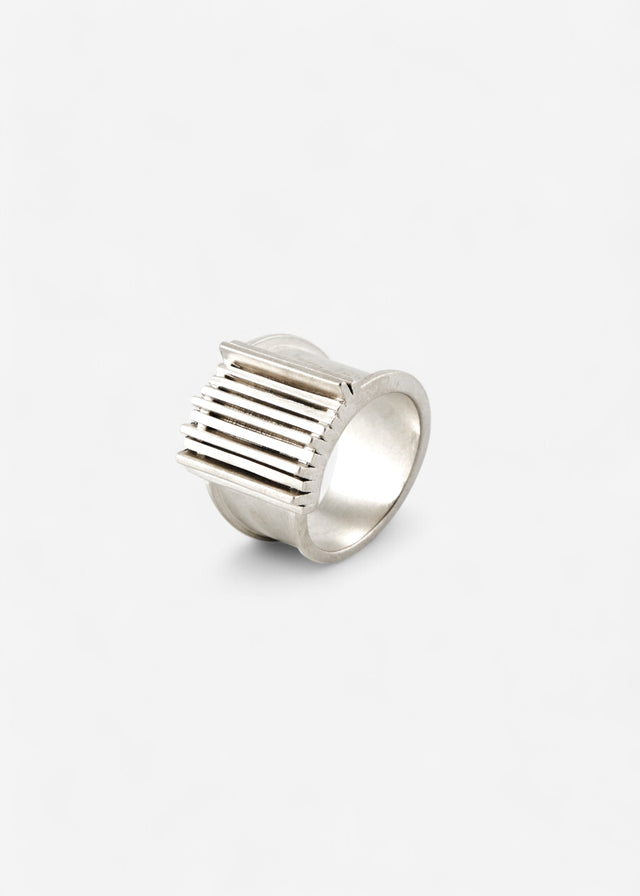
The Brutalism V.1 and V.3 share one architecture in two tones: a wide band, and in place of a smooth seal face, flat bars of different lengths whose ends run past the edge in steps. They are the heaviest rings in the brand. The Thorn Ring carries the sharp flat planes of the THORN form onto the finger and belongs to the DARK UNION line — ready-to-buy rings for the union.
Why do men still wear signet rings in 2026?
Men choose a signet for three things an ordinary ring does not have: history, a sign and mass.
- Connection to tradition. The form runs from the Egyptian scarab through the Roman ring and sealed letters to the class ring. Wearing one is joining a long line.
- Identity in physical form. Initials, crest or blank, the ring puts something about the wearer on the hand. In a world of digital signatures, heavy silver is concrete.
- Architectural object. A flat-faced ring is sculpturally interesting on its own — a small monument on the finger. The brutalist signet leans into this entirely.
Related guides in this cluster
- Men's jewelry style guide
- Should men wear jewelry? Cultural context
- Oxidized silver men's jewelry — care and styling
- Brutalist jewelry for men
- How to layer men's jewelry
Related reading
- Signet ring: what it is and how it differs from a plain ring
- Statement rings — the ring built around a stone or a face
- BRUTALISM collection
- Dark minimalist rings
- Men's jewelry collection
- 925 sterling silver complete guide
About STRUGA. STRUGA is a dark silver jewelry brand founded by Dmitry Strugovshchikov and Ekaterina Strugovshchikova, handcrafted with Balinese and international silversmiths. Most pieces are 925 sterling silver left uncoated, so they darken with wear; part of the range is oxidized at the bench. The darkening is part of the design. It is a brutalist object that reacts and changes through contact with the environment and the wearer.
See STRUGA signet rings — a collection of men's signet rings in 925 sterling silver, in the BRUTALISM and THORN families.
Frequently asked questions
Didn’t find the answer — write to us, we reply personally.
Ask a question →01What finger should a man wear a signet ring on?+–
The English custom is the little finger of the left hand; left-handed men wear it on the right. In parts of continental Europe the signet goes on the ring finger of the right hand. Today any finger works, though married men usually avoid the left ring finger, where the wedding band sits. The middle finger suits large and brutalist signets that need visual weight.
02What does a signet ring on a man's pinky mean?+–
In English tradition, a sign of family and standing: the crested signet was worn on the little finger of the left hand. There is no firm reason for the pinky specifically — it is accrued custom, as the secretary of the Heraldry Society puts it. Today men wear a signet on the pinky without a crest too: there it does not compete with the wedding band.
03What is the meaning of a signet ring?+–
A signet ring is a ring with a flat or slightly domed face that began as a personal seal: its impression in clay or sealing wax authenticated a document. Today it carries identity — initials, a family crest, a sign of belonging to a circle or, in modernist styles, intentional blankness.
04How old are signet rings?+–
The seal is older than the ring: Mesopotamia used cylinder seals from the 4th millennium BCE, but they were worn on a cord. Seal rings are known from Egypt's Middle Kingdom, around 2030–1650 BCE — which makes them roughly four thousand years old.
05Why do men wear signet rings?+–
To carry personal or family identity, to mark belonging to a group — military, university, club — or as a sculptural object on the hand. A signet carries a history an ordinary ring does not: from the Egyptian scarab through the Roman ring and sealed letters to the class ring.
06Is a signet ring the same as a regular massive ring?+–
No. A signet ring is defined by its flat or domed face — the surface that was historically pressed into sealing wax. A massive band has volume without that face. A ring is a signet because of the seal-shaped face, not because it is heavy.
07Does a modern signet ring still work as a real seal?+–
Not in practice. Sealing wax left daily use in the second half of the 19th century, as gummed envelopes spread. For the impression to read the right way round the design is cut in reverse — rings and fob seals were made that way; decorative wear does not need it.
08Should a signet ring be engraved?+–
Only if the engraving means something — your real monogram, a real family crest, a meaningful symbol. Generic engravings and invented crests read fake. A blank face is a legitimate choice too: all three STRUGA signets are built that way, with relief in place of an inscription.
09How much should a real silver signet ring cost?+–
Price follows the mass of solid 925 silver, the size, the construction and the engraving. Check the current price on the page of the signet itself and ask for a quote on custom work; one static range goes stale fast and hides the difference between a solid ring and a hollow or plated one.
10How much does a silver signet ring weigh?+–
Weight grows with size faster than it seems. BRUTALISM signets run from 9.6 g at size 15 to 24 g at size 22 (inner diameter in mm); the Thorn Ring from 4.7 g at 16 to 12.7 g at 22. A ring of the same size at half the weight is a reason to ask whether it is solid.
11What's the difference between a signet ring and a class ring?+–
A class ring is a relative of the signet with a shared ancestor, not a kind of it. West Point introduced the first one for the class of 1835; it carries the school's name, the year and class symbols. A signet carries a personal monogram, a family crest or, in modernist styles, no engraving at all.
12Can a man wear a signet ring on his ring finger?+–
Yes. In parts of continental Europe the right ring finger is the usual place for a signet, and in Rome, according to Pliny, the ring was first worn on the finger next to the little finger. Married men usually avoid the left ring finger because of the wedding band.