Statement Rings: the ring built around a stone or a face
A statement ring is a ring that carries something beyond the band — a stone, a seal, a worked face. It is a large, present form, not a plain band. At STRUGA it reads as a piece of mass in dark silver.
A statement ring carries an object beyond the band — a stone, a seal or relief — which is why it runs larger and heavier than a plain band.
At STRUGA the statement ring is uncoated 925 silver: cut edges, a dense silhouette, weight.
Uncoated 925 is Living Silver: the surface darkens in the recesses and lightens on the edges on its own, with no plating.
The massive reading lives in the BRUTALISM, FUSED and THORN families; a ring with a stone is not in stock and is made to order.
Nine rings live in the catalogue: eight in uncoated 925, one — Brutalism V.3 — blackened at the bench. Weight runs from 2.1 g to 24 g across sizes 15 to 22, because mass grows with the size.
A signet is a special case with a flat face meant for a mark, not a stone.
A particular stone — most often tourmalines, aquamarines, quartz — is made through Custom Order.
The short version
- A statement ring at STRUGA is mass and architecture, not gold around a large stone. Presence comes from the volume of the form, not the sparkle of a stone.
- 925 silver, uncoated — cut edges, a dense silhouette, weight.
- Worn as one large accent on the hand — a single form, not a stack of thin bands.
- Sized to the finger, 15 to 22, and mass grows with the size: the same Brutalism band is 9.6 g at 15 and 24 g at 22.
- The massive reading lives in the BRUTALISM, FUSED and THORN families.
- The silver darkens in the recesses and lightens on the edges. This is Living Silver.
- What a statement ring is
- Where the form comes from
- Statement ring, plain band, signet
- The statement ring at STRUGA
- The form on the objects
- At a glance
- FAQ
What a statement ring is
A statement ring carries a shield or a setting on the band: a stone, a carved seal, a relief plate. Where a plain band is a line of metal, this ring holds an object. In Russian it is named persten, from perst — finger; historically the ring of standing, a stone or a crest on the hand that read at once as status and as a personal seal.
The point of the form is that it carries more than the band. That is why a statement ring is always larger and heavier than an ordinary one — the mass is there to carry that centre — a stone or a face.
Where the form comes from
The ring of standing is one of the oldest. A stone in a setting on a noble hand worked two ways at once for centuries: it showed rank, and it served as a seal — an impression in wax authenticated a document. The heavier the ring, the more a hand's gesture was noticed, the more the wearer weighed.
In time the sealing function fell away and the form stayed. Today the statement ring is about presence on the hand: a large stone, a heavy setting, or dense volume instead of a thin line. It is chosen when a ring should read, not disappear.
Statement ring, plain band, signet
Three things, distinct by what sits on the band.
- Plain band — a smooth ring with no shield and no setting. The base form.
- Statement ring — a ring with a pronounced shield or setting: a stone, a seal, relief. Large, present.
- Signet — a special case with a flat face meant for a mark, not a stone. See the Signet Ring node.
| Plain band | Statement ring | Signet | |
|---|---|---|---|
| On the band | Nothing — a smooth strip | A stone, relief or a pronounced shield | A flat face cut for a mark |
| Weight at STRUGA, across sizes | 2.1–6 g | 3.7–13 g | 9.6–24 g |
| What it does | A line on the finger | Presence: volume read from across the table | Carries a mark, historically an impression in wax |
| Relation | The base form | Any ring carrying an object beyond the band | A special case of the statement ring |
In short: a statement ring is any ring that holds an object beyond the band. A stone — a stone ring; a flat seal — a signet; pure mass with no setting — a massive ring.
The statement ring at STRUGA
STRUGA reads the statement ring as mass and architecture, not as gold around a large diamond. Presence on the hand comes from the volume of the form, not the sparkle of a stone: cut edges, a dense silhouette, weight. The silver is uncoated 925 — Living Silver: it darkens in the recesses and lightens on the edges, and the relief reads sharper over time.
The massive reading lives in the BRUTALISM, FUSED and THORN families — weight and a sheared edge. There is no stone-set ring in stock: none of the nine live rings carries a stone. The language of wild uncut stones lives in the AMULET family, so far in earrings, where the stone is read as geology and not as sparkle. A ring in that language is made through Custom Order — about three weeks for a piece with a stone against two for plain silver. A betrothal or vow ring made to order is the route of the DARK UNION world. A particular stone or a form outside stock STRUGA makes through Custom Order.
The form on the objects
Nine rings live in the catalogue: eight in uncoated 925 silver, one blackened at the bench. Across the whole range they run from 2.1 to 24 grams, and weight is honest to compare only within one size, because mass grows with the finger. At size 16 a plain band is 2.1–3.5 g against 3.7–11 g for a ring carrying an object; at size 22 the same pair is 4.5–6 g against 9–13 g. Five objects show the range.
| Object | Weight, sizes 15–22 | What sits on the band |
|---|---|---|
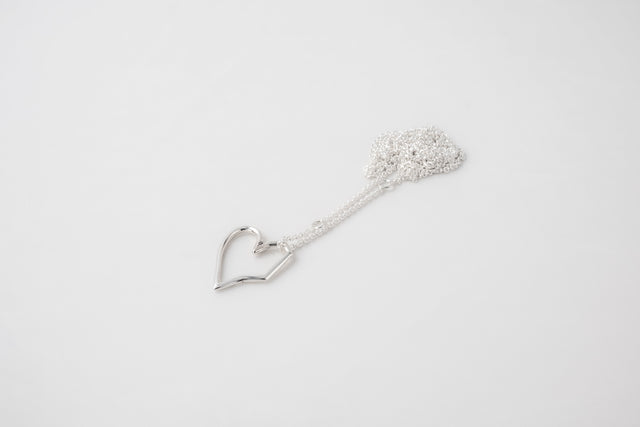
| Heart Lock Ring | 11 g in every size | A lock as the carried object — the one ring whose mass does not change with the size. Uncoated 925: Living Silver |
| Brutalism V.1 Ring | 9.6–24 g | A worked face on a heavy band — the signet reading of the form, and the heaviest ring in the catalogue at the large sizes. Uncoated 925: Living Silver |
| Brutalism V.3 Ring | 9.6–24 g | The same mass, the opposite surface: the only one of the nine blackened at the bench — black oxidation rather than Living Silver |
| Thorn Ring | 4.7–12.7 g | Relief instead of a stone — the band itself is worked into a carried form. Uncoated 925 |
| Signature Links V.1 Ring | 2.7–6 g | The counter-example: a plain band, nothing on it. This is what a statement ring is not |
Sizes run 15 to 22, seven or eight per model. Everything is made to order: about two weeks for silver, three for a piece with a stone through Custom Order.
Statement rings at a glance
| Aspect | What it means |
|---|---|
| What it is | A ring carrying an object beyond the band — a stone, a seal or relief |
| In the catalogue | Nine live rings: eight in uncoated 925 silver, one — Brutalism V.3 — blackened at the bench |
| Weight | 2.1 g to 24 g across the catalogue; mass grows with the size, so weights compare only within one size |
| Sizes | 15 to 22, seven or eight sizes per model |
| Surface | Uncoated silver darkens in the recesses and lightens on the edges by wear — Living Silver. Brutalism V.3 is the exception: blackened at the bench, black oxidation |
| Stone | No stone-set ring in stock; a ring with a stone is made through Custom Order |
| Signet | A special case with a flat face meant for a mark, not a stone |
| Lead time | Made to order: about two weeks for silver, three for a piece with a stone |
Frequently asked questions
Didn’t find the answer — write to us, we reply personally.
Ask a question →01What is a statement ring in simple terms?+–
A ring with a shield or a setting — a stone, a seal, or relief. Unlike a plain band, it carries an object on the band and is therefore larger and heavier than an ordinary ring.
02How is a statement ring different from a plain band?+–
A plain band is a smooth strip of metal. A statement ring has a pronounced shield or setting. Every statement ring is a ring, but not every ring is a statement ring: it needs a stone, a seal or relief beyond the band.
03How is it different from a signet?+–
A signet is a statement ring with a flat face meant for a mark rather than a stone — a special case. The statement ring is broader: it can carry a stone, a seal or relief.
04Are statement rings made of silver?+–
Yes — 925 silver is a strong, workable base for a large form. Eight of the nine rings at STRUGA are uncoated 925, Living Silver: the surface darkens and lightens on its own, with no plating. The ninth, Brutalism V.3, is blackened at the bench.
05Can I order a ring with a particular stone?+–
Yes, through Custom Order. STRUGA works with uncut stones of wild growth and can source almost any to order — most often tourmalines, aquamarines, quartz. The stone is presented as geology, with no claims of effect.