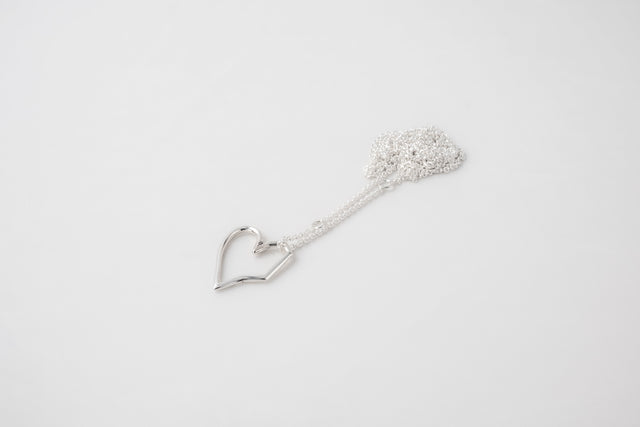
How to Layer Men's Jewelry — Stacking Rings, Bracelets, Chains
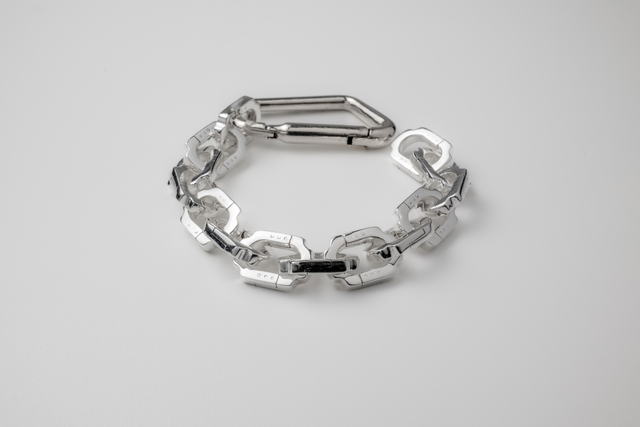
A men's stack holds together on four rules: one metal, a clear difference in weight and length between neighbours, no more than three pieces on a wrist and two chains on the neck, and one strong piece that leads. Adjacent pieces should differ in at least one dimension — weight, length, texture or shape. When they repeat each other, or when nothing leads, the set reads as costume rather than layers.
Updated October 16, 2026
The rules of a stack: one metal, different weight and length between neighbours, no more than three bracelets per wrist and two chains on the neck, and one piece that leads.
Men's neck-base circumference averages 43.5 cm (ANSUR II, 4,082 men), so a 40 cm (16 in) chain cannot drop to the base of the neck on 92% of men and sits on the neck like a choker. For most men the everyday pair is 45 cm over 50 cm (18 in over 20 in), with a clear difference in weight.
Weight sets the hierarchy: in size 20, the Signature Links V.2 Ring weighs 3.6 g, the Thorn Ring 9.6 g and Brutalism V.1 19 g. Three such rings on one hand read as light, medium and lead.
Two rings stack on one finger only when they are clearly different objects: different weight, different surface or a different degree of darkening.
Three to four visible pieces are enough every day, up to six for a night out, two to three at the office.
What are the four rules of a men's jewelry stack?
The four rules work together: break one and the set stops reading as composed.
Rule 1 — One metal
All silver, all gold, or a deliberate mix. A mix starts at three pieces: two pieces in two metals read as an accident, as if no choice was made. For the first six months it is easier to stay in one metal and add the contrasting one later, as a separate step.
Rule 2 — Different weight and length
Two chains of the same weight and length merge into one. Every adjacent piece should clearly differ in at least one dimension — weight, length, surface treatment or shape. Stores rarely publish the width of a ring or bracelet, while every piece in the STRUGA catalogue lists its weight, so weight in grams is the measure used throughout this guide.
Rule 3 — Three on the wrist, two on the neck
One bracelet reads as a single piece, two as a pair, three as a stack, four or more as costume. Two chains are the everyday ceiling: a third one tangles and dims the other two. On the hands, four to five rings across both hands is the ceiling for most men.
Rule 4 — One piece leads
In every stack one piece does the heavy lifting: the longest and heaviest chain, a rigid cuff or the largest ring. The rest stay lighter and quieter. Without that anchor the pieces compete for attention, and none of them wins.
What lengths and weights does the STRUGA catalogue offer?
Every number in this guide comes from the catalogue as of October 16, 2026, not from general styling advice: a stack is planned in lengths and grams that actually exist.
| Piece | Lengths or sizes | Weight | From |
|---|---|---|---|
| Thorn Links Chain | 40 / 45 / 50 / 75 cm | 11 / 12 / 13 / 18 g | $353 |
| Signature Asymmetric Links Choker | 40 / 45 / 50 cm | 27 / 30 / 33 g | $865 |
| Blade Mini Links V.1 Choker | 40 / 45 / 50 cm | 80 / 90 / 110 g | $2,276 |
| Long Chain with Signature Asymmetric Links | 120 cm | 35 g | $1,295 |
| Bracelets | mostly S 17 and M 21 cm; 14.5 to 26 cm overall | 2 to 130 g | $160 |
| Rings | sizes 15–22 | 2.1 to 24 g | $122 |
Two conclusions follow. Chain lengths step in five centimetres, and weight within one model grows slowly with length: the Thorn Links Chain goes from 11 to 13 g between 40 and 50 cm. So the weight difference in a pair of chains comes from a different model, not a different length of the same one. Ring weight depends on size more than it seems: Brutalism V.1 weighs 9.6 g in size 15 and 24 g in size 22, so rings should be compared in your own size.
What chain lengths should you layer so they don't tangle?
The shorter chain in a pair has to be longer than the circumference of the base of your neck, and the second one 5–10 cm longer again. A chain shorter than the neck base cannot drop to it and rides higher, on the neck itself. In the ANSUR II anthropometric survey (4,082 men), neck-base circumference averages 43.5 cm, and nine men in ten fall between 39.5 and 47.9 cm. That is the circumference at the very bottom of the neck; mid-neck is narrower, averaging 39.8 cm in the same survey, and that is the number the men's necklace length guide works from. That decides how each catalogue length behaves:
| Length | Where it sits on most men | Shorter than the neck base for |
|---|---|---|
| 40 cm (16 in) | on the neck, like a choker | 92% of men |
| 45 cm (18 in) | at the base of the neck | 25% of men |
| 50 cm (20 in) | below the base, towards the collarbones | 1% of men |
| 75 cm (30 in) | on the chest | — |
| 120 cm (47 in) | low, below the chest | — |
For most men the everyday pair is 45 cm over 50 cm, and the difference here comes from weight: a 12 g Thorn Links Chain over a 33 g Signature Asymmetric Links Choker. Five centimetres is the minimum gap, so the chains have to differ visibly in mass. A 50 cm and 75 cm pair gives a clean quarter-metre gap and leaves room for a pendant on the lower chain. A 40 cm chain works as the short layer for men whose neck base is under 40 cm — roughly one man in twelve.
Put the short chain on first, then the long one; the heavier chain goes lower. Two chains of the same type and the same mass don't work as a pair — they lie as one line.
How many bracelets can a man wear on one wrist, and how do you combine them?
Up to three bracelets on one wrist, and one of them leads. The strongest version is built like this:
- Anchor: a rigid cuff or a chunky chain. For example, the Big Thorn Bracelet, an open rigid arc of 45 to 95 g depending on size.
- Support: a bracelet of a different construction and visibly lighter — if the anchor is a cuff, a chain. Blade Medium Links V.2 weighs 17–20 g.
- Quiet layer: the lightest piece. The Thorn Bracelet weighs about 5 g.
Bracelets are worn tight so they touch each other: the touching is the look. Order barely matters; the heaviest usually goes towards the wrist bone. For a pair, use a cuff with one chain bracelet, or two chain bracelets that differ in weight three to four times, such as the 5 g Thorn Bracelet and the 17–20 g Blade Medium Links V.2. A watch counts as one of the three pieces on its wrist. Size matters more in a stack than alone: a loose bracelet spins and slides, and the layers disappear — choose the length with the men's bracelet sizing guide.
How do you wear several rings, and can two go on one finger?
One lead ring per hand, the others lighter and simpler. The lead ring goes on the index, middle or ring finger; neighbouring rings are visibly lighter; a pinky ring complements the lead and never competes with it; the thumb is only for a deliberate look you have already worn for months.
Weight again sets the difference. In size 20, three rings from the catalogue form an almost exact ladder: Signature Links V.2 at 3.6 g, the Thorn Ring at 9.6 g, and Brutalism V.1 from the BRUTALISM family at 19 g. Each is two to three times heavier than the one before, and the eye reads it as light, medium and lead. Brutalism V.1 is made to order in about two weeks.
Two rings on one finger work under three conditions:
- they are clearly different objects: a thin link ring under a heavy ring with a wide plate reads as two pieces, while two identical plates read as one lump;
- they differ in more than one way — weight, surface or degree of darkening;
- they are sized as a pair: together they sit tighter than each would alone.
Three rings on one finger are hard to pull off on a man's hand. It is usually a special case — a wedding band, a signet and a memorial ring on the ring finger.
How do you combine rings, chains and bracelets in one look?
In a full look one zone leads — the hands, the wrist or the neck — and the other two stay simple. If rings lead, three across both hands, wear one chain and one bracelet. If a three-bracelet stack leads, keep to one or two rings. If there are two chains on the neck, the hands carry one ring.
The second rule is to count visible pieces. Everyday wear sits between three and six: fewer and the look doesn't read as layered, more and it tips into costume. The watch counts too.
The third is one metal across the body. Silver rings, a silver chain and a silver bracelet read as one. A silver bracelet, a gold chain and a silver ring read as an accident unless the mix is built on purpose.
It is easiest to build inside one world, where the pieces were drawn next to each other. Almost every piece in this guide comes from the CODEX world: links, plates and hard geometry, the Signature Asymmetric, BLADE, THORN and BRUTALISM families. Carbon pieces live in the RITUAL world; next to a heavy silver chain they read as a jump in material, and that contrast has to be built on purpose.
How many pieces should you wear every day, at the office and for a night out?
| Occasion | Pieces in total | Set |
|---|---|---|
| Every day | 3–4 | one 45–50 cm chain, one or two bracelets, one or two rings |
| Office and formal suit | 2–3 | a chain under the shirt, one ring, a bracelet on the wrist without the watch |
| Night out | up to 6 | two chains, three bracelets on one wrist, two rings on one hand |
| Beach and travel | 1–2 | solid silver without stones, nothing extra |
Every day, extra weight gets in the way: bracelets catch on the keyboard and the sleeve, so three to four pieces is the limit of comfort, not only of taste. At the office visible elements stay minimal: a four-bracelet stack under a buttoned shirt cuff bunches up the sleeve. A night out is the only case where all six work, but they have to be built carefully, around one leading zone. For travel, take one or two pieces of solid silver: anything more risks losing a piece or an uneven tan line. Silver does not like chlorinated pool water, so take jewelry off before swimming.
Can you mix silver with gold, or plated pieces with solid ones?
Metals can be mixed; plated and solid pieces in one stack are best avoided. A silver-and-gold mix works from three pieces and with clear contrast, for example two silver pieces and one gold piece echoed on the other hand. Two pieces in two metals read as a mistake.
Plating is harder. Gold plating is a layer measured in fractions of a micron: under the US Federal Trade Commission guides, "gold electroplate" starts at 0.175 microns, and "heavy gold electroplate" and vermeil at 2.5 microns (16 CFR § 23.3, § 23.4). In a stack, bracelets rub against each other, and a thin layer wears through first where they touch. Over time a plated piece changes colour in patches while solid silver darkens evenly, and the stack ages unevenly. STRUGA's silver pieces carry no rhodium plating: the metal darkens as a whole over time, and neighbouring pieces age together.
Which mistakes break a stack most often?
- Adding pieces one at a time without a plan. A coherent stack is built, not accumulated. Every six months, look at it from the outside and take off what isn't working.
- A jump with no middle. A 5 g bracelet right next to a 95 g chain bracelet reads as an accident. Put a medium piece of 17–20 g between them, and the difference becomes a ladder.
- An identical pair. Two bracelets of the same width or two chains of the same mass look unconsidered.
- Chains closer than five centimetres. They touch, tangle and lie as one line.
- Forgetting the watch. The watch is one of the three pieces on its wrist.
- An overloaded formal look. For a suit, take the extra pieces off.
How do you build a stack if you wear one piece today?
If you wear one piece now and want layers, go in this order:
- Identify what you have. Is your piece an anchor, heavy and noticeable, or a quiet one, thin and light?
- If it is an anchor, add light pieces around it. With a heavy ring on the right hand, add a thin 45–50 cm chain and a light bracelet on the wrist without the watch.
- If it is quiet, add an anchor. With a light link ring, add a ring two to three times heavier on another finger or hand.
- Wait two weeks. Let the new layer settle into everyday wear before you judge it.
- Photograph the stack. A mirror photo shows what the eye misses: a look that reads well in person often looks cluttered in a picture.
Which guides go deeper into the topic?
This guide is about the men's stack and measuring it in grams. The general rules of layering silver for any wardrobe are in the guide How to Stack and Layer Silver Jewelry, and a short definition of stacking is in the Atlas section.
- How to stack silver rings — the finger-by-finger guide
- Men's necklace lengths explained — from choker to mid-chest
- Men's silver chain styles compared
- Men's bracelet sizing — how to measure your wrist
- Men's jewelry style guide — minimalist, brutalist, signature
- Oxidized silver — care and styling
- Jewelry for men — the full selection
- Brutalist bracelets
Continue from the journal to a current STRUGA object: Blade Mini Links Bracelet.
About STRUGA. STRUGA is a dark silver jewelry brand founded by Dmitry Strugovshchikov and Ekaterina Strugovshchikova, handmade in Bali by master silversmiths. Most pieces are 925 sterling silver left uncoated, so they darken with wear; part of the range is darkened in advance, at the bench. The darkening is part of the design.
Frequently asked questions
Didn’t find the answer — write to us, we reply personally.
Ask a question →01Can a man wear two chains at once?+–
Yes, two is the everyday ceiling. The chains should differ in length by at least 5 cm and visibly in weight, otherwise they tangle and lie as one line. For most men the everyday pair is 45 cm over 50 cm (18 over 20 in): the lighter chain higher, the heavier one lower.
02How long should the shorter chain in a pair be?+–
Longer than the circumference of your neck base. In ANSUR II it averages 43.5 cm for men, so a 40 cm chain sits on the neck like a choker for 92% of men, while 45 cm lies at the base. Measure your neck base with a tape: the short chain should be longer than that number.
03How many bracelets can a man wear on one wrist?+–
Up to three, including a watch. One leads — a cuff or a chunky chain — and one or two are visibly lighter. Four or more read as costume on most men.
04Can you wear a bracelet and a watch on the same wrist?+–
Yes. The watch counts as one of the three pieces on the wrist, which leaves room for one or two bracelets next to it. In a formal look, move the bracelet to the wrist without the watch.
05Can a man stack two rings on one finger?+–
Yes, if they are clearly different objects: a thin link ring under a heavy ring with a plate, differing in weight, surface or degree of darkening. Size them as a pair. Three rings on one finger are hard to pull off on a man's hand.
06How many rings should a man wear at once?+–
For most men the ceiling is four to five rings across both hands, one per finger. Each hand has one lead ring and lighter ones around it: in size 20, for example, 3.6 g, 9.6 g and 19 g.
07How many pieces of jewelry should a man wear at once?+–
Three to four visible pieces every day, two to three at the office, up to six for a night out. The watch counts too. Beyond six visible pieces the look tips into costume.
08Can men mix silver and gold jewelry?+–
Yes, from three pieces and with clear contrast. Two pieces in two metals read as an accident; with three or more, the mix becomes a visible decision.
09Can you stack gold-plated pieces with solid ones?+–
Better not. Gold plating is a layer of 0.175 to 2.5 microns under the US FTC guides, and in a stack it wears through first where bracelets touch. The plated piece changes colour in patches, solid silver darkens evenly, and the stack ages unevenly.
10What is an anchor piece in a stack?+–
The strongest piece in the set: the longest and heaviest chain, a rigid cuff or the largest ring. The rest stay lighter and quieter so one piece leads and the stack doesn't read flat.
11Is stacking the same as layering?+–
No. A stack is pieces touching on one wrist or finger; layering is the whole composition of rings, chains and bracelets. Coherent layers are built around one anchor piece, not accumulated at random.
12Should layered pieces match each other?+–
In metal, yes; in weight and shape, no. Differences in weight and construction make a stack read as layered, while two pieces of the same width look like an accident. It is easiest to build inside one world, where the pieces were drawn next to each other.