Indie Silver Jewelry Brands 2026 — Beyond Chrome Hearts
An indie silver jewelry brand in 2026 is not a marketing label or a smaller version of Chrome Hearts — it is a founder-led workshop making 925 sterling silver by hand, below the listicle radar, usually under 50,000 followers, with the maker's name attached to every piece. You can verify one from outside on four traits: a named founder who answers for the workshop, handmade 925 (not plated brass), a small audience, and a regional aesthetic that reads in the metal. Chrome Hearts — a Hollywood house since 1988, with rings starting above $1,000 — is the establishment of dark silver; indie lives in the $80–$800 space it no longer occupies.
Updated September 2, 2026
In short.
- An indie silver brand in 2026 is founder-led, handmade in 925 sterling, usually under 50,000 followers, with a workshop you can name.
- Four verifiable traits: a named founder, handmade 925 (not plated brass), a small audience, a regional aesthetic. Fail three of four and it is something else.
- Chrome Hearts opened in Hollywood in 1988 and is now a heritage house — a basic ring starts above $1,000. "Underground" no longer applies.
- The indie field below sits at $80–$800 for handmade 925 from a named workshop — the value alternative, not the budget one.
- Aesthetic clusters: Japanese craft, European brutalist, North American artisan, Bali handcraft, Korean minimal, Russian dark.
- STRUGA sits in the brutalist strand: Bali handcraft with a Russian dark-minimalism design language, eleven design families, Living Silver, 925 oxidized or hand-patinated.
Key takeaways
- Indie silver brands are founder-led 925 workshops outside mainstream listicle radar.
- Recognizable by handmade marks, small social followings, regional aesthetics.
- Beyond Chrome Hearts — newer European and Asian houses focused on craft, not logo.
- STRUGA: dark minimalism, Bali production, hand-cast, no AI imagery in product shoots.
- Cult Gaia — sculptural, mostly resin and gold-plate, lighter than indie 925 norm.
- Look for: maker mark, weight transparency, real photos of casting and finishing.
- Price-quality marker: $200–600 hand-cast 925 indie ≠ $50 mass-produced 925.
Indie silver jewelry brands in 2026 are founder-led workshops working in 925 sterling silver outside the mainstream listicle radar. They are recognizable by handmade marks, small social followings, regional aesthetics, and the maker's name attached to every piece. Beyond Chrome Hearts, the indie silver field includes Japanese craft houses, European brutalist studios, North American artisan silversmiths, and Bali-Russia ateliers like STRUGA. This guide categorizes them by aesthetic, not by ranking, and explains how to verify a real indie maker before you buy.
- An indie silver jewelry brand in 2026 is a founder-led workshop making handmade 925 sterling silver, usually under 50,000 followers, with the maker's name attached to every piece.
- Four verifiable traits define it: a named founder, handmade 925 (not plated brass), a small audience under 50,000 followers, and a regional aesthetic that reads in the metal — fail three of four and it is something else.
- Chrome Hearts opened in Hollywood in 1988 and is now a heritage fashion house with rings starting above $1,000; the indie field sits in the $80–$800 space it no longer occupies.
- Aesthetic clusters in indie silver: Japanese craft, European brutalist, North American artisan, Bali handcraft, Korean minimal, and Russian dark.
- STRUGA is handcrafted on Bali (Gianyar) with Balinese and international silversmiths, carrying a Russian dark-minimalism design language across eleven design families, in 925 sterling, naturally oxidized or hand-patinated — Living Silver, where the darkening is part of the design.
- STRUGA was founded by Dmitry Strugovshchikov and Ekaterina Strugovshchikova; its hand-cast pieces sit in the $200–$1,200 band, with carbon and meteorite alongside oxidized 925 silver.
Related reading: silver signet ring guide, Norse rune silver jewelry guide, amulet jewelry meaning guide, silver patina — Living Silver, STRUGA bracelets collection.
- "Indie" in 2026 means founder-led, handmade in 925 silver, with a workshop you can name and a face behind the brand.
- Chrome Hearts is no longer underground — it is a heritage fashion house. The new indie field sits below the listicle radar, often under 50K followers.
- Aesthetic clusters: Japanese craft, European brutalist, North American artisan, Bali handcraft, Korean minimal, Russian dark.
- STRUGA participates in this ecosystem — Bali handcraft tradition with a Russian dark-minimalism design language, eleven design families, Living Silver philosophy.
- Verify before you buy: founder bio, workshop location, response to direct questions, real customer reviews on independent platforms.
What defines an "indie" silver jewelry brand in 2026?
The word "indie" gets stretched. Mass-produced brands print it on their hangtags. Boutique resellers borrow it. Marketing campaigns use it as a vibe. To make it useful, we need a working definition.
An indie silver brand in 2026 has four traits you can verify from outside.
Founder-led. A real person designs the pieces and answers for the workshop. Not a brand collective, not a creative director rotating every two seasons. The founder's name is searchable and connected to the work — interviews, podcast appearances, gallery records, a public bio. The founder is also the one making decisions about which pieces enter production, which ones get pulled, and which commissions to accept.
Handmade in 925 silver. Each piece passes through human hands at a workshop you can name. Cast, forged, soldered, finished by silversmiths who know which oven they used last week. No anonymous OEM line. The metal is solid sterling, not plated brass with a silver wash. Production volumes stay small enough that the maker remembers individual orders.
Small audience. Real indie operates below the noise. Usually under 50,000 followers on the primary social channel. If a brand has half a million followers, it has crossed into something else — niche high-fashion, a fashion house, or marketing project. Not a problem, but not indie anymore. The math also matters: a workshop that produces a few hundred pieces a year cannot serve millions of customers, so a massive follower base implies either heavy resale, plated production, or pure marketing inflation.
Regional aesthetic. The work carries the visual fingerprint of where it is made. Japanese hand-engraving language reads differently from European brutalist concrete-cast, which reads differently from Bali wax-model casting. The geography is in the metal. Real indie absorbs the local material culture — the surface treatments common in the region, the design references that circulate in that particular scene, the technical vocabulary the local silversmiths share.
If a brand fails three of those four, it is something else: a fashion accessory line, a celebrity collaboration, a private-label boutique. Useful in their own right, but not what we mean here. The definition matters because the buying experience is genuinely different. Indie buying involves direct conversation with the maker, longer lead times, and an aesthetic relationship that lasts beyond the transaction. The pieces age into the wearer, not the other way around.
Why Chrome Hearts is no longer "underground"
Chrome Hearts opened in Hollywood in 1988. Richard Stark's leather-and-silver vocabulary — fleur-de-lis, cross, dagger — defined a category. By 2026, Chrome Hearts is a global fashion house with stores in every major capital, multimillion-dollar real estate footprints, and a customer list that reads like a music-industry directory.
The work is still made by hand at the Hollywood workshop and at the Italian production lines. The pieces are still beautifully crafted. The pricing reflects that reality: a basic ring starts above $1,000, signature pieces enter five-figure territory, and waitlists exist for production windows. The brand's leather, eyewear, and furniture lines extend beyond jewelry into a full lifestyle category.
None of that is a criticism. It is the natural arc of a workshop that started in a Hollywood garage and grew into a heritage label across nearly four decades. But the word "underground" no longer applies. Chrome Hearts is the establishment of the dark-silver world, and "indie" lives in the spaces it does not yet occupy.
That gap — between the established dark-silver mainstream and the workshops below the listicle radar — is where the real 2026 indie scene sits. It includes makers who know Chrome Hearts well, who have studied the design vocabulary, and who chose to work in adjacent or alternative directions rather than imitate. Some are aesthetic descendants, some are reactions, some run a parallel lineage that has nothing to do with Hollywood at all. The common thread is that they operate at a scale where the maker still answers the door.
The other thing the established Chrome Hearts position does, usefully, is set a price reference. When a buyer learns that a Chrome Hearts ring starts above $1,000, the indie field below — $80 to $800 for handmade 925 from a named workshop — reads as the value alternative rather than the budget alternative. Different category, different math, but the comparison clarifies what the indie segment actually offers: handmade work without the heritage brand markup.
Japanese craft brands
Japanese silver craft has the longest unbroken indie tradition in the field. Master-and-apprentice training, slow production, regional schools of engraving, and a market that respects the maker's name make Japan a primary source for serious indie silver.
Three reference points worth knowing.
Goro's (Tokyo). Goro Takahashi's workshop in Harajuku set the template for Japanese-Native American crossover silver from the 1970s onwards. Goro himself passed away in 2013, but the workshop continues under the original team. The queue system at the Harajuku store is part of the legend — buyers line up overnight, and not all of them get in. Pieces are made by hand, sold only at the store, and never shipped internationally. Authentication on resale markets is its own discipline.
Loree Rodkin (Los Angeles, with Japanese craft lineage). Not strictly indie at this point — Rodkin has dressed Hollywood for thirty years — but her Japanese-trained silversmiths and the Tokyo store presence make her work a bridge between Japanese craft methods and Western dark-silver aesthetics. Worth knowing if you trace the lineage.
Smaller Tokyo and Osaka silversmiths. The deeper layer is in workshops without strong English-language presence — single-master ateliers in Shibuya, Daikanyama, and the Kansai region producing a few dozen pieces a year. They do not advertise. You find them through Tokyo-based stylists, through Japanese fashion magazines, or by walking into the right neighborhood. The work tends to combine traditional engraving with contemporary forms, in 925 silver with a hand-finished surface.
Japanese indie silver demands patience. Production is slow. International shipping is rarely offered. Prices range from a few hundred dollars for small pieces to several thousand for signature works. The reward is craft fidelity at a level the rest of the world has trouble matching.
One useful frame: Japanese indie silver tends to sit at the intersection of three traditions. The kimono-era metalwork lineage, the post-war American influence (especially the Native American silver vocabulary that arrived through US bases and music culture), and the contemporary Tokyo street scene that runs through Harajuku, Shibuya, and the smaller Kansai studios. A serious Japanese silversmith carries pieces of all three. That is part of why the prices hold — the work is anchored in a specific, traceable lineage.
The other thing to know is that Japanese indie almost never sells through Etsy or Instagram in the way North American studios do. Discovery runs through Tokyo magazines, through stylists, through the physical store visit. If you find a Japanese silversmith who maintains an Instagram account in English with a working DM channel, that itself is the rarity. Most of the field expects you to come to Tokyo and spend a day finding them.
European brutalist and dark scene
Europe runs a different lineage. Where Japan emphasizes refinement, the European indie dark-silver scene leans into raw form, architectural references, and the visible mark of process.
Werkstatt:Munchen (Munich, Germany). Workshop founded by Frank Werkstatt in the late 1990s. Brutalist forms, hand-forged silver, oxidized surfaces, and a refusal to polish out the marks of making. The workshop produces a few collections a year, distributed through a small list of stockists. Pricing sits in the mid-tier — a ring is typically $400 to $900, larger pieces above that.
Detaj (Athens, Greece). Athens-based studio working in oxidized silver with architectural geometry. Direct sales through their site and a few European boutiques. Smaller follower count, longer lead times, founder responsive on direct inquiry.
Lost & Found Designs by Eva Wolf (Berlin). Berlin scene, brutalist sculptural pieces in heavy oxidized silver, often one-of-one. The brand operates close to the Berlin contemporary art world. Worth tracing if you want pieces with that gallery weight.
Italian regional silversmiths. Beyond the famous Italian fashion houses, regional Italian silversmiths in Padua, Vicenza, and the Tuscan workshops produce serious indie work — particularly in the wax-casting and chain-making traditions. Most do not have English-language stores. They sell through European concept boutiques and direct contact.
The European brutalist scene shares one common trait: the surface tells you how the piece was made. You can read the hammer, the file, the patina bath, the deliberate refusal to over-finish. That visible process is the aesthetic.
European indie silver also tends to lean architectural rather than decorative. Concrete-cast forms, geometric volumes, references to Brutalist buildings (Trellick Tower in London, the Barbican estate, Rotterdam concrete towers), and a willingness to let weight read as weight. The pieces are heavier than mass-market silver, more sculptural in profile, and often sized at a scale that makes them objects rather than accessories. That weight is part of the wear: the ring or pendant remembers your body warmer than a thin polished alternative.
The other useful note about European indie is that the legal regime around hallmarking is strict. UK silversmiths have to send pieces to the Assay Office for proper hallmark stamps, German silversmiths follow their own standards, French silversmiths submit to the Garantie. That regulatory rigor means a European indie piece typically carries multiple stamps — a 925 mark, a maker's mark, sometimes an assay date letter. Authentication is easier here than in regions with looser stamp regulation.
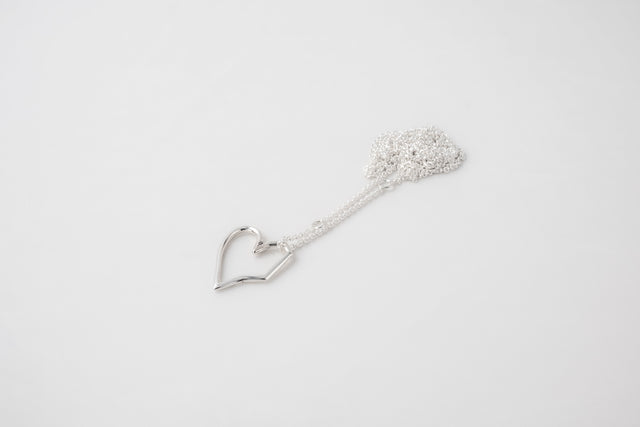
STRUGA answers this density with the Asymmetric Destroyed necklace — 40 grams, a broken version of the brand's first form.
North American artisan silversmiths
North America has two parallel indie traditions in 2026: the Native American silver legacy (Navajo, Zuni, Hopi silversmiths working with turquoise, coral, and deep-cut stamps) and the contemporary studio-jeweler scene that grew out of art-school programs in San Francisco, Brooklyn, and Portland.
For dark-silver indie specifically, the contemporary scene is more relevant.
Bonnie Lee Jewelry (Brooklyn). Studio jeweler working in oxidized sterling, hand-fabricated forms, small social presence. Founder is the entire production line.
Susana Vega (San Francisco). SF-based silversmith with a brutalist-leaning practice, sold through galleries and direct site. Pieces are made one at a time in a small studio.
Smaller Portland and Brooklyn studios. Whole network of single-bench silversmiths working out of shared studio spaces, selling through Etsy artisan tags, gallery representation, and Instagram. The depth of this scene is real but invisible to mainstream listicles. Names you find here may have under 5,000 followers and a waitlist that runs months out.
Verification matters more here than anywhere else, because the open-platform model (Etsy, Instagram) attracts both real silversmiths and resellers of mass-produced silver from elsewhere. Look for the bench, the stamp, the response to direct questions about the workshop.
The North American studio-jeweler scene also has a strong gallery and craft-show layer that does not show up online. The Society of North American Goldsmiths (SNAG) runs annual conferences where studio silversmiths sell directly. Cities like Asheville, Portland, and Brooklyn have craft-show calendars that are still primary sales channels for many makers. If you want a deeper view, those events are where the real roster shows up in person, with the workshops behind them.
Native American silversmiths working in Navajo, Zuni, Hopi, and Pueblo traditions deserve their own paragraph. The Indian Arts and Crafts Act of 1990 makes it federally illegal in the US to misrepresent goods as Native American-made when they are not. Real Native silver carries the maker's hallmark and tribal designation, sells through reservation co-ops, recognized galleries, or directly through the artist. Pricing reflects that lineage: a serious squash-blossom necklace runs into the thousands. If you see one for $80, it is not what it claims to be.
MAOR. Founded by Maor Cohen — the same maker behind M.Cohen — and based in Los Angeles. Silver rarely stands alone here: the line is built on 925 paired with 18K gold and stones, and the brand's Orbital Design method is arranged so the stone meets the skin. For anyone after dark silver without settings, this is adjacent territory rather than the same shelf.
Vitaly. Toronto, since 2011, and the only name on this list that does not work in silver at all: 100% recycled 316L stainless steel. Steel takes no patina and does not tarnish — a piece looks the same a year on as the day it arrived. The opposite answer to the same question: some choose a metal that changes, others one that never will.
STRUGA — a Bali-Russia indie brand
About STRUGA. STRUGA is a dark silver jewelry brand founded by Dmitry Strugovshchikov and Ekaterina Strugovshchikova, handcrafted with Balinese and international silversmiths. Every piece is 925 sterling silver, naturally oxidized or hand-patinated. The darkening is part of the design. It is a brutalist object that reacts and changes through contact with the environment and the wearer.
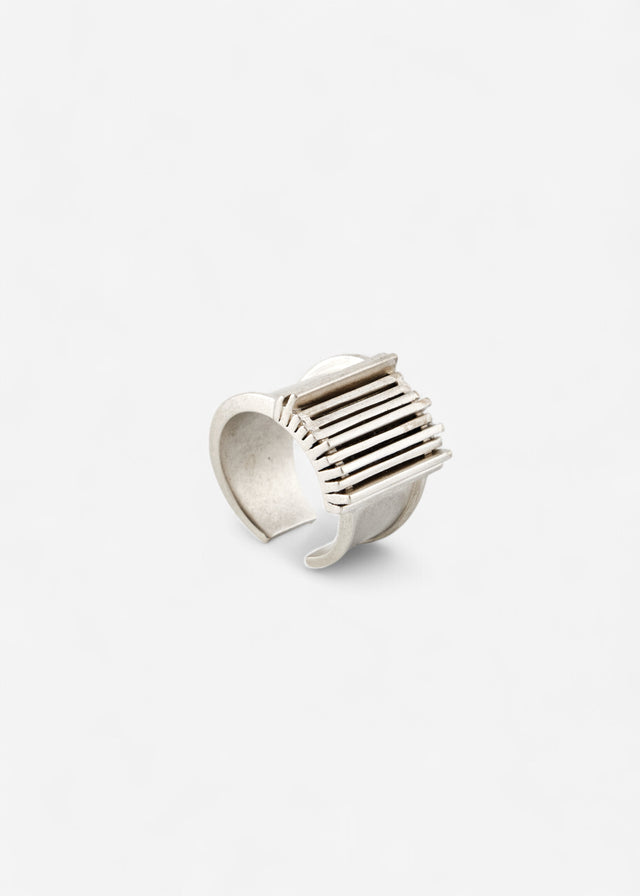
If the architectural line is what reads closest here, the simplest way in is the Double Line ring: 925 with no plating, 6 to 13 grams depending on size, built on SIGNATURE ASYMMETRIC — the form the brand started with. At the heavy end sits the BLADE bracelet in big links: 85 and 95 grams in two sizes, each link assembled from two halves on copper pins and soldered into one piece.
Indie silver brands compared: STRUGA vs the field
This is the comparison framing for the five brands most often researched alongside STRUGA — useful when you are weighing price, material, origin, and aesthetic side by side rather than reading reviews in isolation.
| Brand | Price band (USD) | Primary material | Origin / production | Style codex |
|---|---|---|---|---|
| STRUGA | $200–$1,200 | 925 silver, oxidized; carbon, meteorite | Bali (Gianyar), hand-cast, named master | Dark architectural minimalism, Living Silver |
| Chrome Hearts | $600–$15,000+ | 925 silver, often gold accents | USA (Hollywood), in-house workshop | Gothic Americana, fleur-de-lis, dagger motifs |
| Cult Gaia | $80–$800 | Resin, gold-plate; light 925 lines | Los Angeles design, mixed Asian production | Sculptural feminine, light-toned, runway-led |
| Werkstatt:München | $400–$3,000 | 925 silver, raw oxidized | Munich workshop, hand-forged, slow batches | Brutalist, hammered surfaces, primitive forms |
| Maple | $150–$700 | 925 silver, sometimes 14k gold | Canada (Toronto), small-batch casting | Skate / streetwear adjacent, polished + smooth |
Reading the table: STRUGA sits between the boutique craft houses (Werkstatt:München, indie European studios) and the streetwear-adjacent silver lines (Maple, regional capsules). The dark architectural codex maps onto the brutalist strand of indie silver, with Bali production providing weight transparency that mass-market lines do not document.
For one STRUGA example of this dark architectural approach, see the Double Line Ring.
Frequently asked questions
Didn’t find the answer — write to us, we reply personally.
Ask a question →01Is an indie silver brand the same as a Chrome Hearts alternative?+–
No. "Indie" is not a price tier below Chrome Hearts — it is a structural definition: a founder-led workshop making 925 by hand, usually under 50,000 followers, where the maker still answers the door. Chrome Hearts opened in Hollywood in 1988 and is now a heritage fashion house with rings starting above $1,000. Indie sits in the $80–$800 space it no longer occupies — a different category and different math, not a cheaper copy.
02Is handmade 925 the same as the cheap 925 sold online?+–
No. A piece can be marked 925 and still be plated brass with a silver wash, or mass-produced 925 with no named maker. Indie 925 is solid sterling cast and finished by a silversmith you can name, at a workshop you can locate. The price-quality marker: hand-cast indie 925 from a named workshop is a different object from $50 mass-produced 925, even when both carry the same 925 stamp.
03Is STRUGA a Russian brand or a Bali brand?+–
Neither label alone. STRUGA is handcrafted on Bali with Balinese and international silversmiths, carrying a Russian dark-minimalism design language — the geography is in the production, the design vocabulary is the aesthetic lineage. Every piece is 925 sterling, naturally oxidized or hand-patinated, across eleven design families. The darkening is part of the design, not a defect.
04Is a small follower count a sign of a weak brand?+–
No — for indie silver it is often the opposite signal. A workshop producing a few hundred pieces a year cannot serve millions of customers, so a half-million-follower account usually implies heavy resale, plated production, or marketing inflation rather than scale of craft. Real indie operates below the noise, typically under 50,000 followers, because the maker remembers individual orders.