Norse Rune Silver Jewelry: Modern Interpretation Guide
A silver belt buckle from a late 6th-century Alemannic grave carries a runic inscription scholars have argued over since the 1990s. It is the Pforzen buckle, and it explains the subject better than any list of meanings: runes are real writing, with a grammar and with dark places in it. What follows is three alphabets, three market tiers, and one test that separates an inscription from a pattern.
Updated August 29, 2026
Elder Futhark has 24 characters (c. 150–800 CE), Younger Futhark has 16 (c. 800–1100 CE), Anglo-Saxon Futhorc has 28, later 33.
The Vikings wrote in Younger Futhark, while modern jewelry almost always draws its characters from the Elder row.
The market sorts into three tiers: replica, interpretation and costume.
One test settles it: a real inscription spells something, a decorative surface does not transcribe to any historical alphabet.
Vegvísir, the Helm of Awe and the "blank rune" have nothing to do with the Viking Age — they are 19th and 20th century.
STRUGA does not cut runes and does not claim Norse provenance.
What are runes, and when were they written?
Runes are the characters of the Germanic runic alphabets. A futhark is a runic alphabet named after its first six characters, and there are three principal ones. The heaviest documented use falls between the 2nd and the 12th centuries CE, roughly 150 to 1100. The script descends from one or more Old Italic alphabets that reached Northern Europe in the late Iron Age; the earliest securely dated inscriptions come from southern Scandinavia and northern Germany.
What the word "rune" actually means
The word goes back to the Proto-Germanic root rūnō — "secret" or "whisper". Old Norse rún carries the same shades of mystery and counsel, and that etymology fed centuries of esoteric reading. But for most of their working life the runes were ordinary script: names, ownership marks, prayers, trade records, everyday notes.
How that is known
After the 1955 fire at the Bryggen wharf in Bergen, excavation ran for thirteen years. Medieval layers yielded roughly 670 runic inscriptions on wood — love notes, trade orders, religious quotations, family quarrels. Before that find, runes were assumed to serve names and solemn phrases.
How does Elder Futhark differ from Younger Futhark and Anglo-Saxon Futhorc?
The differences are not cosmetic: behind them sit language change, contact between cultures, and the practical work of writing different sound systems. A buyer should know which row a character comes from before paying for it.
| Feature | Elder Futhark | Younger Futhark | Anglo-Saxon Futhorc |
|---|---|---|---|
| Period | c. 150–800 CE | c. 800–1100 CE | c. 450–1100 CE |
| Number of characters | 24 | 16 | 28, later 33 |
| Region | Continental Germanic, Scandinavia | Scandinavia, Viking diaspora | England, Frisia |
| Who wrote it | Pre-Viking Germanic peoples | Vikings, medieval Scandinavians | Anglo-Saxons, early Old English |
| Major inscriptions | Vimose comb, Kragehul spear, Gallehus horns | Rök runestone, Jelling stones, Bryggen finds | Franks Casket, Ruthwell Cross |
| In modern jewelry | Dominant | Niche, for authenticity buyers | Rare |
Three dates hold the whole table: 150 CE for the first securely dated Elder Futhark finds, 800 CE for the switch to the 16-character Younger row, and 1100 CE for the end of its everyday use. The Futhorc ran alongside from about 450 CE with 28 characters, later 33.
Why did 24 runes become 16?
The shortening of the row is the single most consequential historical fact for a buyer. As Old Norse drifted phonologically in the late first millennium, scribes simplified the alphabet. Several distinct Elder Futhark characters collapsed into single Younger Futhark forms.
- For reading. One Younger Futhark rune often carries several sounds, and context decides which. Viking-Age inscriptions are therefore harder to interpret than their predecessors, despite being later.
- For the market. Mass jewelry leans on the Elder Futhark: its set of 24 gives a wider symbolic vocabulary and maps more closely onto modern sounds when spelling a name.
- For the niches. Younger Futhark is chosen by reenactors and by buyers after strict Viking-Age accuracy; Anglo-Saxon Futhorc stays a narrow niche.
What are the 24 Elder Futhark runes called, and what do they mean?
The Elder Futhark divides into three groups of eight, each called an aett (plural aettir). The group names point to Norse deities, though that link is reconstructive rather than directly attested.
Freyr's aett, characters 1–8
- Fehu (cattle, wealth, movable property)
- Uruz (aurochs, primal strength)
- Thurisaz (giant, thorn, defensive force)
- Ansuz (god, divine speech, message)
- Raidho (ride, journey, ordered movement)
- Kenaz (torch, controlled fire, knowledge through light)
- Gebo (gift, exchange, balance)
- Wunjo (joy, harmony of kin)
Heimdall's aett, characters 9–16
- Hagalaz (hail, sudden rupture)
- Naudhiz (need, hardship)
- Isa (ice, stillness)
- Jera (year, harvest, completed cycle)
- Eihwaz (yew, endurance, the world axis)
- Perthro (lot-cup, fate, the unrevealed)
- Algiz (elk, shelter)
- Sowilo (sun, life-giving force, victory)
Tyr's aett, characters 17–24
- Tiwaz (the god Tyr, justice)
- Berkano (birch, beginnings, renewal)
- Ehwaz (horse, partnership)
- Mannaz (humanity, the self in society)
- Laguz (water, flow)
- Ingwaz (the god Ing, fertility, contained energy)
- Dagaz (day, dawn, transformation)
- Othala (ancestral home, inheritance, ancestral land)
Where do modern rune meanings come from?
The meanings derive from the medieval rune poems — Old English, Norwegian and Icelandic, preserved in later manuscript copies. The poems describe each character in compressed, often gnomic verse. Extended readings are not in them.
The academic frame was set by two works still cited today.
- R. I. Page, "An Introduction to English Runes" (1973). Shows the runes working as a practical script in early England.
- Stephen Pollington, "Rudiments of Runelore" (1995). Gives the rune poems of England, Norway and Iceland in text and translation.
Where the ancient ends and the recent begins
Most expanded readings in popular rune-meaning books are 20th-century reconstructions, not medieval transmission. The runes are old; the "rune meanings" on jewelry packaging are usually recent. Do not pay for antiquity where a modern interpretation is sold.
Were runes worn on jewelry in antiquity?
They were, and it is well documented. Three finds carry the case.
- Vimose comb, c. 160 CE. From the Danish island of Funen; the Elder Futhark inscription harja is probably a personal name, though some read it as a word meaning "warrior". Among the earliest dated runic finds of any kind.
- Bracteates, 5th–6th centuries. Thin gold pendants that often carry runic legends: a deity's name, or a formula such as alu.
- Pforzen buckle, late 6th century. Silver, from a warrior's grave; carries the oldest surviving line of alliterative verse in a Germanic language.
What a bind-rune is
A bind-rune is two or more characters joined on a shared stave. The argument over the Pforzen buckle turns on exactly this: Wagner (1995) reads one element as a bind-rune and gets one translation, Düwel (2001) sees an ornament and gets another. None of this is fantasy: the objects sit in museum collections in Copenhagen, Stockholm, Oslo and London.
Why did the tradition of runic carving break?
No unbroken tradition of carving reached the modern jewelry trade. The runic alphabets were largely abandoned across Scandinavia between the 12th and 14th centuries, displaced by the Latin alphabet of Christianization. One pocket held on longer: the Dalecarlian runes of central Sweden, in fragmentary use into the 19th and 20th centuries.
The alphabet lay dormant in academic study and folk memory, and the revival came in three waves.
- Scholarly, 19th century. Academic recovery of runic studies, alongside Romantic national mythologies. No jewelry market, but the groundwork.
- Neo-pagan, 1970s. The runes taken up as a divinatory system; sets of this period carry the academic Elder Futhark.
- Pop-cultural, 2010s. The Vikings series ran from 2013 to 2020 and built the largest commercial rune jewelry market the world has seen.
Replica, interpretation or costume — which tier is the piece?
The tier tells you what the money is for. The three categories differ not in quality of work but in their relation to historical material.
| Tier | What it is | How to recognize it | Why it costs what it costs |
|---|---|---|---|
| Replica | Reproduction of a documented original with academic accuracy | Source and alphabet are named: the Oseberg finds, the Birka grave goods, a Mammen-style pendant | Higher: research and tooling cost real money |
| Interpretation | A real character of a documented alphabet on a modern form | The rune reads, but form, finish and presentation are 21st-century design | Middle: you pay for work and material, not for antiquity |
| Costume | Rune-like marks used as decorative texture | The marks form no sequence in any historical alphabet | Cheap, and it should be judged as fashion |
Interpretation is honest while it does not pretend to be a replica. Costume is honest while it is sold as fashion, not in the language of provenance.
How do you tell a real runic inscription from a decorative one?
One question settles it: does the piece treat the character as an alphabet or as a texture? A real Elder Futhark inscription spells something — a name, a word, a formula. A decorative surface carries marks that transcribe to none of the historical rows.
The practical check takes five minutes.
- Ask which alphabet. "Ancient runes" without a named row is a costume signal.
- Ask for a transliteration. A replica and an honest interpretation both have one.
- Count the set. 24 is Elder Futhark, 16 is Younger, 25 is Blum's set with its "blank rune".
- Check the named source, if the piece is offered as a replica.
Are Vegvísir, the Helm of Awe and the "blank rune" runes at all?
No, and this is the most common substitution on the market. Three symbols are sold under a Viking banner, and none of them belongs to the runic age.
Vegvísir
Vegvísir first appears in the Icelandic Huld manuscript, compiled by Geir Vigfússon in Akureyri in 1860 and held by the National Library of Iceland. It sits on page 60 with a short note: it keeps its bearer from losing the way in bad weather. It is absent from Norse mythology, from Viking-Age texts, and from that period's archaeology.
The Helm of Awe
Ægishjálmur is known from 17th-century Icelandic grimoires. The name itself appears earlier, in the Eddic lay of Fáfnir, but the graphic sign comes from books written several centuries after the Viking Age ended.
The "blank rune"
The 25th, blank tile in divination sets was invented by Ralph Blum in "The Book of Runes" (1982). It appears in no Edda, no saga, no historical source. A set of 25 tiles is a reliable marker of a 1980s invention rather than of antiquity.
Silver, bronze or iron — what do runes look right in?
The metal carries the inscription and sets how the character reads. Sterling silver 925 is the most frequent choice and STRUGA's base material: soft enough to cut a clean line, dense enough for that line to hold for years.
Oxidized silver deepens the cut: darkness collects in the recesses, bright metal rises along the edges, and the sign reads sharper. This is how Living Silver works — the relief gathers contrast from wear instead of staying factory-even.
- Bronze. Leans toward replica work: many documented originals are bronze.
- Iron. The harshest and most demanding — it rusts, and outside reenactment it rarely goes into jewelry.
- 925 silver. For a piece worn daily, the simple and durable answer.
Does STRUGA make rune jewelry?
No. STRUGA does not make a rune-engraved line and does not claim Norse provenance — claiming it would land the brand in precisely the costume tier this article warns about.
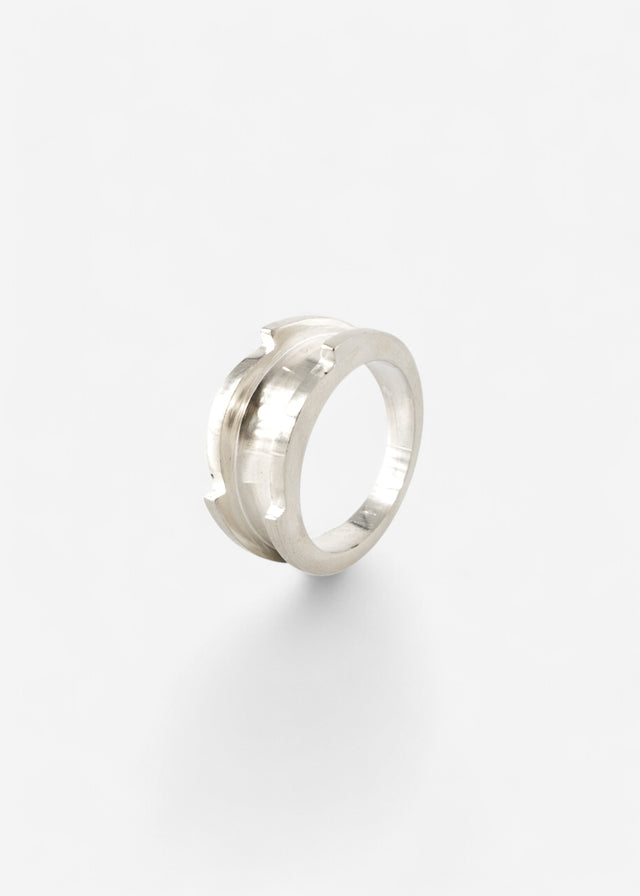
The adjacency is of another kind. The brand's geometric families hold a hard Northern-modernist vocabulary: line, cut, sharp angle, dark surface. BLADE is a CNC aesthetic in silver — even planes, as if cut from sheet material. BRUTALISM is Soviet brutalist aesthetics under the influence of Suprematism: the heaviest rings in the brand, and ear cuffs. The RITUAL world carries personal symbolic weight — amulets, crosses, meteorite, raw wild-growth stones.
The distinction is simple. Anyone after a character with a documented history should go to replica work, to a maker who names the source. Anyone after a form of the same coldness without borrowed mythology belongs here: 925 silver, no rhodium plating, a dark surface, weight in the hand.
Related reading: amulet jewelry meaning and symbolism, silver signet ring guide, Byzantine silver chain guide, non-diamond engagement rings guide, STRUGA full catalogue.
Continue from the journal to a current STRUGA object: Signature Cross V.3.
About STRUGA. STRUGA is a dark silver jewelry brand founded by Dmitry Strugovshchikov and Ekaterina Strugovshchikova, handcrafted with Balinese and international silversmiths. Every piece is 925 sterling silver, naturally oxidized or hand-patinated. The darkening is part of the design. It is a brutalist object that reacts and changes through contact with the environment and the wearer.
Frequently asked questions
Didn’t find the answer — write to us, we reply personally.
Ask a question →01Is the Elder Futhark the same as the Younger Futhark?+–
No. The Elder Futhark has 24 characters (c. 150–800 CE); the Younger Futhark has 16 (c. 800–1100 CE) and is what the Vikings used. Scribes collapsed several Elder characters into single Younger forms, so one Younger rune often carries several sounds. Most modern jewelry still draws from the 24-rune Elder set.
02Is interpretive rune jewelry the same as a costume piece?+–
No. Interpretation carries a real character of a documented alphabet on a modern form, and is honest as long as it does not pretend to be a replica. A costume piece uses rune-like marks as texture; they transcribe to no historical alphabet. The test: a real inscription spells something, a decorative surface spells nothing.
03Is a replica the same as an interpretation?+–
No. A replica reproduces a documented original — a Mammen-style pendant, the Oseberg or Birka finds — cites its source and names the alphabet. An interpretation draws on runic script without claiming to reproduce a specific artifact. Replica work costs more because research and tooling cost real money.
04Is Vegvísir a Viking Age rune?+–
No. Vegvísir first appears in the Icelandic Huld manuscript of 1860 — roughly seven centuries after the Viking Age ended. It is a galdrastafur, a drawn stave, not a rune. The Helm of Awe (Ægishjálmur) is known as a graphic sign from 17th-century Icelandic grimoires. Neither belongs to the Viking Age.
05Why does a rune set have 25 tiles when the Elder Futhark has 24 runes?+–
The 25th tile is blank, and Ralph Blum invented it in "The Book of Runes" (1982). No Edda, saga or historical source contains a blank rune. A set of 25 marks a 1980s invention; 24 answers to the Elder Futhark, 16 to the Younger.