Balinese Silver: Technique, 925 Hallmark, How to Verify
Not a separate alloy and not a separate hallmark: what is sold as "Balinese silver" is 925 sterling silver (92.5% silver, 7.5% copper) cast and hand-finished on the island of Bali, mostly in the Gianyar regency. Bali is a place of production, not a metal grade: the purity stays 925 by international standard. What you buy under the label is a school — hand work without a full move to industrial stamping, visible relief and surface texture, and a finish that makes the metal "alive" rather than mirror-polished.
Updated August 21, 2026
- Balinese silver is 925 sterling silver (92.5% silver, 7.5% copper) cast and hand-finished on Bali, mostly in the Gianyar regency; "Balinese" names a place and a school, not an alloy grade.
- The craft is dated, not estimated: goldsmiths are named in a Balinese inscription of 896 AD, while the silver trade of Celuk village is documented only from 1915.
- The 925 hallmark is the only formal guarantee of composition: 800 and 835 grades are not sterling, silver-plate carries no 925 mark, and 950/999 "fine silver" is too soft to hold a sculptural form.
- A simple ring takes three to five hours of hand work; a complex amulet with relief and stone setting, twenty to forty hours — the price difference is in hand-work hours, not the metal.
- Hand work reads in the object: minor asymmetry, visible tool marks, deeper relief, and even patina in the recesses with light planes — patina laid by hand, not a defect.
- STRUGA objects for the international market are made in Gianyar, Bali, from model to finish; in Bali the pieces are at Hedonist Store and Barefoot Aristocracy, with paired and individual forms through Dark Union and Custom Order.
Key takeaways
- Balinese silver is 925 sterling cast and hand-finished in Gianyar regency, Bali.
- Bali is a place of production, not a metal grade — purity stays 925 by international standard.
- Goldsmiths appear in a Balinese inscription of 896 AD; modern Bali workshops still cast by hand.
- Markers of authentic Bali: beaded silver detailing, wirework, cast-from-wax surface marks.
- STRUGA objects are made in Gianyar — from model to finish, not through an anonymous factory channel.
- Avoid: "Bali-style" mass-produced pieces from non-Bali factories with marketing copy.
- Care: same as any 925 — dry storage and a soft cloth; patina is a property of the metal, not a defect, and comes off only if the owner wants it to.
What Balinese silver actually is
"Balinese silver" is not a separate alloy or a separate hallmark. It is 925 sterling silver (92.5% silver, 7.5% copper) cast and finished by hand on the island of Bali — mostly in the Gianyar regency, where the silver craft formed as a self-contained school long before European jewelry fashion existed.
When a buyer sees the label "Bali silver," they are not buying the metal — sterling silver is the same anywhere in the world if it carries a 925 hallmark. They are buying a school: a way of holding the surface, of working with relief, of leaving visible tool marks, of oxidizing not as imitation but with an understanding of how silver will live on skin afterwards.
This is worth getting clear from the start, because in Russian-language sources the words "Balinese," "Thai," and "Indian" silver are often used as synonyms. They are different schools and different economies — and the difference becomes tangible in the hand within half a year of wear.
How Balinese differs from Thai, Indian, Mexican, and Italian
Sterling silver is always 92.5% silver. The metal composition does not depend on the country. The difference is in the school and the approach.
| School | Visual language | Finish | What to watch for |
|---|---|---|---|
| Balinese | Hand work, relief surfaces, soft asymmetry; objects often massive with emphasised texture | Rarely mirror-bright — more often oxidised, with patina in the recesses | «Bali-style» pieces made outside Bali and sold as Balinese |
| Thai | Close to the Balinese school, but with pronounced geometric ornament and regular symmetry | Embossing and stamping appear more often, especially for the mass market | The upper Chiang Mai segment matches the quality; the visual language still differs |
| Indian | Strong in stones and enamel; range from Rajasthan and Jaipur hand workshops to industrial casting | Varies with the workshop | A 925 stamp in India does not always mean what it does in Indonesia |
| Mexican | The Taxco school: large stones, saturated texture, an American design accent | Usually marked «sterling silver .925» | Historical niche is ethnic ornament, turquoise, onyx |
| Italian | Europe’s industrial standard: thin chains, classical forms | Technologically clean surfaces, without relief | Arezzo and Vicenza are good at scale, not at character |
| Turkish | Close to Italian in technology, with a more vivid decorative language | Polished and decorative | Often large semi-precious stones and strong Eastern ornament |
Why the Balinese school leaves the hand visible
The Balinese school is set apart by the fact that the maker leaves the hand visible. This is not a marketing move — it is a way of working in which the surface is not pushed to industrial perfection, because the goal is different. The goal is for the piece to read as an object, not as factory stamping. A Balinese silver object should ideally make you want to touch it before you examine it from a distance — and that is the difference from the European and Mexican schools, where the piece is made "for visual perception." In the STRUGA catalogue the same logic is easiest to see on the Brutalism V.1 ring — the heaviest and most massive ring form in the brand, architecture in silver.
Another important point is economics. Balinese silver is more expensive than Thai or Indian at equivalent metal mass, because an hour of hand work in Gianyar costs more than in Jaipur or Chiang Mai, and because relief objects need more time to finish. This is not an upcharge for "Balinese-ness" — it is the real cost of sculptural work.
History: a thousand years of silver on Bali
The oldest dated evidence: goldsmiths in a 9th-century inscription
The earliest hard date is not a legend but a document. A copperplate inscription from the village of Bebetin in northern Bali, dated 818 Saka — 896 AD — lists the island's metal trades by name: pande mas, the goldsmith; pande besi, the blacksmith; pande tambaga, the coppersmith. Working precious metal was already an organised occupation on Bali eleven hundred years ago, and it was so ordinary that a legal text could refer to it in passing.
The second layer arrived with people. Java fell under Majapahit rule in 1343, and as the kingdom declined at the turn of the 15th and 16th centuries, priests, artists, and craftsmen crossed to Bali, which stayed Hindu while Java gradually became Islamic. Ritual and court crafts moved with them — silver alongside Balinese painting, music, and dance — and stayed. The flow itself is well attested; exact dates for any migration of jewellers specifically are not.
Celuk: what is documented, and what is jewellery marketing
Celuk, a village in Gianyar, is the name most often attached to Bali jewelry. Its history is dated precisely, and more recently than the marketing suggests. The Indonesian Ministry of Culture's Bali heritage office puts the start at 1915, through the smith I Nyoman Gati, who had learned the work from his father; from 1935 the craft spread through the village, and the workshops served the courts of Gianyar — Ubud, Sukawati, Singapadu. The Jakarta Post described Celuk in 2016 as a century-old home to its gold and silver craftsmen, not a five-century-old one.
The widespread claim that Celuk has been a metal centre since the 16th century, working for the Klungkung dynasty, does not survive its own chronology. In the 16th century that court did not sit in Klungkung at all: it sat in Gelgel and moved to Semarapura only in 1686. The 16th century belongs to Gelgel's golden age of court art, and the goldsmiths' quarter attached to it is Pande Mas in Kamasan, not Celuk. The line circulates because jewellery sites copy each other, and it reached us as well: until this update it stood in the summary and the structured data of our own companion article on Balinese silver. It is corrected on both pages, and spelled out here so the correction is checkable.
Gianyar: the village network behind the craft
Gianyar — the inland regency of Bali — is the historical center of the silver craft. A village model formed there: families of masters passing technique from father to son, shared smelting sheds, shared wax models, and at the same time — dozens of independent studios with their own handwriting. This is not a "factory cluster" in the European sense; it is a village network in which some make the models, others cast, others finish, others set the stones. Family scale — from two people per studio to fifteen — keeps the hand-work level intact and prevents a slide into mass production.
From temple to market
For a long time Balinese silver remained ritual — it went into temple objects, into offerings to the gods (canang), into wedding ornaments, into details for life-cycle ceremonies. Balinese Hinduism — and Bali is the only Hindu island in Muslim Indonesia — is built so that silver is present in every important moment: birth, coming of age, marriage, funeral. This means the masters have never lost demand for quality hand work, and the skill has been transmitted continuously.
The tourist market appeared in the second half of the 20th century — after Bali opened to foreign travelers in the 1970s. By the early 2000s the island was already a recognized world center of handmade silver, and in the 2010s independent European, Australian, and Japanese brands came to Bali looking specifically for the hand school. Today village workshops serving local ritual demand and studios producing collections for global brands work side by side. This coexistence is the main reason the Balinese school has not turned into a museum exhibit.
STRUGA came to Gianyar not as a "European brand using local masters." Its objects are made there from model to finish, inside the local school. More on how the objects are born — in "How a STRUGA piece is made: from concept to silver."
How Balinese silver is made: technique without academic terms
To describe the process through dictionary terms for fine wirework, beaded detailing, and Javanese schools is to drag the reader into academic ethnography. The actual technique is simple and clear.
- Model. The maker either carves the form by hand (often from wax or a soft metal), or designs it in 3D and prints a wax prototype. This is the primary sculpture of the object.
- Silicone mold. A silicone copy is taken from the primary model — this is the "matrix" in which future pieces will be cast.
- Wax. Wax is poured into the silicone form, producing a wax copy — accurate down to fine seams and texture.
- Silver. The wax copy is placed in a plaster flask and burned out — the wax melts away, and molten 925 silver is forced under pressure into the cavity. The result is a silver figure with the same details as the model.
- Hand finishing. The silver is cleaned, worked with files and brushes, polished, oxidized when needed to bring out the relief, and the stones are set. This is where the maker's hand shows up most: at this stage the object becomes recognizable.
This technique is wax-and-mold casting. It is universal to silver craft across the world — but it is the Balinese school that uses it to emphasize relief rather than smooth it away. The surface is not pushed to a mirror; it is brought to a state where the texture reads in the light.
Beyond casting, two more techniques are traditionally used in Bali — beaded detailing (small silver beads soldered to the surface) and wirework. They belong to the maker's repertoire, but they are rarely used in modern sculptural objects. STRUGA does not build the collection around them: they are good for decorative ornament, but they do not fit the brand's architectural design language.
How many hours a single piece takes
Time on a single piece is non-linear. A simple ring — three to five hours from wax to finished object. A complex amulet with relief and stone setting — twenty to forty hours of the maker's work. This range is worth understanding when you look at the price: the difference is not in the metal (the metal costs about the same), but in the number of hand-work hours.
What Bali silver costs, and what you actually pay for
The metal is the small part. Weight and price do not move together, and the arithmetic below is the fastest way to see it.
What the metal costs on the island
Silver hit records in Indonesia in January 2026. Raw metal for craftsmen traded at Rp 50,000–58,000 per gram and spiked to around Rp 65,000; Antam bullion reached Rp 65,600–69,450 per gram, the highest ever recorded. Balinese media reported the consequences plainly: of the island's 538 registered silver craftsmen, part halted production, and exports of Balinese silverwork fell from $25.8 million in 2023 to $19.1 million in 2024 and $18.2 million in 2025. If Bali jewelry costs more than it did on your last visit, that is the reason — and it is a metal story, not a tourism one.
Why a heavier ring is not a dearer one
Our own catalogue is the check, because the weights are published on the cards.
| Ring | Weight | Price | Price per gram |
|---|---|---|---|
| Signature Links | 2.7 g | $96 | $36 |
| Brutalism V.3 | 9.6 g | $235 | $24 |
| Heart Lock | 11 g | $160 | $15 |
Three and a half times the metal buys two and a half times the price, and the heaviest ring costs less than the lighter Brutalism — the price per gram runs the opposite way to the weight. Grams do not set the number; hours do. Across the rings the range runs from $96 to $560, by form and by size.
Is silver cheaper in Bali?
Not automatically, and least of all where most visitors buy it. At the Ubud art market and its equivalents the asking price is an opening position: the customary counter is about half, and reported outcomes land 40–56% below the first number — one documented case ran from Rp 800,000 down to Rp 350,000. Producing workshops and fixed-price shops do not work that way, and haggling there mostly buys irritation. One useful yardstick for the labour itself: a silver-making class in Ubud that includes 10 g of metal costs around Rp 950,000 per person.
Hallmark and quality: what 925 means in Bali
The 925 hallmark means the same thing anywhere in the world — 92.5% silver in the alloy. What differs is who stands behind the number. Indonesia has no state assay office and no compulsory hallmarking of jewelry. A national standard for silver goods exists — SNI 319:2023, which sets the grades and the rules for stamping them — but under the 2014 standardization law a standard becomes binding only through a separate ministerial order, and silver has never had one. A "925" on a Balinese piece is therefore the maker's own declaration, not a state guarantee.
What «lower-grade Asian silver» actually means
What is worth knowing about the "lower-grade Asian silver" that gets mentioned on forums:
- 800 and 835 grades turn up in cheap souvenir rows. This silver is softer, tarnishes faster, and is formally not "sterling." It is not the Balinese school in its mature form — it is tourist mass goods.
- Silver plating and silver-plate are a separate class. This is not silver as material but a thin layer of silver over brass. You see it in Bali too, especially on cheap markets in Kuta. It will not carry a 925 hallmark.
- 950 and 999 grades are no longer "sterling silver." This is "fine silver," cleaner and softer. It is almost never used for sculptural jewelry — too plastic, won't hold a form.
Export-level Balinese workshops work only with 925, and export studios in Gianyar stamp their pieces because buyers abroad expect the mark — not because a regulator demands it. Certification against SNI 319:2023 runs through a single accredited body under the Ministry of Industry, and workshops treat it as a selling argument rather than a licence to trade. If a piece is presented as "Balinese silver" and carries no stamp at all, ask why. If it carries one, what backs it is the seller.
Russia now sits in the same logic. Compulsory assay-office hallmarking of silver was dropped there on 23 June 2020: the state hallmark is applied at the maker's request, while the maker's own registered mark on the piece stays obligatory. The difference between the two countries is institutional, not practical — Russia keeps an assay supervision service and Indonesia never built one. On either side, the number you read is a declaration; its weight is the weight of whoever made it.
Hand work versus mass production: how to read the surface
Bali has both hand workshops and factory lines. The difference is not always obvious from the outside — especially in a photo. But you can see it in the hand within a minute.
- Minor asymmetry. Hand work is never perfectly symmetrical. If the object — a ring, bracelet, or pendant — always has a micro-difference between sides. Factory stamping is symmetrical down to the seam.
- Visible tool marks. On matte and oxidized surfaces, in good light, you can see how the maker's hand moved: thin strokes in one direction, slight unevenness next to complex relief, dots at solder points. This is not a defect — it is a signature.
- Depth of relief. Cast hand work keeps the relief "saturated" — recesses are deeper, planes are sharper. Industrial casting smooths the contours to make stamping easier.
- Behavior of patina. If the object is oxidized, the patina in the recesses should be even, with no running streaks. Clean contrast between a light plane and a dark recess is a sign that the maker laid the patina down by hand.
This does not mean factory silver is "bad." It works for everyday thin chains and classical rings. But if you are paying for "Balinese silver," you are buying the hand school specifically — and it has to read in the object.
Assembled by hand is not the same as made by hand
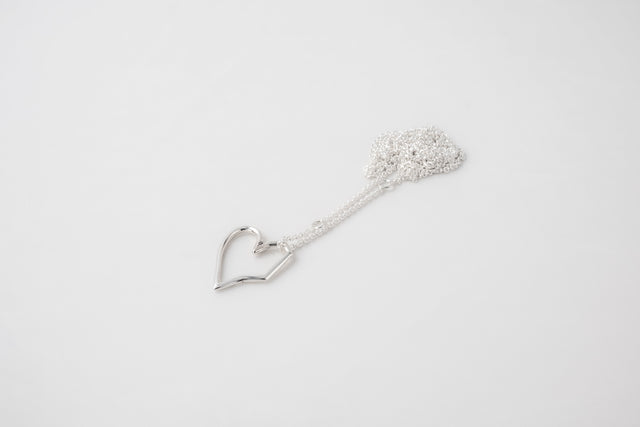
A separate category — "handmade as in assembled by hand from factory parts." This is a compromise segment: the maker does not cast the form from scratch but buys ready castings and assembles them into an object (a chain with a pendant, for example). It is legal and common, but it is not the hand work the Balinese school promises. A real Balinese studio makes the form from scratch — from model to finish.
One cast-925 example in the STRUGA catalog — the Wire Heart Necklace.
Frequently asked questions
Didn’t find the answer — write to us, we reply personally.
Ask a question →01Is "Balinese silver" a different metal grade than 925?+–
No. Balinese silver is not a separate alloy or a separate hallmark — it is the same 925 sterling silver (92.5% silver, 7.5% copper) you would find anywhere with a 925 mark. "Balinese" refers to the place of production and the hand school in Gianyar, not to a metal grade. Sterling silver is identical worldwide if it carries the 925 hallmark.
02Is hand-finished Balinese silver the same as factory "Bali-style" silver?+–
No. Real Balinese studio work is cast from scratch — from model to finish — and reads in the hand within a minute: minor asymmetry, visible tool marks, deeper relief, even patina with no running streaks. "Bali-style" mass-produced pieces are symmetrical down to the seam and smoothed for stamping. A separate compromise category is "assembled by hand from ready factory castings" — legal and common, but not the cast-from-scratch hand work the Balinese school promises.
03Does "lower-grade silver" mean tarnished or old silver?+–
No — it refers to alloy composition, not age. The 800 and 835 grades are softer, tarnish faster, and are formally not sterling; they turn up in cheap souvenir rows, not the mature Balinese school. Silver-plate is a thin layer of silver over brass and carries no 925 hallmark at all. The 950 and 999 grades are "fine silver," cleaner and softer, almost never used for sculptural jewelry because they will not hold a form.
04Is oxidation on Balinese silver a defect?+–
No. On the Balinese school the maker oxidizes deliberately to bring out the relief — patina sits in the recesses while the planes stay light. Clean contrast between a light plane and a dark recess, with no running streaks, is a sign the patina was laid by hand, not a flaw.
05Is Bali silver real silver?+–
Yes, when it is marked 925 — that means 92.5% silver, the same sterling standard as anywhere else. The catch is who guarantees it. Indonesia has no state assay office and no compulsory hallmarking; the national standard for silver goods, SNI 319:2023, is voluntary. So a 925 stamp on a Balinese piece is the maker’s declaration, not a government one, and what backs it is the seller. Silver-plate over brass and the 800 and 835 grades also circulate in tourist rows and are not sterling.
06What is Bali silver worth, and what sets the price?+–
Hours, not grams. In our own catalogue a 2.7 g ring costs $96 while a 9.6 g ring costs $235 — three and a half times the metal for two and a half times the price — and the heaviest ring at 11 g costs less than the lighter one. Raw silver in Indonesia traded at Rp 50,000–65,000 per gram in January 2026, so the metal in a ring is a minor share of what you pay. The rest is modelling, casting, finishing and setting: three to five hours for a simple ring, twenty to forty for a complex piece with relief and stones.
07Is it cheaper to buy silver in Bali?+–
Not automatically, and least of all in the places most visitors reach. At the Ubud art market and its equivalents the asking price is an opening position: the customary counter is about half, and reported outcomes land 40–56% below the first number. Producing workshops and fixed-price shops do not work that way. Since January 2026 the metal itself has been expensive: silver hit records in Indonesia, part of the island’s 538 registered craftsmen halted production, and exports fell three years running.
08How old is the Balinese silver craft, really?+–
Older than the villages usually credited with it. A copperplate inscription from Bebetin in northern Bali, dated 896 AD, already lists the island’s metal trades by name, including pande mas, the goldsmith. Celuk in Gianyar, the village most often named in jewellery marketing, is a much later story: Indonesia’s culture ministry dates its silver craft to 1915 and its spread through the village to 1935. The widespread claim that Celuk worked for the Klungkung court in the 16th century fails on chronology — that court sat in Gelgel until 1686.