Ear Cuffs Guide — How to Wear Without Piercing
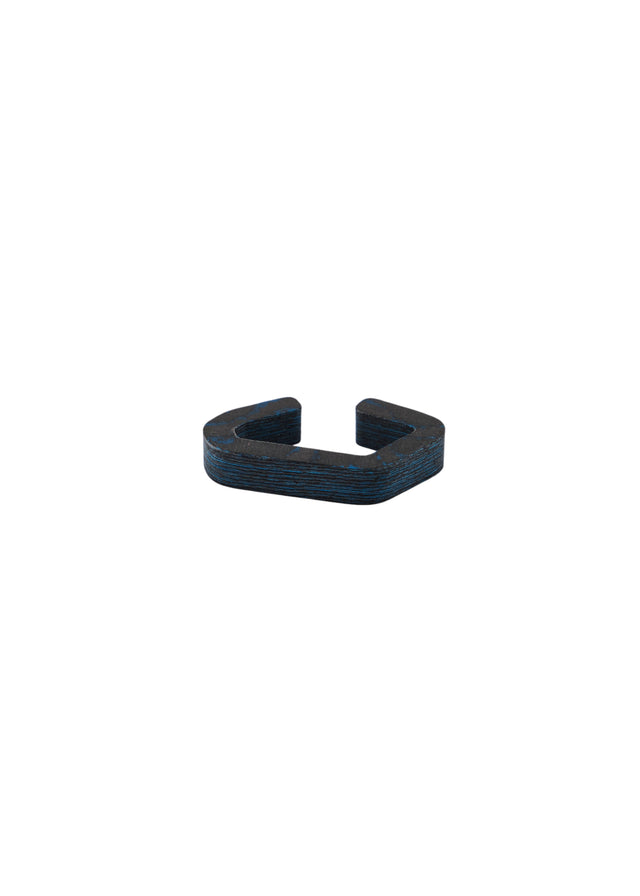
An ear cuff grips the outer edge of the ear by pressure — no piercing, no glue, no clip.
It slides on in two seconds and never sits inside a piercing channel.
STRUGA cuffs run 0.3 g in carbon to 7.5 g in silver, $95 to $250.
Seven of our twelve cuffs weigh under 3 g — comfortable for all-day wear.
Sterling silver is 92.5% silver and 7.5% other metals; ours is copper.
Updated September 28, 2026
Ear cuff earrings are the one form of ear jewelry you can put on today and take off tonight with nothing left behind. This guide covers mechanics, fit, weight, price and wear. Our pieces sit in the ear cuff collection; the wider map of ear forms is in the Atlas chapter on cuffs.
What is an ear cuff, and how does it stay on without a piercing?
An ear cuff is a band of metal shaped slightly narrower than the ear it sits on. Slide it into place and the metal presses inward. That pressure is the whole mechanism — nothing pierces, nothing sticks, nothing clamps shut.
The grip works because the outer rim of the ear is firm and thin. It gives the metal a consistent surface to hold, and it barely changes shape when you move. A lobe does the opposite: it deforms the moment you touch it, which is why a pressure cuff will not stay there.
For people with no piercings, a cuff gives the visual presence of an earring without the hole. For people who already have piercings, it extends the jewelry above the lobe line. One consequence matters later: because the cuff holds by tension, soft metal relaxes over months of wear. That is the material behaving normally, not the piece failing.
What are earrings called when they are not pierced?
Four different objects hide under the phrase "non pierced earrings", and they work in four different ways.
- Ear cuff. Grips the outer rim by pressure. Sits above the lobe. Comfortable for hours, because the pressure spreads along a curve.
- Clip-on earring. A hinged or screw mechanism pinching the lobe between two plates. The pressure lands on one small spot, which is why clip-ons start to ache.
- Magnetic earring. Two magnets holding the lobe between them. Light, and prone to falling off.
- Fake piercing. A description of a look, not a construction — usually a cuff shaped to imitate a hoop or barbell through the ear.
When people search for a "fake ear piercing" or "no hole earrings", the object they usually want is a cuff. It is the only one of the four that reads as a real piercing at conversational distance, and the only one that leaves the lobe alone. All of them are set side by side in the guide to earring types.
What does an ear cuff weigh, and what does it cost?
Weight decides whether you can wear a cuff all day, and almost no brand publishes it. Here is our whole cuff range, straight from the catalogue.
| Form | Weight | Material | Price |
|---|---|---|---|
| Carbon cuffs — BLADE and SIGNATURE, Arctic and Classic | 0.3 g | Matte carbon | $95 |
| Size M — BRUTALISM V.1 and V.3 | 1.6–2.61 g | 925 silver | $125 |
| Size L — THORN | 2.6 g | 925 silver | $160 |
| Size L — BLADE, SIGNATURE, BRUTALISM V.1, V.2 and V.3 | 3.8 g; BRUTALISM about 7.5 g | 925 silver | $160–$250 |
Read the range rather than the single numbers. A carbon cuff at 0.3 g is twelve times lighter than the large silver BLADE at 3.8 g, and you feel that by the end of a day. Seven of the twelve sit under 3 g; the lightest silver piece is the size M BRUTALISM V.3 in dark treatment, at 1.6 g. Silver is made to order in about two weeks, carbon in about four.
Which parts of the ear can hold a cuff?
Placement decides comfort, so anatomy comes before styling. The ear offers four zones, and each behaves differently under a cuff.
| Zone | Where it is | Holds a cuff? |
|---|---|---|
| Helix — outer rim | Curved outer edge, 30–50 mm long | Yes — the default place |
| Lobe — soft tissue | Hanging part at the bottom | No — clips and huggies only |
| Conch — inner bowl | Deep bowl at the centre | Yes, with careful sizing |
| Tragus and antitragus | Small flap and bump at the opening | Yes, bands under 10 mm |
The helix, and why almost every cuff goes there
The helix is firm, thinly covered and consistent in thickness — exactly what a cuff needs to grip predictably. Most cuffs are built for its upper third, the stretch curving from the top of the ear toward the back.
The three harder zones
The lobe has no firm edge, so a pressure cuff slides off it. The conch takes a cuff on its inner edge, but conch shape varies more between people than helix shape does. The tragus is the most discreet placement and the hardest to hold, because the gripping surface is so small.
This guide stays with the object itself — mechanics, weight, price, wear. Fitting zone by zone, including how far along the rim a band should sit and what to do when it drifts, is worked through in the placement guide.
How do you put an ear cuff on, and how do you keep it there?
- Find the thin spot. Run a finger along the upper rim until the ear feels thinnest. That is where the cuff should land.
- Slide, do not force. It should go on under light pressure. If it needs real force, widen the gap slightly with your fingers first.
- Set the position. Move it a few millimetres up or down until it sits without pinching. Ear shapes differ; the right spot is personal.
- Test it. Tug gently, then shake your head. If it shifts, squeeze the gap a fraction closer.
- Give it an hour. The first hour feels unfamiliar. If it still presses after an hour, take it off and open the gap half a millimetre.
An adjustable ear cuff is not a separate product category. Any soft silver cuff is adjustable, because 925 bends under finger pressure and holds the new shape. That is the answer to a cuff that keeps sliding off: close the gap half a millimetre at a time and it stays. Fit is covered in the cuff size guide.
What types of ear cuff are there, and which suits your ear?
- Single-band helix cuff. One band around the upper-outer rim. The most common type, easiest to place, and the one that reads best on a small ear.
- Multiple-band cuff. Two or three connected bands across the ear. More presence, more secure, and it holds its scale on a larger ear.
- Chunky cuff. A wide, heavy single band built to read across a room. Needs a well-matched gap, since the weight works against the grip.
- Conch cuff. Sits inside the bowl of the ear. Less common, and it needs careful sizing.
- Chained cuff. Linked by chain to a separate stud — for ears already pierced that want the two points connected.
STRUGA works in the first three, all inside CODEX, the brand's everyday architectural language. The BLADE cuff carries the chain-link form onto the ear; BRUTALISM gives the heaviest version; SIGNATURE ASYMMETRIC puts the first form of the brand on the rim; THORN brings a sharp angle to it. The first two cuffs STRUGA ever made were BLADE and SIGNATURE ASYMMETRIC. If no standard gap matches your ear, it can be set to your measurement through Custom Order.
Is sterling silver safe to wear on the ear?
Sterling silver is 92.5% silver and 7.5% other metals; ours is copper. Most reactions to jewelry trace back to the alloy partner rather than to the silver, and that partner differs from maker to maker — which is why the alloy is worth asking about instead of reading the 925 mark as an answer.
European law draws the line in a way that is useful here. Under the REACH Regulation (EC) No 1907/2006, Annex XVII, entry 27 — the rules that absorbed the old Nickel Directive 94/27/EC in 2009 — nickel release is capped at 0.2 µg/cm² per week for post assemblies inserted into pierced ears, and 0.5 µg/cm² per week for articles in prolonged contact with skin. The stricter figure for piercing posts was set by Commission Directive 2004/96/EC and has applied since 1 September 2005.
The two limits differ by a factor of two and a half for one reason: a post sits inside an open channel, a cuff rests on intact skin. A cuff is the gentler form of ear jewelry because of where it sits, not what it is made of. Long wear is covered in the comfort guide and the guide for sensitive ears.
Which ear, one cuff or two — how do you compose it?
The side carries no meaning today. It did once — through parts of the twentieth century a single earring on one side was read as a signal about sexuality, and that code has faded from general use.
- One cuff, one ear. On the ear that faces people first. The most legible arrangement, and the hardest to get wrong.
- Cuff high, stud low, same ear. Two points build a vertical line up the ear.
- Cuff on one ear, stud on the other. Asymmetry that stays quiet.
- Two cuffs, one ear. Works only at matched widths — uneven widths look accidental.
Keep to one metal, and watch the weight: two 3.8 g cuffs on one ear press differently than one, and you notice by evening. Fuller compositions are in the ear stack guide.
Can men wear ear cuffs?
Yes, and it is one of the fastest-moving parts of the category. The appeal is simple: jewelry on the ear without committing to a hole in it, and nothing to explain the next morning.
The pieces that work are the plain ones — a single band, dark surface, no ornament, no stones. Start at size M: heavy enough to read as deliberate, light enough to forget. The BRUTALISM V.3 in black oxidation is the darkest of ours, blackened at the bench rather than left to darken on its own; the SIGNATURE ASYMMETRIC (L) is the quietest line, made only in size L.
STRUGA does not split objects by gender — sizes are built by body, form and weight. Placement and occasion are worked through in the guide to cuffs in masculine wear.
Are ear cuffs still in style — and is there an age for them?
They are in style, and the runway is the easiest place to check. Marie Claire's 2026 jewellery round-up names cuffs on the Fendi spring/summer 2026 runway, with jewelry by Delfina Delettrez Fendi, and notes Zimmermann and Schiaparelli showing their own versions the same season.
The form keeps returning for a structural reason rather than a seasonal one. A cuff delivers the look of an extra piercing with none of the aftercare, and that trade holds regardless of what else is in fashion. The 2026 shape of it runs to scale and asymmetry rather than delicacy.
Age is the other half of the question, and it is really about ornament. A cuff covered in crystals reads young because crystals read young. One unornamented band, dark or matte, does not carry an age at all.
How do you care for an ear cuff?
- Wipe after wear. A microfibre pass removes the skin oils that collect on the contact surfaces.
- Take it off for sleep, swimming and training. Cuffs deform under sustained pressure, and side-sleeping presses them into the ear.
- Reshape when it loosens. Squeeze the gap closed before the next wear. Maintenance, not repair.
- Watch the bend. A cuff opened too far will not spring back on its own: squeeze the gap closed by hand, half a millimetre at a time, or send it back for re-bending.
- Store it apart. Cuffs scratch each other in a shared box.
Darkening is a separate matter from wear. Our silver goes out unplated, so it takes patina from air and skin, and a year of wear makes a map of how the piece was handled. Both surfaces — the one that darkens on its own and the one blackened at the bench — are explained in the materials guide; the darkened range sits in oxidized silver cuffs. For the choice laid out as a decision, read how to choose a silver cuff without a piercing, then look at the collection.
About STRUGA. STRUGA is a dark silver jewelry brand founded by Dmitry Strugovshchikov and Ekaterina Strugovshchikova, handmade in Bali by master silversmiths. Pieces are 925 sterling silver worn without rhodium plating, so the surface darkens with air and skin; a smaller part of the range is blackened deliberately at the bench. Both are choices, not wear.
Frequently asked questions
Didn’t find the answer — write to us, we reply personally.
Ask a question →01How do ear cuffs stay on?+–
By pressure. The cuff is shaped slightly narrower than the ear, so it grips the outer rim when you slide it on. No hole, no glue, no clip mechanism in most designs.
02Does an ear cuff need a piercing?+–
No. An ear cuff sits on the outer edge of the ear and holds by pressure alone — ear jewelry with nothing left behind when you take it off.
03How do you wear ear cuffs without them falling off?+–
Take it off and close the gap half a millimetre at a time. Soft 925 silver bends under finger pressure and holds the new shape, so a sliding cuff is tightened in seconds.
04Are there ear cuffs that don’t hurt?+–
Yes — light ones placed on the upper rim. Pain almost always means the gap is too tight or the piece too heavy. Seven of our twelve cuffs weigh under 3 g.
05Which ear do you wear an ear cuff on?+–
Either. The side carries no meaning today. A single cuff on the ear that faces people first is the most legible placement.
06Am I too old to wear ear cuffs?+–
No — the question is about ornament, not age. A plain single band with no stones does not carry an age; crystals read young because the decoration does.
07Are ear cuffs in style in 2026?+–
Yes. Marie Claire’s 2026 jewellery round-up names cuffs on the Fendi spring/summer 2026 runway, with Zimmermann and Schiaparelli showing their own versions.
08What are earrings called that are not pierced?+–
Four different things: ear cuffs, clip-ons, magnetic earrings and pieces described as fake piercings. Only the ear cuff grips the outer rim by pressure.
09Is sterling silver okay for ears?+–
Yes. Sterling silver is 92.5% silver and 7.5% other metals; ours is copper. A cuff also rests on intact skin rather than inside a piercing channel, so the contact is shorter and lighter than with a post.
10Is a loose ear cuff a defect?+–
No. Soft 925 silver relaxes with repeated wear — the material behaving normally. Squeeze the gap closed before the next wear, or send it back for re-bending.
11Is an oxidized ear cuff tarnished or damaged?+–
No. Blackening here is a finish chosen at the bench, not corrosion. Our unplated silver also darkens on its own, and that patina is part of how the object ages.
12How much does an ear cuff cost?+–
STRUGA cuffs run from $95 to $250: $95 for carbon, $125 for a size M in silver and $160–$250 for a size L. Silver is made to order in about two weeks, carbon in about four.