Hypoallergenic Silver Earrings — 925 Sterling Explained for Sensitive Ears
A sensitive-ear reaction is almost never an allergy to silver — it is an immune response to nickel, a cheap hardening metal often hidden inside a «925 sterling» piece. The 925 stamp guarantees silver content, not the rest of the alloy, and «hypoallergenic» on a tag is not a regulated term anywhere we have checked. What protects your ear is a verifiable alloy: true 925 sterling silver alloyed with copper only — 92.5% silver, 7.5% copper, no nickel in the metal, the post, or the back.
Updated August 28, 2026
The short answer: nickel is the trigger, and in Europe 22.0% of women and 5.3% of men are sensitised to it. EU rules let a post inside a piercing release no more than 0.2 µg per cm² per week; a 925 piece alloyed with copper only clears that by carrying no nickel at all. This guide sorts the alloys that are safe from the ones merely sold as safe, and shows how to read a piece on its specs alone.
Written from the STRUGA workshop in Bali, where every piece is hand-cast in 925 sterling silver alloyed with copper only — no nickel, no zinc surrogate. Customers wear these earrings for years of daily use without reaction; the technical reasons are below.
The trigger is nickel, not silver: 22.0% of women and 5.3% of men in Europe are sensitised to it (EDEN Fragrance Study, 2018), and it lasts for life.
«Hypoallergenic» is not a regulated jewellery term anywhere. «Nickel-free» is, and it means no nickel in the alloy at all.
True 925 sterling silver is 92.5% silver and 7.5% copper — no nickel, zinc or manganese.
For a fresh piercing use niobium, titanium grade 23 or platinum. Avoid 316L steel and nickel silver.
STRUGA earrings are bare 925 throughout, post included, with no plating to wear through.
Which metals are safe in a piercing — the short table
| Metal | Nickel | In a piercing |
|---|---|---|
| Niobium | none | yes — implant grade |
| Titanium grade 23 (Ti-6Al-4V ELI) | none | yes — implant grade |
| Platinum | none in standard jewellery alloys | yes |
| 925 sterling silver, copper only | none — 92.5% silver, 7.5% copper | yes, once healed |
| 958 Britannia · 999 fine silver | almost no alloy metal at all | yes, but too soft for posts |
| Yellow and rose gold, 14k–18k | usually none — silver and copper | usually yes |
| White gold | often present as a whitener | only if palladium-white |
| Stainless steel 316L | 10–14% | no, if you are sensitive |
| Nickel silver · German silver · alpaca | about 20%, and no silver at all | no |
| Gold-plated · silver-plated | usually in the base metal | no — plating wears through |
Each row is worked through below, with the alloy figures and the regulation behind them.
Why ears react to earrings — what is actually happening
Most ear reactions are not random irritation. They are a specific immune response to nickel. Nickel is a cheap, hard, white metal commonly added to silver, gold, and stainless steel alloys to make them stronger or whiter. When nickel ions leach into perspiration through the puncture wound of a piercing, the body recognises them as a threat and triggers contact dermatitis: itching, redness, weeping, sometimes a thick callus around the post.
The European Union caps how fast nickel may leach out, and it sets two different numbers. Under REACH Annex XVII, entry 27, a post inserted into a piercing must release less than 0.2 µg per cm² per week; jewellery in prolonged contact with unbroken skin is allowed 0.5 µg per cm² per week. The piercing limit is the stricter of the two, and it is the one that applies to an earring post. The United States has no equivalent federal limit, which is why «sensitive ears» is a much bigger conversation in the American market — domestic-sold sterling can legally contain enough nickel to trigger a reaction.
Once you have a nickel allergy, you have it for life. You can manage it but you cannot un-sensitise. The only treatment is avoidance — and avoidance starts with knowing what is actually in the metal you are putting in your ear.
What «hypoallergenic» actually means in jewellery
Nothing legally binding. The word «hypoallergenic» is not a regulated jewellery term in the EU, the UK, the US, or anywhere else we have checked. A maker can stamp HYPOALLERGENIC on a tag and sell a nickel-bearing piece that triggers a reaction within hours, and there is no enforcement mechanism.
What you actually want to look for:
- Nickel-free — meaning the alloy contains no nickel at all, not just below the EU leach limit. Real, not marketing.
- Specified alloy composition — a maker who lists exactly what is in the metal (e.g., «925 sterling: 92.5% silver, 7.5% copper») is verifiable. A maker who says «hypoallergenic alloy» without specifying is not.
- Nickel-free post and back — many otherwise nickel-free earrings cheap out on the post (the bit that goes through the ear) and use a nickel alloy there for hardness. Always confirm the post material specifically.
The metals that are actually safe — ranked by reliability
1. Niobium and titanium grade 23 (implant-safe)
The gold standard for medical body piercing. Niobium is a soft, dark grey metal that is biocompatible and non-reactive with body fluids. Titanium grade 23 (Ti-6Al-4V ELI — extra-low interstitial) is the alloy used in human bone implants. Neither contains nickel. The downside: niobium is dark and the colour palette is limited to anodised tones; titanium grade 23 has a distinctive cool grey colour and is harder to work into ornamental designs. Both are heavier than silver and wrong for everyday wear — but unbeatable in a fresh piercing.
2. Platinum
Platinum is naturally hypoallergenic and contains no nickel in any standard jewellery alloy. The tradeoff is cost — on 28 August 2026 platinum runs about 27 times the price of silver per gram, $60.43 against $2.25. Worth noting: platinum now costs less than half of gold per ounce, so it is no longer the most expensive way to solve a nickel problem. Still overkill for a daily-wear earring drawer.
3. 925 sterling silver alloyed with copper only
This is the STRUGA standard. The alloy is 92.5% pure silver and 7.5% copper — copper alone, no nickel substitute, no zinc, no manganese. The piece behaves chemically like the silver and the copper individually: silver is non-reactive with skin in normal wear; copper can occasionally leave a faint green mark on very damp skin, but it does not trigger immune-mediated dermatitis the way nickel does.
The problem: not every «925 sterling» piece is alloyed this way. Some American sterling adds nickel for whiteness. Some Asian wholesale sterling uses zinc-nickel mixes. The 925 stamp guarantees silver content, not the rest of the alloy. To know whether a 925 piece is truly nickel-free, you have to ask the maker — or buy from one who publishes the specifics.
4. 958 Britannia and 999 fine silver
Higher purity than 925, with proportionally less alloy metal. 958 Britannia silver is 95.84% silver — the British standard raised by act of Parliament in 1697 and still legal today. It is often written simply as 958, and it is a different standard from 950, which the two are frequently confused with. 999 fine silver is 99.9% silver, almost no alloy. Both are inherently nickel-free because there is barely any non-silver content to worry about. The catch: fine silver is soft and bends easily, so it works for some pendants and earrings but not for posts, hinges, or anything load-bearing. Most makers do not use 999 for earring posts because the post would deform.
5. Solid 14k or 18k gold (with a clean alloy)
Pure gold (24k) is hypoallergenic. The alloys used to make 14k and 18k jewellery — adding copper, silver, palladium, zinc — vary by maker. White gold often contains nickel for the whitening effect; palladium-white gold is the nickel-free alternative. Yellow gold and rose gold are typically nickel-free because the alloy is silver and copper. Gold-plated, gold-vermeil, and gold-filled all have a thin layer of gold over a base metal core — and the base metal can contain nickel. Always verify the alloy or stay with solid yellow/rose gold from a maker who specifies their composition.
The metals that are not safe — even when sold as «sensitive»
Nickel silver / German silver / alpaca
None of these contains any silver at all. The names are 19th-century marketing legacies. The actual composition is roughly 60% copper, 20% nickel, 20% zinc. If you are nickel-allergic, this is the worst possible metal next to your ear. Watch for these names on tags from craft fairs and budget retailers.
Surgical stainless steel
The phrase «surgical» sounds reassuring but most surgical-grade stainless steel (316L) contains 10–14% nickel. The chromium content forms a passive layer that limits leaching, which is why the EU permits 316L for jewellery — but if your sensitivity is high, a passive layer is not enough. Stainless steel is the most common cause of unexpected reactions in people who thought they were buying a safe earring.
White gold (without checking the alloy)
White gold gets its colour from one of two recipes: nickel-and-zinc (cheaper, the historical default) or palladium (more expensive, nickel-free). A «white gold» tag tells you nothing about which alloy it is. Always ask, or buy from a maker who publishes the recipe.
Plated jewellery
The plating is fine — usually a thin gold or silver layer that is itself non-allergenic. The problem is the base metal underneath, which is almost always brass-and-nickel for cost. Plating wears through, and once it does, your skin is in direct contact with the nickel-bearing core. Most «sensitive ears reactions to gold-plated earrings» stories trace back to this.
How to read an earring listing for sensitive ears
Five things to check before you buy:
- Is the metal type stated explicitly? «925 sterling silver,» «14k yellow gold,» «niobium» — specific is good. «Hypoallergenic alloy» or «silver-tone» — specific is not.
- Is the alloy composition broken down? A maker like STRUGA will say «92.5% silver, 7.5% copper.» That sentence is your real guarantee.
- Is the post material specified? Earring posts are sometimes a different metal from the body. Check that the post is also nickel-free.
- Does the maker publish weight and dimensions? Real makers stand behind the spec; vague listings often hide cheaper alloys.
- What happens if you react anyway? Ask before you buy, and read the exact wording. On strugadesign.com an unworn piece can be exchanged once within 14 days of delivery, with a Return Authorization agreed in advance and shipping both ways on the buyer. A reaction to the metal is a case we would rather hear about directly than read in a review.
For a deeper view on the silver standards themselves, see our sterling silver 925 complete guide and the sterling silver jewellery guide 2026.
Why STRUGA sterling silver is safe for sensitive ears
Three things, by design:
One — the alloy is silver and copper only. Every STRUGA piece is cast in 925 sterling: 92.5% silver, 7.5% copper. There is no nickel in the recipe, and we do not source mill stock that contains nickel as a hardener. We confirm the alloy with the workshop on every batch.
Two — the post is the same metal as the body. Many earring makers cast the body in one alloy and use a pre-fab steel-and-nickel post for hardness. We cast the post as part of the piece, in the same 925 alloy. The metal touching your piercing channel is the same metal you can see.
Three — we do not rhodium-plate. Rhodium plating is hypoallergenic in itself, but when the layer wears unevenly — and on earring posts it always does — patches of bare metal underneath are exposed. If that bare metal is a nickel-bearing sterling, you get a sudden reaction months in. Our pieces are bare 925 throughout; what you see when the piece arrives is what you wear for the life of the piece. We call this Living Silver.
A note on copper: the copper in our alloy is metabolically benign for ear-piercing channels in the vast majority of people. The faint green mark some sterling wearers see on damp skin is a chemical reaction (copper carbonate) — not an immune response, not dermatitis, and it washes off. If you have specific copper sensitivity (rare), you would want platinum or fine 999 silver instead, but the population for whom this matters is very small.
Best STRUGA earrings for sensitive ears and first-piercing wear
If your piercing is healed and you are picking by sensitivity rather than by piercing freshness:
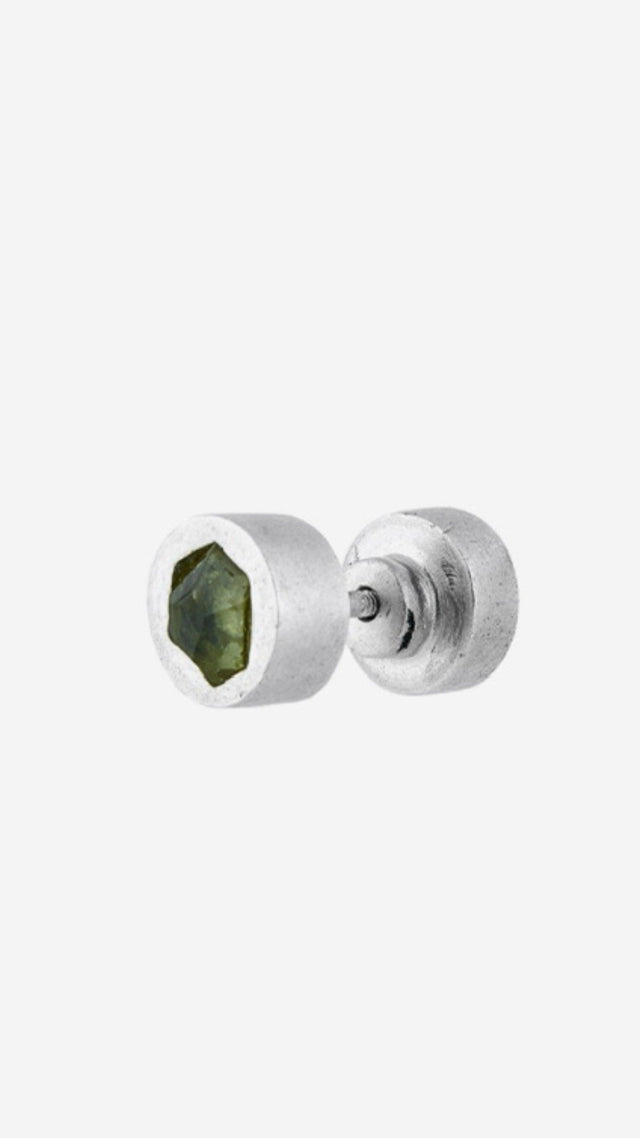
- Stud-style — minimal post movement, lowest irritation profile. The Classic + Suprematism Cross earring is cast in 925 with the post in the same alloy; the rest sit in all STRUGA earrings.
- Hoops with hinged closures — the closure mechanism is also 925, no nickel hinge pin.
- Drop earrings on a French wire — the wire passes through the lobe but does not seat against it; the contact area is small and the piece moves with you.
- Oxidised silver pieces — see oxidised silver earrings. The oxidation layer is silver sulphide, the same chemistry as natural tarnish. Inert with skin.
For a fresh or freshly-troubled piercing, we recommend you stay with niobium or titanium grade 23 from a piercing-specialist supplier until the channel is fully healed (4–8 weeks for a lobe, longer for the upper ear). Once healed, switching to STRUGA 925 is a minimal-risk change for most people. If you have a confirmed strong nickel allergy and want a deeper safety margin, platinum or solid 14k yellow gold are the next step up.
If you are still reacting — what to check
- Is the piece truly the metal it claims? Run the magnet test (see real gold vs silver earrings — how to tell what you’re buying). If it sticks, the post or core is steel.
- Is your piercing fully healed? Even an inert metal will inflame an unhealed channel. Wait until weeping has stopped completely.
- Is something else triggering it? Soaps, hair products, sweat-clogged sleeping habits, even a different earring you wore the day before can sensitise the channel. Clean the post and lobe with sterile saline, leave the earring out for 48 hours, and reassess.
- Have you tested for copper sensitivity specifically? Rare, but possible. A patch test with a dermatologist can confirm or rule out.
Our silver earrings — studs, hoops and oxidised pieces alike — are 925 sterling alloyed with copper only, and they sit in the oxidised silver collection and the broader earring catalogue. The CARBON line is a different material and is not covered by this rule: it is multi-layered matte carbon with other materials set into it — silver-plated metal, copper, brass, meteorite — and in the MOSAIC family it is joined with silver and steel too. Composition there is read from the piece.
Related guides in this cluster
- Sterling silver jewellery guide 2026 — the master pillar for our silver standards.
- Sterling silver 925 complete guide — alloy, history, hallmarks, care.
- Bali silver jewellery guide — what makes Bali 925 different from generic sterling.
- Real gold vs silver earrings — how to tell what you’re buying — gold-vs-silver authentication.
- Oxidised silver earrings — STRUGA earring landing.
About STRUGA. STRUGA is a dark silver jewelry brand founded by Dmitry Strugovshchikov and Ekaterina Strugovshchikova and made by hand in Bali by master silversmiths. The silver line is 925 sterling left uncoated, so it darkens with wear; on 17 of the 134 catalogue objects that darkening is done deliberately at the bench. The CARBON line sets other materials into carbon fibre. The darkening is part of the design: a brutalist object that changes through contact with its surroundings and its wearer.
Frequently asked questions
Didn’t find the answer — write to us, we reply personally.
Ask a question →01Is «hypoallergenic» the same as «nickel-free»?+–
No. «Hypoallergenic» is not a regulated jewellery term in the EU, UK, US, or anywhere else — a maker can stamp it on a nickel-bearing piece with no enforcement. «Nickel-free» is the claim that matters: it means the alloy contains no nickel at all, not merely below the EU leach limit of 0.5 µg per cm² per week.
02Is sterling silver the same as «surgical» stainless steel for sensitive ears?+–
No. «Surgical» sounds reassuring but most surgical-grade stainless steel (316L) contains 10–14% nickel, held back only by a passive chromium layer. True 925 sterling alloyed with copper only contains no nickel at all. The word «surgical» describes the steel grade, not the absence of an allergen.
03Is nickel silver (German silver, alpaca) actually silver?+–
No. Despite the name, nickel silver / German silver / alpaca contains no silver — the composition is roughly 60% copper, 20% nickel, 20% zinc. The names are 19th-century marketing legacies. For nickel-allergic ears it is the worst metal to wear, not a silver substitute.
04Does the green mark from copper mean an allergic reaction?+–
No. The faint green mark some sterling wearers see on damp skin is copper carbonate — a surface chemical reaction that washes off, not an immune-mediated dermatitis. Nickel triggers the allergy; copper in the 925 alloy is metabolically benign for piercing channels in the vast majority of people.