Silver ear cuff without a piercing: how to choose
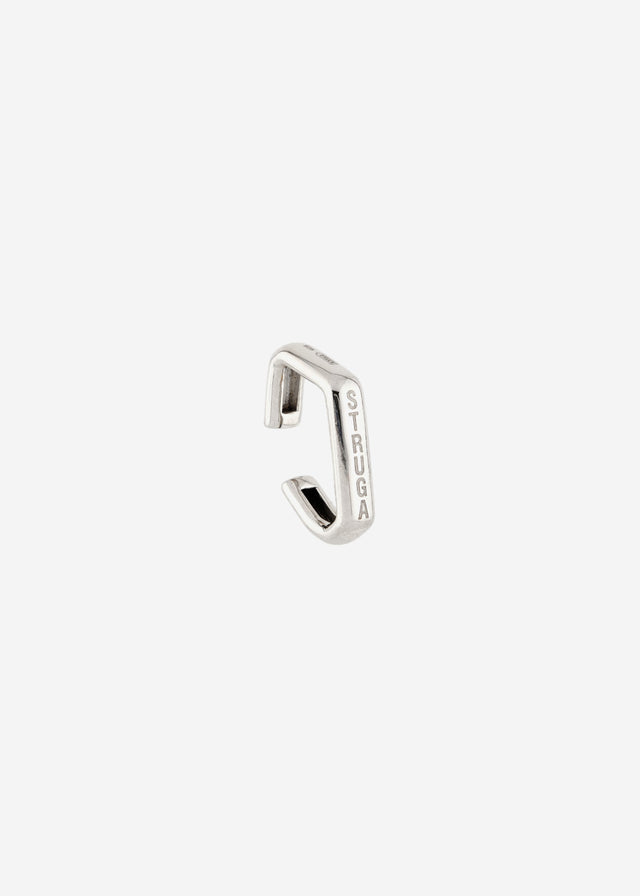
An ear cuff is an earring that holds onto the edge of the ear by the spring of the metal; no piercing is needed. The arc wraps the ear edge and goes on and off in one motion. Choose an ear cuff by three coordinates — fit, weight, material — and only then by shape.
Updated September 2, 2026
The useful order is mechanical before visual: decide where the cuff will sit, choose a material whose weight you want to feel, match the arc to that part of the ear, and only then compare silhouettes. A beautiful cuff with the wrong pressure is not a better choice than a quieter form that stays secure.
In short
- No piercing needed: an ear cuff grips the ear edge, and the fit is adjusted once.
- Material decides weight: 925 sterling silver has presence on the ear; carbon is almost weightless.
- Fit matters more than decoration: a cuff either sits right or gets in the way — check the M/L size range.
- STRUGA silver ear cuffs run from $125 to $250; carbon ear cuffs are $95 — the product card holds the current price.
- Uncoated silver darkens over time — a property of the metal, not a flaw.
How an ear cuff stays on without a piercing
The mechanics are simple: an open arc of metal wraps the edge of the ear and holds by its own spring. You put the cuff on at a thin section of the ear edge and slide it to where it will sit. The fit is set once, by gently squeezing or opening the arc; do not bend it back and forth every day — the metal fatigues. A properly fitted ear cuff stays on through walking, bending down, and pulling off a hat. The rule is the same for a 0.3 g carbon cuff and a roughly 7.5 g Brutalism Ear Cuff V.1 (L): the arc does the holding, not the weight.
- Start at a thinner edge. Do not force the cuff directly onto the place where it will finally sit; first find the easy entry point.
- Slide, then rotate. Move the open arc along the ear and turn the form until its weight rests where the design expects it.
- Adjust once. If the cuff moves, close the arc a little; if it presses, open it a little. Repeated bending is not a daily fastening method.
Silver or carbon: which material to choose
The mass segment is costume jewelry: brass or steel with plating. Cheap, but the plating survives the first months of wear — after that, the base metal. 925 sterling silver is solid metal with no layers: 92.5 percent silver, the international standard; a cuff made of it has nothing to peel off.
STRUGA offers two materials. 925 sterling silver without rhodium plating: it is alive — it darkens with its owner, friction keeps the edges bright while recesses gather shadow; the brand calls it Living Silver, and here patina is a map of wear, not a defect. And carbon: ultralight, unafraid of water, unchanged by time; six signature palettes — Classic, Bloody, Toxic, Arctic, Winter, and Multy Graphite. Silver is the choice for weight and a living surface. Carbon is the choice when you want the form without the feel of metal on the ear.
What shapes ear cuffs come in
STRUGA's ear cuff category holds five families — together they show how differently the same mechanics can be solved.
Five form families
- BLADE — the cuff as chain link: the brand's design code carried to the ear; even planes, as if cut from sheet material.
- THORN — sharp angles, joining CNC aesthetics and 3D modelling: a thorn that quietly reminds you it is there.
- BRUTALISM — architecture in silver on the upper part of the ear; three versions, V.1 to V.3, in sizes M and L.
- SIGNATURE ASYMMETRIC — the first form of the brand: STRUGA's asymmetric silhouette as an ear cuff.
- CARBON — the same principles in carbon: almost invisible by weight, fully visible by form.
Choose the shape from the placement: a narrow arc sits at the middle of the ear edge; a large architectural form sits on the upper part of the ear. The higher and heavier the cuff, the more exact the fit needs to be.
Choose the placement before the silhouette
Placement changes both the view and the pressure. The middle edge gives a narrow cuff a clear side profile. The upper ear gives a larger architectural object room to hold its full outline. Neither position is universally better.
- Middle edge: choose a compact arc when you want the cuff to read as a precise line and combine easily with pierced earrings.
- Upper edge: reserve this space for a wider form whose planes need distance; its weight makes accurate adjustment more important.
- One ear or two: a single cuff creates an asymmetric accent, while two cuffs make material and scale repeat across the face.
- With other silver: connect pieces through surface and proportion rather than forcing every object to repeat the same motif.
Look at the whole ear from the front and side. A cuff that seems quiet in a close photograph may become the strongest line in profile.
How to pick the size and fit
The M/L range is the sweep of the arc, not decoration. M sits closer and reads more quietly from the side; L is a visible object across half the ear. A heavy silver cuff makes itself felt for the first hours; then the hand stops reaching for it — the same as with a massive ring. If it presses, open the arc slightly, once; if it spins, squeeze it.
An honest boundary: if your ear cannot stand pressure at all, the ear cuff is not your form. A pierced earring sits looser; an ear cuff always holds the ear a little — that is exactly how it works.
Size letters describe the available sweep, but the useful test is physical: the opening reaches the chosen entry point, the arc can slide to position, and the finished form does not rotate under its own weight. Compare those three conditions before deciding that a larger size is automatically more comfortable.
A one-minute fit check
A secure cuff should be present without becoming the only thing you feel. Run this check after the first adjustment and again after several minutes of ordinary movement:
Walk and turn your head. The cuff should remain in the chosen position rather than creeping toward the entry point.
Bend forward once. A stable arc does not swing free or rotate around the edge.
Touch the ear around it. Pressure should be local and even; a sharp pinch means the opening is too tight or the placement is wrong.
Remove it by reversing the route. Slide back to the thinner edge before lifting the cuff away instead of pulling across the widest part.
If any step fails, change one variable at a time: placement first, then arc, then size. That makes the cause visible and avoids endless bending. A stable result should feel repeatable each time you put the cuff on.
What a silver ear cuff costs
Costume jewelry can start low, and the plating question comes with it. Handmade 925 sterling silver starts higher because the object is solid metal rather than a coloured skin over another base. At STRUGA the price depends on material, size and form: a silver ear cuff is $125 in size M and $160–250 in L; carbon ear cuffs are $95. Every object is handcrafted in Bali and finished by hand; the product card holds the current price.
- Compare material first: a solid silver cuff and a plated accessory do not age by the same mechanism.
- Compare scale second: a narrow arc and an upper-ear architectural form use different amounts of material and hand finishing.
- Compare the current card: it is the source for the available version and price.
A higher price does not repair a bad fit. Confirm placement and size before treating material or finish as the deciding upgrade.
How to wear an ear cuff and care for it
Wear it as you like: one cuff on the ear, a pair of different ones, or a cuff next to pierced earrings. The form has no gender — fit and shape are built to the ear, not to a sex.
Care depends on the material. Carbon keeps its surface with ordinary wear. Uncoated silver darkens by design: friction brightens the high points while recesses keep more shadow. If you want more contrast, use a soft silver cloth on the raised planes and leave the deeper texture alone. To bring the bright metal back fully, use a silver cleaning solution; on a matte surface the patina comes off with a mild abrasive.
- Before putting it on, check that the opening has not changed since the last wear.
- After taking it off, hold the cuff by the body rather than repeatedly opening the arc.
- When the silver changes, decide whether the patina belongs to the object before removing it; Living Silver is meant to record use.
The aim is a stable fit and a legible surface, not a cuff forced back to one uniform shade after every wear.
Frequently asked questions
Didn’t find the answer — write to us, we reply personally.
Ask a question →01Does an ear cuff fall off?+–
A properly fitted one does not: the arc holds by its spring. If it slips, the fit is too wide — squeeze the arc slightly, once.
02Does wearing an ear cuff hurt?+–
No. An ear cuff holds the ear but should not press: pain is the sign of an over-tightened arc — open it gently. A new cuff makes itself felt for the first hours; after that, it does not.
03Is it true that an ear cuff needs no piercing?+–
True. Every STRUGA ear cuff — all five families — is worn without a piercing: the arc wraps the edge of the ear. No piercing is needed for silver or for carbon.
04Why does a silver ear cuff darken, and what should I do about it?+–
925 sterling silver without rhodium plating reacts to air and skin — it darkens and takes on patina. That is a property of the material: the darkening comes off with a silver cleaning solution if you want the bright metal.
05How does a silver ear cuff stay on without a piercing?+–
An ear cuff is an earring that grips the edge of the ear by the spring of the metal: an open arc wraps the ear and holds by its own tension. You slide it on at a thin section of the edge and move it to where it will sit. The fit is set once, by gently squeezing or opening the arc — no need to bend it back and forth every day. A well-fitted cuff stays put through walking, bending down, and taking off a hat.
06Should I choose silver or carbon?+–
925 sterling silver is solid metal with presence on the ear; STRUGA leaves it without rhodium plating, so the surface stays alive and shifts with wear. Carbon is almost weightless, unbothered by water, and comes in six signature palettes — Classic, Bloody, Toxic, Arctic, Winter, and Multy Graphite. Choose silver for weight and a living surface; choose carbon when you want the form without the feel of metal on the ear.
07How do I pick the right size?+–
The M/L range is the sweep of the arc, not decoration. M sits closer and reads more quietly from the side; L is a visible object across half the ear. Match the size to placement — a narrow arc sits at the middle of the ear edge, a larger architectural form on the upper part — and remember that the higher and heavier the cuff, the more exact the fit needs to be.
08The silver darkens over time — is that a flaw?+–
No. Uncoated 925 silver darkens as it is worn: friction keeps the edges bright while recesses gather shadow. STRUGA calls this Living Silver, and the patina is a map of wear rather than a defect. If you prefer an even, unchanging surface, carbon holds its look over time.
09Does an ear cuff feel uncomfortable on the ear?+–
A heavy silver cuff makes itself felt for the first hours, then the hand stops reaching for it — much like a massive ring. If it presses, open the arc slightly, once; if it spins, squeeze it. One honest boundary: if your ear cannot stand any pressure, the ear cuff is not your form.
10Where can I buy a STRUGA ear cuff?+–
STRUGA pieces are made in Bali and shipped worldwide. In person you can find them at Hedonist Store and Barefoot Aristocracy on Bali, Soul Mate in Phuket, and Poison Drop in Dubai. Shipping cost and timing are shown at checkout.
Continue from the journal to a current STRUGA object: Blade Ear Cuff (L).