Why Does Your Silver Bracelet Turn Your Finger Green or Black? The Chemistry of Sterling Silver, Sweat, and Skin
Silver itself darkens on the body: the invisible oxide film on its surface meets hydrogen sulfide and carbonyl sulfide in the air and turns into black silver sulfide.
The 7.5% copper in sterling tarnishes just as readily, so the alloy darkens faster than pure silver.
A green mark on skin comes from copper compounds that form when the alloy meets sweat. It is a stain, not an allergy, and soap and water remove it.
A black mark on skin is most often metal dust: particles in powder and sunscreen are harder than silver and abrade it.
Neither the mark nor the tarnish proves a fake or proves the real thing: silver behaves this way, and so do copper and brass.
Updated September 29, 2026
Uncoated silver that arrives bright: Blade Mini Links V.2 — 13–17 g · Big Thorn Bracelet — 45–95 g · Thorn Bracelet — 5–5.4 g
Dark film on the links, a green band on the wrist and a black line on the finger under a ring have three different causes, and none of them points to plating. The film is silver sulfide, a thin layer a cloth removes. The green on skin is copper compounds from the alloy, and soap and water wash them off. The black on skin is most often metal dust worn away by cosmetics. All three questions tend to arrive about a month after someone buys their first silver piece. Below is what happens in each case and what to do about it.
Why does sterling silver turn black when you wear it?
Silver turns black on the body because it combines with sulfur from the air, and warmth, moisture and the salt in sweat speed that reaction up. Silver always carries an invisible oxide film. When it meets hydrogen sulfide and carbonyl sulfide, it becomes silver sulfide — the black tarnish. So little of these gases is needed that ordinary indoor air is enough. The mechanism is set out by Tim Burstein of the University of Cambridge in a paper for the London assay office (Assay Office London).
Pure silver tarnishes too, not only the alloy. Sterling is 92.5% silver and 7.5% copper, and copper, in Burstein's words, is as prone to tarnishing as silver itself while being the more base metal. That is why the alloy darkens faster than pure silver — an observation the Canadian Conservation Institute confirms (CCI). The copper is there for hardness: under the Russian standard GOST 30649-99, pure silver measures 50 HV annealed, while 925 measures 77 HV and up to 170 HV after working. Without copper, a link and a clasp would not hold their shape.
Skin adds salt. Sweat carries roughly 20 to 70 millimoles of chloride per litre (Baker, 2019), and in experiments with a sweat model, silver chloride builds up on silver and the corrosion rate rises with salt concentration (Park et al., 2023). Over time the chloride converts to sulfide, which is the more stable of the two. Where a bracelet rubs against skin and sleeve, the film wears away faster than it grows, so raised points stay bright while recesses go dark. Why silver tarnishes in general and how to clean it safely is covered in why 925 silver tarnishes; how to slow it down, in how to prevent silver from tarnishing.
What does each shade on the silver mean?
The colour of the film shows its thickness, and so how far the reaction has gone. According to CCI, as silver sulfide grows from 10 to 100 nanometres the surface moves from yellow through red-brown to blue; past about 100 nanometres the film looks black. Marks on the skin are a separate matter with separate causes.
| What you see | What it is | What to do |
|---|---|---|
| Yellow, then red-brown | A young silver sulfide film | A soft silver cloth |
| A blue cast | A film of about 100 nanometres | A cloth; if it resists, a silver cleaning solution |
| Black | A film thicker than 100 nanometres | Bring it back to bright or leave it — a choice, not a repair |
| Dark recesses, bright high points | Friction removes the film where the piece touches skin and clothing | Nothing: this is how worn silver looks |
| Dark recesses on a new piece | Darkening applied during making | Do not polish it or leave it in a dip |
| Green band on skin | Copper compounds from the alloy | Wash the skin with soap |
| Black line on skin | Metal dust worn off by cosmetics | Wash skin and piece; put it on after cream has absorbed |
Why does silver turn skin green?
The copper in the alloy turns skin green, not the silver. Copper corrosion products are green or blue-green (CCI). Sweat carries salt, lactic acid and ammonia, and in contact with it the copper in the alloy forms compounds that transfer onto skin. It is a stain, not an allergy, and soap and water remove it.
A finger under a silver ring goes green by the same route and often sooner than a wrist. A ring sits tighter than a bracelet, hands are washed and creamed all day, and water, soap and sweat stay trapped under the band. If the piece itself goes green — a deposit in the recesses — it is the same copper compounds. On 925, with 7.5% copper, it appears less often than on brass or copper, where copper is most or all of the metal.
The comparison people reach for is the Statue of Liberty. X-ray diffraction of its patina found it is mainly brochantite, a basic copper sulfate (Matyi and Baboian, 1986). The metal is the same, the setting is not: the statue stands in rain and sea wind, the bracelet on warm skin.
Why does silver leave a black mark on skin?
A black line on a finger or neck is most often metal dust worn off by cosmetics. The mechanism was described in 1969 for the Goldsmiths' Company in London (D. E. Gardam) and in 1971 in the trade journal JCK (A. A. Fisher): powder, foundation and sunscreen contain particles harder than jewellery metal — zinc oxide, titanium dioxide, iron oxide. They grind the surface, and metal broken down into fine dust looks black. Both papers are summarised in the technical archive of the jewellery alloy supplier Hoover & Strong.
The second cause is corrosion of the alloy metals by sweat and salt; the third is the sulfide itself, rubbed off a tarnished piece. That answers the question people ask most: silver and gold both leave black marks on skin. The mark says something about cosmetics and wear, not about a fake. Three things help: washing skin and jewellery with soap, putting silver on after cream and sunscreen have absorbed, and wiping the inside of a ring more often.
Why does my bracelet darken faster than someone else's?
Identical bracelets share the same alloy; what differs is the skin and the air around them. Two people buy the same bracelet on the same day and a month later see different results — that is normal silver behaviour, not a fault in one of the pieces.
What in sweat affects silver?
Sweat differs from person to person in composition and acidity. It carries 10 to 90 millimoles of sodium per litre, and its pH ranges from about 4 when sweating slowly to about 7 when sweating fast (Baker, 2019). More salt on the metal means more silver chloride, which later turns into sulfide. One wrist often runs ahead of the other; that is a difference in sweat volume, not anything unusual.
The popular explanation about diet — eggs, garlic, cabbage — is not supported by research. Eggs do release hydrogen sulfide and darken silver, but through direct proximity, as in a cutlery drawer (CCI), not through the skin.
How do climate and storage matter?
Near hot springs and industry the air carries more hydrogen sulfide, near the sea more salt, and humid air speeds the reaction: conservators keep silver below 50% relative humidity. Storage follows the same rule. A bracelet in a tightly sealed bag stays bright far longer than one left on a dresser.
What speeds up tarnishing the most?
Chlorine, salt and the hard particles in cosmetics speed up change the most, yet none of them ruins sterling for good. Each compresses weeks of ordinary tarnish into days, which is why a bracelet can look aged after a week by the sea.
| What you do | What happens to the metal | What to do instead |
|---|---|---|
| Chlorinated pool or hot tub | Water with chlorine speeds up tarnish on silver | Take the bracelet off before the water |
| Swimming in the sea | Salt forms silver chloride, which later turns into sulfide | Rinse in fresh water and dry |
| Cleaning with chlorine bleach | Chlorine damages metal alloys | Take the bracelet off before cleaning |
| Cream, powder, sunscreen | Hard particles abrade the metal and leave a black mark on skin | Put the bracelet on once the product has absorbed |
| Sleeping in it in hot weather | Hours of contact between metal, sweat and salt | Take it off overnight |
The advice to remove jewellery before chlorinated water and household chemicals comes from the Gemological Institute of America's care notes (GIA).
Does a green or black mark mean the bracelet is fake?
No: a mark neither exposes a fake nor proves the real thing. Sterling, brass and copper all turn skin green — the latter two carry more copper and usually leave a stronger mark. Silver and gold both leave black lines, and the cause is cosmetics and wear. Tarnish itself proves nothing either: copper, brass and nickel silver darken too.
What is worth looking at is what shows under wear, and how the metal behaves when cleaned.
| Signal | 925 silver | Plating over another metal |
|---|---|---|
| What shows on worn high points | The same pale metal | A metal of another colour — yellow or reddish |
| How it comes back to bright | A cloth or silver solution gives an even colour | The plating wears off in patches |
| Acid test at a jeweller | A reaction typical of 925 silver and above | A green reaction — plating over a copper alloy |
How to tell silver from an alloy without a laboratory is covered in how to tell if silver is real.
Does the «925» stamp prove the silver is real?
No: the number is a claim by whoever struck it, and the number itself checks nothing. It is older than the laws around it: the sterling standard goes back to the English pound of silver that was struck into 240 pennies.
In the United States, a quality mark is not required at all, but if one is applied, the law requires a registered trademark of the party responsible for its accuracy next to it. In Russia, the precious metals law (41-FZ, Article 12.1) makes the maker's mark mandatory, while the state assay mark is voluntary on Russian-made silver and mandatory on imported silver offered for sale. What the numbers on silver mean and how to read the marks is covered in 925 sterling silver: composition and hallmarks.
Is the dark film damage, or can it be part of the design?
Tarnish does not damage the metal, and on some pieces a dark surface is the design itself. The difference lies in where the dark came from, and that decides whether to clean a piece or leave it.
- Tarnish from wear arrives unevenly and over time, on the wearer. Living Silver is built around this: the piece arrives bright, darkens where nothing rubs it, and bringing it back to bright is the owner's choice, not the repair of a defect.
- Darkening applied during making is done in advance: recesses are left dark, high points are polished so light lands on them. Such a piece is already where it was meant to be, and a silver dip strips the design.
The STRUGA catalogue has 14 bracelets, and 13 of them are uncoated 925 silver with a Living Silver finish: they arrive bright and darken on the wearer. The fourteenth, One Display Techno, is carbon on a cord with a plate of silver-plated jewellery alloy, not silver. Seventeen of 134 pieces are darkened during making, 16 of them in the RITUAL world, and none of them is a bracelet. One example is the Brutalism V.3 Dark Treatment ear cuff: its dark surface is made before sale, not built up on the wearer.
How do I clean a silver bracelet without ruining it?
A soft silver cloth removes a young film, a silver cleaning solution removes an older one; everything else carries more risk. On matte silver, tarnish comes off with a gentle abrasive — a scouring pad or fine sandpaper — which takes off a thin top layer and sets a new matte finish. What damages a piece are the habits worth dropping.
- Toothpaste. It is an abrasive: even silver polishes leave fine scratches, and pastes are coarser (CCI).
- Soaking in a dip overnight. A dip works fast; long exposure can etch the surface.
- Vinegar and lemon juice. Acids strip the film together with any darkening applied during making.
- Storing it in the bathroom. It is humid there, and moisture speeds the reaction; a dry drawer is better.
The foil-and-baking-soda method works: aluminium paired with silver reduces the sulfide back to metal. But darkening applied during making is the same sulfide and goes with the tarnish, and CCI also warns of pitting on the surface. The full routine is in the guide to cleaning a silver bracelet.
Which bracelet should I choose if my skin reacts?
If your skin only turns green, you do not need a different bracelet — care is enough. If itching, redness or a rash appear, see a dermatologist. Soap removes the green, and less of it forms when the bracelet comes off overnight and before water and the inner side is wiped in the evening. The American Academy of Dermatology suggests clear nail polish as a temporary barrier between metal and skin (AAD); it wears off, needs frequent reapplying, and the silver under it stops changing.
A true allergy looks different: itching and a rash 12 to 72 hours after contact. Contact allergy to silver has been described but is rare. Nickel allergy is common — 11.4% of the general population in the meta-analysis by Alinaghi et al., 2019. The GOST 30649-99 grade for 925 is silver and copper, with no nickel in the grade; nickel turns up in platings, solders and pieces made outside the standard. For copper, patch tests are positive in 3.8% of people tested on suspicion of allergy (Fage et al., 2014). Which metal suits sensitive skin is covered in hypoallergenic silver earrings.
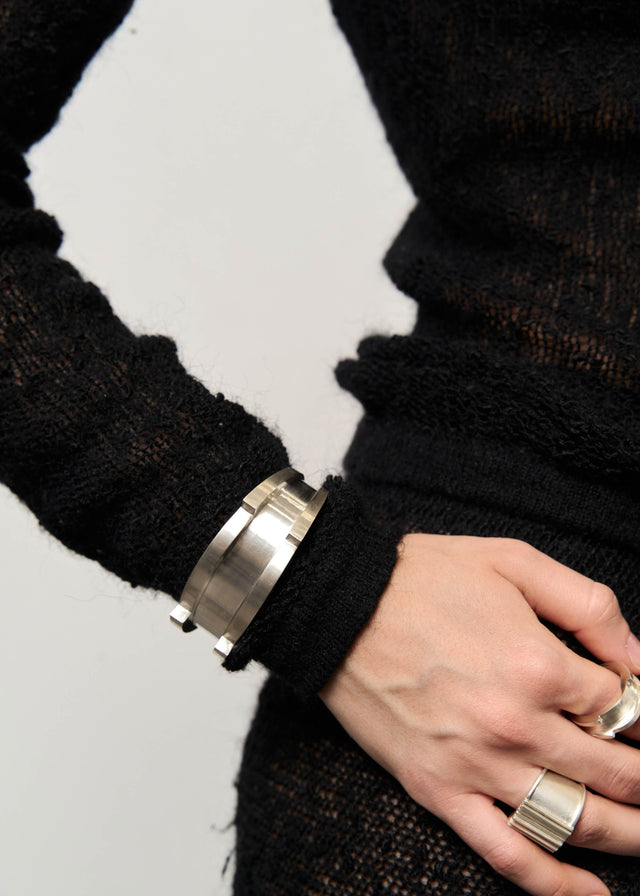
Shape matters too: the tighter a piece sits and the longer sweat stays under it, the more visible the mark. Across the bracelets, silver runs from 5 to 130 grams. The Thorn Bracelet, at 5–5.4 grams, is a light chain that moves with the arm. On the Blade Mini Links V.2 bracelet, at 13–17 grams, each link is split and reassembled on copper pins, and friction keeps the flat planes bright while the recesses collect shadow. The Big Thorn Bracelet, at 45–95 grams, is a rigid open arc rather than a chain around the whole wrist.
STRUGA cleans and makes small repairs to any of its pieces free of charge for as long as the owner has them; shipping to us is on the owner. Silver that records where it has been is doing exactly what this metal is meant to do.
About STRUGA. STRUGA is a dark silver jewelry brand founded by Dmitry Strugovshchikov and Ekaterina Strugovshchikova, handmade in Bali by master silversmiths. Most pieces are 925 sterling silver left uncoated, so they darken with wear; part of the range is darkened in advance, at the bench. The darkening is part of the design.
Frequently asked questions
Didn’t find the answer — write to us, we reply personally.
Ask a question →01Why does silver turn black on the body?+–
Silver combines with sulfur from the air: the invisible oxide film on it turns into black silver sulfide, and warmth, moisture and the salt in sweat speed the reaction up. Pure silver tarnishes too, but 925 does so faster because its 7.5% copper tarnishes just as readily. Where a piece rubs against skin and clothing, the film wears off, so raised points stay bright.
02Why does silver leave a black mark on skin?+–
Most often it is metal dust: powder, foundation and sunscreen contain particles harder than the metal — zinc oxide, titanium dioxide, iron oxide — and they abrade the jewellery. Fine metal dust looks black. Gold marks skin the same way. Washing skin and jewellery with soap and putting silver on after cream has absorbed both help.
03Why does a silver ring turn my finger green?+–
Copper compounds cause the green: 925 contains 7.5% copper, and in contact with the salts and acids in sweat it forms green products that transfer onto skin. It happens more under a ring than under a bracelet, because a ring sits tight and water, soap and sweat stay trapped under the band. Soap and water remove the mark.
04Is a green mark from silver an allergy?+–
No, it is a stain from copper compounds; it does not itch and it washes off. An allergy looks different: itching, redness or a rash 12 to 72 hours after contact. Contact allergy to silver has been described but is rare; nickel allergy affects 11.4% of the general population. Itching or a rash calls for a dermatologist and a patch test.
05Does 925 sterling silver tarnish?+–
Yes, and faster than pure silver, because the copper in the alloy tarnishes just as readily and is the more base metal. That is normal behaviour for the metal, not a fault. A soft silver cloth removes a young film; a silver cleaning solution removes an older one.
06If silver goes black or leaves a mark, is it fake?+–
No. Silver, copper and brass all darken and turn skin green, and gold leaves black marks on skin too. What shows on worn high points says more: on 925 it is the same pale metal, on plating it is a metal of another colour. A reliable check is an acid test at a jeweller.
07Can I stop my bracelet from tarnishing?+–
You can slow it, not stop it. Keep the bracelet in a tightly sealed bag, take it off before the pool, the sea and cleaning, and put it on after cream has absorbed. Rhodium plating stops tarnish but changes the piece; STRUGA bracelets are not plated — the surface is left free to change.
08Should darkened silver be cleaned?+–
Not with a dip: darkening applied during making is the same sulfide, and a silver solution strips it along with the tarnish. A dry soft cloth is enough. This barely concerns bracelets: 13 of the 14 STRUGA bracelets are uncoated 925 silver that arrives bright, and bringing them back to bright is the owner's choice.