AMULET — the Story of the Form
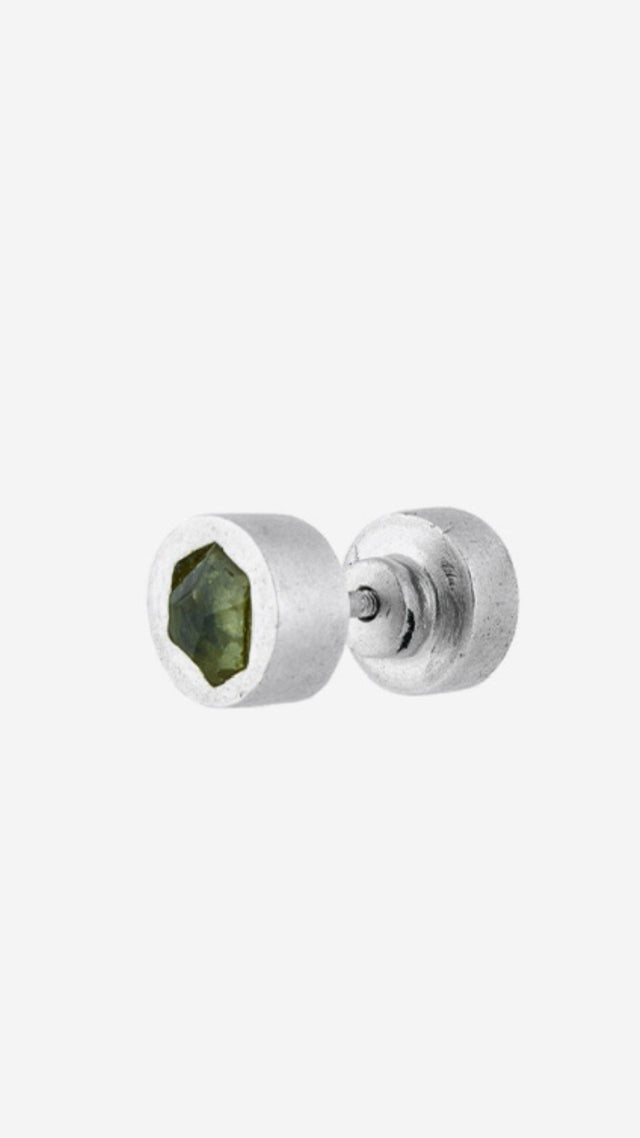
The AMULET family is built around a stone no one has cut. Today it holds 42 objects — 36 earrings and 6 necklaces. No two repeat: the stone in each is its own, and there will not be a second like it.
This is the story of a form, not of jewellery in general. Two lines grew apart, in different worlds of the brand, and in 2026 they met in one family. Below: how that happened, how the types differ, and why an amulet has no production time.
- AMULET is a STRUGA family of earrings and necklaces; today it holds 42 objects — 36 earrings and 6 necklaces.
- Two lines met in one family: the Classic cylinder and the Thorn frame; in 2026 they were united under the name AMULET.
- At the centre of each object is a stone grown without cutting: tourmaline, aquamarine, quartz.
- An amulet is built in advance and exists as a single piece: it has no production time, and it cannot be repeated — the stone is unrepeatable.
- Prices start at IDR 2,320,000 for a Double Thorn earring and reach IDR 18,710,000 for a quartz necklace.
Updated August 29, 2026 — STRUGA editorial team
The amulets of this family differ widely — from quiet, classical objects in a precise Japanese reading of minimalism to large, voluminous pieces that state their presence. The most expressive is the THORN Amulet: its form resembles a torpedo cut in half, as if found in the earth thousands of years later, with a crystal grown inside. It is an homage to Daniel Arsham.
The form continues in current pieces: Classic Amulet Earring #15 — Pink-Grey Tourmaline (S), and Classic Amulet Earring #16 — Green Tourmaline (S).
How was the form born?
AMULET has no single point of origin. Two lines grew separately and later met in one family.
The Classic line: a cylinder that holds the stone
The first line is Classic: a quiet cylinder holding a raw stone. It is the calm, minimal reading of the amulet, where silver does not argue with the stone but gives it a setting and weight. The form depicts nothing: it holds.
The THORN line: a chain link turned into volume
The second line arrived from another world — from CODEX, home of THORN, the third form of the brand.
THORN began as a chain link. The links became bracelets and chokers; then came the THORN Amulet, repeating the form in volume, with raw wild-growth stones; then the simple THORN earrings; then the Big Thorn Bracelet — the brand's first rigid bracelet; and the Thorn Ring.
So the THORN Amulet was born inside another family's chronology — a step in the life of the THORN form. It repeats THORN in volume, yet it belongs to the AMULET family and speaks through the RITUAL world.
For a long time Classic Amulet and Thorn Amulet existed as two separate collections. In 2026 they were united into a single family — AMULET. The two old collection pages now lead to one shared page of the family.
How does the THORN Amulet differ from the THORN family?
These are two different objects under one name, and they are confused constantly. The stone tells them apart.
- A THORN with a raw wild-growth stone is an amulet: the AMULET family, the RITUAL world.
- A THORN without a stone is the form itself: the THORN family, the CODEX world.
The same thorn geometry, but with a stone inside it becomes an object of another order and is counted under another family.
From this follows what is often written wrongly: the THORN family — chokers, earrings, rings, bracelets — does not include amulets. The form crossed the border between worlds and stayed on the other side.
Other variations in the same family: Classic Amulet Earring #25 — Pink Tourmaline (S), and Classic Amulet Earring #26 — Achroite (S).
What does the family hold today?
Today AMULET is 36 earrings and 6 necklaces: four types of object built around one principle.
| Type | How many now | What it is |
|---|---|---|
| Thorn | 18 earrings, 2 necklaces | the thorn form repeated in volume, with a stone inside |
| Classic | 11 earrings | a cylinder holding a raw stone |
| Classic studs | 3 | the smallest scale of the family, close to the lobe |
| Double Thorn | 4 earrings | a mono earring: two torpedoes on a bar, each holding its own stone |
| Quartz necklaces | 4 | Classic necklaces with quartz: clear, green, brown |
Double Thorn stands apart — a mono earring for one ear. Two cast torpedoes sit on a short bar, and the bar is what passes through the piercing: one torpedo sits in front of the lobe, the other behind it. Each torpedo is split lengthwise with its own stone set into the opening — tourmaline spans several mineral species, so the two stones in one earring never match in tone.
The numbers move: the family is open, and every object sold leaves it for good. The composition above was taken from the storefront on August 29, 2026.
The path of every amulet in silver is the same: a wax model, a silicone mold, silver 925, and hand finishing at the end.
Which stones sit in the amulets?
At the centre of each object is a stone grown in its natural form, without cutting. Three kinds stand in the family today.
- Tourmaline — 20 objects: green, pink, grey, purple, transparent, pink-grey.
- Aquamarine — 8 objects: a cold transparency that takes light differently than tourmaline.
- Quartz — 4 necklaces: clear, green, brown; here the stone is larger and works as the centre of the object.
- Achroite — 1 object: the colourless variety of tourmaline, rare enough that there is currently one in the family.
That is 33 objects out of 42, where the stone is named in the title itself. For the other nine — the studs, the Double Thorn earrings and the Thorn necklaces — the stone is given on the product page.
STRUGA works with many stones and, for an individual order, can source almost any raw stone. Why the stone is not cut, and how to choose one, is covered in the Atlas chapter on wild-growth stones. The object itself — the three types, the stone, its place in RITUAL — is set out in the Atlas chapter on the amulet.
How does the form live on the body?
Around the neck, silver turns into architecture. An amulet is a pendant with personal or cultural meaning; the word describes the object and its symbolic weight. STRUGA promises no effects.
A talisman is the same form with a different frame — an object of intention: personal meaning, with no promises of protection or restorative effect.
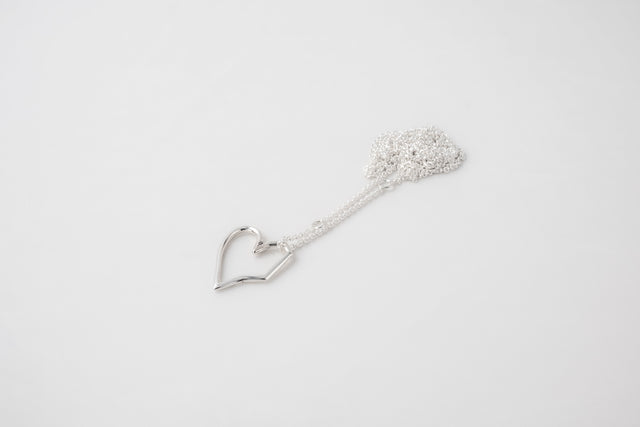
On the ear the family lives at its smallest scale: a stud — a small earring sitting close to the lobe. At STRUGA these are the THORN, AMULET and SIGNATURE HEART studs.
An amulet is an object and its symbolic weight; what it means is decided by its owner. Stones, crosses, meteorite — material, geology, and cultural reference. STRUGA promises no restorative, protective or energetic effect.
What does an amulet cost, and why has it no production time?
Prices on the international storefront, August 29, 2026:
- Double Thorn earring — from IDR 2,320,000, the most affordable piece of the family;
- earrings with a stone — from IDR 2,850,000;
- studs — IDR 3,740,000;
- Thorn necklace — IDR 4,460,000;
- quartz necklaces — IDR 15,150,000–18,710,000.
An amulet has no production time, and that is not a slip. The rest of STRUGA silver is made to order — around two weeks. An amulet is built in advance: the stone is already chosen, the setting for it is already made, the object exists. There is nothing to wait for.
The other side of that is the same: it cannot be repeated. A wild-growth stone is unrepeatable in form, colour and inner structure, so a sold amulet leaves the family for good — not "out of stock", but no longer existing as a position.
AMULET is an object built around a wild-growth stone; what it means belongs to the one who wears it. view the AMULET family
Continue from the journal to a current STRUGA object: Cross V.4 Bloody.
Frequently asked questions
Didn't find the answer — write to us, we reply personally.
Ask a question →01Is an amulet the same as a talisman at STRUGA?+–
No. An amulet is a pendant with personal or cultural meaning — the word describes the object and its symbolic weight. A talisman is the same form with a different frame — an object of intention. Both carry meaning decided by the owner; STRUGA promises no protection or restorative effect.
02Is the THORN Amulet part of the THORN family?+–
No. The stone tells them apart: a THORN with a raw wild-growth stone is an amulet — the AMULET family, the RITUAL world; a THORN without a stone is the form itself — the THORN family, the CODEX world. The THORN family list — chokers, earrings, rings, bracelets — does not include amulets.
03Does a STRUGA amulet protect its owner or restore anything?+–
No. STRUGA promises no restorative, protective or energetic effect. Stones, crosses and meteorite are treated as material, geology and cultural reference; what an amulet means is decided by the one who wears it.
04What is at the centre of an AMULET piece?+–
A stone grown in its natural form, without cutting — tourmaline, aquamarine or quartz. For an individual order, STRUGA can source almost any raw, wild-growth stone.
05How long is the wait, and what does an amulet cost?+–
There is no wait: an amulet is built in advance and exists as a single piece, so it has no production time. On the international storefront prices run from IDR 2,320,000 for a Double Thorn earring to IDR 18,710,000 for a quartz necklace.
06How many objects are in the AMULET family?+–
As of August 29, 2026 — 42 objects: 36 earrings and 6 necklaces. The number moves: every amulet sold leaves the family for good, because its stone is unrepeatable.