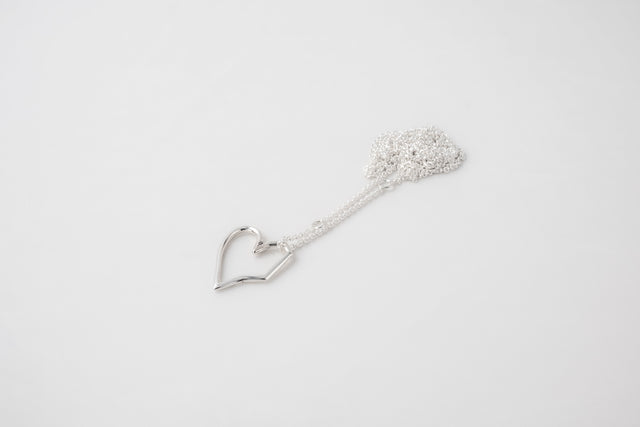
Symbolic Jewelry & Amulets: Meaning, Not Claims
Symbolic jewelry is a form with a cultural meaning — a cross, a sign, an amulet. At STRUGA its weight is meaning and reference, not a promise of protection or effect. The live catalogue holds 42 amulets and 6 crosses; every amulet is one of one, because the stone inside it never repeats.
Symbolic jewelry is a form with a cultural meaning — a cross, a sign, an amulet; the wearer supplies the meaning, the metal carries it.
At STRUGA symbolic pieces live in the RITUAL world: amulets, crosses, stones, carbon.
The AMULET family is earrings and necklaces built around a raw, wild-growth stone: 36 earrings of 2.25–7 grams and 6 necklaces of 9–40, in two flagship models — Classic E-0530 and Thorn E-0528.
Stones — tourmaline, aquamarine, quartz — are material, geology and reference, with no medical or spiritual claims.
Amulets are uncoated 925 silver — Living Silver: it darkens in the recesses and lightens on the edges with wear. The crosses are a different surface: Signature Cross V.3 was darkened in advance, on the bench, and the V.4 pair carries carbon in the Arctic and Bloody palettes.
An amulet is one of one: when its stone is gone it does not come back, and Custom Order builds a new piece rather than a copy of the sold one.
- What symbolic jewelry is
- Why meaning, not claims
- Which forms are worn as a sign
- How to choose an amulet
- Which pieces carry a sign
- In short
- FAQ
What symbolic jewelry is
A symbolic piece is a form that carries a cultural meaning: a cross, a sign, an amulet. What sets it apart from an ordinary pendant is not the material but the reference it holds — to a tradition, to a code, to something personal for the one who wears it.
In STRUGA's vocabulary these pieces live in the RITUAL world — the dark side of the brand, where objects with a personal symbolic weight are gathered: amulets, crosses, stones, carbon. "Symbolic weight" here is about what the object means to its owner. Not about a power the object supposedly radiates. RITUAL is one of the five worlds of the brand and holds 50 live objects; AMULET is one of its three families, alongside CARBON and MOSAIC.
Why meaning, not claims
"Protective amulet", "talisman", "amulet for protection" — that is how people search, and the words are honest exactly as far as a person is honest with themselves. STRUGA does not promise that metal will protect you, bring luck or charge you with energy. Silver does not work that way, and saying otherwise would be a lie.
So the angle is simple: a symbol is a cultural reference plus the personal meaning the wearer brings to it. The brand keeps mysticism as a footnote — what the people who invented the sign believed — not as a property of the piece. A stone at STRUGA is geology and reference, with no medical or spiritual claims. A cross is geometry and a cultural code, not religious kitsch. Across all 42 pieces of the family there is not one line describing a stone as a source of power — that is a rule of the brand constitution, not a stylistic preference.
The meaning lives in the person. The metal only carries it.
Three words circle the same object and are not interchangeable. What separates them is the frame, not the metal:
| Word | What it names | What it promises | At STRUGA |
|---|---|---|---|
| Amulet | the object and its symbolic weight | nothing | the AMULET family: 42 earrings and necklaces around a raw stone |
| Talisman | the same object as an object of intention | nothing | the same pieces, framed by the person wearing them |
| Charm | a small pendant, usually one of many on a bracelet | nothing | not a STRUGA form — a sign here is worn on its own |
The long answer to what an amulet has meant across cultures — Egypt, Rome, the Slavic north — is in the journal: Amulet Jewelry: Meaning, History & Modern Symbolism. This section of the Atlas only holds the definition and sends you on.
Which forms are worn as a sign
Three STRUGA forms answer the "amulet" and "symbolic jewelry" search — 6 crosses, 42 amulets and the stones grown inside them — each with its own node and family:
- Cross: the cross pendant — geometric, in silver with carbon, and in one case out of six darkened in advance (the RITUAL world). Form and cultural reference, not a religious promise.
- Amulet: the AMULET family — earrings and necklaces around a raw, wild-growth stone, gathered in the live amulet collection. Two flagship models: Classic E-0530, a restrained cylinder, and Thorn E-0528 — a halved-torpedo form with a crystal grown inside, an homage to Daniel Arsham.
- Stone as a sign: a raw stone as a symbolic reference. In the live collection the count runs 25 tourmalines, 8 aquamarines and 4 quartzes — material and geology, no claims. They live in tourmaline and quartz on their own, inside the RITUAL world.
One rule runs through all three: the piece carries a reference, and the wearer supplies the meaning. That is what symbolic weight means at STRUGA — without a promise of effect.
How to choose an amulet
The choice starts from meaning, not from "power". First, what the sign means to you or to the person you are giving it to: a cross as a code, an amulet as an object of intention, a stone as a reference. Then the form: a large pendant on the neck, a dense amulet, a stone in its setting.
STRUGA silver is uncoated 925, Living Silver: it darkens in the recesses and lightens on the edges with wear. For a sign that fits — a surface with a history instead of a display-case shine. Two weeks is the making time for a piece in plain 925 silver; an amulet has no making time at all, because it already exists as one object. When its stone is gone the piece does not return, and Custom Order builds a new one around a different stone rather than a copy of the sold one. Pieces that have already found an owner stay visible in One-of-One — RITUAL: an archive of what the family has been, not a shelf to order from.
Which pieces carry a sign
Three forms answer the word «amulet» at STRUGA, and they are built differently. The crosses are the heaviest and the most engineered: they combine 925 silver with carbon, and their weight runs from 4 to 17 grams on the neck. The amulets are lighter and quieter — the stone does the speaking. Everything below is live in the catalogue.
Crosses
Six pieces carry the cross form. The neck ones are silver with carbon: Cross V.4 Arctic Graphite is the lightest at 4 grams; Signature Cross V.3 weighs 9 and is the one piece here whose surface was darkened in advance, on the bench; Cross V.4 Bloody weighs 17. Away from the neck the form goes into Fused Cross Ring — plain 925 silver, sizes 16 to 22, 3.7 grams at the smallest. The whole set lives in Silver Cross Jewelry; what the form itself is, the Atlas holds at cross pendant.
Amulets
Forty-two objects, all of them one of one. On the neck: Thorn Amulet Necklace #1 at 12 grams and Classic Amulet Necklace — Clear Quartz at 9. In the ear: Thorn Amulet Earring #10 — Aquamarine at 5.9 grams and Classic Amulet Earring #18 — Aquamarine (L) at 5.5. All of them uncoated 925 silver — Living Silver. The number is a floor, not an average: ISO 9202:2019 states fineness as a minimum with no minus tolerance allowed, so 925 means at least 925 parts of silver per thousand by weight. The family node is in the Atlas: AMULET.
Stones
The stone is chosen for form and colour, never for an effect it is supposed to have. Tourmaline is not one mineral but a supergroup: its species are told apart by which ions occupy which sites in the structural formula (Henry et al., American Mineralogist 96, 2011), which is why green, pink and grey come from composition rather than from anything ascribed to the stone. Tourmaline dominates the live collection at 25 pieces, then aquamarine at 8 and quartz at 4 — the whole spread sits in AMULET, and the world around it is RITUAL.
In short
| What it is | a form with a cultural meaning: a cross, a sign, an amulet |
| World | RITUAL — 50 live objects |
| Family | AMULET — 42 objects: 36 earrings, 6 necklaces |
| Models | Classic E-0530 · Thorn E-0528 |
| Stones | tourmaline 25 · aquamarine 8 · quartz 4 |
| Weight | earrings 2.25–7 g · necklaces 9–40 g · crosses 4–17 g |
| Metal | uncoated 925 silver; the V.4 crosses add carbon, Signature Cross V.3 is darkened in advance |
| Made to order | plain silver about two weeks; an amulet has no making time — it already exists as one object |
| Promise | none: the wearer supplies the meaning |
Find a sign by its meaning: the RITUAL world — amulets, crosses, stones, carbon; or the live amulet and cross collections on their own. For what a form is and where its node sits, see the Atlas: the cross pendant, the AMULET family and the RITUAL world. For the long history of the sign, the journal: amulet jewelry and the story of the AMULET form. All uncoated 925 silver. If the form or stone you want is not in stock, STRUGA makes it to order through Custom Order.
Frequently asked questions
Didn’t find the answer — write to us, we reply personally.
Ask a question →01Is this protective jewelry?+–
That is often how people search for it. The honest answer: a symbol is a cultural reference and a personal meaning, not a guarantee of protection. STRUGA does not promise that a piece protects or brings luck — the person supplies the meaning, the metal carries it.
02What is the difference between an amulet and a talisman?+–
By form, almost nothing; by framing, a shade. An amulet describes the object and its symbolic weight; a talisman is the same object as an object of intention. Either way, at STRUGA it is meaning, not a promise of healing or protection.
03Is a STRUGA cross about religion?+–
It is a form and a cultural reference. The cross is geometric, in silver with carbon, and in one case out of six darkened in advance — it reads as a sign and a code, not as religious kitsch. What it means to the wearer is the wearer's own business.
04Does the stone in an amulet carry any effect?+–
A stone at STRUGA is material, geology and a symbolic reference. Tourmaline, aquamarine and quartz are chosen for form and meaning, with no medical or spiritual claims.
05Does the silver on a symbol darken?+–
Yes, by design. This is Living Silver — uncoated 925: it darkens in the recesses and lightens on the edges with wear. On a sign the darkening is character and history, not a fault.