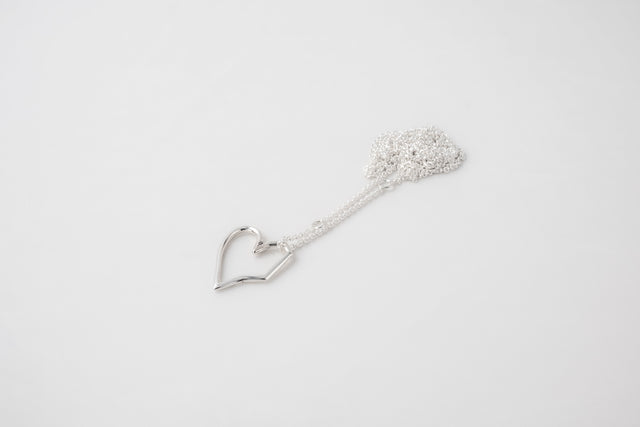
How to Style Statement Silver Jewelry
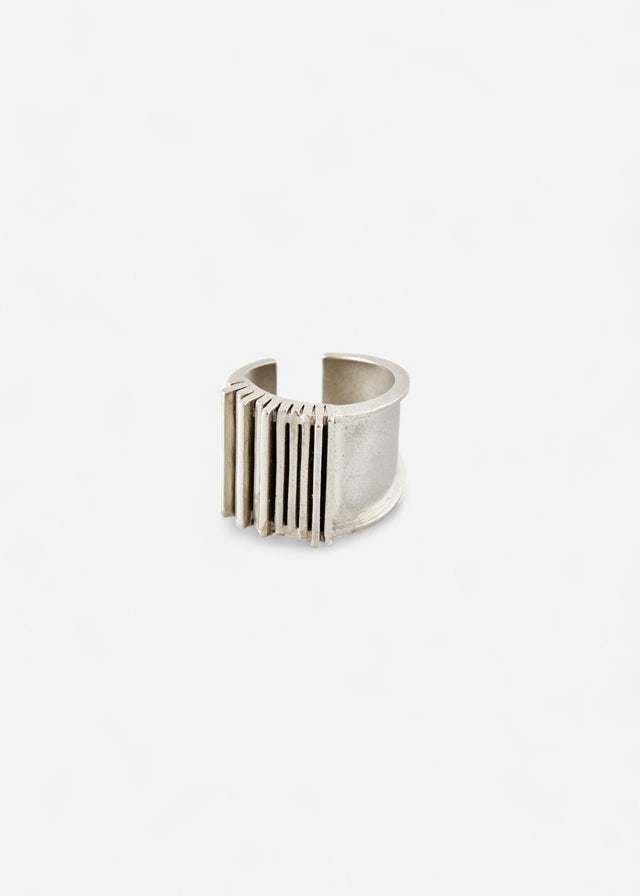
Styling statement silver is not about wearing more — it is about letting one piece read clearly. The working rule is reductive: one statement piece per visual zone (wrist, hand, ear, neck), a clean wardrobe around it, and deliberate placement. When two heavy pieces share a zone, they compete and the look reads as collection display rather than styling.
Updated September 13, 2026
- Statement silver styling is reductive, not additive: one piece per visual zone — wrist, hand, ear, neck — while several pieces in one zone compete.
- Scale is measurable, and it moves with size. In the STRUGA catalog a ring runs 2.1–24 g, a bracelet runs 2–130 g, a neck piece runs 4–110 g; one bracelet alone spans 45 g at 16 cm to 95 g at 23 cm.
- Daily: one ring on the dominant hand and no bracelet — the Brutalism V.3 ring is 9.6 g at size 15 and 24 g at size 22.
- Evening: one bracelet of 45 g or more plus a single mono earring, hands left quiet.
- Match finish to palette. Uncoated silver that darkens on the wearer suits dark wardrobes; bright polished silver suits monochrome contemporary.
- The widely repeated 2:1:1 rule has no traceable source and three contradictory published definitions.
How many statement pieces should you wear at once?
One per visual zone, and usually one in total. Give each zone — wrist, hand, ear, neck — a single piece that carries the design weight, and keep the others quiet. Two heavy bracelets on one wrist read as collection display rather than styling. The eye cannot decide which object it is looking at, so it settles on neither.
Scale is what makes a piece a statement, and scale is measurable. These are the real weights across the STRUGA catalog, taken from the pieces themselves.
| Type | Range in the catalog | Median piece, smallest size | Heaviest piece, largest size |
|---|---|---|---|
| Rings | 2.1–24 g | 4.7 g | Brutalism V.1 and V.3, 24 g at size 22 |
| Bracelets | 2–130 g | 17 g | Carabiner #2 Big Cross, 130 g at 21.5 cm |
| Necklaces and chains | 4–110 g | 9 g | BLADE Mini Links choker, 110 g at 50 cm |
| Earrings | 1.6–8 g | 3.9 g | Classic + Signature Mushroom, 8 g |
| Ear cuffs | 0.3–3.8 g | 1.6 g | L Blade cuff, 3.8 g |
The Brutalism V.3 ring runs 9.6 g at size 15 and 24 g at size 22 — the same design, more than twice the metal. The Big Thorn Bracelet runs 45–95 g depending on length, and the BLADE Big Links bracelet runs 85–95 g. A piece at that weight becomes the focal point whether you planned it or not.
Does jewelry weight change with size?
Yes, and by more than most size charts suggest. A statement piece is sold as one design, but the metal in it scales with the size ordered. Two people wearing the same bracelet can be wearing a 45 g object and a 95 g object. A single published weight for a sized piece describes one size and not the others — worth knowing before you read any styling advice that turns on grams.
The Big Thorn Bracelet is the clearest case in the catalog, because it exists in five lengths.
| Length | Weight | Against the shortest size |
|---|---|---|
| 16 cm | 45 g | baseline |
| 17 cm | 52 g | +16% |
| 19 cm | 74 g | +64% |
| 21 cm | 82 g | +82% |
| 23 cm | 95 g | +111% |
Rings behave the same way. The Thorn ring is 4.7 g at size 16 and 12.7 g at size 22 — 2.7 times the metal across six sizes. The practical consequence: on a larger hand or wrist, a piece described as moderate arrives as a statement, and the rules below apply to it even when the size chart read quietly.
What colors work with dark silver jewelry?
Dark silver sits naturally against black, charcoal, deep grey and deep navy: in those palettes the metal joins the outfit instead of interrupting it. Against white, cream or raw linen the same piece reads as a hard graphic mark. Both are usable — they are different intentions.
The finish decides which effect you get, and two different things hide behind the word dark. Most STRUGA pieces are uncoated 925 silver that darkens on the wearer over months of contact — the brand calls this Living Silver. A smaller group is oxidized at the bench before the piece ships, and holds that tone from the first day.
The difference shows when you dress. An oxidized piece keeps its depth against a black coat and needs light around it to be seen at all. Uncoated silver moves: bright in the first weeks, then settling into grey, with the raised edges rubbing back to light where fingers pass.
Which fabrics work best with heavy silver?
Soft ones. Wool, cotton jersey, silk and linen give the metal something to contradict, and the contrast flatters both. A 45 g bracelet against a knit sleeve reads as an object placed on a surface. The same bracelet against a stiff technical shell reads as hardware on hardware, and the shape disappears.
Leather is the exception worth naming. Leather and silver share a behavior rather than a texture: both take marks, both change color with use, both look better after a year than on the first day. Uncoated silver darkens where it meets skin; leather darkens where it folds. Worn together long enough, they age at a comparable pace.
Sleeve length is the practical limit. A bracelet under a cuff is not styling, it is storage.
How do you match jewelry scale to your clothing?
Decide first whether the piece should contrast the silhouette or complete it. On a fitted outfit a bold piece stands out by contrast: the line of the body is clear, and the object interrupts it deliberately. Under an oversized coat the same piece appears only in glimpses at the wrist or the collar. It becomes a detail for whoever catches it, and it no longer leads the outfit.
Weight tracks with visibility more reliably than size does. A 4.7 g ring — the median of the catalog — sits inside a look. The Heart Lock ring at 11 g changes the hand. Earrings top out at 8 g, which is heavier than it sounds on the ear and reads clearly in profile; the Double Thorn earring is 7 g.
Test at distance, not at arm's length. Invisible from across a room, it is jewelry; first thing seen, it is the statement.
Can you wear statement silver every day?
Yes, and the assumption that you cannot is the older one. Statement silver was tied to evening because ornamental statement jewelry was tied to evening. Architectural and brutalist forms are not ornamental, and they carry differently in daylight. A BRUTALISM ring in a meeting reads as a decision, not as an occasion.
The practical test is workplace, not calendar. Conservative fields — law, finance, government — still expect minimal jewelry, and a 45 g bracelet is a conversation you may not want at nine in the morning. Creative, technical, academic and fashion contexts generally read a single strong piece as competence rather than display.
Daily wear changes the object itself. Uncoated silver worn every day darkens unevenly, catching light on the raised edges and holding shadow in the recesses. A ring worn daily for a year looks different from the same ring worn six times. That is the intended behavior, not damage. Returning it to light takes a few minutes of care, whenever the owner decides.
What is the 2:1:1 rule for jewelry, and does it hold up?
It is the most-asked question in this subject, and it has no source. Search for statement jewelry styling and the 2:1:1 rule appears near the top of every result page. Follow it back and every explanation lands on a jewelry retailer's blog. No two of them agree on what the numbers mean.
Three published definitions, three different rules
Each of the three comes from a jewelry retailer, and none of them agrees with the other two:
- By placement. Zar Jewellery: "two items on the hands or wrists (rings or bracelets), one item on the neck (necklace), and one pair of items on the ears".
- Descending scale. bubs & sass: "you choose two statement pieces, one medium piece, and one small piece".
- Ascending scale. Ritani: two subtle pieces, one medium, one statement — the exact inverse of the version above.
None of the three cites a stylist, a publication or an origin. Two of them contradict each other on the central question: whether you wear two bold pieces at once, or none. The only older idea anyone points back to is the adage attributed to Coco Chanel about taking one thing off before leaving the house — which argues for subtraction, not for a formula that prescribes four pieces.
What survives is the part every version shares: spread the pieces across zones, and let one lead. Keep that. The arithmetic is worth dropping — a rule that cannot agree with itself on how many statement pieces to wear is not a rule.
Can you mix silver with gold in one look?
Yes, on one condition: one metal leads and the other appears once. Mixed metals fail when the proportion is even, because then the look has two centers and no hierarchy. They work when silver carries the outfit and a single gold element — a wedding band, one earring, a watch case — answers it somewhere else. Keep the mix inside one zone or across two, not scattered over four.
Finish matters more than metal here. Bright polished silver next to yellow gold is a clean pairing. Oxidized silver next to yellow gold is a harder one, and it needs the gold to be small. Which metal suits you as a base is a different question — the material comparison lives in sterling silver against other metals.
What does each context call for?
Each context sets the weight, and the rest of the look follows it. The piece that leads changes; the principle of one focal point does not.
| Context | What leads | What stays off |
|---|---|---|
| Daily professional | One ring on the dominant hand, 9–11 g | Bracelet; anything beyond a single small stud |
| Evening, social | One bracelet of 45 g or more, plus one mono earring | Rings — hands stay quiet |
| Architectural, dark wardrobe | Ring, ear cuff and bracelet on one side, along a single vertical line | Symmetry — it reads conventional |
| Wedding, formal | Wedding band, at most one minimal second piece; DARK UNION covers the union itself | Statement pieces |
| Subcultural, techno, club | One heavy piece — oversize reads under low directional light | Fine detail; it disappears in the room |
What are the most common styling mistakes?
- Stacking statement pieces. Two heavy bracelets on the same wrist, or several bold rings on one hand. The pieces compete instead of supporting each other, and the strongest one loses.
- Loud wardrobe with loud jewelry. Patterned or brightly colored clothing fights the metal. Statement pieces need visual room, and pattern takes it away.
- Wrong finish for the palette. Bright polished silver in a dark architectural wardrobe reads tonally wrong. Oxidized silver in a warm bohemian wardrobe reads wrong for the opposite reason.
- Ignoring sleeve length. A 45 g bracelet at $1,100 hidden under a cuff is money doing nothing. Match the piece to the season and to the outfit.
- Overdoing asymmetry. One-sided stacks work in moderation; one-sided stacks plus mismatched earrings plus different ring counts on each hand read as chaos.
How do you test a look before you commit to it?
- Stand two meters from a mirror. What does the eye find first? If the answer is "several things", edit down until it is one.
- Photograph yourself. The camera flattens depth and finds the clutter the mirror forgives.
- Add one piece at a time. Wear a new object for a few weeks before introducing the next, or you cannot tell which one is working.
Continue Reading
About STRUGA. STRUGA is a dark silver jewelry brand founded by Dmitry Strugovshchikov and Ekaterina Strugovshchikova, handmade in Bali by master silversmiths. The silver line is 925 sterling silver; the CARBON family is cut from carbon, with a silver-plated jewellery alloy set in rather than silver. Most pieces are left uncoated and darken on the wearer — this is Living Silver. A smaller group is oxidized at the bench and is dark from the first day. The darkening is part of the design: a brutalist object that changes through contact with the environment and the wearer.
One statement piece from the STRUGA catalog — the Big Beads with Capsule Bracelet, 50 g of silver on the wrist.
Frequently asked questions
Didn’t find the answer — write to us, we reply personally.
Ask a question →01Is statement-silver styling about wearing more pieces?+–
No. It is the opposite. Statement styling is reductive: one piece per visual zone with space to read. Stacking statement pieces — two heavy bracelets on one wrist, several bold rings on one hand — makes them compete instead of supporting each other.
02What is the 2:1:1 rule for jewelry?+–
It is a formula repeated by jewelry retailers with no traceable origin, and the published definitions contradict each other. One says two pieces on the hands, one at the neck, one at the ears. Another says two statement pieces, one medium, one small. A third says two subtle pieces, one medium, one statement. The shared idea — spread across zones, let one piece lead — is sound; the arithmetic is not.
03How heavy is a statement silver piece, in grams?+–
In the STRUGA catalog, rings run 2.1 to 24 g and earrings run 1.6 to 8 g. Bracelets run 2 to 130 g; necklaces and chains run 4 to 110 g. The median piece at its smallest size is 4.7 g for rings and 17 g for bracelets. Weight moves with size: the Big Thorn Bracelet is 45 g at 16 cm and 95 g at 23 cm, and the Brutalism V.3 ring is 9.6 g at size 15 and 24 g at size 22. A ring reads as a statement from roughly 9 g, and a bracelet from roughly 40 g.
04Is a statement piece the same as a focal point?+–
A statement piece is a candidate; the focal point is the one you let lead. An outfit holds a single focal point — a Thorn cuff on the wrist needs nothing else to anchor it. The rest stays quiet so one piece carries the design weight.
05Should bright polished and oxidized silver be styled the same way?+–
No — finish should match the wardrobe palette, not the wearer's habit. Oxidized silver fits dark wardrobes; bright polished silver fits monochrome contemporary. Bright polished silver in a dark architectural wardrobe reads tonally wrong, and oxidized silver in a warm wardrobe reads wrong too.
06Do statement pieces date faster than minimal ones?+–
Not by size, by language. Architectural and brutalist pieces age well across decades because they are not trend-led. Highly ornamental statement pieces date faster — so choose clean architectural form for longevity.
07Can I wear statement silver to work?+–
It depends on the workplace. Conservative fields — law, finance, government — often expect minimal jewelry. Creative, technical, academic and fashion fields generally allow statement pieces. Match the piece to the context, not to the calendar.
08How do I style chunky silver if I usually wear no jewelry?+–
Start with one piece, and make it a ring. A ring is the easiest entry point — visible to you all day, and it does not change your silhouette. Wear it consistently for a month before adding anything at the wrist or the ear.
09Should statement pieces match my watch?+–
Loosely. Coordinate the metal tone — silver with steel watches, gold with gold. Avoid clashing finishes, such as bright silver with vintage brass.
10Can statement pieces work in tropical climates?+–
Yes. Silver darkens faster in humid air, but the metal underneath is unaffected. STRUGA pieces are designed for tropical climates because they are produced in one.
11Should the statement match my engagement or wedding ring?+–
Coordinate the metal type. With a silver wedding band, statement pieces in silver fit directly. With a gold band, statement silver still works, but it needs the silver to lead and the gold to stay small.