How to Stack and Layer Silver Jewelry — A Minimalist Guide
Stacking and layering silver jewelry is more rule-bound than people think. Done right, multiple pieces create a coherent statement greater than any single piece would. Done wrong, the pieces compete for attention and the wearer reads as over-accessorized rather than considered. This guide covers the rules — how scale, material, weight distribution, and texture interact — and the specific combinations that work for different aesthetics and body areas.
Updated September 24, 2026
- A stack is a hierarchy, not a quantity: one dominant anchor piece surrounded by lighter supporting pieces, not simply wearing more.
- Anchor and support are set apart by weight: in the STRUGA catalog the median bracelet is 19 g against 8 g for a ring, and the range runs from 0,3 g at the lightest ear cuff to 130 g at the heaviest bracelet.
- Chains sit in tiers of 40, 45, 50, 75 and 120 cm (16", 18", 20", 30", 47"). Keep at least 5 cm between neighbouring tiers or the links catch on each other all day.
- You can wear silver with gold: the ban came from the era of matched sets. What works is one leading metal plus an accent — roughly two thirds to one.
- Living Silver darkens on its own from air and skin; oxidized silver is darkened deliberately during the work — the two are not the same.
- Wear 1–2 rings per hand daily, 3 for styled looks, 4+ for deliberate statements. Rings worn together should touch but not pinch: 1–2 mm of space at rest.
What rules govern a silver stack?
Four rules carry the whole thing:
- Vary the scale — different sizes in one set, never a row of equals.
- Stay inside one metal family — change the finish, not the colour.
- Spread the weight across body zones instead of one point.
- Favour asymmetry over mirroring, and declare it as a choice.
Everything else follows. They describe the typical case rather than forbid anything — each gets broken deliberately, and the break reads as a decision only when the rule was observed up to that point.
Below they are taken one at a time, with catalog numbers instead of general advice — from the live STRUGA catalog on 24 September 2026, 134 active objects. The rules bite hardest in the dark, architectural register where these objects usually live: few pieces, each of them large, so an error in hierarchy shows immediately. Weight comes first, because three of the four lean on it. The objects in the examples below — THORN, BRUTALISM, SIGNATURE ASYMMETRIC — all come from CODEX, the everyday architectural language of the brand, which is why they agree with each other without effort.
How much does a full stack weigh?
An everyday stack weighs 30–80 g; a full evening one goes past 150 g. Not an estimate: below is the weight spread across the live STRUGA catalog on 24 September 2026, 134 active objects. Every piece states its weight on its own page, so a set can be built from numbers instead of by trial.
| Zone | Objects in catalog | Lightest | Median | Heaviest |
|---|---|---|---|---|
| Rings | 9 | 2,1 g | 8 g | 24 g |
| Earrings and ear cuffs | 70 | 0,3 g | 4 g | 8 g |
| Chains and necklaces | 37 | 4 g | 9 g | 110 g |
| Bracelets | 14 | 2 g | 19 g | 130 g |
Read it this way: the anchor is almost always a bracelet or a necklace — the only two zones holding anything above 40 g. Rings and ear cuffs are support by definition. The heaviest ring in the catalog, Brutalism V.1, reaches 24 g in a large size, while a bracelet from the same statement group runs to 130 g.
Rule 1 — vary the scale
Combine pieces of different sizes. A heavy bracelet plus a thin ring. A statement earring on one side, a minimal stud on the other. Contrast in scale creates the visual interest a uniform set lacks: when every piece is the same size, the whole reads as repetition.
In practice: pick one anchor — the heaviest piece — then surround it with smaller ones. The anchor takes the visual weight; the supporters add complexity without competing. A working gap starts around three times by weight. In the catalog the Carabiner #2 Big Cross Bracelet runs 95–130 g depending on size, while the Thorn Ring runs 4,7–12,7 g — a tenfold gap at the ends, and worn together they read as anchor and support with no explanation needed. Two 45 g pieces on one wrist do not.
Scale is not only weight. Width does the same work — one wide band next to two thin ones reads as composed, three thin ones as careless. So does density: a tight weave beside a large link gives contrast even at equal weight.
Rule 2 — one metal family, different finishes
Stay inside one metal, but not inside one surface. Bright polished silver next to oxidized next to Living Silver keeps a set from reading as uniform while the material stays single. It is the cheapest way to add complexity: nothing needs buying, only placing pieces with different wear histories side by side.
The range inside one metal is wider than it looks. A freshly polished surface reflects almost like a mirror. An oxidized one goes graphite and brings the relief forward. Living Silver settles into a mid tone after about six months and keeps moving. Three states on one hand, three densities of shine, all of it sterling 925 — the fineness fixed by ISO 9202, the standard that lists 925 among the recognised silver alloys.
Why does silver darken on its own?
The darkening is a chemical fact, not a defect. Reduced sulfur gases present in ordinary indoor air react with the surface and build silver sulfide on it; British Museum conservation research names hydrogen sulfide and carbonyl sulfide as the two gases responsible and found carbonyl sulfide, not hydrogen sulfide, to be the predominant one (Bradley, JAIC 44:3, 2005). This is why a piece left alone still changes tone: the air does the work.
There is a flip side nobody warns about. Pieces worn side by side darken in step, so the spread narrows on its own: the polished one settles toward the middle tone, the oxidized one lifts on its raised edges. To keep the contrast, the bright piece is brought back to light with care — an owner's choice, not a repair.
Rule 3 — distribute weight
Don't cluster everything at one point. A heavy bracelet on the wrist means minimal rings; a statement in the ears means lighter wrists. People read the whole figure: the body has several zones and pieces should occupy them in proportion.
- Wrists: one statement piece per wrist, optionally a thin chain bracelet alongside. How many bracelets one wrist holds is a separate question with its own numbers.
- Hands: 1–2 rings per hand at most for daily wear; 3 or more reads as deliberately styled. Which finger takes which ring is worked through here.
- Ears: one statement earring plus one minimal stud reads stronger than two equally weighted earrings. Cuffs, mixed metals and the order of the holes — the ear stack.
- Neck: 1–2 chains for everyday, up to three tiers for a styled look; the tiers are covered below.
Physical and visual weight are not the same thing, but they are linked. A 130 g bracelet makes itself felt by the end of the day; a 3,8 g ear cuff never does. That gap is why the wrist takes the anchor and the ear the accent.
Rule 4 — asymmetry over symmetry
Symmetric arrangements — matching rings on both hands, identical earrings, balanced bracelets — read as composed but predictable. Asymmetric ones — one heavy bracelet and one thin, a mono earring, a single ring on one hand only — read as deliberate.
Asymmetry works as a declared choice, not on its own. One earring with the other ear bare reads as a decision; the same earring with its pair forgotten at home reads as a loss. The rest of the composition settles it: when weight is spread on purpose, the empty zone reads as part of the whole. The Rick Owens vocabulary is built on asymmetry, the traditional schools on mirroring. Choose before you put the pieces on.
At STRUGA asymmetry sits inside the form: SIGNATURE ASYMMETRIC is the first form of the brand and off-balance by design. One such object sets the tone for the rest.
Can you wear silver and gold together?
Yes. The ban came from the era of matched sets, when a mismatch read as an assembly error. Nobody wears suites now — but mixing has its own mechanics, and without them it really does look accidental.
Three approaches work:
- Name a leading metal. Roughly two thirds of the visible volume goes to one; the second one stays an accent.
- Use a transition piece. One object where both metals are already joined explains why the rest sit together.
- Separate by zone. Silver on the hands, gold at the neck — mixing at one point is what looks accidental.
And the boundary, plainly. The dark architectural register STRUGA works in is not built for mixed colours: few pieces, each large, and a second colour pulls attention off the form. Sets from the brand's catalog vary the finish, not the colour — a choice of register, not a prohibition.
How do you layer necklaces without tangling?
Separate the chains into tiers at least 5 cm apart and keep pendants off neighbouring tiers. Tangling is not a property of chains — it follows from two settling onto one line. The catalog offers five ready tiers.
| Tier | Length | Inches | Where it sits | What to wear on it |
|---|---|---|---|---|
| First | 40 cm | 16" | at the base of the neck | a dense chain, no pendant |
| Second | 45 cm | 18" | along the collarbone | a chain with a small object |
| Third | 50 cm | 20" | below the collarbone | the accent pendant |
| Fourth | 75 cm | 30" | on the chest | one long object |
| Fifth | 120 cm | 47" | below the chest or doubled | a chain without a pendant |
Why chains catch on each other
- Close lengths. Chains at 45 and 47 cm lie on one line and braid through the links. The everyday scheme is two tiers: 40 cm bare, 50 cm with one accent.
- Identical weave. Matching links interlock more readily than different ones, so a dense chain goes next to a larger one.
- Pendants on neighbouring tiers. They meet at one point on the chest and pull the chains together.
Which combinations work?
The six schemes below cover almost every everyday case. Each is a set of zones, not a list of pieces: substitute your own using the weights above. Read the third column first — context decides faster than taste.
They are not equal in load: "minimal dark" comes to about 13 g, "full set" past 80 g and asks the wardrobe to carry it. Choose by what the day holds, not by mood.
| Look | Pieces | Best for |
|---|---|---|
| Minimal dark | 1 ring + 1 ear cuff or single stud | Daily wear, professional contexts |
| Statement | Heavy bracelet + small studs | Evening, social events, deliberate looks |
| Full set | 2–3 rings + bracelet + mono earring | Strong subcultural or fashion-forward contexts |
| Neck focus | Choker or pendant + pin earrings, no bracelets | Neckline-revealing tops, hot weather |
| Asymmetric | All pieces on one side (one ear, one hand) | Architectural fashion, Rick Owens vocabulary |
| Wrists only | 1 heavy + 1 thin bracelet, no rings | Long-sleeve dominant wardrobes, masculine looks |
How do you build a first stack?
- Pick the anchor piece first. The heaviest, most distinctive object of the set. Build the rest around it.
- Add support pieces in descending weight. Each subsequent piece is lighter than the anchor — the table above gives the reference in grams. The anchor stays dominant.
- Test for distance reading. Stand back from a mirror or photo. Does the eye focus on the anchor, or does everything read as visual noise? If the latter, remove pieces until the focus returns.
- Let pieces age together. Living Silver objects worn side by side develop coordinated patina. The set becomes more cohesive over months.
- Edit ruthlessly. The hardest part is removing pieces. If one does not contribute to the overall reading, take it off.
The first three steps take an evening; the fourth takes six months. A set drawn from minimalist silver comes together fastest — those objects already agree on a language of form.
What are the most common mistakes?
- Over-stacking. 5+ rings per hand, 4+ bracelets per wrist — this reads as collection display, not styled outfit.
- Equal weights throughout. Every piece the same size and weight; no anchor; no hierarchy.
- Mixed metals without intent. Two random silvers and one gold piece rarely look intentional — the leading-metal scheme is covered above.
- Chains at matching lengths. Two chains 2 cm apart rub against each other all day and braid together by evening.
- Ignoring the wardrobe. Heavy pieces under long-sleeve coats are invisible; light ones under loud printed shirts are lost.
- Pieces from different design languages. Gothic ornament and architectural minimal side by side tend to fight.
Five of those six are an absence of hierarchy. The test is the same each time: if you cannot name the main object within a second, there is none. The sixth is about the setting — it is cured by changing the clothes or the set under them, and it is the only one visible solely in a full-length mirror.
Related
- Dark fashion style guide
- Silver bracelets — weight and how to wear
- Dark minimal jewelry — everyday guide
- Atlas — stacking and layering
- Minimalist silver collection
- Statement pieces
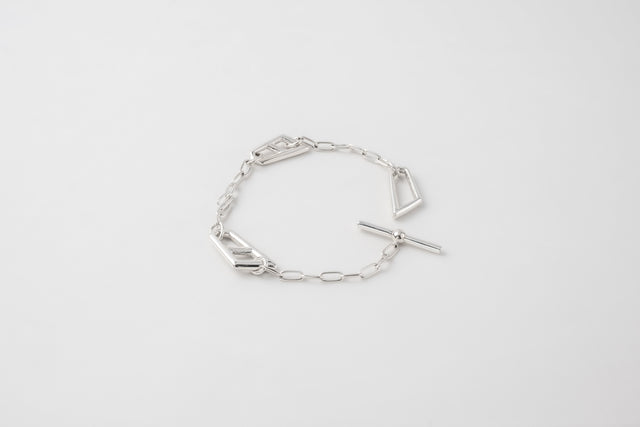
One layer from the STRUGA catalog — the Small Beads with Heart Bracelet.
STRUGA stacking philosophy. Architectural pieces designed to anchor a set rather than disappear into one. Living Silver objects worn side by side develop coordinated patina. The whole becomes more cohesive over months.
Frequently asked questions
Didn’t find the answer — write to us, we reply personally.
Ask a question →01Is stacking just wearing more jewelry?+–
No — it is a hierarchy, not a quantity. Without one dominant anchor piece and lighter supporting pieces, more pieces read as visual noise rather than a styled look. 5+ rings per hand or 4+ bracelets per wrist reads as collection display, not an outfit.
02Is Living Silver the same as oxidized silver?+–
No. Oxidized silver is darkened deliberately during the work; Living Silver is silver left to darken on its own from air and skin. Worn side by side, bright polished, oxidized and Living Silver give three finishes of one metal — that spread is what keeps a stack from reading as uniform.
03Can you mix silver and gold in one stack?+–
Yes, if one metal leads — roughly two thirds of the visible volume — and the other stays an accent. The dark architectural stack this guide covers works differently: it stays inside the silver family and varies the finish rather than the colour. Both are valid; they are different registers, not right and wrong.
04Should rings sit tightly against each other?+–
No. Stacked rings should touch but not pinch — allow 1–2mm of space at rest. Pinching causes discomfort and uneven wear on the silver, and over-stacking (5+ rings, 4+ bracelets) works against the look rather than for it.
05How many rings should I wear per hand?+–
1–2 for daily wear, 3 for considered styled looks, 4+ for deliberate fashion-forward statements. Going past 3 requires confidence that the look is coherent rather than over-decorated.
06How do you combine pieces with stones?+–
One stone-set piece per area max. Several stones together tend to compete, especially with strong colors (raw tourmaline, aquamarine). Plain bands and stone-set pieces work well together.
07Is stacking better for women or men?+–
Both, but the conventions differ: men's sets usually run 1–2 pieces per zone, heavier each; women's run more tiers, lighter each. STRUGA does not split objects by gender — sizing goes by the body. Detail by audience: layering men's jewelry and layering silver for women.
08Should stacked rings be the same width?+–
No — different widths usually read as more deliberate. Two thin bands side by side look careless; one wide band next to one thin band looks composed. Width is the second scale lever after weight, and it works even when both rings weigh the same.
09Can you combine pieces from different brands?+–
Yes if they share design language. STRUGA objects sit well next to Werkstatt:München, Parts of Four, and similar architectural brands. Less well with brands from the gothic-ornamental tradition.