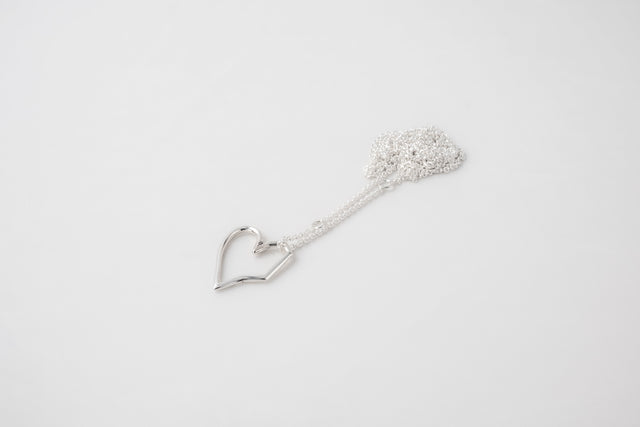
How to Stack & Layer Jewelry
Stacking means wearing several pieces together: rings in a stack, an ear cuff with a stud on one ear, chains in layers by link size. The word is new; the habit is old — people have always worn more than one piece at once.
A stack is built by mass and by tone: one large piece anchors the look, thinner and smaller pieces balance it.
The catalog gives the mass to build with: silver ear cuffs 0.5–3.8 g, rings 2.1–11 g, chains 11–80 g, bracelets 2–95 g — the heaviest piece is the anchor, the rest goes lighter.
The silver in STRUGA pieces is uncoated 925 — Living Silver — so pieces of the same metal settle into a shared dark tone over time.
Chains layer by length and link size: the finer link shorter and higher, the larger link longer and lower, with a gap so the layers do not tangle.
An ear cuff holds along the edge of the ear and pairs with a stud in the lobe — an asymmetric stack on one ear.
A stack does not have to be symmetrical: a single earring on one ear and a pair on the other is a combination, not a mistake.
What stacking is
Stacking, also called layering, is when the body carries not one piece but several together. Rings sit in a stack on one finger or spread across the hand. An ear cuff and a stud meet on the same ear. Chains lie in layers: the short one higher, the long one lower. The point is not the count.
It is how the forms argue and agree with each other — thin next to massive, smooth next to faceted, light silver next to dark. A stack is assembled, not piled on.
Four places on the body carry a stack: the ear, the hand, the neck, the wrist. STRUGA makes 16 ear cuffs, 9 rings, 5 chains and 14 bracelets for them, and the mass runs from 0.3 g in a carbon ear cuff to 95 g in a bracelet. The whole assembly lives between those two numbers.
Why STRUGA forms stack
STRUGA's architectural forms are built to combine from the start. Ear cuffs hold along the edge of the ear and sit next to a stud — on one ear they gather into a stack. Rings stack by mass: a flat top under a massive statement ring, a thin band under a wide one. Chains layer by link size — the large link lower, the finer one higher.
Three families carry most of a stack, and they are built to meet: BLADE gives the flat cut and the link, THORN the spike and the point, BRUTALISM the heaviest mass — 9.6 g in a ring against 2.1 g in a thin band.
One thing runs through all of it: uncoated 925 silver, Living Silver. Pieces of the same metal settle next to each other without a fight — edges lighten, recesses go to graphite, and over time a stack arrives at a shared tone. Dark next to dark, not a random set.
What goes with what
Several STRUGA forms answer the "how to combine" search — each with its own node and its own collection. Where to build a stack from:
- Ear: an ear cuff along the edge of the ear plus a stud and a hoop — an asymmetric stack on one ear. See ear cuffs and earrings.
- Hand: rings in a stack — a statement ring with mass at the base, a thin band above. See rings.
- Neck: chains in layers by link size — the finer link shorter and higher, the large link longer and lower; a choker is always the top layer. See necklaces, chain weaves and chains.
- Wrist: a chain bracelet next to a rigid cuff — a flexible link and a sculptural object on the same arm. See bracelets and the bracelets collection.
One rule across every place: build by mass and by tone. The largest piece anchors the look, the small ones balance it. Easiest to gather it all from one window — all items in one place.
How to build a stack
Start with an anchor — one large form the rest is built around: a statement ring on the hand, an ear cuff on the ear, a heavy chain on the neck. Then add finer pieces, one at a time, until it is enough.
Keep the tone on dark silver: pieces of the same uncoated 925 settle next to each other. Each size is matched separately — the width of a ring to the finger, the length of a chain to the neck, the fit of an ear cuff to the edge of the ear. A stack does not have to be symmetrical: a single earring on one ear and a pair on the other is also a combination, not a mistake.
In short
Four places on the body, four anchors, and the mass each stack is built from — the numbers come from the STRUGA catalog, not from a style rule.
| Place | Anchor | On top | Mass in the catalog |
|---|---|---|---|
| Ear | Blade Ear Cuff (L), 3.8 g | Thorn Stud, 2.92 g | Cuffs 0.5–3.8 g |
| Hand | Brutalism V.1 Ring, 9.6 g | Signature Links V.2, 2.1 g | Rings 2.1–11 g |
| Neck | Long Signature Chain, 35 g | Thorn Links Chain, 11 g | Chains 11–80 g |
| Wrist | Signature Links Bracelet, 15 g | One Display Techno, 2 g | Bracelets 2–95 g |
One metal runs through all four: uncoated 925 silver. Size is matched piece by piece — ring size, chain length, ear cuff fit, wrist. Built step by step in one place — the journal goes deeper: ear stacks, stacking rings, bracelet stacks and necklace layering.
Frequently asked questions
Didn’t find the answer — write to us, we reply personally.
Ask a question →01How do you combine jewelry pieces with each other?+–
By mass and by tone. Pick one large piece as the centre, then add thinner and smaller ones around it. Keep the silver in one register — dark to dark. At STRUGA it is simpler: the silver is uncoated 925 throughout, so the forms settle next to each other.
02How do you wear several rings at once?+–
Stack them by mass: a massive statement ring at the base, a thin band above, or several rings across different fingers of one hand. Each width is matched to its own finger. See STRUGA rings in the rings collection.
03Can you wear an ear cuff and a stud on the same ear?+–
Yes — that is what ear cuffs are for. The cuff holds along the edge of the ear, the stud sits in the lobe; together they make an asymmetric stack on one ear. The other ear can stay with a single earring.
04How do you layer chains so they do not tangle?+–
By length and link size: a short chain higher, a long one lower, with a gap between them. The large link goes lower, the fine one higher. That way the layers read separately instead of knotting into one.
05Does a stack have to be symmetrical?+–
No. Asymmetry is a working choice: a single earring, different stacks on each ear, rings on one hand only. Symmetry calms the picture, asymmetry brings it alive — the choice belongs to whoever wears it.