Types of Men's Silver Bracelets — Widths, Links, and What They Signal
Nine in ten adult men have a wrist between 16.2 and 19.1 cm — measured across 4,082 soldiers in ANSUR II. Bracelet width follows that number, not the model: our fourteen bracelets run from 2 to 130 g. What actually matters when you pick one: width and weight against your wrist, what a heavy chain says versus a thin one, the link styles that have stood for centuries, and why sterling silver — not steel, not gold — is the metal that ages with you. Built from the questions men routinely ask in the Bali workshop, and from the measured weights of every bracelet we make.
Updated August 29, 2026
Width follows the wrist, not the photograph: 6–9 mm under 16 cm, 8–12 mm at 16–18 cm, 12–18 mm above. Nine in ten adult male wrists sit between 16.2 and 19.1 cm.
Weight carries the signal: under 15 g reads as an accent, 25–50 g as the everyday middle, over 50 g as a statement.
Link style is the second layer — Cuban reads heritage, Figaro classic, rope traditional, brutalist architectural.
How tight should a men's bracelet be?
A men's bracelet should sit snug but not tight: loose enough to rotate and slide about a centimetre, snug enough that it never slips over the hand. The practical test is one finger between the bracelet and the wrist, and no more. Too tight and it digs in every time the wrist flexes; too loose and it spins and catches on sleeves.
- Chain or link bracelet. Wrist measurement plus 1.5–2 cm, so the links drape rather than bind.
- Cuff or bangle. Wrist measurement plus about 1 cm.
- Reference point. The average adult male wrist measures 17.6 cm, and nine in ten fall between 16.2 and 19.1 cm (ANSUR II, 4,082 men measured).
The full sizing guide works through length and fit; the wrist-to-width numbers are in the table below.
The men’s silver bracelets collection holds thirteen of the fourteen models. In the everyday weight middle sits Big Beads with Capsule at 34.4–50 g; the heavy end of the whole line is held by Carabiner #2 Big Cross at 95–130 g.
Why silver rather than steel or gold?
Three metals dominate men's bracelets and they are not equivalent. Sterling silver — 92.5% silver, the balance usually copper. It carries weight without clumsiness, takes a personal patina from skin chemistry, and is hypoallergenic in the alloy form most men can wear. The 925 floor has been law in England since 1300, when Edward I fixed it by statute (Assay Office London); in the US the same floor is held by 16 CFR § 23.5.
| Metal | Ages on the wrist | Relative cost per gram | Reads as |
|---|---|---|---|
| Sterling 925 | yes — takes a personal patina | baseline | taste |
| Stainless steel | no — identical after five years | below silver | uniform, tactical |
| 14k gold | barely | many times silver | price, before the man speaks |
Steel is dead metal on the wrist: it takes no patina and does not respond to the wearer, which is a virtue in uniform and rarely anywhere else.
The third advantage never appears on a spec sheet: uncoated silver records the wearing. A bracelet worn for three years carries a face; a steel one carries nothing. Which of the two actually lasts longer, and how silver compares with gold, white gold and platinum, are each answered in full elsewhere.
What width and weight suit your wrist?
The commonest mistake on a first silver bracelet is choosing width by eye instead of by wrist: a 14 mm chain looks heroic in a product photo and absurd on a 15 cm wrist. Measure with a soft tape just above the wrist bone, snug but not tight, and read across.
| Wrist circumference | Width range | Weight target | Reads as |
|---|---|---|---|
| under 16 cm. | 6-9 mm | 15-25 g | refined, quiet |
| 16-17 cm | 8-11 mm | 25-40 g | balanced, classic |
| 17-18 cm | 10-14 mm | 35-55 g | masculine, present |
| 18-19 cm | 12-16 mm | 50-80 g | strong, statement |
| 19-21 cm | 14-20 mm | 70-120 g | commanding, hero |
The table is the safe centre, not the only choice: a 17 cm wrist carries a 16 mm chain if the arm supports it, and a 19 cm wrist can wear 7 mm out of restraint. Weight matters more than men expect. A 15 g bracelet feels like jewellery; a 60 g one feels grounding, settles into the wrist within fifteen minutes and then goes unnoticed, while lighter silver moves and catches more. The full sizing guide covers length, fit, and how a stacking piece should differ from a solo bracelet.
Link styles and what they mean
Five link families dominate men's silver bracelets. Each one has a meaning that has been earned over decades of how men actually wear them.
- Cuban link. Tight interlocking ovals, shaped by Cuban goldsmiths in Miami in the seventies — not on the island itself — and made an American hip-hop signature in the eighties. A Cuban link reads heritage and confidence. The flat-back versions sit closer to the wrist; the rounded versions catch more light. Width 8–18 mm is the sweet spot. We do not make one: the Cuban form is the market default, and our own link work runs through BLADE instead.
- Figaro chain. Three small ovals between one elongated oval, the rhythm Italian. Reads classic and slightly retro — the bracelet your grandfather might have worn. Figaro stays balanced at narrower widths (5-10 mm) where the rhythm is visible. Heavier Figaros lose the syncopation.
- Rope chain. Two strands of small circles twisted into a spiral, looking like a literal rope. This is the oldest mainstream men's chain — present in Mediterranean jewelry for over two thousand years. Reads tradition and Catholic-Mediterranean heritage. Rope chains catch more light than any other style because of the twist.
- Snake chain. Tight rounded segments that move like the namesake, and polished, snake-skin texture. Reads refined and minimalist — closer to a watch strap than a chain. Best at 4-7 mm; wider and they look mechanical.
What replaced the chain for men who left chains behind?
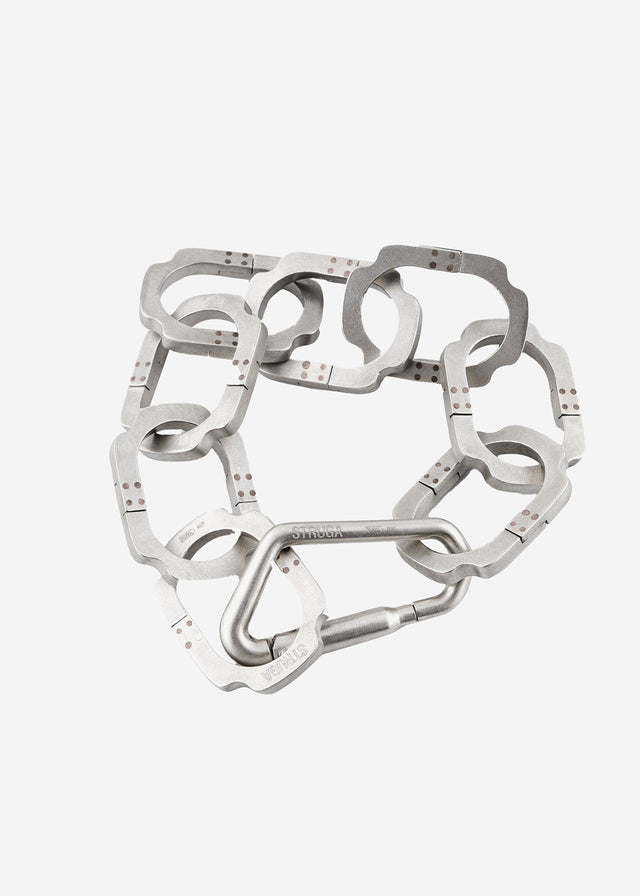
- Brutalist and architectural. Modern men's bracelets that abandon the chain entirely — solid bands, asymmetric forms, sculptural silver. Reads architectural intent, and the wearer is signalling design literacy, not heritage, and our brutalist bracelet line belongs here: weight without ornament, form following function. This is the style most men in their thirties land on after they have outgrown chains.
- ID bracelet. Flat plate on a cable or curb chain, sometimes engraved, and reads identity-stating. Was the seventies men's standard, fell out, returned in the 2010s as both throwback and hip-hop reference. Best worn solo, never stacked.
What chunky versus minimalist signals
The width and weight of your bracelet say more about you than the metal does. A man who walks into a room with a 16 mm Cuban chain on his wrist has chosen to be observed. A man with a 5 mm rope chain has chosen to be felt only at handshake distance. Neither is more correct — they are different signals.
- Chunky (12-18 mm, 50-100 g). Reads confidence, presence, statement, and works on broader wrists, tailored sleeves, masculine silhouettes. Reads less well in academic, surgical, or financial-conservative contexts; pair with a watch on the other wrist or wear solo.
- Mid-weight (8-12 mm, 25-50 g). The default men's bracelet, visible but not declarative. Pairs with watches, suits, casual wear; the least risky choice and the most common.
- Minimalist (4-7 mm, 8-20 g). Reads refined, design-literate, intentional. Frequently the choice of architects, designers, and men who already wear a watch and rings and want a third quiet piece. Stacks easily.
Most men own two bracelets in their lifetime: one mid-weight workhorse for everyday wear, one statement piece for occasions when restraint is the wrong move. A few men own three — adding a minimalist for stacking with the workhorse. Almost no one needs four.
Which wrist should a man wear a bracelet on?
The traditional arrangement puts the watch on the left and the bracelet on the right, so the two never compete and the bracelet does not catch on the crown. It still works for most men. Two exceptions matter. Men who no longer wear a watch have no rule at all, and many find the left wrist — where the watch used to live — feels more natural. Stack-wearers break the one-wrist rule entirely, and our stacking guide covers that case in depth. Cultural readings exist and are weaker than men assume: the right hand is the giving hand in several traditions and reads outward, the left receives and reads inward, Hindu and Buddhist habits favour protective amulets on the left, Catholic and Orthodox ones lean right. None of it is binding.
What does the combination signal to other men?
Like rings read by finger, a bracelet is read in context, and the reading happens in seconds at a handshake:
- Bracelet alone. Discipline — the man chose one piece and stopped.
- Bracelet with a watch on the opposite wrist. Balance between work and personal expression.
- Bracelet with rings. Metal literacy — the coordination is deliberate rather than accidental.
- A stacked wrist, two or three pieces. Ease with self-display; the man is past asking permission.
Weight reinforces whichever signal is being sent. A heavy bracelet beside a plain watch reads traditionally masculine, a light one beside an elaborate watch reads design-aware, and a brutalist piece worn with no watch at all reads architectural.
Is a STRUGA bracelet oxidised, or is it living silver?
Two words are used for dark silver and they do not mean the same thing. Oxidising is a bench technique — the piece is darkened during finishing and arrives dark. Living Silver is a property — the piece arrives bright and the wearing darkens it. Our bracelets are the second kind. Of the fourteen bracelets in the catalogue, thirteen leave the bench in bright 925 and one carries a graphite finish; none is blackened at the bench. Deliberate oxidising lives in our earrings and amulets, not on the wrist.
Bright silver ages the same way for everyone only inside a display case. On a wrist, the pH of your skin, sweat, oils and the rings on the same hand write the surface over the first six months. After a year the bracelet carries a face no other copy has. That is the whole argument for uncoated metal: a plating would freeze the piece at day one.
What does each STRUGA bracelet actually weigh?
The weights below are measured on finished pieces, not estimated from renders. The line runs from 2 g to 130 g.
| Family | Bracelets | Measured weight | Finish |
|---|---|---|---|
| BLADE | 5 | 13–95 g | Living Silver |
| SIGNATURE ASYMMETRIC | 4 | 13–130 g | Living Silver |
| THORN | 2 | 5–95 g | Living Silver |
| EXPERIMENTAL | 1 | 34.4–50 g | Living Silver |
| SIGNATURE HEART | 1 | 17–21 g | Living Silver |
| CARBON / MOSAIC | 1 | 2 g | graphite |
Five models sit under 15 g, so a light bracelet here is a real choice rather than a compromise, while Brutalist Bracelets hold the heavy end at 13–130 g and CODEX bracelets stay at 15–21 g.
How long does a silver bracelet actually last?
A sterling silver bracelet worn every day outlives the man's interest in it. Sterling is a working alloy, not a display one: the metal does not wear out on a wrist, and the part that fails first is the catch. The oldest pieces we service come back for a clasp, never for the body of the bracelet.
Care is close to nothing. Clean it occasionally if you want it bright, or leave it alone if you want the patina to deepen; it will tarnish slightly in air and that is not damage. One rule outranks the rest: never store silver against rubber bands or wool, because both accelerate tarnish sharply. Our cleaning guide covers what strips a patina in seconds — silver dip being the fastest way to undo years of wear.
Which STRUGA bracelet fits the signal you want?
How do you choose a first silver bracelet?
Three steps in order get most men to the right piece without backtracking.
- Measure the wrist. Soft tape, or a string held against a ruler, plus 1.5–2 cm — that gives both the length and the width range from the table above.
- Pick the signal. On a first bracelet, balanced (8–11 mm, 25–40 g) beats statement; the heavy pieces work better as a second purchase.
- Pick the form last. Brutalist pieces and solid bands age slowest, because they do not date the way chain styles do.
- Never choose by photograph. A bracelet looks heavier in a product shot than it feels, and lighter on a model than it weighs. Read the gram weight and trust it.
Which piece matches which weight?
Choose by weight first, because weight is what the wrist feels and what a photograph hides. Asymmetric Minimalist at 14–15 g is the quiet end. Blade Medium Links V.2 at 17–20 g is the everyday middle. Blade Mini Links at 50–62 g is present without shouting. Blade Big Links at 85–95 g is the declarative end.
Which family does each form belong to?
By family: BLADE holds the link-driven forms, SIGNATURE ASYMMETRIC the off-balance silhouettes the brand started with, and THORN the pieces that are felt through the fingers before they are seen. Most of them belong to the CODEX world. The wider metal story sits in our oxidised silver bracelet hub, and the complete sterling silver jewelry guide sits beneath everything we make.
If this is your first silver bracelet, the workhorse choice is something around 12 mm and 40 g — visible but not declarative, balanced for most wrists, ages well, stacks well later. From there men either go quieter (refined second piece) or louder (statement piece). Almost no one regrets starting in the middle.
About STRUGA. STRUGA is a dark silver jewelry brand founded by Dmitry Strugovshchikov and Ekaterina Strugovshchikova, handcrafted with Balinese and international silversmiths. Most pieces are 925 sterling silver without rhodium plating — the surface is left exposed, so it keeps changing on the wearer. Most of the catalogue darkens on its own; a smaller part is blackened at the bench. It is a brutalist object that reacts and transforms through contact with the environment and the wearer.
Continue from STRUGA catalog:
The same choice without the address: bracelets by construction, width and material.
Frequently asked questions
Didn’t find the answer — write to us, we reply personally.
Ask a question →01Is oxidized silver the same as silver that has tarnished with age?+–
No. Oxidising darkens a piece deliberately at the finishing stage; age tarnish is the slow, uneven film that builds on untreated silver in air. STRUGA bracelets are not blackened at the bench — they leave bright and darken on the wrist, which is Living Silver: a property of uncoated metal, not a finish applied to it.
02Is a heavier silver bracelet a worse everyday piece?+–
No. A 60 g bracelet settles into the wrist within about fifteen minutes and then goes unnoticed, while a 15 g piece moves and catches more. STRUGA bracelet weights are measured on finished pieces: the line runs from 2 g to 130 g, and five models sit under 15 g.
03Is sterling silver the same as fine silver?+–
No. Sterling silver is 92.5% silver, the balance usually copper; fine silver is nearly pure. The copper is what makes sterling harder and rigid enough for everyday wear, where fine silver would be too soft. Sterling is also the alloy most men can wear without a skin reaction.
04What size silver bracelet should a man wear?+–
Match width to wrist circumference: under 16 cm wears 6-9 mm, 16-18 cm wears 8-12 mm, 18-21 cm wears 12-18 mm. Add 1.5-2 cm of comfort fit beyond the measured circumference, and 18.5-20.5 cm finished length.
05Is sterling silver good for men's bracelets?+–
Sterling silver is the standard everyday-wear metal for men's bracelets. It is harder than fine silver (the copper alloy adds rigidity), develops personal patina, costs a fraction of gold, and is hypoallergenic for nearly all wearers. Steel and titanium are alternatives but they do not age — sterling silver does, and that is the point.
06Which wrist should a man wear a silver bracelet on?+–
Traditionally the right wrist, with a watch on the left, so the two pieces do not compete. Men who do not wear a watch can use either wrist, and stacked wrists (multiple pieces) break the rule entirely. Cultural readings (left for receiving, right for giving) are weak signals — choose by what feels balanced.
07What does a silver bracelet say about a man?+–
Width and weight do most of the talking, and chunky (12-18 mm, 50-100 g) reads confidence and presence. Mid-weight (8-12 mm, 25-50 g) reads balanced and classic; minimalist (4-7 mm, under 20 g) reads refined and design-literate. The link style adds the second layer: Cuban heritage, Figaro classic, rope traditional, brutalist architectural, ID identity-stating.
08How heavy should a men's silver bracelet be?+–
Match weight to presence: 15-25 g for refined everyday wear, 25-50 g for the standard masculine workhorse, 50-100 g for statement pieces. Under 15 g the bracelet reads as an accent rather than an anchor. Anything over 120 g needs a wrist of 19 cm or more to wear without imbalance.