How to Wear Dark Jewelry Every Day — Styling Guide
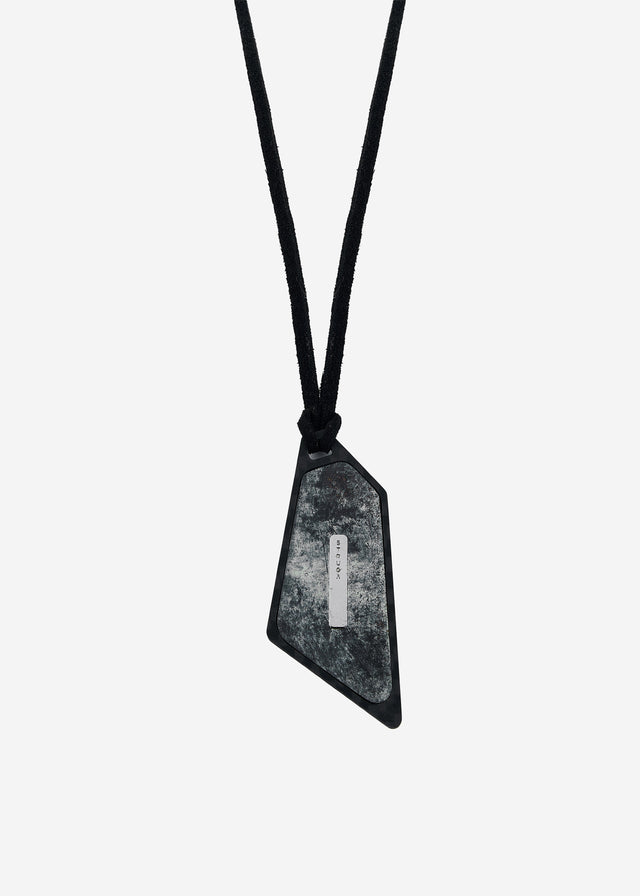
Wearing dark jewelry every day is not a styling problem, but a math problem: pick one focal point and keep everything else quiet. Oxidized silver isn't a costume reserved for concerts or full goth looks — it's a single architectural piece read against a neutral palette (black, white, grey, navy, olive), worn daily until the patina makes it yours.
Updated September 28, 2026
- Dark minimal jewelry is architectural 925 silver in an oxidized or Living Silver finish — one focal piece against a neutral palette.
- One rule: a single focal point, everything else quiet.
- The everyday set is five pieces: anchor ring (2–6 g; a BRUTALISM ring reaches 24 g), statement bracelet (median 21 g), mono earring, pendant, second ring.
- Patina is the point: recesses deepen, high points brighten.
Dark jewelry has a reputation problem. People think it's "too much" for daily wear — reserved for concerts, parties, or full-on goth outfits. That's outdated thinking. The dark is not a coating either: it is silver sulfide, growing on the metal out of the 86–600 parts per trillion of hydrogen sulfide that ordinary indoor air carries. Here's how dark silver works with any wardrobe, every day.
What are the two rules of wearing dark jewelry daily?
Two rules cover nearly every decision you will make in the morning, and both are about restraint rather than taste.
One focal point. Pick a single piece to carry the look. A bold brutalist ring with a plain white tee. A silver choker with a simple black dress. One piece commands attention; stacking everything at once creates noise. The rule holds because dark silver reads as silhouette rather than sparkle — two silhouettes on one body compete, and the eye settles on neither.
A neutral palette. Oxidized silver pairs naturally with black (obvious), white (high contrast, very clean), grey (tonal, low contrast), navy (unexpected but excellent), and olive or khaki (military-inspired edge). Bright colours compete with dark metal: neon and oxidized silver is a clash, not a contrast. The reason is physical — a patinated surface reflects little light, so it needs a quiet background to hold an edge. Against a saturated colour the metal reads grey and flat.
Where can you wear dark jewelry — office, weekend, formal?
The pieces do not change between contexts — the number of them does. This is the whole adjustment, and it takes one decision at the door.
| Context | What works | What to leave at home |
|---|---|---|
| Conservative office | one anchor ring; a bracelet under the shirt cuff; ear cuffs (no piercing needed), a thin oxidized chain, pin earrings | statement bracelet, visible pendant, stacked rings |
| Casual and weekend | stack rings, add a cuff bracelet, wear larger earrings; dark denim with a THORN piece | nothing — this is the context the collection is built for |
| Formal events | one SIGNATURE piece with a tailored suit or a little black dress | the matching-set instinct — a coordinated trio reads weaker than one strong piece |
| Gym, sport, swimming | nothing | rings against bars and weights deform the metal and pinch skin; chlorine and sweat accelerate patina unevenly |
For him the office version is usually the ring alone, with the bracelet hidden under a cuff. For her it is ear cuffs or pin earrings, which read as deliberate rather than decorative. In both cases the piece is noticed on the second look, not the first — which is exactly what a conservative room allows. On a weekend the same logic runs in reverse: a THORN piece against dark denim is the one loud thing in an otherwise plain outfit, and it does the work of three.
Why does dark silver look better the longer you wear it?
Here is what makes dark silver suited to daily wear specifically: it improves with use. Oxidized silver deepens the contrast in its recesses while the high points naturally brighten against skin and fabric. Your daily wear is producing a finish nobody else has.
Two practical consequences follow. First, do not polish the whole piece — a full polish strips the darkened recesses and flattens the drawing back to plain silver. Before an event, wipe only the raised surfaces with a soft cloth — that is the contrast the design was cut for. Second, a piece worn every day ages more evenly than one kept in a box. Silver in storage still reacts with sulfur in the air, but uniformly and dully, without the bright high points that contact with skin and cuffs produces.
A 24 g Brutalism V.3 ring shows this faster than a thin band: more surface, more recesses, more contrast to gain.
Start with one piece. Wear it for a week. You will wonder why you ever thought dark jewelry was «too much».
How do you build a five-piece daily set?
Dark minimal jewelry as everyday wear works when the pieces fit alongside your existing wardrobe and lifestyle without forcing changes. The goal is not building a fashion-show collection — it is building a small, coherent set of pieces that you actually reach for daily. The anchor ring usually comes out of CODEX, the world of everyday architectural form; pieces that are oxidized from the start belong to RITUAL. Building the set deliberately takes 1–2 years; the gallery tier of the same aesthetic (Werkstatt:München, Parts of Four) sits several times above it, and the look itself does not require that tier.
The five-piece foundation
A complete daily-wear dark minimal collection typically has five core pieces. More than this, and pieces start competing with each other; less than this, and the collection feels incomplete.
- One anchor ring. The piece you wear daily. Architectural form, oxidized 925 — 2–6 g across the SIGNATURE rings, up to 24 g if you want the weight of BRUTALISM. The visual anchor of the collection.
- One statement bracelet. Heavier piece — the catalogue median is 21 g, and the big BLADE and carabiner links run 95–130 g. Worn for evening or specific occasions, single, not stacked.
- One mono earring or ear cuff. Asymmetric placement reads as deliberate. Worn alone or paired with a small stud on the other side.
- One pendant on chain. Light architectural pendant. Worn under or over layered tops.
- One alternative ring for the secondary hand or for variety. Smaller or different design from the signature ring.
How do you wear dark minimal where the dress code is conservative?
Most professional and social environments don't share the dark minimal aesthetic. The pieces still work, but require careful integration.
- Conservative office. One piece only — usually the signature ring. Skip the statement bracelet and visible pendant. The single piece reads as personal style without disrupting professional norms.
- Casual social settings. Two pieces — signature ring plus mono earring or statement bracelet. Adds visual interest without overwhelming.
- Travel. Sub-set the collection to two or three durable pieces. Avoid the statement bracelet (risk of damage) and stone-set pieces (risk of loss).
- Formal events. Signature ring plus minimal pendant. The dark aesthetic adapts to formal contexts when reduced to one or two pieces; full collection is too informal.
- Active sport / gym. Take everything off. Even daily-wear pieces benefit from being removed for heavy sweat or impact contexts.
What changes compared with conventional jewelry?
- The pieces become more visible. A heavy oxidized ring is read at distance more than a thin gold band. Dark minimal pieces draw attention; conventional pieces blend in.
- Wardrobe choices interact more. The pieces look different against different colors and textures of clothing. Long-sleeve coverage hides bracelets; v-necks emphasize pendants.
- Patina becomes a thing. Living Silver pieces visibly age. The collection looks different at year three than at year one. Some wearers love this; others want consistency.
- Repairability matters more. The pieces are designed for long lifetimes, but they need periodic refinishing. Plan for this in budget and time.
None of this is a reason to hesitate, and all of it is a reason to own fewer pieces and wear them harder. A conventional jewelry wardrobe works by variety; this one works by repetition — the same ring for years, recording that time on its own surface.
What is actually happening to the metal?
The dark surface is a compound, not a coating. Tarnish on pure silver is silver sulfide (Ag2S); on sterling silver it also contains copper sulfide (Cu2S), because the alloy carries 7.5% copper alongside the 92.5% silver. The reaction is driven by hydrogen sulfide, measured indoors at roughly 86–600 parts per trillion, and at the same concentration silver darkens faster as relative humidity climbs (Canadian Conservation Institute). Sulfur compounds are the strongest tarnishing agents in ordinary indoor air, and they come from burning fuel as much as from foam rubber, carpet padding, paint, wool and felt (NPS Museum Handbook, Appendix O).
Two consequences matter for daily wear. Freshly polished silver tarnishes faster than silver that has already darkened — the bright surface is the reactive one, which is why a piece left alone settles into an even tone instead of a patchy one. And a piece worn in a humid climate darkens sooner — the same concentration of gas does more work in damp air. Neither is damage. It is the surface finding its level.
What should you never do to an oxidized piece?
Four habits shorten the life of a dark finish, and all four are done with good intentions.
- Do not polish the whole piece. Cleaning and polishing remove original metal, and intense treatment strips information from the object. On an oxidized piece that information is the drawing itself — the darkened recesses.
- Skip dip solutions and ultrasonic baths. They work indiscriminately, and metal cleaners can leave chemical residues that generate further corrosion.
- Do not store silver against rubber, felt, wool or carpet padding. Those materials give off sulfur — the tarnishing agent itself.
- Store it dry. Below roughly 50% relative humidity the reaction slows down; a closed drawer in a humid bathroom does the opposite.
What to do instead
It takes a minute: before an event, wipe only the raised surfaces with a soft cloth and leave the recesses alone. That contrast is what the form was cut for.
About STRUGA. STRUGA is a dark silver jewelry brand founded by Dmitry Strugovshchikov and Ekaterina Strugovshchikova, handcrafted with Balinese and international silversmiths. Most pieces are 925 sterling silver left uncoated, so they darken with wear; part of the range is oxidized at the bench. The darkening is part of the design. It is a brutalist object that reacts and changes through contact with the environment and the wearer.
Frequently asked questions
Didn’t find the answer — write to us, we reply personally.
Ask a question →01Is dark minimal jewelry the same as black/gothic jewelry?+–
No. Dark minimal jewelry is not black-plated costume or full-goth styling — it's architectural 925 silver with an oxidized or Living Silver finish, worn as one focal piece against a neutral palette. The darkness is the surface treatment of the metal, not a coating added to look 'goth'.
02Is oxidized silver good for everyday jewelry?+–
Yes. Oxidized silver is not a fragile finish that wears off into a defect — daily wear deepens the contrast in the recesses while high points naturally brighten. The everyday use is what creates the one-of-a-kind patina, not what ruins it.
03Is dark minimal jewelry only for men?+–
No. Dark minimal is not gendered — the same five-piece logic (signature ring, statement bracelet, mono earring or ear cuff, pendant, alternative ring) applies to anyone. For her, ear cuffs need no piercing; for him, a single dark ring under a cuff reads as professional. The piece is chosen by form and weight, not by gender.
04How long does it take to build a five-piece collection?+–
Realistic timeline is 1–2 years if you buy pieces deliberately. Buying all five at once is possible but you lose the iteration of «I wore the first piece for 6 months and learned what I want next.»
05What's the typical investment?+–
The storefront names the total: prices on strugadesign.com are shown in USD, and a five-piece set adds up from the current prices of the specific families. The gallery tier (Werkstatt:München, Parts of Four) sits several times higher. The aesthetic does not require the higher tier; the choice is about specific brand preferences.
06Can I mix dark minimal with my existing jewelry?+–
Possible but the result depends on the existing pieces. Mixing dark minimal with conventional gold jewelry usually fights aesthetically. Mixing with other dark/architectural pieces works better.
07Will dark minimal date out of style?+–
The aesthetic has been stable for over a decade and continues to grow. Investment in good architectural pieces is reasonably future-proof.
08Can I wear dark minimal in warm climates?+–
Yes. STRUGA pieces are produced in tropical Bali; the metal handles tropical humidity fine. Tarnish accelerates slightly but the metal isn't damaged.
09How does dark minimal differ from conventional minimalist jewelry?+–
Dark minimal uses oxidized or Living Silver finishes; conventional minimalist jewelry uses bright polished silver or gold. The forms can be similar; the surface treatment differs significantly.
10What if I'm new to wearing jewelry at all?+–
Start with one piece. The signature ring is the easiest entry — small, visible, worn daily. Build the rest of the collection over months as you learn what you actually wear.
Continue from the journal to a current STRUGA object: Asymmetric Minimalist Bracelet.