Dark Engagement Rings — Black, Oxidized, and Gothic Alternatives (2026 Guide)
The short answer: a dark engagement ring takes its colour in one of three ways. The silver surface itself turns dark — oxidation or niello; a thin black layer is plated over the metal — black rhodium or ruthenium; or the metal carries its own dark oxide or grey body — zirconium and tantalum. The first is renewed at any silver bench, the second wears at contact points and goes back to the plating bath, the third keeps its tone but is hard to resize.
Updated September 29, 2026
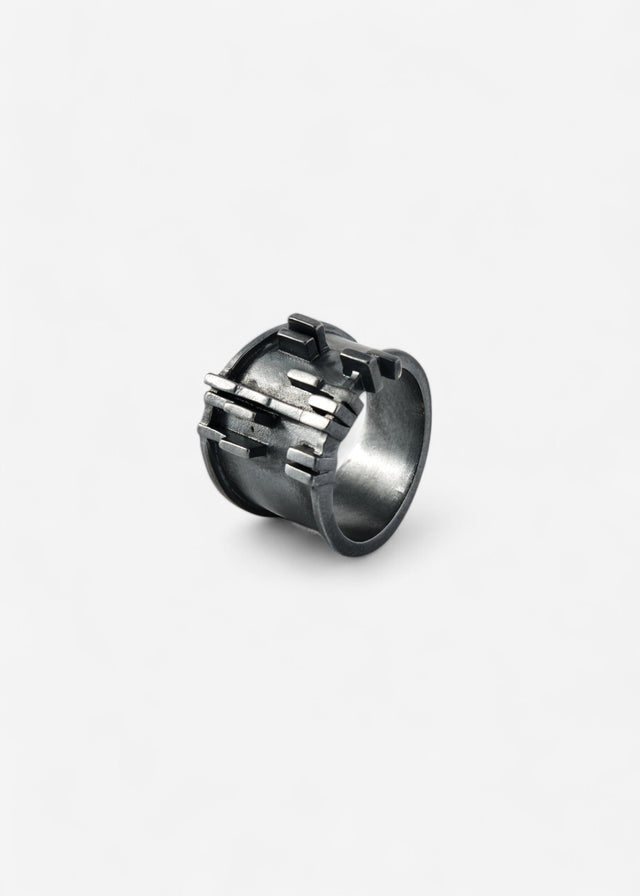
In the STRUGA ring line one ring is blackened at the bench: the Brutalism V.3 Ring, 9.6–24.0 g of 925 silver, $368–$920 by size. The other silver rings leave the bench light and darken on the hand — among them the Thorn Ring, the ring of the DARK UNION family, $181–$488. Both routes are unpacked below, next to the plated and ceramic ones.
Oxidation and niello darken the silver itself; black rhodium and ruthenium are a plated layer; oxidized zirconium grows its own oxide, tantalum is grey all through.
Black rhodium on jewellery is a fraction of a micron thick — about 0.1–0.7 µm by its maker’s data — and it wears at contact points; silver is re-darkened on any silver bench.
Oxidized zirconium keeps its tone but is rarely resized; tantalum resizes only within limits; silver is the easiest to cut, solder and resize.
Soft dark stones — onyx and garnet, 6.5–7.5 on the Mohs scale — ask for a bezel or flush setting; sapphire, moissanite and diamond do not.
What does «dark» mean in an engagement ring?
«Dark engagement ring» names the finish, not the form. A 2 mm band, a heavy architectural piece and a classical solitaire can all be dark: what unites them is the colour of the metal — black, charcoal, graphite or smoke — instead of the white of platinum and polished silver or the warmth of yellow and rose gold. The way the colour is made matters more than its shade, because over years it settles four practical things:
- how the ring ages — a plated layer thins and breaks through, a surface film wears off the high points and stays in the recesses;
- whether it can be resized — silver yes, oxidized zirconium and tantalum hardly;
- what happens to a scratch — on silver it is darkened again, on plating it shows the metal underneath until the next bath;
- what upkeep costs over a decade — nothing, a bench visit now and then, or a plating cycle.
Paint, epoxy and enamel make a ring dark too. For an object worn every day for decades they are the weakest route: coatings chip, and epoxy resin yellows in light through photo-oxidation, which is permanent (Varganici et al., Polymers, 2024). The rest of this guide leaves them aside.
Which ways make a ring dark, and which of them belong to the metal?
One question sorts every route: does the dark belong to the metal, or does it sit on it as a separate layer. The answer decides the ageing, the repair and the upkeep that follow.
| Route | What it physically is | How it ages | Repair and resizing |
|---|---|---|---|
| Oxidized silver | a film of silver sulphide formed on the silver surface | wears off raised faces first, stays in recesses | resized and soldered like any silver, then darkened again |
| Niello | a black sulphide inlay melted into engraved recesses | holds inside the engraving | heat near the inlay needs a specialist |
| Black rhodium, black ruthenium | a plated layer over gold, silver or palladium | wears gradually at contact points; the ring is replated | the worked area shows the metal underneath until replating |
| Oxidized zirconium | an oxide layer grown from the metal itself by heat | keeps its tone; a deep scratch reaches grey metal | rarely resized |
| Tantalum | a naturally blue-grey, very dense metal | grey all through | resizing is limited |
| Paint, epoxy, enamel | a coating over metal | chips; epoxy yellows in light | not suited to a ring worn daily |
Only oxidation and niello make the silver itself dark; plating hides a light metal under a black one; zirconium and tantalum are dark by their own chemistry. That is why the same word «black» on a listing can mean a ring you refresh at a bench, a ring you replate, or a ring you can hardly resize.
How does an oxidized silver ring change with wear?
Silver is oxidized with sulphur compounds — traditionally liver of sulphur. The surface reacts and forms a dark film of silver sulphide; with time, temperature and concentration the colour passes from gold and blue through bronze and grey to black, and a colour forced too fast flakes (Canadian Conservation Institute, Notes 9/7). The film grows more slowly as it thickens but never seals the metal, and polishing or a silver dip removes it (Burstein, Assay Office London).
So friction works on it from the first day: raised faces and the outer side of the band brighten, recesses and textured areas stay dark. This is behaviour, not failure — a ring that lightens on the high points and keeps its depth in the recesses reads as an object with a history. The shape decides how far it goes: on a smooth polished band the dark leaves quickly, on relief and facets it sits where nothing rubs.
Oxidation or Living Silver: which one is a STRUGA ring?
At STRUGA two things carry different names. Oxidation is a technique: the piece is darkened at the bench before it ships. Living Silver is a property: uncoated 925 silver arrives light and darkens by itself through air and skin, recesses first, while friction keeps the raised faces bright. Both are silver without rhodium and both are renewed on a silver bench, but they are bought differently: a blackened ring is dark from the first day, a Living Silver ring becomes dark over months on its wearer. Anyone who wants a tone that barely moves should look past silver altogether, to oxidized zirconium.
How is niello different from oxidation?
Niello is not a film but an inlay. It is a black material of metal sulphides — silver and copper, with lead added in eastern Europe from about the 11th century — melted into engraved recesses and polished flush with the silver around it (La Niece, British Museum, The Antiquaries Journal, 1983). Because the black fills the cut, the drawing stays black while the silver beside it is polished bright.
How can you tell niello from oxidation on a listing?
Oxidation works the other way round: it darkens the whole surface and lets wear decide where silver shows through. Listings often call both «blackened silver». The useful question is where the black lies — in engraved lines, which is niello, or across the whole surface, which is oxidation. For an engagement ring the difference is practical: niello is a drawing that stays fixed, oxidation is a tone that moves with the hand.
How do black rhodium and ruthenium plating behave on a ring?
Black rhodium is rhodium electroplated with a darkening additive over white gold, silver or palladium. The layer is thin: the maker of widely used black-rhodium electrolytes, Umicore, gives about 0.1 µm for pen application and up to about 0.7 µm from a bath (RHODUNA 471, RHODUNA 275). Rhodium builds internal stress as the deposit thickens and eventually cracks, so the layer is not simply laid on thicker.
Is black ruthenium more durable than black rhodium?
Black ruthenium is the second plating route. Its hardness range overlaps rhodium’s — roughly 600–1,300 HK against 750–1,100 HK (Sharretts Plating) — and Umicore offers its black rhodium for work where black ruthenium does not meet abrasion requirements. The popular idea that ruthenium lasts longer on a ring is not supported by the supplier’s own data.
How often does a plated ring need replating?
Either layer wears away gradually and the ring is replated from time to time (GIA). No reliable number of months exists: the rate depends on the thickness, the shape and how the hand works. The point of the route is black over white gold, palladium or silver; the price is a plating cycle, and after a resize the worked area shows the metal underneath until the ring goes back to the bath.
What do zirconium, tantalum and black titanium give — and what do they take away?
Oxidized zirconium is zirconium heated in air until a black zirconium-oxide layer grows from the metal itself — about 1–10 µm, typically around 5 µm (US patent 7,582,117). The ceramic oxide is far harder than the metal and keeps its tone in normal wear, but a deep scratch reaches the grey metal beneath, and makers rarely resize such rings because cutting or stretching breaks the oxide.
What about tantalum and black titanium?
Tantalum is a blue-grey metal, grey all through without any coating, and very dense. Black titanium needs a caution: anodizing titanium gives only interference colours — gold, blue, purple — not a true black, so a black titanium ring owes its colour to another layer, and it is worth asking which one (Xometry).
How heavy is each metal in the hand?
Weight in the hand is set by density — the same form weighs more in a denser metal:
| Metal | Density, g/cm³ | Same ring against 925 silver |
|---|---|---|
| Titanium | 4.51 | about 0.4× |
| 925 silver | 10.40 | 1× |
| 18k gold | about 15.0–16.0, by alloy | about 1.5× |
| Tantalum | 16.69 | about 1.6× |
| 24k gold | 19.32 | about 1.9× |
Densities: Goodfellow for tantalum, Kassoy jewellery density table for the rest. The trade-off of all three metals is the same: permanence of tone against repair — an ordinary silver bench can do little with them.
What makes a ring gothic rather than merely dark?
Colour is only the start. A ring reads as gothic through proportion and reference: weight in the band, an architectural rather than delicate silhouette, kinship with mourning ornament and church metalwork. A thin polished band dipped dark stays simply a dark ring.
| Direction | What you see | Who it suits |
|---|---|---|
| Gothic, ornate | worked surface all over, motifs, dark stones | those who want a clear nod to history |
| Mass and geometry | weight, planes, relief, often no stone | those who want a contemporary statement |
| Minimal | an even dark line 2–5 mm wide | those who want the tone without visual mass |
| Classical, dark | solitaire or halo on a dark band | those who want a familiar form in an unfamiliar tone |
Mourning jewellery is older than the Victorians — the V&A holds pieces from the 17th century on — but black jewellery reached its height after Prince Albert died in 1861 and Queen Victoria’s mourning stretched on for decades; its materials were Whitby jet, black enamel and hair (V&A, jet necklace, about 1875). The architectural line points elsewhere, to mid-century brutalism: exposed concrete, raw steel, deliberate mass. For the wider taxonomy of forms see engagement ring types.
Which stone works in a dark ring?
It is a decision about tone before it is one about hardness. A clear stone reads as contrast: it lifts off the dark band and catches light where the metal stays matte. A black stone reads as depth — stone and metal close into one mass, and the light comes only from the cut.
| Stone | Mohs hardness | How it reads in a dark ring |
|---|---|---|
| Onyx | 6.5–7 | depth, closes into the metal; asks for a sheltered setting |
| Garnet | 6.5–7.5, by species | dark colour with fire inside it |
| Sapphire | 9 | dense tone, takes daily wear |
| Moissanite | 9.25 | strong contrast against matte metal |
| Diamond, including salt-and-pepper | 10 | a familiar stone in an unfamiliar setting |
Hardness by GIA (garnet, sapphire, moissanite). The conclusion is simple: soft dark stones need a bezel or flush setting where the metal edge takes the knocks; black onyx on the market is commonly dyed chalcedony, which is worth knowing before paying for «natural black». In DARK UNION rings STRUGA can set a wild-growth stone or meteorite into the silver of a ring made to a brief, and there the shape of the stone dictates the setting rather than the other way round.
How do you choose a route: repair, even tone, weight?
Most choices come down to one priority, and each priority points to a different route.
| What matters most | Route that answers it | What you give up |
|---|---|---|
| Repair and resizing for decades | oxidized or Living Silver 925 | the tone moves with wear |
| A tone that barely moves | oxidized zirconium | resizing |
| Black over white gold or palladium | black rhodium or ruthenium | a replating cycle |
| Heft in the hand | tantalum, or a heavy silver form | easy repair, with tantalum |
| Lightness | titanium | a true oxide black |
Price follows form and work more than metal: a plain band in any of these costs less than a sculptural one. In silver, weight is the honest measure — the same form in a larger size carries more metal and costs more, which is why STRUGA prices every ring size by size.
How does a dark engagement ring pair with a wedding band?
If the plan is an engagement ring plus a separate band, both are usually dark: a matched pair reads as deliberate, a mixed one as accidental. The Dark Wedding page collects bands for exactly that scenario.
The pair does not have to match in every detail. One ring can be blackened from the start and the other can be Living Silver that darkens on the hand and catches up over months. The two can share one feature — the tone, a repeated edge — and differ in width, weight or stone.
If only one ring is worn, the dark engagement ring is also the wedding ring, and the choice tilts toward a wider piece: a ring carrying both meanings asks for more visual mass. On where it is worn see which hand the engagement ring goes on; on the difference between the two see engagement ring vs wedding ring; for the wider range of options see the guide to alternative engagement rings.
Which dark rings does STRUGA make, and what do they cost?
STRUGA makes rings in 925 silver without rhodium, by hand in Bali. Ready forms are made to order in about two weeks, with delivery worldwide. Weights and prices below are from the catalogue on the day of this revision; with handmade pieces the weight varies a little from one to the next.
| Ring | Surface | Weight | Price |
|---|---|---|---|
| Brutalism V.3 | blackened at the bench | 9.6–24.0 g | $368–$920 |
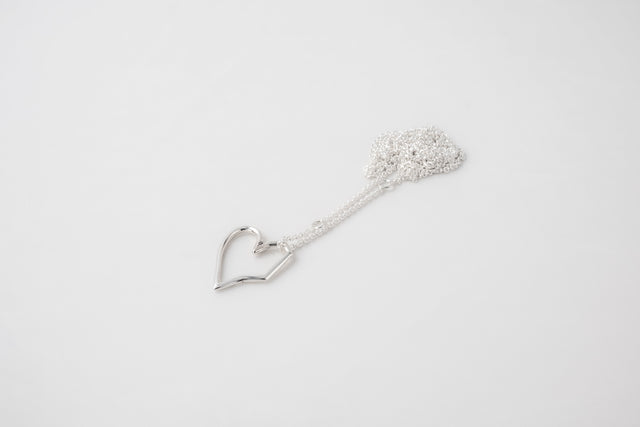
| Thorn Ring, DARK UNION | Living Silver | 4.7–12.7 g | $181–$488 |
| Brutalism V.1 | Living Silver | 9.6–24.0 g | $382–$1,013 |
| Double Line | Living Silver | 6.0–13.0 g | $250–$542 |
The Brutalism V.1 Ring and V.3 are two separate forms of the BRUTALISM family, not two versions of one; both are closed forms with relief across the top and are not resized after they are made, so the size is chosen before production. Every other STRUGA ring gets one free resize, with postage both ways on the owner. The Double Line Ring belongs to the SIGNATURE ASYMMETRIC family. All eight forms of the selection are in dark minimalist rings, and every blackened piece of the catalogue is in blackened silver.
How is a DARK UNION ring ordered outside the catalogue?
DARK UNION is the STRUGA world for engagement, wedding and paired rings. Its ready line is the DARK UNION family, which for now holds the Thorn Ring. A ring outside the catalogue is built for one couple through a brief:
- what you name: the form, the stone if there is one, the surface and the fit;
- what can go into the silver: a wild-growth stone, meteorite or another metal;
- timing: about three to six weeks after the brief is confirmed — a frame, not a date;
- entries by scenario: proposal rings and Dark Wedding.
About STRUGA. STRUGA is a dark silver jewelry brand founded by Dmitry Strugovshchikov and Ekaterina Strugovshchikova and made by hand in Bali by master silversmiths. The silver line is 925 sterling left uncoated, so it darkens with wear; on 17 of the 134 catalogue objects that darkening is done deliberately at the bench. The CARBON line sets other materials into carbon fibre. The darkening is part of the design: a brutalist object that changes through contact with its surroundings and its wearer.
Frequently asked questions
Didn’t find the answer — write to us, we reply personally.
Ask a question →01Is oxidized silver the same as black-rhodium plating?+–
No. Oxidation turns the silver surface itself dark: sulphur compounds form a film of silver sulphide that wears off the raised faces first and is renewed on any silver bench. Black rhodium is a separate plated layer over white gold, silver or palladium — about 0.1–0.7 µm thick by its maker’s data — which wears gradually at contact points and is renewed by replating.
02Is niello the same as oxidized silver?+–
No. Niello is an inlay: a black alloy of metal sulphides melted into engraved lines and polished flush, so the drawing stays black while the silver around it is polished bright. Oxidation darkens the whole surface and lets wear decide where silver shows through. Listings often call both «blackened silver» — ask whether the black lies in engraved lines or across the surface.
03Does black rhodium plating wear off a ring?+–
Yes, gradually, and first where the ring meets objects — the palm side and the edges. The ring is then replated. There is no reliable number of months: the rate depends on the thickness of the layer, the shape of the ring and how the hand works.
04Can a dark ring be resized?+–
It depends on how the dark was made. Silver is cut, soldered and darkened again on an ordinary bench; STRUGA gives each ring one free resize, with postage both ways on the owner, except the Brutalism V.1 and V.3 rings, whose relief does not survive resizing. Plated rings are replated after the work, oxidized zirconium is rarely resized, tantalum only within limits.
05What happens if I scratch an oxidized ring?+–
A scratch shows as a bright line through the dark surface. For many owners it becomes part of the ring’s history; if not, the area is darkened again on a silver bench. STRUGA cleans its pieces and does minor repairs free for as long as the piece is with its owner, with postage to us on the owner.
06Do dark engagement rings work for men?+–
Yes. STRUGA does not divide its objects by gender: size follows the body — form, weight and fit. A wider band and a heavier form read as a man’s engagement ring without any change of finish.
07Are black rings bad luck?+–
No. The idea is folklore, and STRUGA assigns no superstition, protection or fortune to any object: a ring is form, weight, surface and the silver it is made from. Black jewellery did sit at the centre of mourning in the 19th century — likely where the association began — but those pieces were about memory, not misfortune.
08What does a black or gothic engagement ring mean?+–
There is no fixed meaning — the two people who wear it set it. A dark ring reads as a chosen form rather than a default one, and it is a full alternative to the diamond solitaire rather than its opposite: many dark rings carry no stone at all, others hold one, a diamond included.