What Hand Is the Engagement Ring Worn On? Traditions Worldwide
In short.
- Left hand in roughly two-thirds of the world; right hand in the remaining third — neither is more "correct."
- Left-hand tradition: a 2,000-year-old Roman belief about the vena amoris, the "vein of love" from the fourth finger to the heart (the anatomy is wrong; the symbol stuck).
- Right hand is standard for the wedding ring in Germany, Austria, Norway, Denmark, Poland, Greece, and India, and in Eastern Orthodox, many Slavic, and Hindu traditions.
- Stacking order: wedding ring goes on first, closest to the palm; the engagement ring sits above it.
- An engagement ring is symmetric and fits either hand of the same size — the dominant hand is usually slightly larger, so a ring sized for the left may run a half-size small on the right.
- STRUGA includes free resizing within 12 months of delivery; lifetime resizing after that is offered at workshop cost only.
The engagement and wedding ring are worn on the left hand in roughly two-thirds of the world and on the right hand in the remaining third. The left-hand tradition comes from a 2,000-year-old Roman belief about a vein running from the fourth finger to the heart. The right-hand tradition comes from older Northern European, Slavic, and Indian customs where the right hand is treated as the dominant or sacred hand.
Neither is "correct." Both are correct. Which one applies to you depends on where you live, where your family is from, and what religion or tradition is being followed.
This guide covers the question by country, by religion, by hand position during the ceremony, and by the practical question of how to wear the engagement ring on a different hand than the wedding ring.
- The engagement and wedding ring are worn on the left hand in roughly two-thirds of the world and on the right hand in the remaining third; neither is more "correct."
- The left-hand tradition comes from a 2,000-year-old Roman belief in the vena amoris, a "vein of love" from the fourth finger to the heart, recorded by Aulus Gellius in the 2nd century AD; the anatomy is wrong but the symbol stuck.
- The right hand is standard for the wedding ring in Germany, Austria, Norway, Denmark, Poland, Greece, and India, and in Eastern Orthodox, many Slavic, and Hindu traditions.
- Stacking order: the wedding ring goes on first, closest to the palm; the engagement ring sits stacked above it.
- A ring is symmetric and fits either hand of the same size, but the dominant hand is usually slightly larger, so a ring sized for the left may run a half-size small on the right.
- STRUGA includes free resizing within 12 months of delivery and lifetime resizing after that at workshop cost only; paired options include the DARK WEDDING concept and the DARK UNION wedding rings.
The short answer
In the United States, United Kingdom, France, Italy, Spain, Canada, Australia, New Zealand, Mexico, and most of South America, both engagement and wedding rings are worn on the fourth finger of the left hand.
In Germany, Austria, Norway, Denmark, Poland, Greece, India, Colombia, Venezuela, and several other countries, the wedding ring is worn on the right hand. The engagement ring is sometimes worn on the left during engagement and switched to the right during the ceremony — or both rings stay on the right.
In some Eastern Orthodox, Jewish, and Hindu traditions, ring placement follows the religion rather than the country.
Why the left hand?
The left-hand tradition traces to ancient Rome. Roman writers — particularly Aulus Gellius in the 2nd century AD — recorded a belief that a vein, the vena amoris (vein of love), ran directly from the fourth finger of the left hand to the heart. Wearing the ring on that finger therefore connected the ring to the heart.
The anatomy was wrong. There is no special vein. But the symbol stuck. The Roman tradition spread through the Roman Empire, through Christianity, and through 1,500 years of Western European cultural inheritance. By the time the question arose in modern English-speaking countries, the left hand was already the default.
The fourth finger specifically — counting from the thumb — is the "ring finger." In English, we still call it that. In most Romance languages it has a similar name (French annulaire, Spanish anular, Italian anulare — all from Latin anulus, ring).
Why the right hand?
Several traditions land on the right hand for different reasons.
Northern and Eastern European tradition. Pre-Christian Northern and Slavic European cultures treated the right hand as the sacred or active hand. Religious gestures, oaths, and signing happened with the right hand. The wedding ring, as a sacred object, naturally went on the right. Germany, Austria, Norway, Denmark, Poland, and several others retained this even after Christianization.
The pattern persists strongly across many Slavic and Orthodox-tradition countries: wedding rings are worn on the right hand in Bulgaria, Georgia, Serbia, Belarus, and Ukraine. In some, the engagement ring follows the same pattern; in others, it stays on the left until the wedding day.
Eastern Orthodox tradition. The Eastern Orthodox Church places wedding rings on the right hand in the wedding ceremony itself. The priest blesses the rings and places them on the right ring finger. Greek, Bulgarian, Serbian, and Romanian Orthodox weddings follow this rule regardless of the country's general tradition.
Indian tradition. Hindu tradition treats the left hand as ritually impure (used for cleaning), so most jewelry is worn on the right. The wedding ring or wedding band, where used, is worn on the right hand. However, modern Indian weddings — especially in cities — increasingly follow the Western left-hand convention as a secondary tradition alongside the religious ceremony.
Some Jewish tradition. In traditional Jewish weddings, the groom places the ring on the bride's right index finger during the ceremony itself (so the witnesses can clearly see the act). After the ceremony, the bride moves the ring to her left hand. This means a single ring physically passes through three positions: groom's hand → bride's right index → bride's left ring finger.
By country — quick reference
Left hand traditions:
| Country | Engagement ring | Wedding ring |
|---|---|---|
| United States | Left | Left |
| United Kingdom | Left | Left |
| France | Left | Left |
| Italy | Left | Left |
| Spain | Left | Left |
| Canada | Left | Left |
| Australia | Left | Left |
| New Zealand | Left | Left |
| Ireland | Left | Left |
| Mexico | Left | Left |
| Argentina | Right (engagement) → Left (wedding) | Left |
| Brazil | Right (engagement) → Left (wedding) | Left |
| Japan | Left | Left |
| South Korea | Left | Left |
Right hand traditions:
| Country | Engagement ring | Wedding ring |
|---|---|---|
| Germany | Left | Right |
| Austria | Left | Right |
| Norway | Left | Right |
| Denmark | Left | Right |
| Poland | Left → Right | Right |
| Greece | Right | Right |
| India (Hindu) | Right | Right |
| Bulgaria | Right | Right |
| Serbia | Right | Right |
| Colombia | Right | Right |
| Venezuela | Right | Right |
| Netherlands | Left → Right (Catholic) or Left (Protestant) | Same as engagement |
The Brazil and Argentina pattern is unique: the engagement ring (called aliança de noivado) is worn on the right hand during engagement, then moved to the left hand at the wedding ceremony. Both rings end on the left.
The Polish pattern is similar but in reverse: engagement ring on the left, then both engagement and wedding rings move to the right after the ceremony.
Which goes first — engagement or wedding ring?
The wedding ring goes on first, closest to the heart. The engagement ring is then stacked above it.
The reasoning is partly symbolic (the wedding ring closer to the body, the engagement ring "guarding" it) and partly practical (the wedding ring stays on through the wedding ceremony itself; the engagement ring is often removed for the ceremony so the wedding ring can be placed on the empty finger and then re-stacked afterward).
For Western (left-hand) traditions, the typical sequence is:
- Day before wedding: bride wears engagement ring on left ring finger
- Wedding morning: bride moves engagement ring to right hand temporarily
- Wedding ceremony: groom places wedding ring on left ring finger
- After ceremony: bride moves engagement ring back to left ring finger, stacked on top of the wedding ring
By the end of the wedding day, both rings are on the left hand, with the wedding ring closer to the palm and the engagement ring further out.
Mixed-tradition couples
What if one partner is from a left-hand country and the other from a right-hand country? Three patterns we see at STRUGA's custom studio:
- Each partner follows their own tradition. The wife wears her rings on the left; the husband wears his on the right. Visually mixed but personally meaningful.
- Both follow the country of residence. Whichever country the couple lives in becomes the default. Common when one partner has emigrated.
- Both follow the religious tradition. The ceremony's religion decides — Catholic or Protestant left-hand, Eastern Orthodox right-hand.
None of these is wrong. The choice is the couple's. Custom workshops do not require any particular hand orientation — a ring is symmetric and works on either hand of the same size.
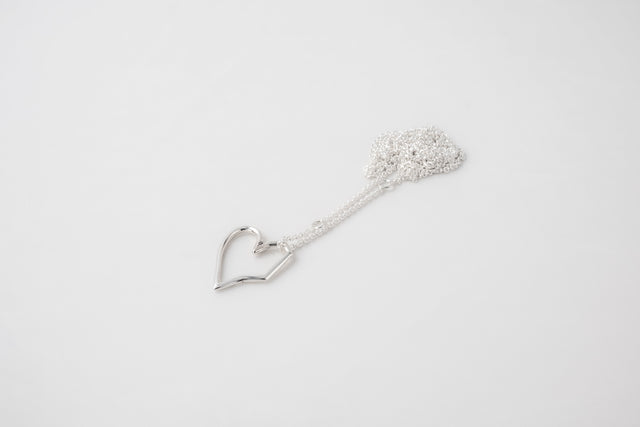
Two traditions holding in one marriage have a parallel in the brand's own form: SIGNATURE HEART is half smooth, half angular, two different hearts joined into one. The Wire Heart Necklace is its lightest reading — 5 grams of 925 silver drawn as a single continuous line, on a 75 cm chain that also fastens at 65 and 55 cm.
Wearing the engagement ring on a different finger
Some people prefer not to wear the engagement ring on the ring finger. Reasons include:
- Profession requires no jewelry on the dominant hand (surgeons, machinists, kitchen staff)
- The ring is too valuable for daily wear
- Personal preference for the middle finger or pinky
- Knuckle joint changes with age — the ring no longer fits the original finger
The engagement ring can be worn on any finger. Popular alternatives:
- Right ring finger. Mirrors the conventional position on the opposite hand.
- Middle finger of either hand. Common in fashion-forward markets; acceptable in most cultures.
- Pinky finger. Older European tradition for unmarried family heirs; modern fashion choice.
- On a chain around the neck. Common when the ring cannot be worn during work or sports.
For a wedding ring, traditional ceremonies place the ring on the fourth finger specifically. After the ceremony, what the wearer does with the ring is personal.
What if my finger size has changed?
Finger size changes with weight, age, climate, and pregnancy. Most people experience a 0.5–1.5 size change over a 20-year period.
Three options when a ring no longer fits:
- Resize. Most rings can be resized up or down by 1–2 sizes. Cost: $50–$120 in 925 silver, $80–$200 in gold. Some settings (channel, eternity) cannot be resized — those need a new ring.
- Wear on a different finger. If the original finger no longer fits, the ring may fit a different finger naturally.
- Wear on a chain. Permanent solution if the wearer no longer wants daily ring wear.
STRUGA includes free resizing within 12 months of delivery. After that, lifetime resizing is offered at workshop cost only — no markup.
What about same-sex couples?
Same-sex couples follow the same hand and finger conventions as opposite-sex couples in the country of marriage. Both partners typically wear matching wedding bands, and the engagement ring tradition is increasingly common — sometimes one partner gives, sometimes both partners give simultaneously, sometimes the engagement is marked by paired rings rather than a single one.
Custom workshops often see same-sex couples designing the engagement and wedding rings as a single coordinated set from the start, which simplifies the visual planning. This approach also works well for couples in mixed-tradition marriages.
Common questions about ring placement during the wedding day
Three small details that surprise couples on wedding day:
- Removing nail polish from the ring finger. Some traditions and superstitions say the ring finger should be unpainted at the moment of placement. This is a personal choice with no practical effect.
- Engagement ring transferred during the ceremony. Many brides hand the engagement ring to a maid of honor at the start of the ceremony, then receive it back after the wedding ring is placed. This avoids a fumble.
- Photographs of the ring placement. The "ring shot" works best when both rings are visible. Many photographers ask for a brief moment after the ceremony to capture the stack — engagement on top of wedding band — on the left or right hand depending on tradition.
Cultural sensitivity for international couples
If you are getting married in a country that is not your own, the local tradition may not match yours. Three things to think about:
- Where is the ceremony? If the ceremony is in a country with a strong tradition (Greek Orthodox in Greece, Hindu in India), the local tradition may apply by default.
- Whose family is more involved? Older family members may have strong opinions. Mixed-tradition couples often follow the more religious family's tradition for the ceremony, then choose freely afterward.
- What feels right? Tradition is meaningful. So is the freedom to design your own. STRUGA clients have done both — strict tradition and complete improvisation. Both work.
The history in more detail
The vena amoris idea is older than Rome but Romans codified it. Egyptian and early Greek sources mention a vein from the fourth finger to the heart, with various explanations — sometimes nerve, sometimes blood, sometimes spirit. By the 2nd century AD, Aulus Gellius's Attic Nights documented the Roman version explicitly. Rings on that finger therefore "touched the heart" symbolically.
The belief survived the fall of Rome and entered Christian wedding tradition through Pope Nicholas I in the 9th century, who made the ring exchange part of the formal Christian wedding rite. The fourth finger of the left hand became standard across Catholic Europe.
The Eastern Orthodox Church, which split from Roman Catholicism in 1054, kept earlier Greek and Slavic right-hand traditions instead. This is why Greek, Bulgarian, Serbian, and most Eastern European Orthodox weddings still use the right hand for the wedding ring.
Protestant Reformation countries (England, Scotland, Scandinavia) mostly retained the left-hand Catholic tradition, except Norway and Denmark which kept the older pre-Christian right-hand custom. Germany is mixed: traditionally right-hand wedding ring, traditionally left-hand engagement ring, with regional and religious variation.
The British colonial period spread the left-hand tradition to North America, Australia, New Zealand, and parts of Africa and Asia. The Spanish and Portuguese colonial period spread it through South America. By the 21st century, the left-hand tradition is dominant globally because it travels with the languages of former colonial empires.
What the wedding ceremony itself does
The placement happens publicly. Three common ceremony patterns:
- Western Christian. The officiant says "with this ring, I thee wed." The ring is placed on the fourth finger of the left hand by the partner. One ring, one moment, one position.
- Eastern Orthodox. The priest blesses two rings, often metals (gold for groom, silver for bride or vice versa, depending on tradition). The rings are exchanged three times over the partners' heads, then placed on the right ring finger.
- Jewish (traditional). The groom places a plain gold ring on the bride's right index finger so witnesses can clearly see. After the ceremony, the bride moves the ring to the left ring finger.
In each case, the public moment of placement matters more than the long-term position. The ring may move after the ceremony, but the witnessed act of placing it on a specific finger at a specific moment is the legal and religious act of the marriage.
STRUGA design implications
A right-hand wedding ring fits slightly differently than a left-hand wedding ring because most people's hands are not perfectly symmetric. The dominant hand is usually slightly larger. A ring sized for the left hand may be a half-size too small for the right.
For mixed-tradition couples or for clients who plan to switch the ring between hands, we offer adjustable sizing or two slightly different sizes for the same ring. Discuss this in the brief — it is a 30-second conversation that prevents an awkward fit.
For paired wedding bands designed to work on either hand, see the DARK WEDDING wedding ring concept and browse the DARK UNION wedding rings collection. For a step-by-step custom process article, see the custom engagement ring process guide. For deeper reading on the engagement vs wedding ring distinction, see our comparison article. For pricing and material breakdowns by metal, see our engagement ring cost guide. Submit a brief through the custom order form. Read about the founder's design philosophy at Dmitry Strugovshchikov's bio.
About STRUGA. STRUGA is a dark silver jewelry brand founded by Dmitry Strugovshchikov and Ekaterina Strugovshchikova, handcrafted with Balinese and international silversmiths. Every piece is 925 sterling silver, naturally oxidized or hand-patinated. The darkening is part of the design. It is a brutalist object that reacts and changes through contact with the environment and the wearer.
Frequently asked questions
Didn’t find the answer — write to us, we reply personally.
Ask a question →01Is the left hand the "correct" hand for an engagement ring?+–
No. There is no single correct hand — both are correct. The left hand is the default in roughly two-thirds of the world (the United States, United Kingdom, France, Italy, Spain, Canada, Australia, and most of South America), while the right hand is standard in Germany, Austria, Norway, Denmark, Poland, Greece, India, and across many Slavic and Orthodox-tradition countries. Which applies to you depends on country, family, and religion, not on a universal rule.
02Is the engagement ring the same as the wedding ring in how it is worn?+–
No. They are worn differently in sequence. The wedding ring goes on first, closest to the palm and "closer to the heart"; the engagement ring is stacked above it. In many ceremonies the engagement ring is removed during the rite so the wedding ring can be placed on the empty finger, then re-stacked on top afterward.
03Does the right-hand tradition mean the marriage is different from a left-hand one?+–
No. The hand is a regional and religious convention, not a difference in the marriage itself. The witnessed act of placing the ring on a specific finger at a specific moment is the legal and religious act of the marriage — the long-term hand position can even change afterward without affecting it.
04Does a ring sized for the left hand fit the right hand?+–
Not always exactly. A ring is symmetric and works on either hand of the same size, but most hands are not perfectly symmetric — the dominant hand is usually slightly larger, so a ring sized for the left may be a half-size too small for the right. For clients who plan to switch hands, STRUGA offers adjustable sizing or two slightly different sizes for the same ring; free resizing is included within 12 months of delivery.