Alternative Engagement Rings — Beyond the Diamond Solitaire (2026 Guide)
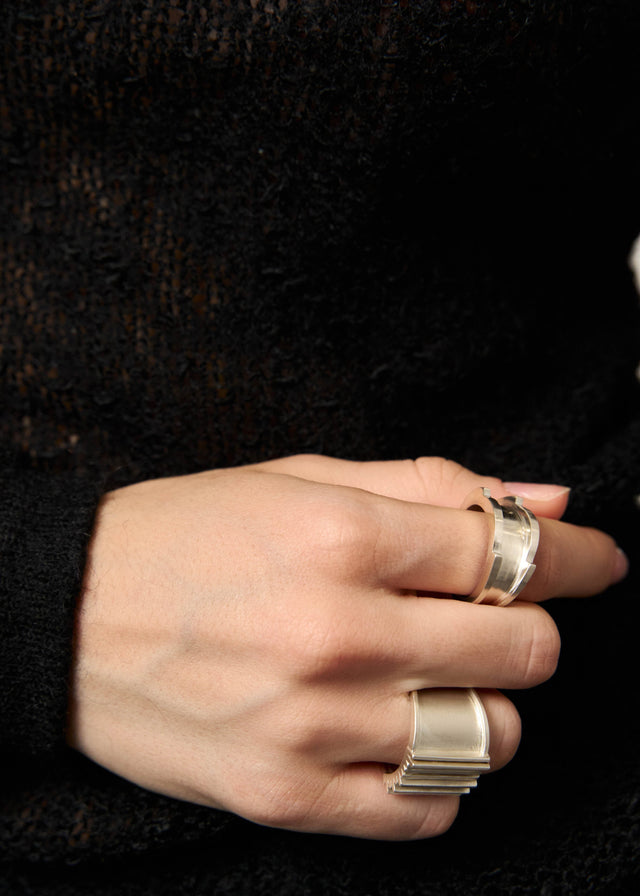
A single sapphire, a dark silver band and a sculptural ring without a stone can all mark an engagement. They ask for different choices: colour, surface, weight, or the way the ring sits on a hand. Compare the eight-gram Thorn Ring with the seventeen-gram Brutalism V.1 at the same 19 mm inner diameter. Both are 925 silver. The difference is in the form you will wear every day.
An alternative engagement ring changes the stone, metal or form of a conventional diamond solitaire. Start with what the wearer likes, then check the setting, fit and care.
Lab-grown diamond is diamond; moissanite is silicon carbide. A sapphire brings colour, while a ring without a stone puts the metal and its surface in view.
STRUGA's nine catalogue rings are made in 925 silver and need no centre stone. The model comparison below gives weights at one size and prices checked on 13 October 2026.
Updated October 15, 2026 · first published May 2, 2026
What counts as an alternative engagement ring?
Changing one feature is enough. A conventional solitaire has one centre diamond, usually held above a gold band by small metal claws called prongs. Replace that stone with a sapphire, choose dark silver for the band, or give the metal a sculptural shape, and the ring takes a different direction. Those choices can be combined; they do not have to be.
A salt-and-pepper diamond keeps the material but shows its visible inclusions. A vintage art deco ring changes the arrangement of the stones and the proportions of the setting. Lab-grown diamond offers another kind of alternative: its origin and cost differ from a mined stone even when the ring looks like a traditional solitaire. So the label tells you where to begin looking, rather than how the finished ring must look.
Why do couples consider alternative rings?
The familiar image of a diamond solitaire has a history in advertising. Frances Gerety wrote “A Diamond Is Forever” for N.W. Ayer in 1947; the two-month salary rule appeared in US advertising by the 1980s. Neither fixes how much a couple should spend today. The market around that image has also changed:
- De Beers' estimated market share has fallen. Estimates put its share of the world's rough diamonds at 80–90% at its peak and above 80% in the late 1990s, compared with roughly 35% by value at the end of 2018. In the 2025 results, its owner Anglo American recorded a $2.3 billion reduction in De Beers' carrying value. These are dated figures, rather than a measure of what any particular ring should cost.
- The salary rule is a budget suggestion from an advertisement. Earlier campaigns suggested one month's pay; later US ads used two. Choose an amount you can afford, then compare the rings available within it.
- Lab-grown stones are common in The Knot's US survey. Among 10,474 couples surveyed for The Knot Worldwide's 2026 Real Weddings Study, 61% of engagement rings had a lab-grown centre stone. The couples married in 2025. The report's lab-grown diamond section also gives average spending of $4,600. That US survey does not describe every country or every alternative ring.
Which stones replace a diamond, and what affects their cost?
First decide whether you want diamond, coloured stone or metal alone. Lab-grown diamond has the same material identity as mined diamond. Its prices have changed quickly: wholesale prices fell 26% in 2025. BriteCo's 2025 sales data gives a median price per carat of $2,057 for lab-grown centre diamonds in engagement rings, compared with $8,428 for natural ones. These are medians across the recorded stones, rather than quotes for two diamonds of identical quality. Compare the cut, colour, clarity and weight of the stones in your own short list.
Moissanite is a different material, silicon carbide. Its dispersion is 0.104, compared with diamond's 0.044. Dispersion is the separation of light into colours, visible as coloured flashes, or “fire.” Moissanite has more of it. Sapphire and morganite shift attention towards colour; salt-and-pepper diamond shows inclusions instead of a clear white appearance.
| Stone | Mohs hardness | Price against a mined diamond | What it looks like |
|---|---|---|---|
| Mined diamond | 10 | baseline | colourless example used as the baseline |
| Lab-grown diamond | 10 | lower median per-carat price in the cited 2025 data | diamond |
| Moissanite | 9.25 | depends on size and grade | more fire than diamond |
| Sapphire | 9 | varies by colour and origin | colour is the point |
| Salt-and-pepper diamond | 10 | varies with size and quality | grey, visibly included |
| Morganite | 7.5–8 | depends on size and grade | soft warm pink, softest here |
The Mohs scale in the table measures resistance to scratching. It does not measure how well a stone survives a knock. GIA gives morganite a hardness of 7.5–8 and advises protecting it from scratches and hard blows. For daily wear, look at both the stone and the metal holding it: a higher hardness number cannot compensate for an unsuitable setting.
An uncut stone needs a different approach to the setting. Its natural outline determines where the metal can hold it; carat weight alone will not describe that outline. STRUGA uses such stones in AMULET earrings and necklaces. A stone for a DARK UNION ring is discussed individually, with its shape, material and setting confirmed before work begins.
What are the five families of alternative engagement rings?
There are five useful ways to narrow the search: change the centre stone, the metal, the surface, the shape, or leave the stone out. The table separates them so you can compare what matters to you. A single ring may combine several: a dark silver band with a sculptural top changes both its surface and its form.
| Family | What changes | Typical form | What you want |
|---|---|---|---|
| Non-diamond centre stone | the stone only | sapphire or moissanite solitaire | colour or sparkle without diamond |
| Non-traditional metal | the metal only | sterling silver, titanium, tantalum | cool tones or a different weight and feel |
| Dark or oxidized finish | the surface | blackened silver band, flush-set stone | a dark surface that changes with wear |
| Sculptural or brutalist form | the shape | wide asymmetric band, fused forms | sculptural shape |
| Plain band, no stone | the stone is removed | wide oxidized band, fused pair | one ring instead of two |
Look at the silhouette before choosing a category name. A teal sapphire adds colour to a familiar setting; a wide blackened band brings the metal into view. In STRUGA's BRUTALISM family, Brutalism V.3 combines the sculptural form with a surface darkened in advance. FUSED uses the appearance of molten metal, with less sharply defined edges. Both directions work without a centre stone.
Which metal should an alternative ring be made from?
The metal determines the band's colour, weight and care, and affects whether its size can be changed later. Compare those properties alongside the stone. A low setting in a metal you enjoy wearing can be more useful than choosing each material in isolation.
- Rose gold gets its warm colour from copper in the alloy. Compare it with yellow gold of the same karat, then check the specific ring's weight and construction; colour alone does not set the price.
- Platinum is naturally white and needs no plating to keep that colour. It is dense, so a ring of comparable dimensions feels heavier than one in white gold. Its surface can scratch, too; white colour does not mean a finish will remain unchanged.
- Titanium and tantalum give a grey surface and require a different conversation about sizing from gold or silver. Ask the maker whether the particular design can be resized. Tungsten carbide resists scratches but cannot be resized: a future size change means replacing the ring.
- Sterling silver is an alloy containing 92.5% silver. Its lower material cost leaves more of the budget for the form and the work. It can be left bright or darkened at the surface; neither finish will stay exactly the same through daily wear.
That changing surface is central to STRUGA's 925 silver rings. Darkening forms silver sulphide from the metal at the surface. Friction gradually lightens the raised areas, while recesses can remain dark. It differs from black plating, an added coating that may need to be reapplied when worn through. If you want an unchanging mirror finish, uncoated or darkened silver calls for more attention than its first photograph suggests.
Which independent brands and Bali silver makers can you compare?
Start with the design you want to wear, then compare makers who can work in that direction. Bali has several kinds of silver practice. Reva Jewellery describes itself as an independent brand founded by Laurent Leger in 1997. Its range uses mainly 950 silver, with selected sterling-silver designs; its private commissions include engagement rings made in its Bali workshop. A dark finish, chosen stone and size can be discussed for the individual design.
Charista Bali, founded by designer and maker Meidy in 2016, describes small-batch work in sterling silver from its Bali studio. Its ring catalogue includes stacking rings and signets. STRUGA offers another direction: 925 silver, darkened surfaces and sculptural forms, with DARK UNION for engagement and paired-ring orders.
Compare the exact ring rather than treating every Bali maker as the same style. For dark silver, ask whether the surface is darkened silver or a coating, how it changes with wear, and whether the chosen form can be resized. Confirm the stone, finish and production time before ordering. The makers above offer different starting points; a ring's suitability for an engagement depends on the form and fit you choose.
How do you choose the right alternative for one specific person?
Once you have a short list of stones and metals, bring it back to the person who will wear the ring. These five questions turn a broad search into a brief for a particular shape and size.
What do they already wear day to day?
Start with the jewellery they already choose. Warm gold or cool silver gives you a useful starting colour; a thin band or a large sculptural ring tells you more about scale. If they rarely wear rings, do not assume a wide band will feel familiar. Try several widths and weights before choosing the size.
Do they want a stone at all — and which one?
Look at the designs they save or point out, and talk about the difference between a visible centre stone, a small inset stone and a band without one. A cluster of small stones and a single raised stone can appeal for different reasons. If keeping the proposal a surprise makes the choice uncertain, a temporary ring lets you choose the lasting one together afterwards.
How do they use their hands?
Consider the height of the setting as well as the face of the ring. Prongs project around a stone; a bezel is a metal rim around it; a flush-set stone sits within the band. Lower settings reduce the projection, but no ring is automatically safe for every kind of work or sport. Check workplace requirements and take it off when an activity makes wearing it unsuitable. The proposal rings selection is a starting point for comparing silver forms; assess the fit of the particular piece.
Will there be two rings or one?
Decide whether the engagement ring will also serve as the wedding ring, or whether two rings will share one finger. For two, compare how their edges meet and whether the settings leave room for each other. Customs differ by country: in Russia and Poland, wedding rings are commonly worn on the right hand. The guide to engagement-ring hands and traditions covers those differences. Your arrangement should still fit the way you plan to wear the rings.
What is your budget?
Set the amount before comparing the short list. Include the stone, setting, delivery and any custom work rather than using a salary multiple. Compare specific rings by metal, weight and construction. The product pages give the listed price for each size; a custom design is quoted after the form, material and budget have been discussed.
How does STRUGA approach alternative engagement rings?
STRUGA's engagement-ring direction starts with 925 silver and a form that works without a centre stone. The brand was founded in 2018. STRUGA objects are made in Bali; the Bali silver guide explains the craft context. The models differ most clearly in shape, weight and surface.
DARK UNION is STRUGA's direction for engagement, wedding and paired rings. It began with the Thorn Ring. Dark silver gives the pair a shared material even when their surfaces begin differently: one ring can be darkened in advance, while the other darkens through wear. Raised areas lighten with contact; the appearance changes with use. A stone, meteorite or another metal can be discussed for a custom order, with the material and construction confirmed for that particular ring.
| Ring | Family | Weight, 19 mm | Price | Surface |
|---|---|---|---|---|
| Thorn Ring | THORN · DARK UNION | 8.0 g | $181–488 | uncoated |
| Brutalism V.1 | BRUTALISM | 17.0 g | $382–1,013 | uncoated |
| Brutalism V.3 | BRUTALISM | 17.0 g | $368–920 | darkened in advance |
| Fused Cross | FUSED | 6.0 g | $150–359 | molten-metal appearance |
| Double Line | SIGNATURE ASYMMETRIC | 9.0 g | $250–542 | uncoated |
The table compares weight at an inner diameter of 19 mm. Size still matters: Brutalism V.1 weighs 9.6 g at 15 mm and 24 g at 22 mm. The price ranges cover the listed sizes, whose starting diameters differ by model. Across the nine catalogue rings, prices checked on 13 October 2026 run from $122 to $1,013, rounded to whole dollars. Use the range to compare budgets, then open the exact size on the product page. The proposal rings page gathers forms to consider for one ring or the engagement ring in a pair.
For a stone set into an existing form, or a ring developed around a chosen stone, start with Custom Order. We discuss the shape, material, size and budget before confirming the design. Allow roughly three to six weeks for custom work; the actual date depends on the design and workload and is confirmed individually.
What do couples ask us most before ordering?
Before ordering, settle the care, timing and sizing questions. They can change the choice even after you have found the form you want.
How long will an alternative ring last?
A silver ring can stay in use for many years, but its surface will change. Scratches and lightening on raised areas are expected with wear; the amount depends on the ring and what you do while wearing it. Clean bright silver when it needs it, and discuss care before polishing a deliberately darkened finish. STRUGA provides free cleaning and minor repair for as long as the piece belongs to you; shipping to us is the owner's responsibility.
How long does a ring take, and what if the size is wrong?
Standard catalogue rings outside DARK UNION are made to order in plain silver in about two weeks, with roughly another week for delivery. Orders from $300 ship free. DARK UNION and Custom Order pieces take around three to six weeks; confirm the timing for your date before ordering.
One resize is free, with shipping both ways paid by the owner. Brutalism V.1 and V.3 are the exceptions: they are not resized after making because of the relief across their tops. Choose their size first. If it does not fit, the general one-time size-exchange rule within 14 days of delivery applies, subject to the published conditions.
Can a stone be added to a STRUGA ring later?
It depends on the ring. The band needs enough metal to hold a setting without weakening the form. A bezel holds the stone with a surrounding rim; a flush setting seats it within the metal. Send the model and the stone you have in mind for custom work. We confirm whether the combination is possible and quote it before starting.
Do alternative rings hold their value?
The purchase price is not a promise of resale value. It includes the work on the ring as well as its materials, and a second-hand buyer may value those differently. Falling lab-grown diamond prices also make an earlier retail price a poor guide to a later sale. Choose a ring you want to wear within a budget you can afford, rather than relying on resale to justify it.
What if the ring in the proposal is not the final one?
The ring used for the proposal can be temporary. You can choose the final form together afterwards or discuss a custom design through messages and drawings. This is useful when the size, preferred metal or wish for a stone is still uncertain.
What alternative engagement rings do men choose?
There is no single men's shape. At STRUGA, width, weight and fit are chosen for the wearer. For a heavier silver form, compare BRUTALISM with BLADE; the men's collection brings those options together. For a broader view of stone settings and bands, see engagement ring types. Choose the dimensions you want to wear rather than taking a category as a size recommendation.
Where should you start your alternative ring search?
If you have chosen the metal and the amount of projection you want, begin with the corresponding range. Compare a few specific rings at the same size before moving into custom work.
- DARK UNION — rings of union, starting with the Thorn Ring.
- Proposal rings — silver forms to compare for an engagement.
- Dark Wedding — a route for considering the proposal ring and wedding bands together.
If the form is still open, use engagement ring types to compare settings, then the sterling silver guide for the metal. Custom Order is the next step when the shape, stone or finish you want is absent from the catalogue.
Finish the search with a specific ring, a size and a clear idea of its care. On darkened silver, the high points will gradually become lighter than the recesses. Choose it with that future surface in mind.
About STRUGA. STRUGA is a dark silver jewelry brand founded by Dmitry Strugovshchikov and Ekaterina Strugovshchikova. STRUGA objects are made in Bali. Most pieces are 925 sterling silver left uncoated, so they darken with wear; part of the range is darkened in advance, at the bench. The darkening is part of the design.
Frequently asked questions
Didn’t find the answer — write to us, we reply personally.
Ask a question →01Is an alternative engagement ring the same as a cheap engagement ring?+–
No. Alternative describes the choice of stone, metal, surface or form. It does not set a price category. Compare the material, weight, setting and work on the specific rings you are considering.
02Is a silver engagement ring a compromise rather than a real choice?+–
Silver is a choice of colour, weight and changing surface. In darkened sterling, silver sulphide forms from the metal at the surface. Raised areas gradually lighten with friction while recesses can stay dark. Choose it if you want that appearance and understand its care.
03Is an alternative ring the same as a plain band with no stone?+–
No. A ring without a centre stone is one option. Others change the stone to sapphire or moissanite, use a visibly included diamond, change the metal or alter the shape. A lab-grown diamond changes the stone's origin and cost while remaining diamond.
04Is moissanite or a lab-grown diamond a fake diamond?+–
A lab-grown diamond is diamond grown in a laboratory. Moissanite is silicon carbide, a different material with a hardness of 9.25 on the Mohs scale and more coloured flashes than diamond. Ask which material is being offered; the two names are not interchangeable.
05How long does a STRUGA engagement ring take to make?+–
Standard catalogue rings outside DARK UNION take about two weeks in plain silver, with delivery about a week on top; DARK UNION and Custom Order pieces take around three to six weeks. This is an estimate, not a guaranteed date.
06Can a STRUGA ring be resized after the proposal?+–
Once, free of charge; the owner pays shipping both ways. The exception is the Brutalism V.1 and V.3: the relief across the top does not survive resizing, so their size is chosen before they are made.