Men’s Silver Chain Styles: Weaves, Weight and Strength
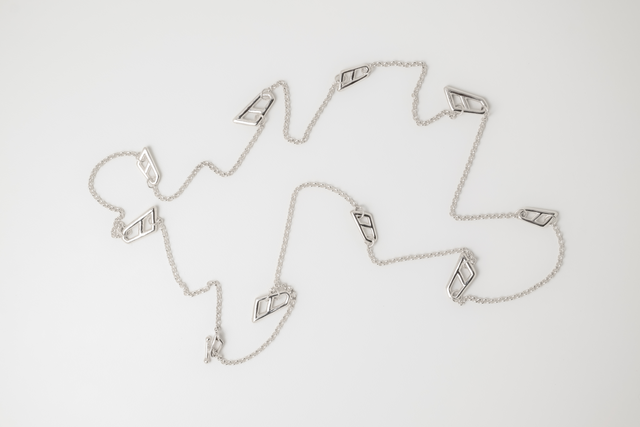
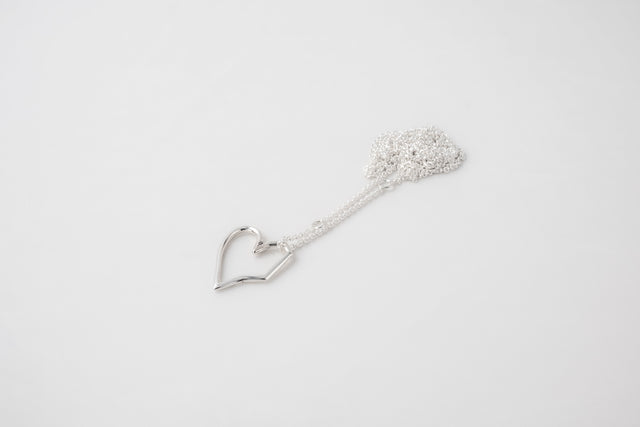
Choose a men’s silver chain by its link pattern and fit. The 50 cm Chain Thorn lists 13 g: length alone says little about mass. Assess strength through the construction of the whole chain, including its joins and clasp.
- The weave gives a chain its pattern: open rings, flat links, a spiral or a close-fitting cord.
- A pendant needs a chain that fits through its bail and suits the particular pendant.
- Ask whether the links are solid or hollow. A universal width-to-weight rule cannot answer that.
- Try the length on your own body. The same measurement can sit differently on different people.
Updated September 13, 2026
How do the main silver chain styles differ?
Look at a close-up of one short section. Cable links alternate in orientation. Curb links turn to lie in a flatter line; close-set Cuban chains belong to that family. Figaro introduces a rhythm of shorter and longer links. Arden Jewelers’ illustrated chain guide is a useful reference for these distinctions. For square box links, the Byzantine unit and other constructions, see Rio Grande’s illustrated chain reference. A photograph helps when two sellers use different names for similar constructions.
| Chain style | Visible construction | Detail to compare |
|---|---|---|
| Cable | Individual rings alternate in orientation | The opening and thickness of each ring |
| Curb / Cuban | Turned links form a flatter line | How closely the neighbouring links sit |
| Figaro | A repeating sequence of short and long links | The proportions of the repeating section |
| Rope | Links build a spiral pattern | The spiral’s profile in close-up |
| Snake | Closely fitted elements form a smooth cord | Its curve and surface condition |
| Wheat | Interwoven links form a braided pattern | The chain’s cross-section and movement |
| Box | Square links make a sequence of small boxes | Link shape and consistency of connections |
| Mariner | Oval links contain a central bar | The bar that distinguishes it from plain cable |
| Byzantine | Interlocked rings form a repeating three-dimensional unit | The construction from more than one side |
| Bismark | A dense pattern of connected groups of rings | The particular variant and its profile |
Names need some care across languages. The Russian term for a basic anchor chain usually describes the alternating rings of a cable chain; an English mariner chain has bars across its links. Bismark and Byzantine should be checked against the actual pattern instead of treated as interchangeable labels. SOKOLOV’s manufacturing guide describes Russian terminology and several variations of these constructions.
Figaro also allows different sequences. Three short links followed by one long link is familiar, but the name does not require that single arrangement. Compare the repeat itself: it determines how much uninterrupted chain the eye follows before the longer link returns.
Which silver chain weave is strongest?
No weave name establishes a universal winner for every silver necklace. Strength belongs to the finished chain, including its links, joins, end fittings and clasp. Length and width describe only part of that construction.
Borsheims includes wheat, rope and curb chains among its recommendations for pendants. That provides a practical starting point for shopping. A recommendation for a chain family is not a load rating for every silver chain sold under that name. Ask about the particular piece and its intended use.
For an in-person comparison, open and close the clasp yourself. Lay the chain down without pulling it tight and watch how the links turn. Inspect the end fittings as carefully as the middle of the chain. A visible opening at a join, a pronounced kink or a sticking clasp deserves a jeweller’s inspection. A pull test at home can damage the very piece you are trying to assess.
The 50 cm Blade Mini Links V.1 Choker lists 110 g. Choose that mass when you want its weight and presence on the neck. Its mass does not reveal the force that the weakest connection can withstand. Equally, a light chain may be a deliberate design: the right question is whether its construction suits the way you intend to wear it.
What is the difference between solid and hollow links?
A solid link has metal throughout the cross-section of its wire or component. A hollow link has a cavity inside its walls. The visible opening in the middle of an ordinary ring-shaped link is a separate thing; it does not make the link hollow.
Ask for the construction first, then use weight as another specification. Two chains of equal width can have different openings, wall thicknesses, link counts and clasps. There is no reliable universal rule that a 50 cm, 4 mm chain must weigh a particular number of grams. The 925 designation describes the silver alloy; it does not describe whether a component is hollow.
Repairability is another reason to ask. Arden Jewelers distinguishes the repair of solid and hollow links and notes limitations in closely fitted chain patterns. The condition and construction of the actual chain determine what can be restored. Tapping it for a particular sound or deliberately bending a link is a poor substitute for that information.
When comparing listings, keep the selected length visible beside the weight. A shop may show one weight for a reference size while offering several lengths in the selector. Confirm which version the number describes before using it in a comparison.
How do you match a chain to a pendant?
Bring the pendant to the fitting. If that is impossible, record its weight and the internal dimensions of its bail, the loop through which the chain passes. Check the passage needed for the chain’s end fitting as well as the links. The end piece can be the part that prevents the pendant from sliding on.
With the necklace fastened, check whether the pendant moves freely and faces the way you want. Look for a bail that catches on a link or holds the pendant awkwardly. Have a jeweller confirm the pairing for a heavy pendant using both objects. A fixed ratio between chain weight and pendant weight cannot replace that assessment.
Snake and herringbone chains deserve particular attention to bending. Arden and Borsheims discuss kinking in these constructions. They have different profiles: snake forms a cord, while herringbone forms a flat ribbon. Follow the recommendations for the specific necklace when considering a pendant.
For a chain worn on its own, concentrate on the link and clasp. In the Choker Signature Asymmetric Links, hexagonal links alternate with straight bars. The pattern already occupies the whole line around the neck; there is no need to make pendant compatibility the deciding feature of that choice.
How should you choose length and width?
Start with a necklace that sits well on you. Fasten it and note where it falls against a shirt collar or neckline. When comparing its measurement with a new chain, check how the seller measures length and whether that measurement includes the clasp. A large closure can account for a noticeable part of the finished necklace.
A soft measuring tape can help locate the line you want to follow. It remains a starting point: tape cannot reproduce a chain’s thickness, mass or movement. Try the actual chain where possible, turn your head, sit down and close the collar. The position should work through those ordinary movements.
Measurements such as 40, 45 and 50 cm describe the object. They cannot promise the same position on everyone’s collarbones. Width needs a side view too. A flat chain and a rounded weave can measure the same from above while occupying different amounts of space.
STRUGA sizes objects around the body, weight and fit. “Men’s silver chain” is a useful search description; the form itself is open to whoever wears it. Select the line you want on your own neck, then compare the available sizes of that design.
How do STRUGA chains compare at the same length?
These are the listed weights for the 50 cm variants in the current product cards. Each number belongs to the named size. They are neither family-wide averages nor breaking-strength measurements. The weight of an individual handmade piece can vary slightly.
| Chain, 50 cm | Listed weight | Defining form |
|---|---|---|
| Chain Thorn | 13 g | A continuous sequence of angular THORN links |
| Choker Signature Asymmetric Links | 33 g | Hexagonal links alternating with straight bars |
| Choker Small Beads with Heart Lock | 33 g | Perlina beads and a SIGNATURE HEART clasp |
| Blade Mini Links V.1 Choker | 110 g | BLADE mini links and Carabiner #2 Big |
These forms belong to CODEX, STRUGA’s world of everyday architectural forms.
Signature Asymmetric and Perlina share a listed weight at this length while drawing different lines: open angular links in one, a sequence of beads in the other. Blade carries the even planes of the BLADE form into a chain. Its large carabiner becomes a visible part of the object. Thorn repeats sharp angles; a fitting lets you assess that contact with the skin.
The Long Chain with Signature Links offers another proportion: 120 cm and 35 g. Small round links carry separate SIGNATURE ASYMMETRIC elements along the chain. Its length allows you to try multiple loops and find the position on your own body. It also shows why length alone tells little about a necklace’s mass.
What does handmade mean in a chain?
How a chain is made and what its weave is called are separate specifications. Bronnitsy’s manufacturing guide discusses both machine-made and handmade chains, including a machine-made Bismark. A weave name cannot establish the production method.
With STRUGA, look at the component itself. A BLADE link is assembled from two halves on copper pins and soldered together. The even planes refer to a CNC aesthetic: that describes the appearance. Signature Asymmetric takes a different route through the link, joining a hexagonal outline with a straight bar. Perlina repeats a bead, with the SIGNATURE HEART double heart serving as the clasp.
Close-up photographs make these distinctions visible. They explain the piece more precisely than “handmade” on its own. For the international market, STRUGA objects are made in Bali.
How does the silver surface change with wear?
The STRUGA chains listed here use Living Silver: 925 sterling silver without rhodium plating. The surface darkens over time, while friction can lighten raised areas. A link’s flat plane and its recesses can show that wear differently. Patina is a property of the material.
Choose care for the particular surface. Begin with the instructions in the product card; if you want to preserve dark areas in the recesses, check the cleaning method before applying a product. Mechanical damage needs a separate jeweller’s assessment. Cleaning does not restore the shape of a link. Questions about a finish, clasp or fit can go through the STRUGA contact page.
For the distinction between pendants, chokers and collars, see the necklace atlas. For a broader reference of link patterns, open the chain weave atlas.
Where should you start?
Choose the pattern first: open rings, flat links, a cord or larger individual components. Compare two or three actual chains at the same length. Check the weight of the selected variant and its closure in each listing, then assess position and movement at the fitting.
For a pendant pairing, add the bail and compatibility checks. For a chain worn alone, look at how the pattern continues through the closure. One clasp almost disappears; another becomes the centre. By this point, a weave name has become something you can assess directly: silver resting on your own neck.
Frequently asked questions
Didn’t find the answer — write to us, we reply personally.
Ask a question →01Are Cuban and curb chains the same?+–
Cuban belongs to the curb chain family. Individual models differ in link density and profile. A 4 mm boundary does not define the name: compare photographs and the dimensions of the actual links.
02What does 925 mean on a silver chain?+–
925 identifies an alloy containing 92.5% silver. It does not specify length, weight or link construction; check those characteristics separately.
03Should a necklace and bracelet have the same weave?+–
That is a styling choice, not a technical requirement. You can repeat a link in two objects or combine different forms. Try them together and compare the scale of the links and their surfaces.
04Will one chain fit every pendant?+–
Check the specific pairing. The bail must admit the chain and its end fitting; assess the pendant’s weight together with the chain’s construction. Take both pieces to a jeweller for a heavy pendant.
05How should I try several chains together?+–
Wear them with the clothing you plan to use. Check the space between the lines, clasp positions and movement of any pendants. Different listed lengths do not guarantee a comfortable fit together.
06Can I straighten a kink myself?+–
Do not pull a damaged section straight. Remove the chain and show it to a jeweller: the repair depends on its construction and condition. A weave name alone cannot promise a full restoration.